Yesterday your baby drained the bottle or settled into a full breastfeed. Today they latch, pull away, chew the teat, cry after a few sucks or seem interested only in the cold teething ring.
If the gum is sore where a tooth is coming through, sucking may seem less comfortable. But “it must be teething” is not a safe diagnosis for every feeding dip. A cold, sore throat, ear pain, thrush, reflux, a faster or slower bottle teat, distraction or another illness can look similar.
Offer milk calmly in response to hunger cues, pause when your baby pulls away, and judge the whole baby, not one unfinished feed. Wet nappies, alertness, swallowing and the direction across the day matter more than forcing a target number. If feeds fall markedly, nappies become drier or your baby seems unwell, seek advice rather than waiting for the tooth.
What to do at the next feed
- Remove the pressure. Hold the bottle away when your baby turns their head, or let them come off the breast. Repeatedly pushing the teat back can turn temporary discomfort into a feeding battle.
- Try a cool teething ring first. The NHS recommends a teething ring cooled in the fridge, never the freezer. A few minutes may soothe the gum before another offer.
- Follow the next hunger cue. Babies often feed little and often. If your baby takes a small amount, do not force the rest or delay the next offer to fit a timetable.
- Reduce distraction. Use a quiet room and a familiar position. Older babies commonly become too interested in the room to feed for long.
- Check the ordinary mechanics. For a bottle, check the teat is not blocked, collapsed, damaged or flowing much faster than usual. For breastfeeding, look and listen for rhythmic swallowing rather than timing sucking alone.
- Count wet nappies and watch behaviour. Compare with your baby's normal day. Fewer or lighter nappies, dark urine, dry lips or increasing sleepiness matter.
Do not make formula weaker, add cereal to a bottle or replace milk with large amounts of plain water. Prepare formula exactly as the manufacturer instructs. For babies under six months, breast milk or first infant formula remains the normal source of fluid unless a clinician gives different advice.
Is teething really the likely cause?
The NHS says teething may cause a sore, red gum, extra dribbling, chewing, fretfulness and disturbed sleep. Symptoms are usually mild and local.
A teething explanation becomes more plausible when:
- a tooth is visibly or recently emerging
- the gum is red or swollen in one area
- your baby wants to chew everything
- sucking begins normally but becomes uncomfortable
- the baby is otherwise alert and responsive
- wet nappies remain close to normal
- feeds improve after gum comfort or at a sleepier, calmer time
It becomes less convincing when:
- there is a temperature of 38°C or above
- your baby has a cough, breathing change or marked congestion
- swallowing seems painful
- there are white patches in the mouth that do not wipe away
- vomiting or diarrhoea is present
- your baby pulls at an ear and seems unwell
- the feed decline began without any eruption signs
- your baby is unusually sleepy, floppy or hard to wake
Teething can happen at the same time as an infection. One does not rule out the other.
Bottle feeding: measure the day, not the rejected bottle
Bottle volume is visible, which can make every leftover 40ml feel alarming. Compare complete days rather than demanding that the next feed repairs the missing amount.
Record:
- what was offered
- what was actually taken
- the time and duration
- whether the baby pulled away, coughed, cried or simply lost interest
- vomiting or significant posseting
- wet nappies
- temperature and other symptoms
Use paced, responsive feeding: hold your baby close and semi-upright, keep the bottle reasonably horizontal and allow pauses. Stop when they consistently close their mouth, turn away or relax their hands.
Do not enlarge a teat hole, repeatedly switch flow rates or distract a baby into drinking without first considering why the feed changed. Coughing, spluttering and milk leaking from the mouth may indicate that flow is too fast. Frustration, teat collapse and a very long effort may suggest a bottle or flow issue, but ask your health visitor when uncertain.
Never prop a bottle or leave a baby feeding alone.
Breastfeeding: minutes are not millilitres
A shorter breastfeed does not automatically mean less milk. An older baby may transfer milk efficiently, and time at the breast includes both active swallowing and comfort sucking.
Look for:
- deep, rhythmic sucks with visible or audible swallows
- a relaxed jaw and hands as the feed progresses
- breasts feeling softer afterwards, where that is usual for you
- the baby releasing the breast independently
- wet nappies and alert periods remaining normal
If your baby repeatedly latches and pulls off, try a different comfortable position, a calmer room or the cool-ring pause before reoffering. Keep access frequent so a day of short feeds does not become a long gap.
Get feeding support if there is clicking, persistent shallow attachment, pain, damaged nipples, very brief feeds without swallowing, a baby who cannot stay attached or concern about supply. The NHS recommends asking a midwife, health visitor or breastfeeding specialist to observe a feed when intake is uncertain.
Do not use feed minutes as a home conversion to ounces. There is no reliable “minutes × ml” formula.
Mixed feeding needs its own baseline
When a baby takes breast and bottle feeds, one side of the record can fall while the other rises. A 120ml bottle reduction may be balanced by extra effective breastfeeds, or it may not be.
Keep the units separate:
| Feed type | What you can record | What it cannot prove | |---|---|---| | Bottle | actual millilitres taken | absorption, hydration or why the baby stopped | | Breast | side, duration and observed swallowing | milk volume transferred | | Solids | food and approximate response | replacement for milk hydration or calories absorbed | | Wet nappy | timing and whether it felt normally wet | exact fluid intake |
This is why one combined “milk total” can create false precision for mixed-fed babies. Use the feeding pattern alongside nappies, behaviour and professional assessment when needed.
What wet nappies can tell you
Wet nappies are a practical output measure. A baby's individual pattern and age matter, but a clear reduction from normal deserves attention.
For a newborn, feeding and nappy expectations change rapidly by day of life. From day five, the NHS breastfeeding guide describes at least six heavy wet nappies in 24 hours as one reassuring sign. Follow the personalised plan from your midwife or neonatal team, particularly after prematurity, jaundice or weight concerns.
For an older baby, notice:
- how many genuinely wet nappies there were
- whether each feels lighter than usual
- dark yellow or strong-smelling urine
- a dry mouth or cracked lips
- few or no tears when crying
- sunken eyes or a sunken soft spot
- unusual drowsiness or irritability
The NHS dehydration guidance lists fewer wet nappies, dry mouth, few tears, sunken eyes or fontanelle and drowsiness as warning signs.
Do not wait for every sign to appear. If a baby is taking much less milk and nappies are clearly dropping, contact your GP or NHS 111.
Could solids be replacing too much milk?
Around the same age that teeth often appear, babies are commonly starting solids. That overlap can confuse the picture.
Breast milk or first infant formula should remain the main drink through the first year. The NHS notes that milk intake may gradually reduce as a baby eats more solids, but a sudden large dip should not be manufactured by filling a baby with snacks or water.
If solids have recently increased:
- offer milk responsively rather than withholding it until a timetable slot
- avoid replacing missed milk with sweet pouches
- offer sips of water with meals from around six months, not instead of milk feeds
- keep solids portions pressure-free
- look at constipation or tummy discomfort as another possible reason for reduced appetite
One new tooth and one new meal schedule can happen in the same week. The log helps separate the timing.
Pain relief and teething products
The NHS recommends trying a cooled teething ring and simple comfort first. Gently rubbing the gum with a clean finger can also help.
If pain relief is needed, use only an age-appropriate product and dose, following the label and advice from a pharmacist, GP or health visitor. Do not give aspirin to children under 16. Do not combine products containing the same medicine.
Avoid:
- amber teething necklaces, which present strangulation and choking risks
- frozen teething rings, which can injure gums
- general adult oral-pain gels
- unlicensed homeopathic teething products
- sugary rusks or drinks as teething treatment
Pain relief should make a comfortable feed possible; it should not be used to override a baby who still refuses or seems unwell.
When reduced feeding needs help today
Contact your GP or NHS 111 promptly if your baby is feeding much less than usual, has markedly fewer wet nappies, seems drowsy or dehydrated, or you are worried.
Get urgent medical help if:
- your baby is not feeding
- there has been no drink for eight waking hours
- there has been no wet nappy or pee for 12 hours
- urine is dark, the mouth is dry or there are few tears
- feeds are repeatedly painful or followed by significant vomiting
- your baby has breathing difficulty, persistent coughing or choking during feeds
- your baby is getting worse or you remain worried
- a baby under three months has a temperature of 38°C or higher
- a baby aged three to six months has a temperature of 39°C or higher
Call 999 for severe breathing difficulty, blue or mottled colour, a baby who is floppy or very difficult to wake, a seizure, collapse or another life-threatening emergency.
These current NHS urgent-help signs are reasons to seek assessment, not targets to approach deliberately. Babies do not need to show every sign to be seriously unwell.
Young babies, premature babies and babies with medical, feeding or growth plans need a lower threshold for advice. A young infant becoming reluctant to feed should not be managed as ordinary teething from a blog.
How the real OBubba app spots a milk dip around a tooth
OBubba's current engine contains a specific teethingFeedDip insight. It only starts from an actual tooth entry in the baby's Smile map, not a parent typing “maybe teething” in a note.
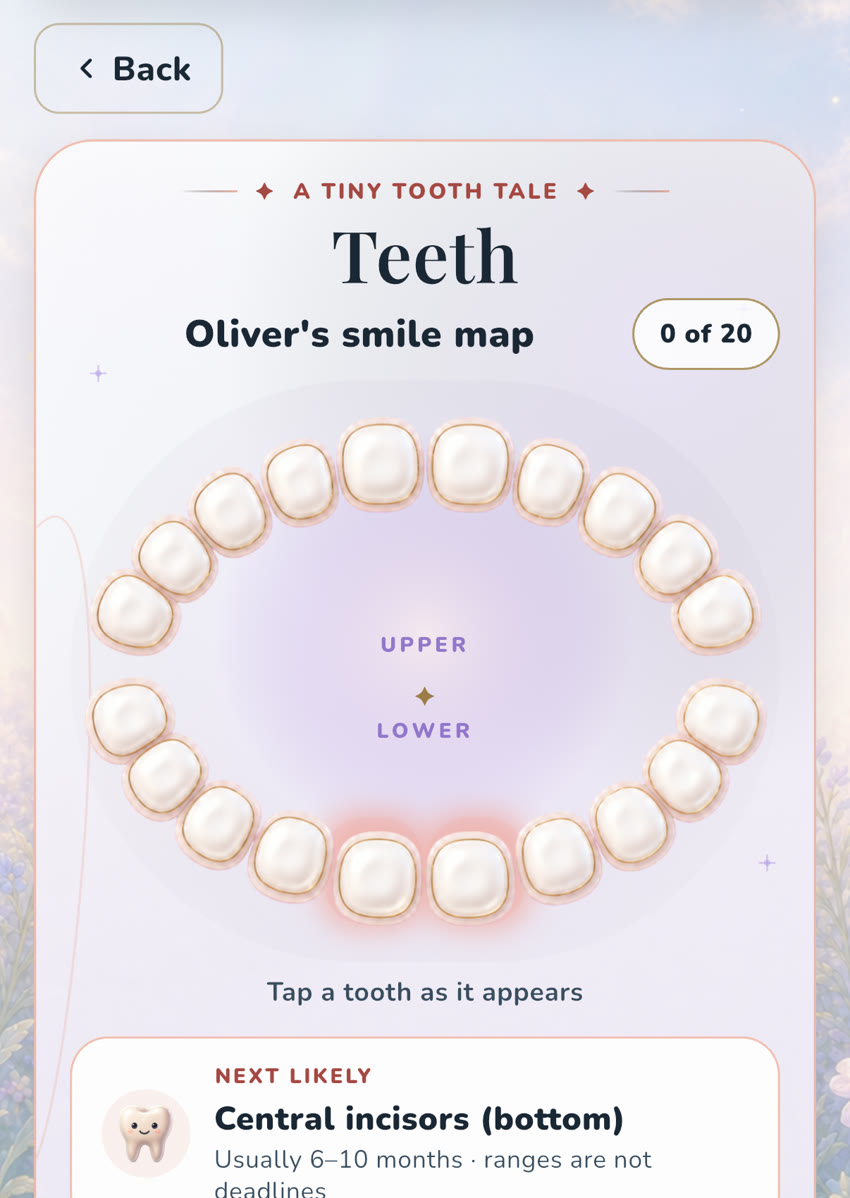
The calculation:
- finds the most recent recorded tooth from today or the previous five days
- builds a tooth-centred window from five days before eruption through five days afterwards, stopping at today
- compares it with the 14-day baseline immediately before that window
- needs at least two logged feeding days near the tooth and five baseline days
- analyses daytime milk only and ignores solids in the milk-type calculation
- surfaces only when the chosen measure falls by at least 15%
For a mostly bottle-fed pattern, it compares millilitres per logged day. For a mostly breastfed pattern, it compares minutes per day but says explicitly that time is only a rough proxy because breast volume is not measured.
The engine requires one feed mode to make up at least 70% of the milk records across those periods. If feeding is genuinely mixed, it stays quiet rather than averaging millilitres and minutes into a meaningless number. Missing days are not treated as zero-intake days. That avoids one kind of false alarm, but it creates another limitation: the comparison only knows about days containing feed records. An incompletely logged day can look like a lower-intake day, and unlogged night feeds are outside this daytime comparison. The result is useful only when logging has been reasonably consistent.
A dip of 15–29% produces a low-urgency observation. A dip of 30% or more raises the insight's urgency, while the wording still directs parents to feeds and wet nappies rather than diagnosing dehydration. The card reports how many days informed it and has a separate identity for each eruption, so dismissing one tooth's insight does not silence every future tooth.
This is pattern detection, not proof that the tooth caused the feeding change. OBubba does not use wet nappies to calculate this percentage and cannot observe swallowing, check a mouth or ear, measure breast-milk transfer, recognise an unlogged feed or assess hydration. A percentage can help a parent notice change. The baby, the feeding picture and the nappies decide whether help is needed.
Try OBubba free → and keep tooth dates, milk feeds, wet nappies, symptoms and sleep in one shared record, so “is this really different?” has better evidence behind it.
A calmer 24-hour review
If your baby is otherwise well and hydration signs are reassuring, review the next 24 hours rather than chasing one feed.
Track:
- every milk opportunity and what happened
- active swallowing or actual bottle amount
- wet nappies
- temperature
- teething signs and eruption date
- vomiting, diarrhoea, cough or congestion
- any new solids pattern
- comfort measures that genuinely helped
At the end, ask:
- Did total feeding opportunities recover?
- Were nappies near the baby's normal pattern?
- Was the baby alert between feeds?
- Did comfort before a feed help?
- Is there evidence for another cause?
If the direction is worsening, do not extend the home experiment. Ask for advice.
Frequently asked questions
How long can a teething milk dip last?
Teething discomfort is usually mild and short-lived, but there is no safe universal number of days for reduced milk. If feeds remain substantially lower, wet nappies reduce or your baby seems unwell, seek advice rather than waiting for a tooth to break through.
Should I offer a bottle more often while teething?
Yes, smaller responsive offers may be easier than pressuring a large feed. Stop when your baby turns away and try again at the next cue. Never prop the bottle or force the teat into a closed mouth.
Can I give water instead of missed milk?
Do not use water as a replacement for milk, particularly under six months. From around six months, small sips of water can accompany meals, while breast milk or first infant formula remains the main drink during the first year.
Does chewing the bottle teat mean teething?
It can, but it may also mean the baby is exploring, distracted, finished or unhappy with the flow. Look for sore gums and other eruption signs, and check the teat itself.
Does a shorter breastfeed mean my supply has dropped?
Not necessarily. Duration does not measure transfer. Look for active swallowing, wet nappies and the baby's behaviour, and ask a trained supporter to observe a feed if you are concerned.
Can OBubba tell me whether my baby is dehydrated?
No. It can identify a logged feeding change and keep wet nappies visible. It cannot examine your baby or measure hydration. Fewer wet nappies, dry mouth, few tears, sunken eyes or unusual drowsiness need professional advice.
Reliable UK sources
- NHS: Baby teething symptoms
- NHS: Tips for helping your teething baby
- NHS: Is my baby getting enough milk?
- NHS: Drinks and cups for babies
- NHS: Feeding on demand
- NHS: When to get urgent medical help for babies and children under 5
- NHS 111 Wales: Dehydration
This article provides general information for UK families. It is not a feeding or hydration assessment, and OBubba is not a medical device. Follow your baby's clinical feeding plan and seek professional advice whenever intake, nappies, behaviour or your instincts concern you.
Ready to try OBubba?
Use OBubba to track feeds, sleep, naps, nappies, growth, milestones and family handovers in one calm baby tracker app.