Banana disappears. Porridge is welcomed. The same toast fingers are picked up without hesitation. Then a teaspoon of parsnip arrives and the mouth closes before it gets close.
When that happens meal after meal, it is easy to decide that your baby is “picky”, hates vegetables or needs to be persuaded into one successful mouthful.
A better first response is to keep one familiar food, make the new exposure tiny, remove the pressure and repeat it on another day. A surprised face, touch, lick or spit-out taste can still be part of learning. But repeated gagging, coughing, pain or difficulty across textures needs a different response from ordinary new-food hesitation.
OBubba’s current engine tries to preserve that distinction. It can separate a recent run that looks mostly new-food related from one whose notes point to a texture gap. It does not diagnose why a baby refused, and one difficult meal is deliberately not enough.
The short answer
At the next calm meal:
- serve a small amount of one accepted food;
- add one tiny, recognisable new food in a safe texture;
- let your baby touch, smell, lick, hold or ignore it;
- stop at repeated head turns, a closed mouth or distress;
- record what was offered, how it was prepared and what actually happened; and
- offer the same food again on another day without turning it into a test.
The NHS says a baby may need 10 or more attempts to accept a new food. A funny face does not necessarily mean dislike, and it is more useful to consider eating across a week than to judge one meal.
| What happened | More useful interpretation | Next step | |---|---|---| | Ate the familiar food, ignored the new one | Novelty may be the main barrier today | Keep the new amount tiny and repeat it later | | Touched or licked the new food, then stopped | Exploration, not a failed exposure | Count the contact; do not demand a bite | | Accepted smooth carrot but repeatedly gagged on lumpy carrot | Texture may matter more than flavour | Make the step smaller and review preparation | | Refused familiar and new foods while tired or unwell | This may be a general off-patch | Protect milk, comfort and hydration; try later | | Coughed, choked, sounded wet or seemed in pain | Not ordinary fussiness | Stop and seek appropriate professional advice | | Developed possible allergy symptoms | Not a “keep trying” situation | Stop the suspected food and get medical advice |
New does not mean disliked
A baby meets more than a flavour when food is unfamiliar. The colour, smell, temperature, shape, stickiness and movement in the mouth may all be new at once.
That is why acceptance can look gradual:
- tolerating the food on the tray;
- touching it with one finger;
- squeezing or smearing it;
- bringing it towards the mouth;
- licking it;
- taking a tiny taste and pushing it back out; and
- eventually swallowing some.
You do not need to call every stage “eating”, but you can recognise that learning occurred. Pressure can make the spoon, highchair and adult attention feel more threatening than the food itself.
The NHS recommends going at the baby’s pace, avoiding meals when they are too hungry or tired, allowing self-feeding and never forcing food. It also encourages touching and playing with food because this helps babies learn about different foods and textures.
A seven-exposure plan that stays small
This is not a seven-day challenge and there is no required bite. Space the offers around ordinary family meals.
Exposures 1 and 2: make the food predictable
Place a teaspoon or one soft piece beside an accepted food. Name it once—“broccoli”—then continue eating your own meal.
Do not hover with the new food or keep returning it to the baby’s hand. Let it remain available without becoming the centre of the room.
Exposures 3 and 4: repeat before redesigning
Use the same recognisable preparation again. If Monday’s broccoli was a soft floret, repeating that form gives familiarity a chance to build.
Changing broccoli into soup, fritter, purée and pasta sauce at every attempt may create four separate sensory experiences. Variety is useful later; consistency is useful when you are trying to learn whether simple familiarity helps.
Exposure 5: model, do not perform
Eat the same food yourself. Let your baby see ordinary chewing and enjoyment without exaggerated praise or a request to copy you.
Exposure 6: offer a small choice
Try the same food as one soft finger-food piece and a little on a preloaded spoon, if both forms are suitable for your baby’s current skill. The choice is about participation, not about hiding the food.
Exposure 7: review the pattern
Ask:
- Is the food now tolerated, touched or tasted more readily?
- Is refusal specific to this ingredient or shared by many new foods?
- Does the reaction change with texture?
- Was every attempt late, rushed or close to sleep?
- Are accepted foods and textures continuing to narrow?
If nothing changes, you can pause and return later. Repeated exposure is not an instruction to repeat distress.
Keep one familiar food—but do not hide everything in it
A familiar food can make a meal feel manageable. Serve a little porridge beside pear, yoghurt beside a soft vegetable or an accepted toast finger beside a new spread.
Mixing foods is also normal cooking. The important distinction is whether the baby gets chances to recognise the new food as well as encounter it inside something else.
For example:
- stir a small amount of lentil purée into an accepted vegetable mash and leave a tiny visible lentil taste on the side;
- serve pear with plain yoghurt without making every vegetable taste of fruit; or
- offer a familiar pasta shape with one new soft sauce, rather than replacing the entire meal.
The goal is not to trick the maximum amount into the stomach. It is to build a safe, varied relationship with food.
Is it the food—or the texture?
Use a same-food comparison when it is safe and practical.
Suppose your baby eats completely smooth carrot but rejects fork-mashed carrot. That does not prove a texture disorder, but texture deserves more attention than the carrot flavour.
If smooth carrot and mashed carrot are accepted but courgette in either form is rejected, novelty or flavour may be the stronger clue.
Change only one variable where possible:
| Keep the same | Change one thing | What it may reveal | |---|---|---| | Food | smooth to fine mash | response to texture progression | | Texture | carrot to parsnip | response to a new flavour | | Food and texture | calm lunch to tired tea | effect of timing and regulation | | Food, texture and time | adult spoon to preloaded spoon | whether control changes participation |
Do not run a home experiment after choking, a suspected reaction, repeated coughing or professional feeding advice. Safety outranks a clean comparison.
Gagging is not the same as choking
The NHS explains that gagging is a normal reflex while babies learn to chew and swallow. It is commonly noisy; the tongue may push forwards, the eyes may water and the baby may retch or bring food back towards the front of the mouth.
Choking can be quiet because airflow is blocked. Learn baby choking first aid before it is needed. If a child cannot breathe properly, follow emergency first-aid guidance and call 999.
Even when a gag is protective, repeated gagging that prevents progress or causes significant distress deserves discussion with a health visitor or feeding professional. Do not put fingers blindly into a gagging baby’s mouth.
Food should be prepared for the baby’s current ability. The NHS safer-weaning guide advises considering size, shape and texture, avoiding firm and round foods, seating the baby safely upright and supervising every meal.
What to record in OBubba
The current path is:
Track → Feed → Solids
The sheet records:
- the time;
- What did they eat? as free text;
- any allergens the food-text detector recognises; and
- How did they take it? as Loved it, Unsure or Reaction.
Specific descriptions create more useful history:
- weak: `veg`;
- better: `parsnip, first try`;
- texture-aware: `parsnip, fine fork-mash`;
- safety-relevant context: `soft chopped pasta; coughed twice and meal stopped`.
Use Reaction for a possible reaction, not as a general dislike button. A funny face, gag or refusal is not automatically an allergy.
How the real refusal detector works
We traced `diagnoseWeaningPattern`, its tests and the data assembled by the current brain.
First, it requires a real run
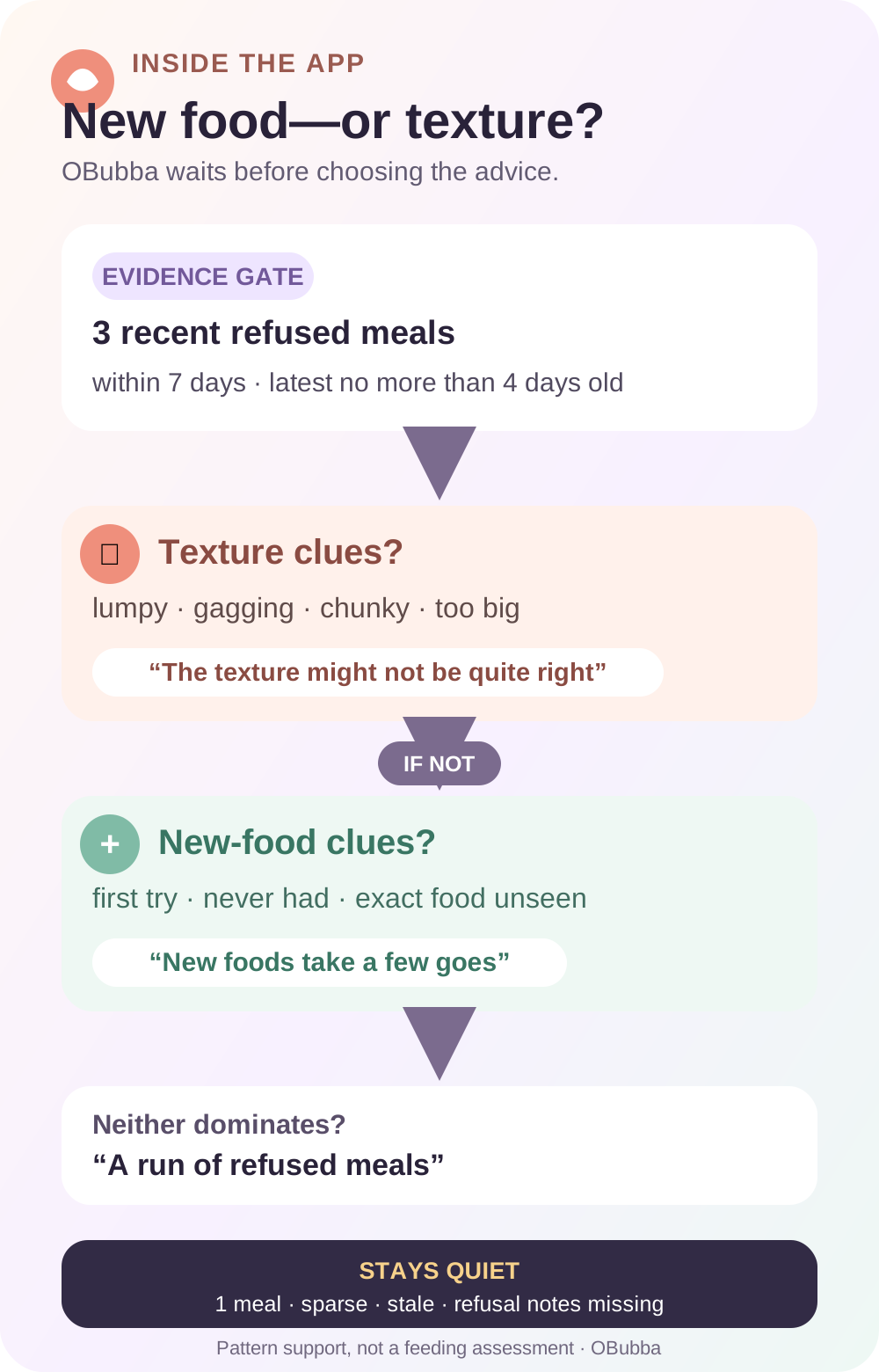
The detector examines the three most recent solids meals. All three notes must contain refusal wording such as refused, spat, turned away, no interest, pushed away, cried, gagged or threw.
The three meals must also:
- fall within a seven-day span; and
- end no more than four days before the current date.
That means one rejected spoon, three refusals scattered across several weeks or an old cluster after logging stopped cannot create a present-tense card.
Then, texture gets the first safety-minded check
The app looks in the meal notes for clues such as:
- chunk or chunky;
- lump or lumpy;
- gummy;
- gag or gagging;
- choke or choked;
- too big; or
- whole.
If texture-linked meals are at least tied for the dominant explanation, the card becomes “The texture might not be quite right”. The advice suggests stepping softer after gagging, or considering soft finger foods when a baby appears bored with smooth purées, while staying within arm’s reach.
This is a coarse language classifier—not a swallowing assessment. The word “gagged” can be a normal learning event or part of a bigger feeding concern; the app cannot see which.
New-food clues form a separate route
When texture does not dominate, the app checks whether the notes explicitly say new, first time, first try, never had or similar wording.
It also compares the exact lowercased food description with foods logged before the three-meal tail. If earlier history exists and the new description has not appeared before, that meal can count as new.
When new-food clues dominate, the card becomes “New foods take a few goes” and recommends another pressure-free offer, perhaps with a familiar favourite or as a finger food to explore.
Exact text comparison creates an important limitation: `carrot purée` and `smooth carrot` are different strings. The app may treat the second description as unseen even when the ingredient is familiar. Consistent naming improves the history.
Otherwise, it uses general refusal reassurance
If neither texture nor novelty is a convincing dominant explanation, the app uses its general “A run of refused meals” card. Teething, appetite, tiredness and distraction may all matter; the code does not pretend to know which one caused the run.
A current limitation worth knowing
The classifier depends on `SolidsLog.note`. However, the current Feed → Solids segment shows the food field and Loved/Unsure/Reaction chips but does not currently display the Note field that bottle and breast segments show.
The underlying entry model can carry a note, including data written through another or synced entry route, and the engine will read it. But a solids meal entered only through the visible form may not contain the refusal words this classifier requires.
So the card can stay silent even when the parent experienced three refusals. That is a product-input gap, not proof that the app judged the meals acceptable. OBubba should eventually expose an optional solids context note or structured refusal reason so this otherwise thoughtful detector is reachable without relying on hidden or synced data.
What OBubba can still do with the food history
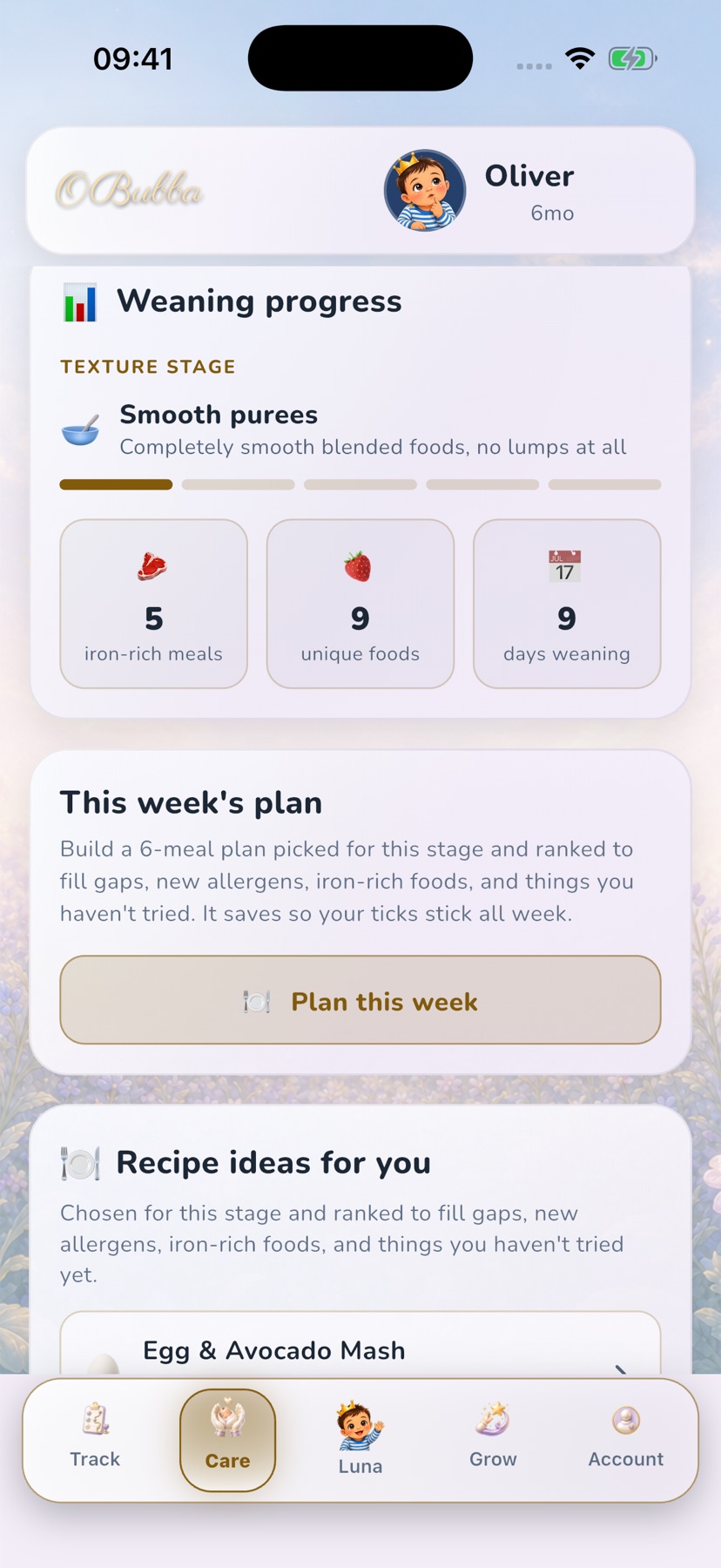
Even without that refusal note, the current Weaning area uses recorded food history to support:
- texture-stage progress inferred from descriptions such as smooth, mashed, lumpy, finger food, chopped and family meal;
- unique-food and iron-rich-meal counts;
- the major-allergen journey;
- first-taste ideas based on what has not yet been recorded;
- age- and history-ranked recipes; and
- a saved six-meal weekly plan designed to fill gaps without pretending it is a prescription.
The useful habit is simple: describe the actual food and preparation consistently. The record becomes a memory aid for the parent and a better input for the app.
Try OBubba’s weaning tracker free → — keep first tastes, textures, allergens, reactions, milk and the rest of the day in one shared family history.
When to ask for help
Speak to your health visitor, GP, paediatric dietitian or feeding team if:
- the accepted range of foods or textures keeps narrowing;
- refusal is persistent across most meals rather than limited to novelty;
- meals regularly cause pain or marked distress;
- there is repeated coughing, choking, wet or noisy breathing, or concern about swallowing;
- your baby struggles with liquids or smooth foods as well as lumps;
- vomiting is persistent or there is blood in vomit or stool;
- weight, growth, hydration or milk intake is a concern; or
- you simply feel the pattern is not ordinary for your baby.
A suspected allergic reaction is different from refusal. Stop the suspected food and seek appropriate medical advice. Call 999 for severe breathing difficulty, swelling affecting the airway, collapse, marked floppiness or another life-threatening reaction.
Frequently asked questions
Should I stop serving favourite foods?
No. A familiar food can keep the meal manageable. Add a tiny new opportunity beside it rather than removing every safe option. Continue to build variety over time without using hunger as leverage.
Does touching count as trying?
It is an exposure, although it is not the same as swallowing. Touching, smelling and licking can reduce unfamiliarity. Record honestly and let the next step develop without pressure.
How many times should I offer a new food?
There is no pass mark. The NHS says acceptance can take 10 or more attempts. Space offers across ordinary calm meals; stop and seek advice when refusal is accompanied by pain, swallowing concern, illness or a possible reaction.
Should I mix the new food into a favourite?
You can combine foods as part of normal meals, but also keep occasional recognisable exposure so your baby can learn what the new food looks, smells and tastes like. Never hide a known or suspected allergen.
Why did OBubba stay quiet after three refused meals?
The real detector needs three trailing refusals within seven days, the latest no more than four days old, plus refusal words in each meal note. The current solids form does not visibly expose that Note field, so entries made in the new app may not provide the required evidence. Silence is not a diagnosis.
Can OBubba tell whether my baby has a texture problem?
No. It can group words in the history and offer a gentle prompt. It cannot inspect the food, observe oral movement, assess swallowing or diagnose sensory, developmental or medical causes.
Sources
- NHS: Help your baby enjoy new foods
- NHS: Your baby’s first solid foods
- NHS Best Start in Life: Choking and gagging on food
- NHS Best Start in Life: Preparing food safely
- OBubba source reviewed: `weaning_insights.dart`, `weaning_texture_readiness.dart`, `brain.dart`, `log_sheet.dart`, `weaning_insights_test.dart` and `weaning_texture_test.dart`
OBubba is a record, pattern and education tool. It cannot assess swallowing, texture safety, dietary adequacy, growth, allergy or why a food was refused. It does not replace advice from a health visitor, paediatric dietitian, GP, feeding team, paediatrician, NHS 111 or emergency services.
Ready to try OBubba?
Use OBubba to track feeds, sleep, naps, nappies, growth, milestones and family handovers in one calm baby tracker app.