It is 2:17am. Your baby is miserable, two adults have taken turns settling them and nobody is completely certain whether the medicine on the counter was already given. One person remembers discussing it. The other remembers preparing it. Neither remembers seeing it swallowed.
This is not carelessness. It is a predictable handover failure caused by broken sleep, overlapping shifts and a conversation that sounded like a completed action.
The safest short rule is: one person gives; that person logs immediately. Record the exact medicine, the amount actually given and the time it was actually given — never the time someone planned to give it. The packet, prescription or pharmacist remains the authority for whether a medicine is suitable and how it should be used.
Why accidental repeat doses happen
Most family medicine mistakes begin with ambiguity rather than arithmetic:
- “I sorted the medicine” can mean measured, given or merely put nearby.
- a text message is missed while the other parent is settling the baby
- the planned time is entered before the dose is actually given
- one carer knows a brand name while another knows only the active ingredient
- two different products may contain the same active ingredient
- a nursery, grandparent or babysitter has a separate paper record
- everyone is relying on memory after several disrupted nights
The answer is not a more complicated schedule. It is one shared definition of given and a record made at the point of care.
The 20-second medicine handover
Whenever medicine is given, capture these details before moving on:
- Medicine: use the exact product name. Add the formulation or strength in the name or notes when that distinction matters.
- Amount: record exactly what was measured and given, using the unit shown on the label or prescription.
- Actual time: log when it was given, not when it was due or prepared.
- Who gave it: add initials or a carer name in the notes if several adults are sharing care.
- Useful context: temperature, reason, response or any side effect can go in the notes.
Keep the record factual. “Children's medicine, 2:17am, given by Z” is clearer than “night dose done”. Do not use a vague entry such as “pain relief” when different products are in the home.
Say “given and logged” out loud
A tiny verbal handover closes the loop:
“It has been given and logged at 2:17.”
If it has only been measured, say exactly that. Do not leave a filled oral syringe or open medicine as a visual reminder, especially where a child could reach it. Close and store medicines immediately after use.
Check before every dose
Even with a shared log, pause and check:
- Is this the correct medicine and formulation for this child?
- Does the packet or prescription say it is suitable for their age and circumstances?
- Is it in date, and has it been stored as directed?
- Has anybody already given this medicine — or another product with the same active ingredient?
- Does the actual last-dose time match what the other carer remembers?
- Are you measuring with the supplied oral syringe or medicine spoon rather than a kitchen teaspoon?
If the log and the human handover disagree, stop and resolve the discrepancy. A digital record is helpful evidence, not proof that every real-world dose was entered correctly.
Planned is not the same as given
Never pre-log medicine simply because you intend to give it in five minutes. Babies spit medicine out, fall asleep, vomit or need a fresh suitability check. A planned entry can later look identical to a completed dose.
Only log the amount actually given. If you are unsure how much was swallowed or whether somebody else gave a dose, do not guess and do not automatically repeat it. Check the packet or leaflet and ask a pharmacist, GP or NHS 111 what to do.
The same principle applies to a missed dose: never double the next dose to make up for it. Follow the instructions for that particular medicine or get professional advice.
Paracetamol and ibuprofen need separate clocks
Paracetamol and ibuprofen are different medicines, but that does not make an improvised alternating routine automatically safe. NHS guidance says not to give them at the same time. Only alternate them if a health professional has told you to, and follow the specific plan they provide.
If a professional does advise alternating, keep a separate, unambiguous record for each medicine. Never collapse both into a single entry called “pain relief”. Before using ibuprofen, check the label and suitability carefully: it may not be appropriate for some children, including in situations such as dehydration or chickenpox, and asthma may require professional advice.
Products and strengths vary. A time interval that appears in an app cannot tell you the correct amount for the bottle in your hand or whether it is appropriate for your child.
What if an extra dose may have been given?
Act on uncertainty rather than waiting for symptoms.
- For an extra dose of children's paracetamol or ibuprofen, contact NHS 111 for advice.
- Keep the packet, leaflet, remaining medicine and your time log with you; the adviser may need the exact product and amount.
- Call 999 for a life-threatening emergency, such as severe breathing difficulty, collapse, a seizure or a child who cannot be woken.
Do not induce vomiting. Do not give another medicine to “balance it out”. Follow the advice given for the exact product and situation.
How the current OBubba app supports a clear record
In OBubba, open Track → Log details → Health → Medicines. The native medicine sheet records:
- medicine name
- dose as entered by the parent or carer
- temperature, if relevant
- actual time
- optional notes
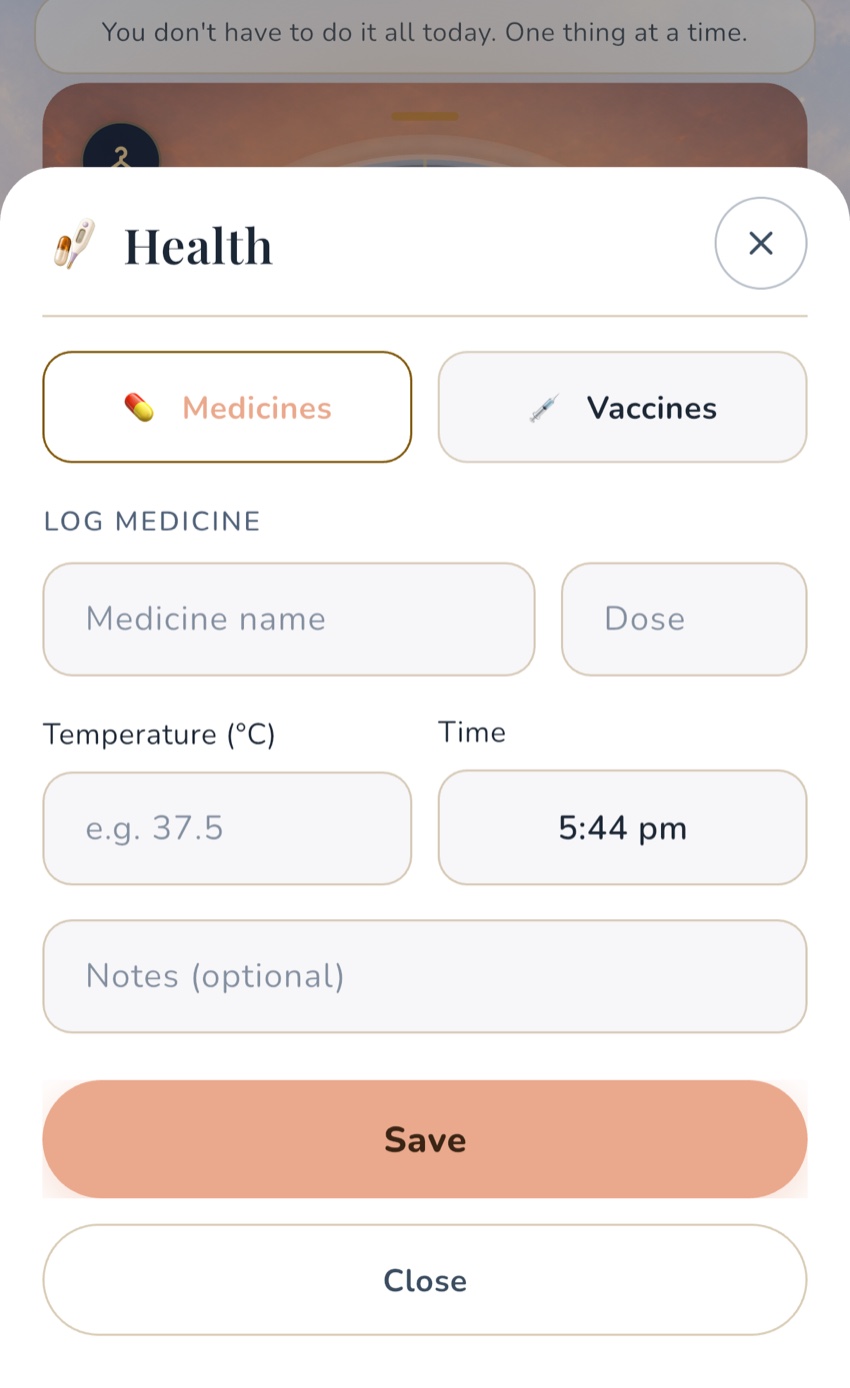
Frequently used medicines can be saved for faster logging. The quick-log view can show the last recorded time and how many entries exist that week, helping a tired parent spot recent activity before adding another entry. Typed and one-tap entries use the same timing checks, and OBubba protects against a rapid double-tap creating two identical logs.
The shared child timeline keeps medicine entries beside sleep, feeds, nappies and temperature. With Partner Sync, parents using the same shared child can see the recorded medicine name, dose, notes and time rather than reconstructing the night from messages the next morning. Voice logging can also capture medicine details when typing is awkward, but the saved entry should still be checked for accuracy.
For recognised paracetamol and ibuprofen names, OBubba may flag entries that appear unusually close together or have reached a general 24-hour count. That is a cautious timing prompt only. It is not a dose calculator, a prescription or permission to give medicine.
OBubba cannot verify the bottle's strength, the correct amount for your child, current weight, hydration, contraindications, another unlogged dose or instructions from your clinician. Even a quiet screen — or wording that suggests a timing window looks clear — never overrides the packet, prescription, pharmacist or NHS advice.
What the carer handover does — and does not — show
OBubba's carer handover can include the names of medicines recorded recently. That is useful context for a grandparent or babysitter, but it is not a complete administration record: they should confirm the medicine, amount and actual time directly with the parent and follow the agreed care plan.
For nursery or childcare, use the provider's official medication consent and administration record as the source of truth. OBubba can give parents additional context, but it should never replace the setting's safeguarding process or required signatures.
Try OBubba free → — give both parents one calm timeline for medicine, temperature, sleep, feeds and nappies, without pretending an app can make the clinical decision.
Make the system safer before anyone is tired
Set up the handover while the house is calm:
- Agree that only the person who gives the medicine marks it as given.
- Keep one shared record, not competing notes in several chats.
- Store medicines locked or high up, out of sight and reach; child-resistant packaging is not child-proof.
- Keep each medicine in its original packaging with its leaflet and measuring device.
- Return expired or unwanted medicines to a pharmacy rather than putting them in household waste or down the sink.
- Never use medicine prescribed or bought for somebody else.
The goal is not perfect tracking. It is a clear answer to the one question that matters during a handover: what was actually given, and when?
Sources and further reading
- NHS: Medicines for babies and children
- NHS: Paracetamol for children
- NHS: How and when to give ibuprofen for children
- NHS: Taking ibuprofen with other medicines
- NHS: Baby and toddler safety
OBubba supports recording, handover and parent education. It does not calculate doses, prescribe or determine whether a medicine is suitable. Always follow the packet or prescription and advice from a pharmacist, health visitor, GP, NHS 111 or emergency services.
Ready to try OBubba?
Use OBubba to track feeds, sleep, naps, nappies, growth, milestones and family handovers in one calm baby tracker app.