At baby group, one child is rolling across the mat, another is sitting like a tiny statue and yours is happily chewing the label on a muslin. It is very easy to turn three different babies into a league table.
Baby milestones are broad windows, not appointments. During the first year, look for development across movement, communication, social connection and thinking — and for skills gradually building on one another. The order and timing vary, some babies skip an obvious step such as crawling, and one unchecked box cannot diagnose a delay.
This guide offers a calm map of what may emerge. It is not a test to perform before bedtime or a reason to repeatedly “train” a tired baby.
What is a developmental milestone?
A milestone is a recognisable new skill or behaviour: smiling back, reaching deliberately, babbling, sitting, looking for a dropped toy or waving. These firsts sit in connected areas:
- social and emotional: noticing familiar people, smiling, laughing and joining simple games
- communication: listening, taking turns with sounds, babbling, gestures and understanding words
- movement: head control, reaching, rolling, sitting and ways of moving around
- thinking and learning: following objects, exploring, copying actions and understanding cause and effect
Development is rarely tidy. A baby may be busy practising movement and show less obvious change in language that week, then suddenly produce a stream of new sounds. A skill can also appear once, disappear while another skill takes attention and return more reliably later.
The useful question is not “Did this happen on the average day?” but “Is my baby gaining skills and engaging with people and their surroundings over time?”
Birth to 3 months: faces, voices and early control
In the earliest months, development is woven into care. Your baby may increasingly:
- look closely at faces and begin to recognise familiar voices
- settle in response to being held or spoken to
- make sounds beyond crying, such as coos and gurgles
- move both arms and legs and bring hands towards the mouth
- briefly lift or turn their head during supervised tummy time
- watch a slowly moving face or high-contrast object
You do not need special equipment. Talk during feeds and nappy changes, answer your baby's noises, sing the same song again and give them short, supervised opportunities to move freely on a firm surface.
Choose an alert, settled moment. The NHS describes a quiet-alert baby as ready to look, listen and interact; fussing is a cue to slow down or change what you are doing. Responsive play includes stopping.
Around 3 to 6 months: reaching, laughing and experimenting
Over these months, many babies become more deliberately social and physical. You may notice:
- smiles and laughter becoming easier to invite
- more varied squeals, coos and sound “conversations”
- steadier head control
- hands meeting in the middle and reaching towards a toy
- holding, shaking or mouthing safe objects
- pushing up during tummy time
- rolling beginning in one direction, then becoming more controlled
Rolling has a wide window. The first roll may even be an accidental-looking tip caused by shifting weight. Give your baby safe floor space and place an interesting object just to one side; do not pull an arm or force the movement.
Once there are signs of rolling, review sleep safety and stop swaddling. Always place your baby on their back to start every sleep, even when daytime movement is changing quickly.
Around 6 to 9 months: sitting, babbling and finding things
This is often a visibly busy period, but babies still take different routes. Emerging skills can include:
- sitting with support and gradually needing less help
- passing an object from one hand to the other
- reaching more accurately and banging safe objects together
- repeated babbling sounds such as “ba-ba” or “da-da”
- turning towards a familiar voice or responding to their name
- enjoying back-and-forth games such as peek-a-boo
- looking for something that falls or becomes partly hidden
- rolling, pivoting, shuffling or beginning to crawl
Not every baby crawls on hands and knees. The NHS notes that some babies bottom-shuffle instead, and others find another way to move. Crawling is not a compulsory certificate before standing or walking.
Simple play works well: put a toy partly under a cloth, roll a soft ball, copy a sound and wait, or name pictures in a board book. Give your baby time to respond before doing the interesting part for them.
Around 9 to 12 months: gestures, problem-solving and mobility
Towards the first birthday, you may see a mixture of:
- moving between positions with more control
- crawling, shuffling, pulling to stand or cruising along furniture
- picking up smaller objects with improving finger-and-thumb control
- putting objects into a container and taking them out
- copying actions such as clapping or waving
- using gestures to ask, show or refuse
- understanding familiar words before saying them
- searching for a hidden toy and repeating actions that create a result
Some babies take first steps before 12 months; many do not. Some say a recognisable word; others communicate mainly with sounds, expressions and gestures. Understanding often develops before clear speech.
The NHS says to ask a health visitor for advice if a baby is not showing any signs of moving around by 12 months. That does not mean every baby must crawl or walk by then — it is a prompt for someone to look at the whole pattern.
Corrected age for a baby born prematurely
For developmental expectations, a baby born early is usually considered using corrected age: their age counted from the original due date rather than the day they were born.
For example, a baby born 8 weeks early who is 6 months old chronologically is around 4 months corrected. Comparing them only with a 6-month guide can create worry that ignores those 8 weeks of expected development.
NHS guidance says developmental age is calculated from the original due date until age 2 for babies born prematurely. Your neonatal, paediatric or therapy team may use more individual context, so follow their advice when it differs from a general chart.
Corrected age is not an excuse to dismiss a concern. It is the fairer starting point for the conversation.
How to encourage development without turning play into homework
The most useful activities are short, responsive and easy to repeat inside normal life.
Follow what has their attention
If your baby looks at the spoon, name the spoon. If they shake a cup, copy the sound. Shared attention is more valuable than redirecting them to the activity an age chart selected.
Leave room for a reply
Talk, pause and watch. A widening of the eyes, kick, smile, sound or reach can be their turn in the exchange. NHS language guidance recommends repeating the sounds a baby makes to introduce listening and turn-taking.
Offer safe movement variety
Use supervised floor play in different positions rather than keeping a baby in a seat for long periods. Put safe objects within reach and sometimes just to one side. Stay close; the aim is opportunity, not completing a movement for them.
Repeat familiar games
Babies do not need a daily stream of new toys. The same song, peek-a-boo pattern, fabric book or in-and-out game lets them anticipate, practise and eventually take a bigger part.
Stop when your baby turns away, becomes distressed or looks tired. Rest, feeding and cuddling are not time stolen from development.
How to track milestones without feeding comparison anxiety
A useful milestone record answers three things:
- What happened? Use a simple description such as “sat without my hands for about ten seconds”.
- When did you first notice it? An approximate date is enough if the exact day is unclear.
- What else was happening? Note if the skill appears only occasionally, on one side or in one setting.
Do not make a baby repeat a skill for proof or change the date to match the “typical” month. One candid video can be a lovely memory, but constant recording can pull attention away from the interaction itself.
Keep the Red Book and health-visiting reviews as the clinical record. In England, babies are usually offered a development review at 9 to 12 months. The health-visiting team may send the ASQ-3 questionnaire beforehand and will discuss movement, language and learning, diet, behaviour, hearing, vision and any concerns.
You do not have to wait for that appointment to ask a question.
How the current OBubba app remembers firsts
In Grow → Milestones, OBubba separates firsts into Social, Language, Movement and Thinking chapters. The opening message is deliberate: celebrate new skills in their own time; there is nothing to rush.
OBubba uses the child's corrected-age context where relevant and sorts common skills into broad windows. It uses warm states such as “practising window” rather than calling one unlogged skill a failure. Its gentle pattern read also avoids raising a health-visitor prompt from a sparse record or one isolated late item.
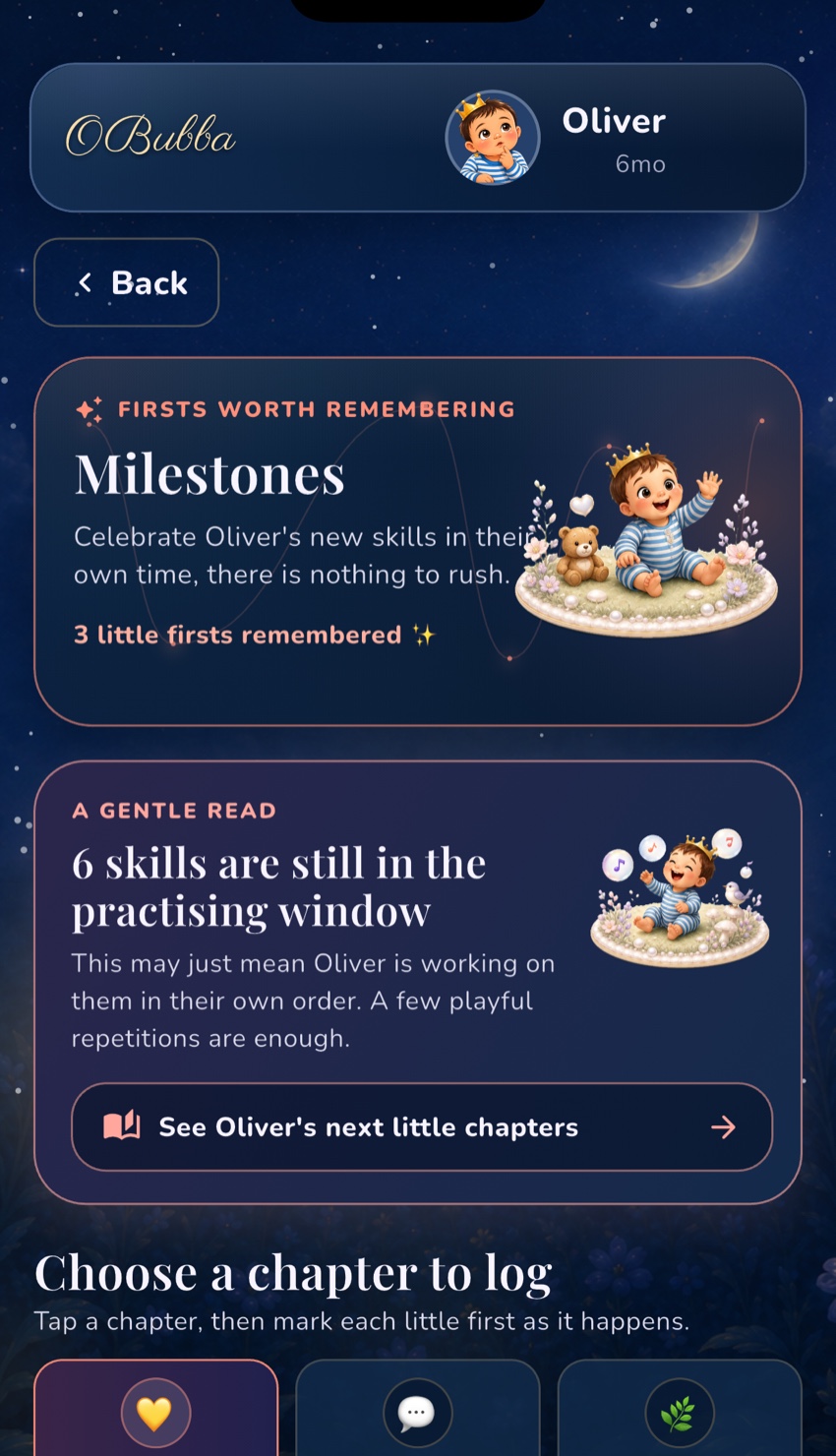
Tap a first and choose Today, Pick a date or Not sure yet, just mark it. A saved first can be dated later, corrected, unmarked or turned into a shareable celebration. When genuine play history exists, the celebration can also reflect the ordinary activities logged before that moment rather than pretending the skill appeared from nowhere.
Dated milestones can flow into OBubba's Memory Book alongside growth checks, first teeth and other moments you actually recorded. That makes the feature more like a family scrapbook with useful context than a checklist you must finish.
OBubba's “next little chapters” and suggested activities are age-contextual ideas, not predictions or prescriptions. The app cannot observe movement quality, hearing, vision, muscle tone, interaction or the home context a health professional considers.
Try OBubba free → — remember first smiles, sounds, movements and discoveries beside sleep, feeds, nappies, growth and family handovers, without turning childhood into a race.
When should I ask for help?
Talk to a health visitor, GP or your baby's specialist team whenever you are worried about how your baby moves, communicates, plays or responds. Ask sooner if your baby:
- loses a skill they previously used — seek advice urgently
- seems unusually stiff or floppy while awake
- consistently moves or uses one side very differently from the other
- does not respond to sounds, voices or visual interaction as expected
- is not making sounds by around 6 months or has not begun babbling by around 9 months
- is not showing signs of moving around by 12 months
- has feeding, swallowing, breathing or general-health concerns alongside development
These signs do not tell you the cause. They are reasons for a real assessment rather than more home testing. If a baby is acutely unwell, has breathing difficulty, a seizure, unusual drowsiness or you think there is an emergency, seek urgent medical help.
Three questions parents often ask
Does missing one milestone mean my baby is delayed?
Not necessarily. Milestones have wide ranges, and an unrecorded skill may simply have been missed. Look at the whole developmental pattern and raise the concern rather than trying to diagnose it from one row.
Do new milestones cause sleep regressions?
A new movement or communication burst can coincide with more practising and unsettled sleep, but timing alone does not prove a cause. Check the ordinary sleep picture — routine, naps, feeding, comfort, illness and environment — instead of labelling every wake a leap.
Should I practise a skill every day?
Offer varied floor play, conversation and simple games most days, but follow your baby's cues. Development comes through repeated real interactions, not drilling one action until it appears.
Sources and further reading
- NHS: Your baby's health and development reviews
- NHS Best Start in Life: Baby moves
- NHS: Help your baby learn to talk
- NHS Best Start in Life: Understanding your baby
- CPFT NHS: Early years physical development
- Great Ormond Street Hospital: Speech and language development from birth to 12 months
- Healthier Together: General information about child development
OBubba supports organisation, memories and parent education. It does not observe your child, verify a milestone, assess development, hearing, vision, movement quality or communication, or replace the Red Book, health visitor, neonatal team, therapist, paediatrician or GP.
Ready to try OBubba?
Use OBubba to track feeds, sleep, naps, nappies, growth, milestones and family handovers in one calm baby tracker app.