At home your baby naps at 9:30. At nursery they sleep for 24 minutes after lunch, doze in the car at pickup and arrive home both exhausted and mysteriously ready to party. Does the home schedule need fixing? Should nursery copy it exactly? And what time is bedtime now?
The short answer: expect nursery naps to look different. Keep two anchors steady — the morning start and the familiar evening wind-down — then adjust bedtime from the sleep that actually happened, not the schedule you hoped for. Give the carer a short, useful handover and collect only the facts you need at pickup.
Why nursery naps often look different
A baby's sleep is shaped by more than the clock. Nursery adds:
- a different room, light level and background noise
- other children settling, waking and moving
- new carers and new soothing styles
- meals, outdoor play and group routines
- more social and sensory stimulation
- separation from the parent they usually fall asleep with
NHS guidance says separation anxiety is common from around 6 months to 3 years and can make leaving a child at nursery or with another carer difficult. That does not mean nursery is damaging the bond. It means the setting and relationship are still becoming familiar.
Some babies initially nap less because they are alert to everything. Others sleep longer after a busy morning. Neither result proves the home routine was wrong.
Do not ask nursery to reproduce home minute by minute
Share your baby's normal rhythm, but offer a window rather than a deadline. “Usually ready between 9:15 and 9:45” is more practical than “must be asleep at 9:27”.
The most useful information is:
- the usual first-nap range
- early tired signs, such as becoming quiet or looking away
- late overtired signs, such as frantic movement or crying
- a short settling sequence the carer can repeat
- whether a dummy is used and how
- current feeding context that affects settling
- any clinical sleep, airway or positioning advice
The setting also has other children and safeguarding duties. A collaborative question — “What can you realistically keep consistent?” — gets farther than asking staff to recreate a private one-to-one routine.
The nursery sleep questions worth asking
In England, Ofsted-registered early-years providers must follow the Early Years Foundation Stage. Current Department for Education guidance says sleeping children should be checked frequently and babies should be placed down in line with current safer-sleep advice.
Ask the provider:
- Where do babies sleep, and what sleep surface is used?
- How are sleeping children supervised and checked?
- How do staff record the nap start and end?
- What happens if a baby refuses the scheduled nap or becomes tired early?
- How are babies placed down to sleep?
- What is the policy on comforters, dummies and sleeping bags?
- How will staff contact you about an unusual sleep, breathing concern or illness?
For babies, the safe answer should stay aligned with NHS guidance: on the back in a clear, firm, flat sleep space, without pillows, cot bumpers, pods, nests, toys or loose bedding. Current EYFS requirements say sleeping children must be checked frequently and babies placed safely in line with NHS advice. Strengthened Department for Education wording due to apply from 1 September 2026 explicitly adds that babies under six months must have an adult in the same room for every sleep.
Do not ask a provider to copy an unsafe home practice. Equally, if an answer about sleep safety is vague, ask to see the written policy rather than relying on reassurance alone.
A 60-second morning handover
Long explanations disappear during a busy drop-off. Give the facts that change today's care:
1. Last night
Share the morning wake time and whether the night was unusually disrupted. “Up at 5:20 after four wakes” explains why the first nap may need to come earlier.
2. Last feed and likely next feed
Hunger can look like tiredness and can stop a nap from settling. Include what was actually eaten, not a perfect plan.
3. The next sleep window
Give a range based on the morning wake, plus the cues nursery can watch. Avoid presenting an app prediction as an appointment.
4. What usually settles your baby
Name the top one or two methods: a short cuddle, patting and shushing, a dummy or a familiar phrase. A carer does not need every technique you have ever tried.
5. Safety and health information
Use the nursery's official forms and medicine procedures for allergies, conditions, doses and consent. A tracker summary can support the conversation; it is not a prescription, medical record or authorisation to give medicine.
What to ask at pickup
You do not need a minute-by-minute reconstruction of the whole day. Ask:
- When did each nap start and end?
- Were there any hidden dozes in the buggy or car?
- How did your baby seem after waking?
- Was anything unusual about feeds, nappies, breathing or behaviour?
The hidden five-minute doze matters. It can take the edge off sleep pressure and explain why a baby rejects the planned nap or bedtime later.
Record reality, including a refused nap. Do not replace it with the schedule nursery was aiming for.
How to choose bedtime after nursery
Use the last actual sleep and your baby's behaviour.
If naps were short or one was missed
Bring the wind-down and bedtime earlier. How much earlier depends on age, the final wake time and how your baby is coping; often 20 to 45 minutes is enough to start. An extremely early bedtime is not automatically better if the baby had a late car doze.
If there was a late pickup nap
Count it, even if it lasted only a few minutes. Expect bedtime to need its usual awake gap from that doze. Keep the routine calm rather than trying to “wear the baby out”.
If nursery naps were long
Use the ordinary wind-down but be prepared for bedtime to land slightly later if your baby is clearly not ready. Avoid making several changes at once; first see whether the longer day sleep repeats.
If your baby is falling apart before dinner
Simplify the evening. Offer the feed, dim the environment and begin the familiar sequence. This is not the night to add errands, stimulating play or a brand-new settling method.
Keep the anchors, flex the middle
Nursery sleep is easier to manage when the whole day is not drifting. Keep:
- a reasonably consistent morning wake range
- daylight and ordinary activity after waking
- the same short wind-down cues at home
- a bedtime based on the final wake window, not a fixed promise
Let the middle flex. A nursery day may have different naps without ruining home sleep. The useful question is not “Did they follow our schedule?” but “What does today's sleep mean for tonight?”
Give the transition time
For the first few weeks, look at trends rather than judging every day. Practise short separations when possible, use a confident goodbye and let the key person build their own trusted relationship with your child. NHS guidance says separation anxiety is normal; if distress remains severe for a long time after you leave or continues for more than a few weeks, speak to your health visitor.
A rough nursery nap followed by a rough night is still one pair of days. It takes several matched nursery and home days to know whether there is a repeatable effect.
How OBubba keeps away days in context
On the current app, Track → Today type → Change lets you label the day Home, Daycare, Grand, Travel or Sick. The tag can also be added retrospectively.
OBubba keeps Daycare, Travel and Sick days from distorting the clean home baseline used to learn wake windows. The tag is context, not an instruction: if today's plan actually needs changing, use Track → Today's plan → Adjust.
After enough home and away nights, the on-device pattern engine can surface whether nights tend to run rougher or calmer after nursery, grandparents or travel. It remains quiet until it has enough comparison nights and a meaningful difference rather than inventing a conclusion from one difficult pickup.
A calmer handover with Bubba Care
Open Care → Bubba Care to share a simple browser link without giving the carer your parent account. The carer can see the relevant routine and log feeds, naps and nappies; those entries flow back into the parent's Track timeline.
The separate Carer hand-off screen distils recent logs into one shareable briefing: next nap, bedtime, last night, the soothing methods that work most often, known allergies or conditions, recently logged medicines, current developmental context and one useful insight.
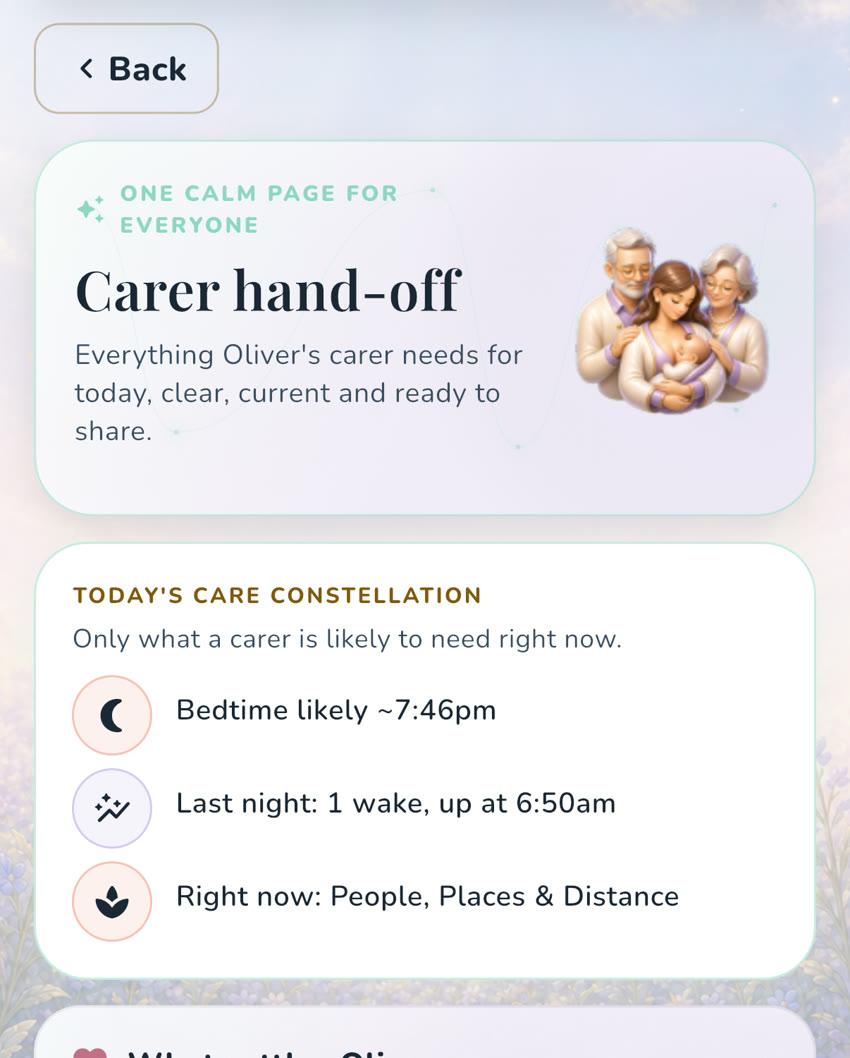
Only include what the carer needs, verify allergy and medicine information directly, and end access when the care session is finished. Bubba Care is day-to-day coordination, not an emergency or medical system.
Try OBubba free → — nursery-day context, adaptive bedtime, live carer logging and one calm handover instead of a chain of messages.
Sources and further reading
- NHS: Separation anxiety
- Department for Education: Safer sleep in early-years settings
- GOV.UK: Early Years Foundation Stage
- NHS Best Start in Life: Your baby's sleep patterns
- NHS Best Start in Life: Safer sleep advice for babies
OBubba supports tracking, planning and care coordination. It is not a medical record, childcare provider, medicine authorisation or substitute for professional advice and the setting's safeguarding procedures.
Ready to try OBubba?
Use OBubba to track feeds, sleep, naps, nappies, growth, milestones and family handovers in one calm baby tracker app.