The clock says 5:12am. Your baby’s body says 6:12am, and apparently the day has begun. Naps arrive “early,” tea feels late and bedtime is suddenly an hour away from the familiar sleepy patch.
You do not need to move the whole routine by an hour in one day. After the autumn clocks go back, keep the pre-6am environment dark and quiet, anchor the morning with daylight when you want the day to begin, and move naps and bedtime towards the new clock in small steps. Some babies adjust without a plan; others do better with 10–15-minute shifts over several days.
> The clock changed overnight. Your baby’s body clock is allowed to take longer.
What the one-hour change feels like to a baby
When UK clocks go back, 6am becomes 5am and 7pm becomes 6pm. The wall clock changes; hunger, sleep pressure and the baby's learned pattern do not instantly follow.
| What the new clock says | What the old rhythm may feel like | What you might notice | |---|---|---| | 5am | 6am | Baby seems ready to start the day | | 8am | 9am | First nap cues appear earlier than expected | | 5pm | 6pm | Evening fussiness or an accidental late nap | | 6pm | 7pm | Baby seems ready for bed “too early” |
In spring, the direction reverses: 7pm suddenly feels like 6pm, so bedtime may be met with bright eyes rather than tired ones.
This is not a regression, a failed routine or proof that your baby now needs less sleep. It is a one-hour mismatch between social time and the rhythm their body was expecting.
First choose: follow baby or shift the clock?
Not every family needs to correct the schedule.
Follow the new pattern if the earlier wake and bedtime work for your household, baby is content, feeds are going well and the total day remains manageable. A clock change can reveal a rhythm that suits the family better.
Shift gradually if 5am starts are exhausting, childcare requires a later timetable, feeds or medicines with prescribed timings are becoming difficult, or the early bedtime would regularly split the family evening.
Ask for individual advice when your baby is premature, very young, unwell, struggling to feed or following a neonatal, growth or medication plan. Do not delay a prescribed feed simply to “fix” the body clock.
The gentle post-change plan
Use the first morning as observation, not an exam. Record what actually happened, then choose one small adjustment.
Day 1: protect the edges
- Before your chosen morning start, keep lights low and interaction quiet.
- Feed responsively. Hunger does not become invalid because the clock says 5am.
- Once morning begins, open the curtains and get ordinary daylight.
- Offer the first nap from the actual wake time and tired cues, not from yesterday’s wall-clock slot.
- Start the familiar bedtime routine when baby is genuinely approaching sleep, even if that is earlier than you hoped.
The goal is to prevent a tired baby being stretched by a full extra hour.
Days 2–4: move one anchor at a time
Move your chosen morning start, naps and bedtime 10–15 minutes later each day after the autumn change. For example:
| Day | Morning target | Bedtime target | |---|---:|---:| | Old rhythm showing on new clock | 5:30am | 6:15pm | | Day 2 | 5:45am | 6:30pm | | Day 3 | 6:00am | 6:45pm | | Day 4 | 6:15am | 7:00pm |
This is an example, not a prescription. A newborn does not need these targets. An older baby who is coping well may move faster; a sensitive sleeper may need smaller steps or a pause.
Days 5–7: hold the workable rhythm
Once morning, naps and bedtime are close to the clock times you want, stop moving them. Repeat the ordinary cues:
- daylight and normal household activity after morning begins
- age-appropriate movement and play during awake time
- responsive milk feeds and usual family mealtimes for an established eater
- a familiar, calm bedtime sequence
- dim, boring overnight care
The NHS baby-sleep guidance recommends making day and night distinct and keeping bedtime simple and soothing. Those cues matter more than inventing a perfect one-off timetable.
What to do with a 5am wake
An early wake is the part most likely to make parents abandon the gradual plan.
- Check the need first. Feed if hungry, change a nappy when needed, and respond to discomfort or illness.
- Keep it night-like. Use low light, a quiet voice and minimal play.
- Do not battle for sleep. If baby is content but awake, offer calm reassurance. If they will not resettle, begin the day gently rather than escalating everyone’s stress.
- Use daylight at the desired morning. Open curtains or go outside once the day is officially starting.
- Calculate Nap 1 from the real wake. Stretching the first awake period by the full hour can create overtiredness and a 20-minute nap.
Newcastle Hospitals' infant-sleep guidance explains that daylight and darkness help babies develop their body clock and suggests morning outdoor time as a useful cue.
If your baby wakes early for more than a week, also check room light, temperature, noise, hunger, illness, nap timing and bedtime, not just the clock change. Read our calm guide to early waking for the wider checklist.
How to move naps without ruining bedtime
The safest adjustment is usually small and responsive.
- Move a nap by 10–15 minutes, not a full hour.
- If the previous nap was short, offer the next sleep earlier rather than defending the plan.
- Avoid adding a very late rescue nap that baby no longer usually needs.
- If a short bridge nap is necessary, keep it genuinely short and reassess bedtime from the actual wake time.
- Count pram or car sleep that really happened; do not pretend it did not count because it was inconvenient.
For a baby on three or more naps, the shift can be absorbed across the day. For a baby on one or two naps, the morning anchor and nap end time may have a stronger effect on bedtime.
Do not wake a newborn or a baby on a clinical feeding plan merely to preserve a clock-based nap schedule. Their care plan leads.
Feeds and solids during the clock change
Milk feeding stays responsive. A breastfed or bottle-fed baby may ask at the “old” time for several days. Offer the feed; do not hold off for an hour to make the log look tidy.
For a baby established on solids, gradually moving breakfast and family meals can provide another ordinary daytime cue. But:
- milk remains the main drink throughout the first year
- do not use extra solids to force longer sleep
- do not delay hunger for the sake of a clock
- keep any prescribed medicine or specialist feeding schedule exactly as instructed
If early waking arrives with much shorter feeds, fewer wet nappies, vomiting, fever, unusual sleepiness or a baby who seems unwell, seek clinical advice rather than treating it as a schedule problem.
What about newborns?
Newborn sleep and feeding are naturally distributed across day and night. Their body clock is still developing, and many wake frequently regardless of daylight saving.
For a newborn:
- follow feeding cues and any instruction to wake for feeds
- use normal daylight and household sound during the day
- keep overnight feeds calm and dim
- do not impose a wake-window programme
- accept that “bedtime” may not yet be one stable event
The NHS notes that babies have individual sleep patterns and that all babies change those patterns. A clock-change plan should reduce stress, not create a new reason to judge a newborn.
Keep safer sleep unchanged
An exhausting 5am start can tempt families onto a sofa or into improvised sleep arrangements. The clock change does not alter safer-sleep guidance.
For every sleep, place baby on their back in a clear, separate sleep space with a firm, flat mattress. Keep the room appropriately cool and never add pillows, pods, positioners or loose bedding to encourage a later wake. If you might fall asleep while feeding or comforting, plan the environment before you are exhausted and follow current safer-sleep advice.
How the real OBubba app handles a clock-shift week
The native app does not silently rewrite a baby's routine because the phone time changed. It keeps the actual sleep log intact, then lets the parent decide whether the family wants to shift. This adjustment is for an older baby with an established rhythm, not a newborn or a baby whose clinical feeding plan sets the day.
In Track → Adjust Schedule, a parent can set a preferred wake time, bedtime and nap count, then choose:
- Just today for a one-day wake or bedtime change
- Gradually to ease wake and bedtime towards the target over three calendar days
- Every day for a continuing family preference
Nap count and any pinned nap times are different: they remain in place until the parent resets them to Auto, even if Just today was selected. The tested gradual engine calculates one wake and bedtime step per calendar day and will not overshoot the chosen target. A one-hour target therefore moves by about 20 minutes per day across the three-day transition. Calendar differences are date-based rather than fixed 24-hour subtraction, so the 23- or 25-hour DST day cannot stall a step or accidentally keep a one-day wake or bedtime override active tomorrow.
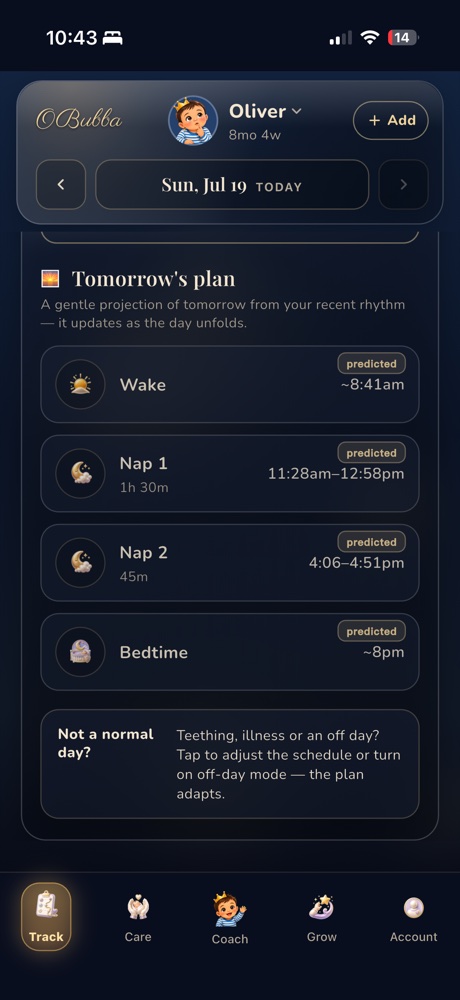
The Tomorrow's Plan view projects wake, naps and bedtime from recent usable history. When there is not enough usable wake history, it falls back to a 7am starting wake and age-based nap structure, so treat a new or sparsely logged plan as a starting estimate rather than a learned personal rhythm. The same resolved schedule is passed to the clock and wind-down reminders, so a manual bedtime adjustment is not shown in one place while the old reminder fires somewhere else.
What OBubba does not assume
The app cannot know whether:
- the early wake is caused by the clock, hunger, room light or illness
- baby is ready to stretch an awake period
- nursery will follow the same transition
- a clinical feed or medicine time can move
- the family's preferred clock time is better for this baby
That is why the adjustment is chosen by the parent and remains reversible. Set naps back to Auto when you want the live rhythm to lead again.
Track the clock-change week in OBubba →
Keep what actually happened separate from the plan, see tomorrow's projection and make a parent-chosen adjustment without rewriting the sleep log.
The no-overthinking version
If the full plan feels like too much, remember four anchors:
- Feed the baby in front of you.
- Use morning daylight when you want the day to begin.
- Shift sleep in 10–15-minute steps, abandoning the step when baby is clearly tired.
- Keep the bedtime sequence and safer-sleep setup familiar.
One early week does not permanently reset your baby. Consistency can be gentle and flexible at the same time.
Frequently asked questions
How long does a baby take to adjust to the clocks changing?
Some barely notice; others take several days or longer. Age, temperament, nap structure, daylight and the stability of the previous rhythm all matter. Look for steady movement rather than demanding a specific deadline.
Should I put my baby to bed an hour later when the clocks go back?
Usually not in one jump. If baby is visibly tired, a full extra hour may create overtiredness. Move bedtime by 10–15 minutes a day or accept an earlier bedtime if it works for your family.
Should I wake my baby later in the morning?
If baby is asleep and there is no clinical instruction to wake them, you do not need to manufacture a later morning. A consistent morning anchor can help an older baby's rhythm, but feeding and health needs come first.
Do I move feeds as well as naps?
Keep milk responsive. For an older baby, established meals can move gradually with the household, but never delay clear hunger or a prescribed schedule just to match the clock.
What should I do before the spring clock change?
If you want to prepare, move morning, naps and bedtime 10–15 minutes earlier on the clock for several days before the clocks go forward. Or make no advance change and use the same gradual approach afterwards in the opposite direction.
Can OBubba detect daylight saving automatically?
The phone supplies local clock time, but OBubba does not assume the family's preferred routine should move. The parent chooses a schedule adjustment; the app then keeps the plan, prediction and reminders aligned.
Sources and support
- NHS: Helping your baby to sleep
- NHS: Sleep and young children
- Newcastle Hospitals: Sleep in infants 0–12 months
- Great Ormond Street Hospital: Sleep hygiene in children
- The Lullaby Trust: Safer sleep overview
This UK-oriented article provides general information, not medical advice or an individual sleep prescription. Follow your baby's feeding, neonatal and medication plans. Contact your health visitor, neonatal team, GP or NHS 111 when concerned; call 999 in an emergency.
Ready to try OBubba?
Use OBubba to track feeds, sleep, naps, nappies, growth, milestones and family handovers in one calm baby tracker app.