Your baby chews everything all afternoon, fights bedtime and wakes crying 90 minutes later. Is a tooth finally coming through? Should you change the sleep routine, offer another feed or assume every difficult night is teething now?
The short answer: teething can make sleep more unsettled, but one rough night does not prove the cause. Look for a small cluster of signs — sore or red gum, extra chewing, dribbling and unusual fretfulness — then offer simple comfort and keep bedtime familiar. Check a genuine fever or a baby who seems unwell separately rather than writing it off as teething.
Can teething really disturb sleep?
Yes. NHS guidance includes sleeping less well among the signs that can accompany teething. A tender gum can make it harder to settle and can wake a baby who was already moving between sleep cycles.
The timing is messy, though. Many babies get their first tooth at around 6 months, while normal sleep development, rolling, starting solids and separation awareness may be changing at the same time. Some babies teethe before 4 months; others have no tooth after their first birthday. Teeth can also emerge with little or no discomfort.
That means age alone is weak evidence. “Six months plus a bad night” is not a diagnosis. The pattern is more persuasive when the sleep change arrives alongside visible or behavioural signs and settles again after the tender period.
Signs that fit teething
The NHS lists possible signs including:
- a sore, red gum where a tooth is coming through
- more dribbling, gnawing or chewing
- one flushed cheek or a facial dribble rash
- more fretfulness than usual
- rubbing an ear
- a mild temperature below 38°C
- sleeping less well
None of these signs is unique to teething. Ear rubbing can be tiredness; poor sleep can follow a missed nap; refusing food may happen with illness. Look at the whole baby, not one checkbox.
A high temperature is not “just teeth”
A temperature of 38°C or above is a fever. The NHS teething page describes only a mild temperature below 38°C as a possible sign. Fever is usually the body's response to infection and needs its own check.
Seek urgent advice from NHS 111 or your GP if a baby under 3 months has a temperature of 38°C or higher, or a baby aged 3 to 6 months has a temperature of 39°C or higher. Get help sooner whenever your baby seems unusually unwell, is hard to wake, has breathing difficulty, has a rash that does not fade under a glass, is not feeding normally or has drier nappies than usual. Trust your instincts.
What may help before bed
The aim is not to “fix” teething. It is to take the edge off discomfort without turning bedtime into a long experiment.
1. Offer something cool to chew
Chill a solid teething ring in the fridge and let your baby use it while awake and supervised. Follow its instructions. Do not put a teething ring in the freezer: the NHS warns that a frozen ring can damage a baby's gums.
A clean, cool wet flannel can also be soothing. Never tie a teether around your baby's neck because it can become a choking hazard.
2. Massage the gum
Wash your hands and gently rub the sore area with a clean finger. Keep it brief and stop if your baby dislikes it. This can be useful just before the wind-down, when chewing toys would otherwise keep the room bright and busy.
3. Use food only if your baby is already weaning
For a baby already eating solid foods, appropriate cool, soft foods may feel comfortable. Sit them upright and supervise closely. Do not introduce solids early as a teething treatment, and do not replace their usual milk feeds.
Avoid rusks and sweet biscuits. Sugar can contribute to tooth decay, and frequent sugary contact matters as well as the total amount.
4. Keep the familiar bedtime sequence
Do the ordinary short routine: feed, clean teeth if one has appeared, dim lights, cuddle, song and sleep space. Add comfort; do not rebuild the entire schedule after one hard night.
If your baby is clearly exhausted after disrupted naps, start the wind-down a little earlier. If they had a late rescue nap, count it rather than forcing the original bedtime. Comfort and timing can change for the night while the familiar cues stay the same.
What about pain medicine or teething gel?
If your baby is in pain, the NHS says sugar-free paracetamol can be used from 2 months and ibuprofen from 3 months, but suitability depends on age, weight, health and the specific product. Read the leaflet, measure with the supplied syringe and ask a pharmacist, GP or health visitor if you are unsure.
Do not give paracetamol to a baby under 2 months. Do not give ibuprofen to a baby under 3 months, under 5kg, dehydrated or with chickenpox; children with asthma should only have it if a doctor recommends it. Do not alternate paracetamol and ibuprofen unless a health professional tells you to.
General oral pain-relief gels are not suitable for children. Products licensed specifically for young children have limited evidence of benefit and should only be used according to their instructions after simpler measures have not helped. Never use somebody else's prescription or treat an app entry as dosing authorisation.
A simple plan for a teething night
When you are tired, use the same short sequence each time:
- Check the baby, not the theory. Look at breathing, colour, responsiveness, temperature, feeding and wet nappies. If something feels wrong, seek advice.
- Check ordinary needs. Hunger, a dirty nappy, trapped wind, temperature of the room and an overtired day can coexist with teething.
- Offer calm comfort. Try a cuddle, clean-finger gum rub or chilled teether while awake.
- Use medicine only when appropriate. Follow the label or professional advice; log what was actually given.
- Return to the usual sleep cues. Keep the room dark and interaction gentle. Place your baby down in their normal safer-sleep space.
- Review tomorrow, not at 3am. One difficult wake is not the moment to start sleep training, drop a nap or remove every sleep association.
Responsive help during a sore night does not “undo” good sleep. If you are working on a settling change or night-weaning plan, pause progression during a teething peak and resume when your baby is comfortable again.
Track enough to see the pattern — not every dribble
Useful notes are small and specific:
- date the tooth or swollen gum was first noticed
- which tooth or area appears affected
- sore gum, chewing, unusual fussiness or disturbed sleep
- feeds and wet nappies if intake seems lower
- naps, bedtime and night wakes
- temperature measured with a digital thermometer
- medicine name, strength, dose and time, if given
Avoid logging “teething” as the explanation for every behaviour. Record what you observed. “Lower gum red; chewed teether; woke three times” is more useful than “terrible teething night”.
After several days you can ask a better question: did wakes rise only around the tender period, or was bedtime already drifting beforehand? If the pattern continues after the gum settles, look again at the wider sleep day rather than waiting indefinitely for a tooth.
How the current OBubba app handles teething
Open Grow → Teeth for your baby's current smile map. Each of the 20 tooth positions is tappable, and the next likely group is highlighted from your baby's age with a deliberate reminder that ranges are not deadlines.
The tooth logger stores the date, selected tooth, tender-day symptoms and a note. Symptoms include drooling, red cheeks, chewing, fussiness, disturbed sleep, swollen gums, going off food and temperature. A temperature entry is kept as an observation; OBubba does not label it as caused by teething.
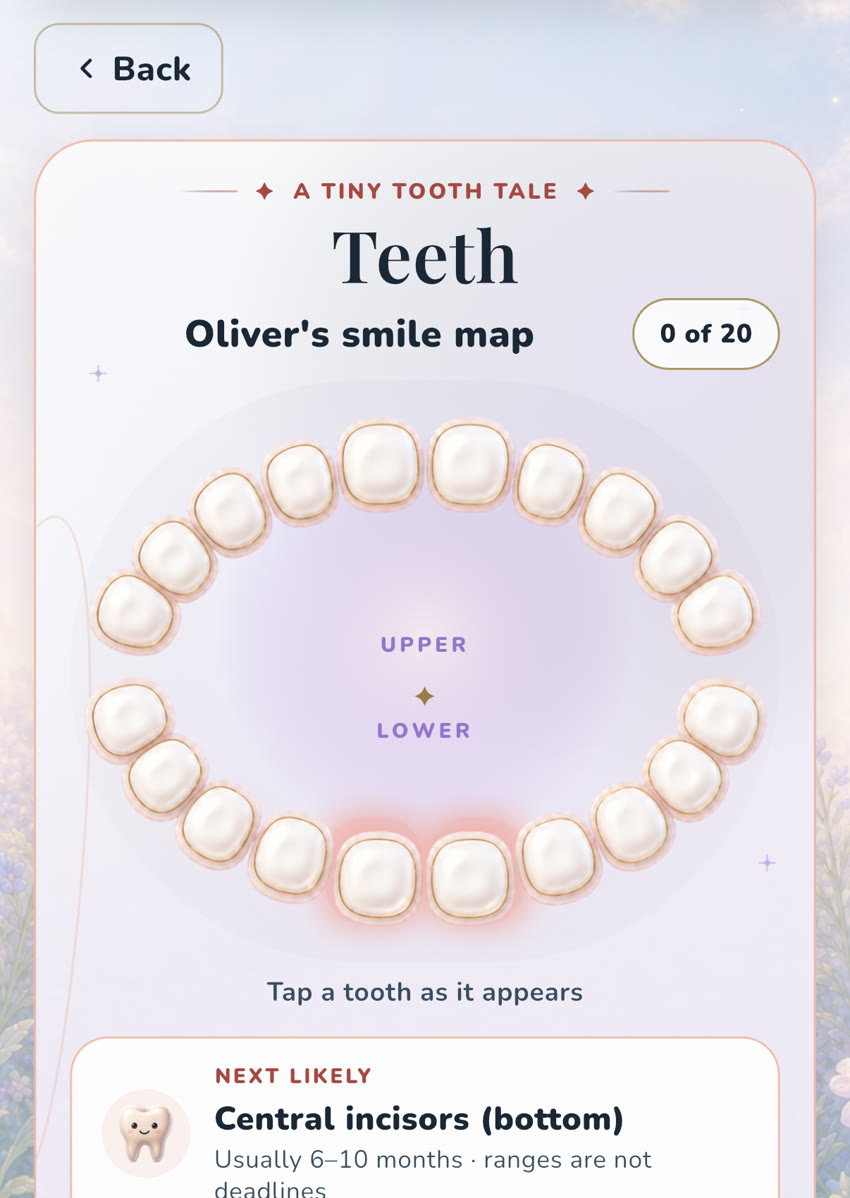
The same screen gives age-aware oral-care guidance and simple sore-gum comfort: chilled rather than frozen teethers, clean-finger massage and soft cool food only once weaning. After the first tooth appears, it prompts a tiny smear of fluoride toothpaste containing at least 1,000 ppm, brushing at bedtime and one other time, and arranging a dental visit.
Recent tooth and symptom logs are also treated as context elsewhere in OBubba. The app can soften the projected day on a teething patch, keep an extra nap option available and mention teething among plausible reasons for disrupted nights. It does not claim a tooth caused a wake. Illness and teething days are kept from distorting the baby's clean sleep baseline, and sleep-coaching progression is held rather than pushed during an active rough patch.
If enough bottle or breastfeeding history exists around a logged eruption, OBubba may also notice a meaningful daytime milk dip. Bottle volume and breastfeeding minutes remain separate measures; mixed or sparse data stays quiet. The prompt is to keep offering milk and watch wet nappies, not to diagnose dehydration.
Try OBubba free → — keep teeth, sleep, feeds, nappies and comfort in one calm timeline, then let the app use the context without turning every difficult night into a verdict.
Sources and further reading
- NHS: Baby teething symptoms
- NHS: Tips for helping your teething baby
- NHS: High temperature in children
- NHS Best Start in Life: Baby and toddler tooth care
OBubba supports tracking, planning and parent education. It does not diagnose teething, illness or dehydration, prescribe medicine, or replace advice from a pharmacist, dentist, health visitor, GP, NHS 111 or emergency services.
Ready to try OBubba?
Use OBubba to track feeds, sleep, naps, nappies, growth, milestones and family handovers in one calm baby tracker app.