The first spoonful of egg can feel like an event. You choose a quiet morning, prepare it carefully, watch every patch of skin and breathe again when nothing worrying happens.
Then the next week arrives and a less dramatic question appears: do we need to give it again?
Yes. Once an allergenic food has been introduced and tolerated, current UK guidance is to make it part of your baby’s usual varied diet rather than treating one taste as a completed checkbox. The NHS does not prescribe one universal timetable. Allergy UK suggests keeping tolerated allergens such as egg and peanut in the diet ideally at least twice a week; its peanut-specific guidance describes 1 to 2 teaspoons in a safe form, 2 to 3 times a week.
That is a pattern, not a challenge or a guarantee. If your baby has ever reacted, has moderate-to-severe eczema, already has a food allergy or follows a specialist plan, use the advice from your GP, health visitor, dietitian or allergy team instead of a generic rotation.
Why the second, third and tenth serving matter
Introducing an allergen is not like ticking off a museum visit. The aim is for a tolerated food to become ordinary.
The NHS food-allergy guide says that foods which can trigger allergy should become part of the baby’s usual diet once introduced and tolerated. It also warns against unnecessarily delaying peanut and hen’s egg beyond 6 to 12 months.
Allergy UK goes one step more practical: after successful introduction, continue the food regularly, ideally at least twice a week. For peanut, its current factsheet suggests 1 to 2 teaspoons, 2 to 3 times weekly, served in a safe form.
This does not mean:
- one calm meal proves that an allergy can never appear later
- every allergen needs an identical dose or schedule
- a baby must finish a target portion
- you should continue after possible reaction symptoms
- a family should introduce a food they never intend or know how to serve safely
It means tolerated foods should move from “test day” into normal family eating.
What counts as “tolerated”?
For an ordinary home introduction, tolerated usually means your baby ate the food in an age-appropriate form and you did not observe concerning immediate or delayed symptoms.
That is encouraging, but it is not a medical diagnosis. The NHS says many immediate reactions appear within minutes and may take up to two hours; some delayed reactions, including some cow’s-milk reactions, can take longer.
A calm first serving also does not create permission to ignore a later rash, swelling, vomiting or breathing change. Look at each meal in front of you.
If a food produced an unexplained symptom and you marked the meal “unsure”, do not relabel it tolerated simply to keep the rotation tidy. Record what happened and ask a health professional whether and how it should be offered again.
A simple repeat-allergen rhythm
You do not need fourteen alarms or a colour-coded laboratory calendar. Start with foods your baby has already eaten without a concerning reaction.
One workable pattern is:
- choose two repeat slots in the week
- attach each food to a meal your family already serves
- use a small, familiar and safe form
- keep the rest of the meal ordinary
- let your baby decide how much to eat
For example:
| Tolerated food | Easy repeat form | A natural place in the week | |---|---|---| | Well-cooked egg | omelette strip, mashed boiled egg or egg stirred into a familiar dish | breakfast twice a week | | Peanut | smooth peanut butter thinned with water or mixed through porridge or yoghurt | two familiar breakfasts or snacks | | Cow’s milk in food | plain full-fat yoghurt, pasteurised cheese or milk used in cooking | breakfast or family meal | | Wheat/gluten | toast finger, porridge, soft pasta or couscous | ordinary breakfast or lunch | | Sesame | smooth tahini thinned into a familiar food or hummus in a manageable texture | lunch alongside vegetables or bread | | Fish | carefully checked, well-cooked and softly flaked fish | family fish meal | | Soya | tofu or plain soya yoghurt in a suitable texture | lunch or snack | | A tolerated tree nut | that specific nut as a smooth, thinned butter or finely ground powder | mixed into porridge or yoghurt |
This is a menu example, not an instruction to offer every row. Peanut and tree nuts are different allergen groups; tolerating one does not prove tolerance to another. Cow’s milk can be used in food from around six months, but it should not replace breast milk or first infant formula as the main drink before 12 months.
A seven-day example after several foods are established
Suppose egg, peanut, dairy, wheat and sesame have each already been introduced separately and tolerated. A normal week might look like this:
| Day | Ordinary meal idea | What the rotation is doing | |---|---|---| | Monday | well-cooked omelette strips with a familiar vegetable | repeat egg | | Tuesday | plain yoghurt with fruit | repeat dairy | | Wednesday | porridge with thinned smooth peanut butter | repeat peanut and familiar wheat only if both are established | | Thursday | usual allergen-free family meal | no need to make every day a project | | Friday | soft pasta with a familiar sauce | repeat wheat | | Saturday | mashed egg in a familiar meal | second egg opportunity | | Sunday | hummus with safely prepared soft food | repeat sesame |
Peanut could appear again on Sunday or in the following week, depending on your family’s plan. The important distinction is that these are repeat servings of established foods. Do not copy a multi-allergen menu for first introductions.
If your baby licks the spoon, eats a small amount or turns away after one taste, do not force more to satisfy the tracker. Keep the next opportunity calm. Ask a dietitian or allergy professional if you need a specific therapeutic amount.
Safe forms do not become optional after introduction
A food can be biologically tolerated and still be a choking risk.
Egg
Use well-cooked egg unless current UK food-safety guidance for the exact product and your baby’s situation says otherwise. Omelette strips, mashed hard-boiled egg and soft pieces of well-cooked egg can work at different texture stages.
Peanut and tree nuts
Never give whole or coarsely chopped nuts to a child under five. Do not offer a sticky spoonful or chunk of nut butter. Use smooth nut butter thinned into another food, or a finely ground form prepared for the baby’s current eating skills.
Fish and shellfish
Cook thoroughly, remove bones and shell carefully, and adapt the texture. Tolerating cod does not establish shellfish or every other fish as tolerated.
Sesame
Tahini is thick and sticky on its own. Thin a small amount or mix it into a familiar food. Hummus may also contain other ingredients, so check the label and do not use a mixed dish for a first introduction unless all relevant ingredients are already understood.
At every meal, seat your baby upright in a stable highchair, use the harness and supervise within arm’s reach. Read gagging versus choking and learn infant first aid before relying on a search during an emergency.
What if we miss a week?
Do not panic or compensate with an oversized portion. Resume the familiar food in its usual safe form.
A holiday, illness, refusal spell or chaotic week can interrupt the routine. A missed serving is not proof that tolerance has vanished. But if the gap is long, if there was any previous symptom, or if you stopped because you were concerned about allergy, get individual advice before restarting, particularly for peanut.
The aim is sustainable family food, not perfect streak maintenance.
What if baby refuses the repeat food?
Refusal is not the same as a reaction.
Try changing one practical variable:
- offer egg as a soft strip instead of mashed
- stir a familiar amount of thinned peanut butter into porridge instead of yoghurt
- use the tolerated allergen in a family recipe your baby can safely manage
- offer it when baby is alert and not ravenous
- keep the portion small and let baby touch or taste without pressure
Do not hide a concerning food in a meal after a possible reaction. And do not repeatedly pressure a baby to eat an allergen for the sake of a weekly target. Persistent refusal, distress, coughing, swallowing difficulty, poor growth or an increasingly narrow diet deserves support from a health visitor, GP or paediatric dietitian.
When routine should stop
Stop giving the suspected food and seek medical advice if your baby develops possible allergy symptoms such as:
- swelling of the lips or face
- a red, itchy or raised rash
- repeated vomiting or significant diarrhoea
- worsening eczema linked repeatedly with the food
- coughing, wheezing or breathing change
- unusual pallor, floppiness or sudden marked sleepiness
Call 999 for breathing difficulty, swelling of the tongue or throat, collapse, marked floppiness or another sign of anaphylaxis. Follow your baby’s prescribed allergy action plan and use prescribed adrenaline immediately if the plan says to do so.
Redness only where acidic food touched the skin can be irritant rather than allergy, but parents should not have to diagnose that from a blog. Photograph the area if safe, note the timing and ingredients, and ask for advice when uncertain.
Never use repeated home servings to “prove” that a previous reaction was harmless. Stop the suspected food, note the timing and ingredients, and follow the NHS food-allergy guidance or your baby’s own allergy action plan.
Higher-risk babies need an individual starting plan
Talk to your GP, health visitor, dietitian or allergy team before first introduction if your baby has moderate-to-severe or persistent eczema, an existing food allergy, or another reason a clinician has identified as higher risk.
Some higher-risk babies benefit from earlier introduction of egg and peanut once developmentally ready, but timing, amount and supervision may be different. Do not delay for months while waiting in uncertainty; ask promptly for the right pathway.
If your baby already has a diagnosed allergy, follow the avoidance, tolerated-form or ladder plan provided by their clinical team. An egg ladder, milk ladder or oral food challenge is not the same as routine allergen maintenance and should not be improvised from an app.
How OBubba remembers what has become ordinary
OBubba’s real Care → Weaning screen includes an Allergen journey. It combines recognised allergens from solids logs with any groups a parent marks manually, and preserves lifetime “ever tried” information so an old introduction does not disappear when daily data is archived.
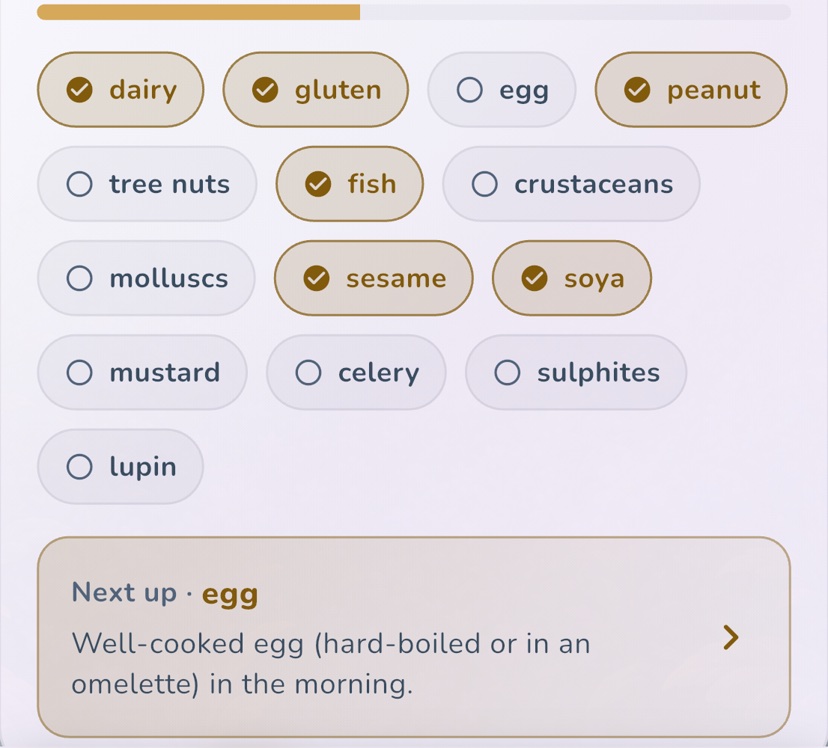
Opening an allergen shows one of two importantly different states:
- Introduced: the screen reminds the parent to keep the tolerated food in regular rotation, approximately twice a week.
- Reaction logged: the first-taste suggestion is hidden, and the screen says to pause and check with a doctor before offering it again.
The app also has a small confidence insight inspired by repeat exposure. It can say Looking good with Egg only when recent records contain at least three clearly tolerated egg meals, no recorded egg reaction, including reactions preserved from older history, and fewer than two ambiguous Unsure meals. It is limited to a recent introductory window and appears separately for each allergen.
Those boundaries are more important than the celebratory wording. Three app entries do not medically clear a food. An Unsure meal is not silently counted as a clean exposure. A reaction from weeks earlier is not forgotten just because it left the recent timeline.
Food-name recognition is useful but imperfect. “Egg toast” may be recognised; “yellow breakfast” cannot be. A recipe can contain several allergens. Check what actually went into the meal and correct the record rather than trusting an automatic label blindly.
Keep the allergen journey in one place →
Track first introductions, repeat servings, reactions, textures and milk alongside the rest of your baby’s day, with safety boundaries that remember more than a checkbox.
Frequently asked questions
Is one successful peanut serving enough?
No. It is encouraging, but UK guidance recommends keeping tolerated allergenic foods in the usual diet. Allergy UK’s peanut guidance suggests a safe peanut serving 2 to 3 times a week. Use individual advice for higher-risk babies or any previous concern.
How often should I give egg after introduction?
Allergy UK recommends keeping tolerated allergens such as egg in the diet ideally at least twice weekly. Serve egg well cooked and in a texture your baby can manage. A specialist plan takes priority.
Can I serve several established allergens together?
Yes, ordinary meals may contain several allergens after each has been introduced separately and tolerated. The problem with combining brand-new allergens is that a reaction becomes harder to attribute.
Does baby have to eat the full portion every time?
Do not force food. Offer a familiar safe serving and follow appetite cues. If your clinician prescribed a specific maintenance amount, ask what to do when your baby eats less.
Should I retry after a rash?
Not without advice when allergy is possible. Stop the suspected food, record the timing and ingredients, and contact a health professional. Call 999 for severe symptoms.
Can OBubba confirm that my baby is not allergic?
No. OBubba can preserve what was offered and how the parent recorded the response. It cannot examine a rash, diagnose allergy, measure the amount of allergen protein or guarantee future tolerance.
Reliable UK sources
- NHS: Food allergies in babies and young children
- Allergy UK: Weaning and introducing your baby onto solids
- Allergy UK: Peanut allergy and maintaining tolerance
- NHS: Help your baby enjoy new foods
This article gives general information for UK families. It is not a personalised allergy-prevention, diagnosis or reintroduction plan, and OBubba is not a medical device. Follow advice from your baby’s own healthcare or allergy team.
Ready to try OBubba?
Use OBubba to track feeds, sleep, naps, nappies, growth, milestones and family handovers in one calm baby tracker app.