Your baby's vaccination appointment is in an hour. The changing bag is ready, but is the Red Book in it? Should you feed before you leave? Which symptoms are ordinary afterwards, and where will you record the answer when sleep-deprived you needs it tonight?
The short answer: take your baby's Personal Child Health Record (the Red Book), dress them for easy access, bring a short list of questions and ask the vaccinator exactly what was given and what aftercare applies. Afterwards, note facts — vaccine, date and time, temperature, symptoms and any medicine actually given — while keeping the Red Book and GP record as the official source of truth.
First, check the current invitation — not an old schedule screenshot
Routine vaccination programmes change. In the UK, significant childhood schedule changes took effect in July 2025 and January 2026, including a new 18-month appointment for eligible children and the introduction of MMRV, which adds protection against chickenpox. Eligibility can depend on a child's date of birth and where in the UK they live.
That is why a saved chart, an older sibling's schedule or an app estimate should never decide what your baby is due. Follow the invitation from your GP surgery or vaccination service, check the current NHS schedule and ask the practice if anything is unclear or appears to have been missed.
If you know your child is due, the NHS says you can contact your GP surgery rather than waiting for an invitation. A missed appointment can be rearranged; it does not mean the opportunity has gone.
The night-before checklist
Keep the preparation small enough to finish:
- Red Book: put the Personal Child Health Record in the bag so the clinical team can update it.
- Appointment details: confirm the place, time and which adult is taking the baby.
- Easy clothing: babies under 12 months usually receive injections in the thigh, so choose clothing that is simple to remove and replace.
- Ordinary baby supplies: nappies, wipes, feed supplies, muslin and spare clothes.
- Questions: note allergies, previous reactions, medicines, health conditions and anything you are worried about.
- Aftercare plan: decide who will be with the baby later and how both carers will record observations or medicine.
You do not need to make the entire day clinical. Feed your baby as usual unless the vaccination service has given different instructions. Leave enough travel time to avoid arriving flustered.
What if your baby is unwell on the day?
The NHS says a baby can usually still be vaccinated if they have a minor illness without a temperature, such as a cold. Allergies, asthma, eczema, food intolerance and being born prematurely do not automatically prevent routine vaccination either.
Call the practice before travelling if your baby has a high temperature, seems significantly unwell or you have been told they need individual advice. The clinical team can decide whether to proceed or rearrange.
Premature babies should generally still start routine vaccinations from 8 weeks after birth rather than waiting for corrected age. Follow the neonatal or vaccination team's advice for your baby's circumstances.
Five questions to ask before you leave
The appointment is the best time to remove ambiguity. Ask:
- Which vaccines were given today? Ask the vaccinator to record them in the Red Book.
- What reactions are common for these particular vaccines, and when might they happen? Different vaccines can have different aftercare.
- Does my baby need paracetamol after today's vaccines? Do not assume the answer from a previous appointment.
- What should make me call the GP or NHS 111? Repeat the advice back if you are tired or anxious.
- When is the next appointment, and will the practice contact me? Put the date or expected window somewhere you will see it.
If somebody else is taking your child, tell the practice and make sure that carer has the Red Book, your questions and any relevant health information.
What is common after baby vaccinations?
Babies may cry briefly after an injection and settle with a cuddle or feed. The injection area can be sore, red or slightly swollen for 2 to 3 days. Some children feel irritable or unwell, and some develop a high temperature. These reactions are usually short-lived.
For comfort:
- offer normal feeds and plenty of fluid
- keep cuddles and the rest of the day gentle
- avoid too many layers or blankets if your baby has a temperature
- use medicine only according to the instructions for the vaccine, the product leaflet or a health professional
The NHS specifically recommends children's paracetamol after MenB vaccinations at 8 and 12 weeks to reduce the risk of fever. This is vaccine- and age-specific advice: ask the vaccinator what to give, how much and when, then follow the exact product instructions. Do not copy a dose from a blog, an app or another baby.
When should you get help?
Speak to a GP or call NHS 111 if you are worried about your child's reaction. Seek urgent advice if a baby under 3 months has a temperature of 38°C or higher, or a baby aged 3 to 6 months has a temperature of 39°C or higher. After MenB vaccination, NHS guidance also advises getting help if a high temperature is still present after 48 hours or your baby is unwell and you are worried.
Call 999 for a life-threatening emergency — for example, severe breathing difficulty, collapse, a seizure or a child who cannot be woken. Serious allergic reactions are rare and usually happen within minutes; vaccinators are trained to recognise and treat them.
Trust the baby in front of you, not only the clock. Poor feeding, fewer wet nappies, unusual drowsiness, breathing difficulty, a rash that does not fade under a glass or a child who seems seriously unwell deserves prompt clinical advice, whether or not vaccination happened recently.
A useful after-vaccination log
The goal is a reliable handover, not minute-by-minute surveillance. Record:
- vaccines given, exactly as written by the clinical team
- appointment date and approximate administration time
- injection site if the vaccinator identifies it and it later becomes sore
- measured temperature and time
- feeding and wet nappies only if they change noticeably
- observed reaction, when it started and whether it is improving
- medicine name, formulation, measured amount and actual time, if given
- advice received and who provided it
Write “sleepier than usual; woke for feed” rather than “bad reaction”. Facts help another parent, pharmacist or clinician understand the pattern without turning an expected sleepy afternoon into a diagnosis.
Let routine bend for the day
A tender, tired or feverish baby may nap differently, want more contact or need an earlier bedtime. Respond to them. One post-vaccination day is not evidence that a wake window is wrong or that sleep progress has disappeared.
Keep safer-sleep practice unchanged: place your baby on their back in their own clear, flat sleep space. Extra cuddles while you are awake are fine; falling asleep together on a sofa or armchair is not.
How the current OBubba app helps
Open Care → Reminders to reach OBubba's Reminders & appointments screen. You can add a vaccination appointment with a title, optional note, date and time, then choose a nudge at the time or from 15 minutes up to 1 day beforehand. A future appointment can be added to the device calendar, and saved appointments can also be exported as an `.ics` calendar file.
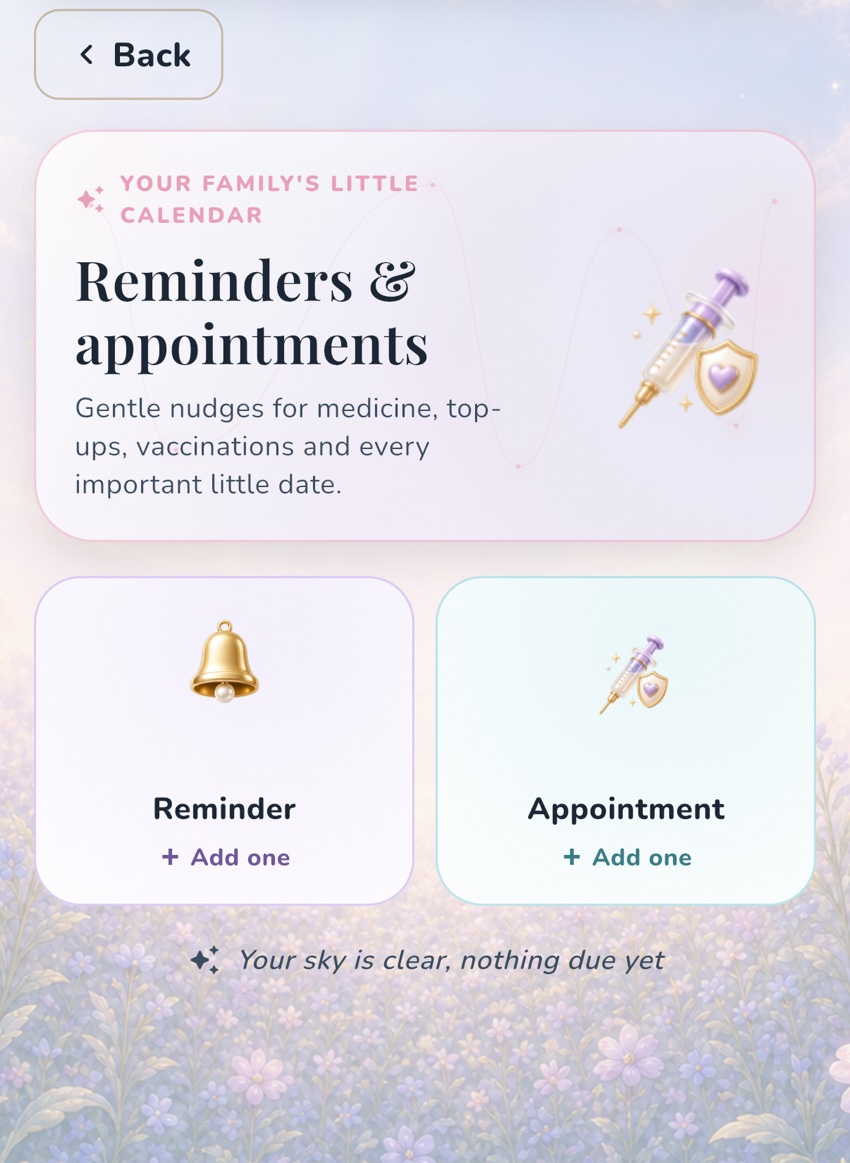
This is deliberately separate from recording what actually happened. After the appointment, Track → Log details → Health → Medicines can hold a measured temperature plus any medicine name, amount, actual time and note. That makes the overnight handover clearer without converting an observation into a diagnosis.
The Health sheet also contains a country-aware, age-timed vaccination overview with circles a parent can mark as given. Treat this as an organising overview only. It is stored on the device and is not the official vaccination record, a booking confirmation or proof that a dose was administered. Programmes and eligibility change — as the UK schedule did in 2025–26 — so confirm every due date and vaccine with the current NHS schedule, your GP invitation and the Red Book.
OBubba does not decide whether a baby is well enough to be vaccinated, tell you which vaccine they need, prescribe aftercare medicine or assess a reaction. Its useful job is smaller: help the family remember the appointment, keep observations together and hand over accurate times when everybody is tired.
Try OBubba free → — keep appointments, temperature, medicine, feeds, nappies and sleep context in one calm family organiser while the Red Book and clinical team remain in charge.
The two-record rule
Use two records for two different jobs:
- Red Book and GP/NHS record: the authoritative vaccination history.
- Your family log: reminders, questions, observed reactions and care handover.
That separation avoids two risky assumptions: that marking a circle in an app proves a vaccination happened, or that a missing app entry means it did not. Bring the Red Book, ask the vaccinator to update it, and let OBubba reduce the surrounding mental load.
Sources and further reading
- NHS: Vaccination tips for parents
- NHS: Booking your child's vaccination appointment
- NHS: MenB vaccine for children
- NHS: Your baby's health and development reviews and Red Book
- UKHSA: Complete routine immunisation schedule
OBubba supports organisation, tracking and parent education. It is not a vaccination booking service, clinical record or medical device and does not diagnose reactions or prescribe medicine. Always follow your invitation, Red Book, current NHS guidance and advice from your GP, practice nurse, health visitor, NHS 111 or emergency services.
Ready to try OBubba?
Use OBubba to track feeds, sleep, naps, nappies, growth, milestones and family handovers in one calm baby tracker app.