At 5:07am your baby opens their eyes. You feed them in the dark, they look almost asleep on your shoulder, and OBubba asks:
Night wake or up for the day?
The clock cannot answer that question on its own.
Choose Night wake if you are still treating this as part of the overnight sleep—keeping things quiet and trying to help baby return to sleep. Choose Wake for the day when baby is genuinely staying awake and you have stopped trying to continue the night.
Five o’clock is not a biological border. The same baby may have a 5am night wake on Monday and a 5am morning start on Tuesday. What happens next gives the time its meaning.
> Still resettling? Keep the night open. Day genuinely started? Close it.
The 20-second decision
Ask one observable question:
Are we still trying to continue this sleep?
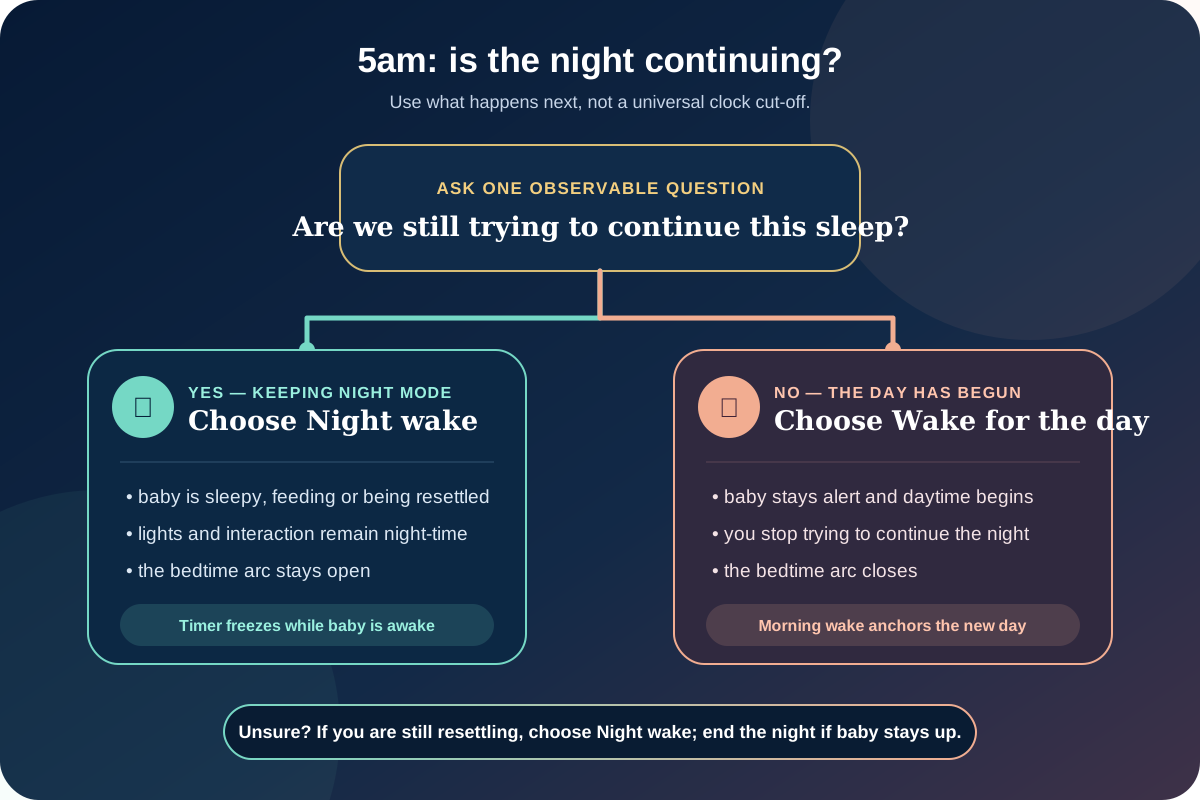
| What is happening at 5am? | Best OBubba choice | What the record means | |---|---|---| | Baby feeds, stays drowsy and returns to sleep | Night wake | one continuing night with an awake interruption | | Baby is alert, curtains open and the household starts the day | Wake for the day | the overnight sleep ends and the first wake window begins | | Baby is crying and you are actively resettling | Night wake | the sleep timer pauses while baby is awake | | You try for 15 minutes, then decide baby is definitely up | Night wake, then end sleep | the app can close the unresolved wake and start the day honestly | | Baby makes one sound, wriggles and settles without waking | Do nothing yet | active or light sleep can look surprisingly busy | | You cannot remember whether more sleep happened | use the best known times and add a note | honest uncertainty is better than false precision |
This is a tracking decision, not permission to ignore hunger, distress or illness. Meet the baby's need first. Label the sequence second.
Why a 5am movement is not always morning
Babies move through lighter and deeper sleep. NHS guidance on baby states notes that during light sleep a baby may move their face or body, make brief fussy sounds or show fluttering eyelids. In a drowsy state, they may fall back to sleep if given a moment before being fully woken.
That is why one noise, eye opening or wriggle does not automatically end the night. Look for the direction of travel:
- Are their eyes becoming bright and focused?
- Are they staying awake after feeding or comfort?
- Are you still using low light, quiet voices and a night-time response?
- Does baby return to the sleep space and sleep again?
- Have you actually begun the first daytime wake window?
The NHS says every baby has an individual waking and sleeping pattern. It also recommends using light, ordinary activity and noise to distinguish day from a quieter, dimmer night. Those cues are more useful than pretending every family starts at 6am.
If your family consistently begins at 5:15, that is a real morning. If baby sleeps from 5:30 until 7:00, the 5am episode sat inside the night.
What Night wake does in the actual app
The current OBubba app keeps a bedtime sleep as one open arc from bedtime to the final morning wake. When you tap the centre pause control during that live night, it does not silently guess what happened. It opens a chooser with two routes.
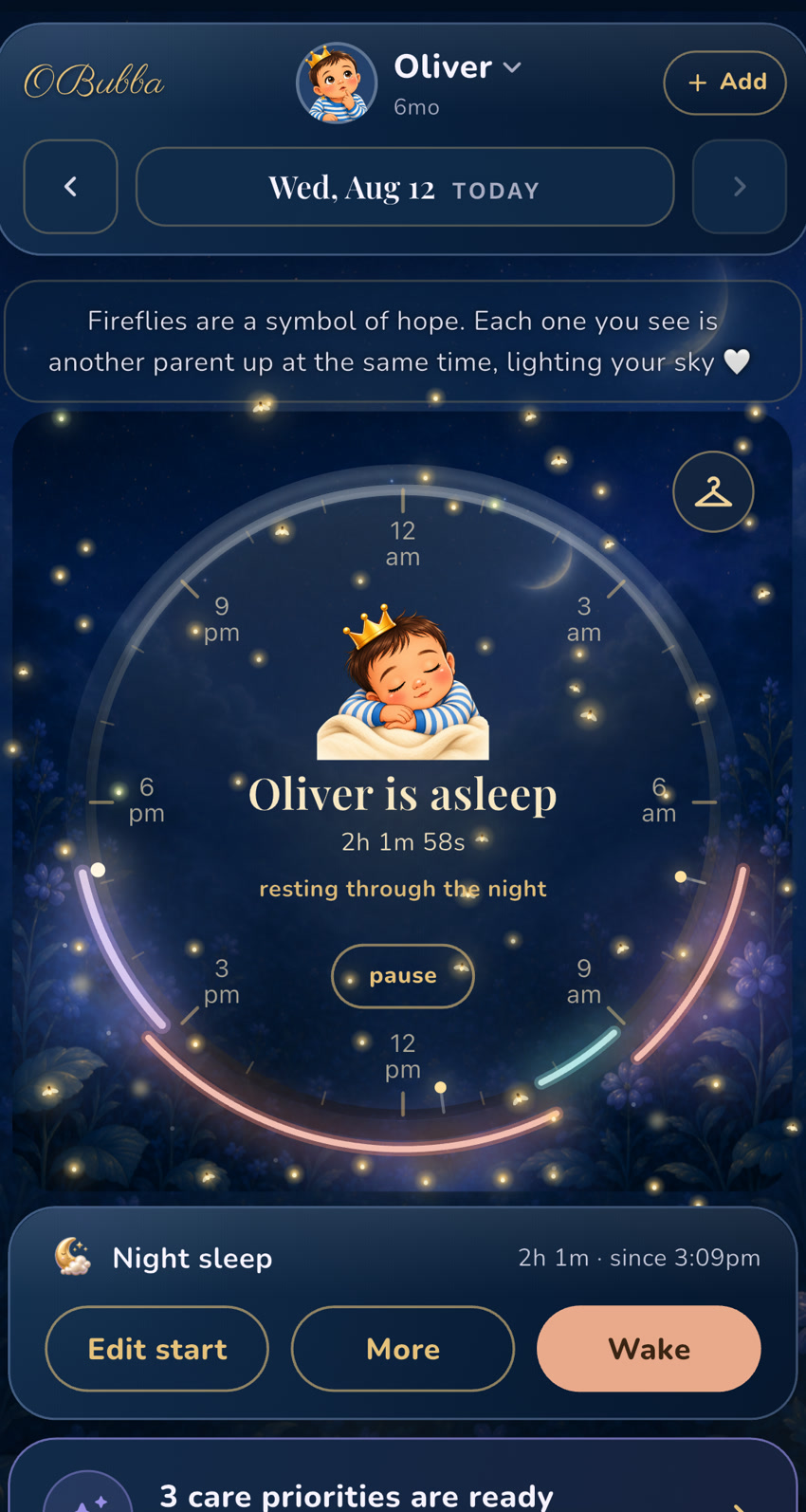
Choosing Night wake creates a night-wake entry marked as still being settled. The bedtime sleep remains open, but the live elapsed-sleep display freezes because baby is awake.
When baby returns to sleep, tap Resume. OBubba then:
- closes the awake interval
- records its duration when that duration is plausible and known
- lets you record how baby was resettled
- resumes the same bedtime timer
- deducts the awake interval from actual night sleep
If feeding was part of the resettle, the app can also create a linked night-feed entry so the milk is counted without inventing a second waking.
This matters because a bedtime-to-7am timer is not automatically eleven hours of sleep. A 35-minute wake at 5am belongs inside the physical night, but those 35 awake minutes should not be reported as sleep.
What Wake for the day changes
Choosing Wake for the day closes the open bedtime sleep and writes a daytime morning-wake entry.
That new wake is more than a line in the journal. It becomes the anchor for the day that follows:
- the awake-since display
- the first wake window
- the next-nap projection
- readiness and overdue language
- day-plan timing
- reminders and glanceable widget state
- the next evening's interpretation of the complete night
This is why an accidental 5am morning label can make the next nap look earlier than expected. The app is not punishing the family; it is faithfully calculating from the wake time it was given.
Conversely, keeping the bedtime arc open after everyone is clearly up can leave OBubba thinking baby is still asleep or being settled. Good guidance begins with an honest transition.
What should you choose when you genuinely do not know yet?
If you are still trying to resettle, choose Night wake.
That choice preserves uncertainty without pretending the night ended. Two outcomes remain possible:
- baby returns to sleep, so you tap Resume and keep one night
- baby stays awake, so you end the sleep and begin the day
This is a better model than ending the night immediately and then creating a new nap five minutes later because baby unexpectedly nodded off.
Do not wait indefinitely simply to protect a tidy graph. If baby is clearly alert, the room has shifted to daytime and you are no longer attempting sleep, choose Wake for the day even if the time looks unfashionably early.
Four mornings that look similar on a clock
1. The sleepy feed
- wakes at 4:52am
- feeds in low light
- back in the cot at 5:18am
- sleeps until 6:43am
Choose Night wake, then Resume. The feed and awake interval sit inside one continuing night. Our companion guide explains why a 5am feed can still be a night feed.
2. The genuine early start
- wakes at 5:11am
- remains bright-eyed after feeding
- you open the curtains and stop attempting sleep
- first nap happens later that morning
Choose Wake for the day. It may be earlier than hoped, but it is the truthful wake anchor for that day.
3. The uncertain resettle
- cries at 5:03am
- you choose Night wake and soothe quietly
- at 5:22am it is clear baby will not return to sleep
End the sleep. OBubba resolves the open wake rather than leaving a permanent “settling” state. The precise wake history may show a short overnight waking followed by the morning start, which matches what happened.
4. The noisy sleep-cycle transition
- squirms and grunts at 5:00am
- eyes stay closed or flutter briefly
- quiet again at 5:02am
- wakes fully at 6:20am
Do not tap anything merely because the monitor became noisy. NHS baby-state guidance describes light sleep as active and easy to interrupt. Observe safely before turning a sleeping baby into an app event.
How OBubba protects the record between two carers
At 5am, both parents may open the app.
The repository uses a shared child record and guards against two carers creating the same open pause. If both devices attempt to pause the same night wake, the app avoids treating that as two separate real wakings. Resume-side linked feeds use a deterministic ID so two simultaneous completions do not inflate the night-feed count.
Online writes use an atomic transaction and retry on contention. When the active child is already cached but the connection drops, the logging path can update the local view and queue the write for reconnection.
No sync system can infer which parent is physically with the baby. A useful household rule is still:
> The person handling the wake controls the live sleep state; the other parent checks before tapping.
That one convention reduces conflicting ends, duplicate feeds and the 5am conversation nobody wants to have twice.
Why OBubba does not impose a 6am cut-off
A fixed cut-off looks simple but produces bad records at both edges.
If every 5:59am waking were forced into “night”, a family genuinely up at 5:30 would get a false morning anchor. If every 6:01am waking ended the night, a baby who feeds and sleeps for another two hours would get a split, misleading night.
The app instead asks the parent to name the event. That is an extra tap, but it protects the meaning of the data.
The current code also distinguishes a paused night from a paused nap. A mid-nap stir is stored as a separate `napwake`, so it cannot become the morning wake. A real night wake uses the night-wake path and remains part of the overnight analysis. The labels look similar because the parent action is similar; the downstream interpretation is deliberately different.
What if you tapped the wrong option?
Do not abandon the whole day.
If you chose Night wake but baby stayed up, end the sleep as soon as you realise. If you chose Wake for the day and baby immediately returned to a substantial sleep, review the timeline and correct the sleep end or wake entry rather than accepting a false first wake window.
Use the times you actually know. Avoid “repairing” a graph into the schedule you hoped to have.
One imperfect morning will not permanently train the app in the wrong direction. OBubba recalculates from the current record, and broader pattern reads use multiple days rather than treating one 5am decision as a diagnosis.
A simple family rule for predawn wakes
Write this in plain language for every carer:
- One brief stir: watch before logging.
- Actively trying to resettle: Night wake.
- Back asleep: Resume.
- Clearly staying up: Wake for the day.
- Fed during the wake: log the feed in the same night context.
This rule works at 4:30am, 5:45am or 6:15am. It follows the baby's state rather than a clock superstition.
Try OBubba free → — track one physical night, pause real wakings, keep awake gaps out of sleep totals and let the true morning wake anchor the day ahead.
Keep the sleep response safe
The choice in a tracker never outranks the baby's wellbeing.
For the first six months, the NHS recommends that baby sleeps in the same room as a carer, in a clear, separate cot or Moses basket, on their back on a firm, flat mattress. Keep pillows, bumpers, nests, loose bedding and soft objects out of the sleep space. See the current NHS safer-sleep guidance.
Respond to hunger and distress. Seek urgent help for breathing difficulty, blue or grey colour, unusual floppiness, a baby who is very difficult to wake, a seizure or another life-threatening symptom. A pause button records an observation; it cannot assess a baby.
If repeated very early waking is exhausting the family, review the full pattern—bedtime, total naps, feeding, light, illness and development—and speak to a health visitor or GP when worried. The NHS notes that night waking is normal and sleep patterns vary widely.
Quick answers
Is anything before 6am automatically a night wake?
No. Choose Night wake when the overnight sleep is still being continued. Choose Wake for the day when the first sustained daytime awake period has begun.
What if baby is awake for 30 minutes and then sleeps again?
That can still be one night with a 30-minute awake interval. Pause at the real wake and Resume when sleep restarts so awake time is not counted as sleep.
Does Night wake stop the bedtime timer?
It freezes the elapsed-sleep display while baby is awake but keeps the bedtime arc open. Resume continues the same night; Wake for the day closes it.
Does Wake for the day affect the next nap?
Yes. The morning wake anchors the first wake window and feeds the next-nap and readiness calculations. Use the time the day genuinely began.
What if I forgot to Resume?
End the sleep when you notice and correct known times if needed. The implementation avoids blindly converting an implausibly long forgotten pause into hours of confirmed awake time.
Can both parents pause the same wake?
Both devices can see the shared child record, but the repository guards against duplicate open pauses and deterministic linked feeds. Agree that the parent handling the wake controls the live timer wherever possible.
Let the morning reveal itself
At 5am, you do not need to predict the next two hours.
If you are still in night mode, log a Night wake and keep the sleep open. If the day has truly begun, close the night. If baby only stirred, wait before creating an event at all.
The clock tells you when the sound happened. What happened next tells OBubba whether it belonged to the night or the new day.
Sources
- NHS Best Start in Life: Your baby's sleep patterns
- NHS Best Start in Life: Understanding your baby
- NHS: Helping your baby to sleep
- NHS Best Start in Life: Safer sleep advice for babies
OBubba is a tracking, pattern and education tool. It cannot determine whether a baby is asleep, diagnose early waking or replace medical advice. Follow your baby's individual feeding or clinical plan and seek qualified help when concerned.
Ready to try OBubba?
Use OBubba to track feeds, sleep, naps, nappies, growth, milestones and family handovers in one calm baby tracker app.