OBubba opens tonight’s guidance with a line such as “Expect roughly 1–2 wakes tonight.”
That can feel reassuring: perhaps you can set out the muslin, agree who responds first or simply stop wondering whether last night was the new normal. It can also feel ominous. Does the app know the baby will wake? Is one wake now a target? Does “1–2” mean a feed is unnecessary?
No baby sleep app can know exactly how many times your baby will wake tonight. In the current OBubba app, the range is a plain-language summary of the baby’s average logged wake count across enough recent completed nights. It is useful for preparation, not a promise, score or instruction to ignore a wake.
We traced the production Tonight’s Guidance provider, range function, age wording and tests for this guide. Here is what that sentence really means—and the safer way to use it at 2am.
The short answer
OBubba’s current calculation works like this:
- It first checks that at least three nights in the latest 14-night history contain entries.
- It reviews the seven completed nights before today.
- Only nights with a reconstructed bedtime are eligible for the wake average.
- At least three eligible nights are needed for the current average.
- The average is rounded to one decimal place, then translated into a simple range such as 0–1, 1–2 or 2–4.
- If at least three eligible nights exist in the previous seven-night window, the app can also say whether wakes have meaningfully fallen.
- The explanation changes with corrected age, but the count itself still comes from the logs.
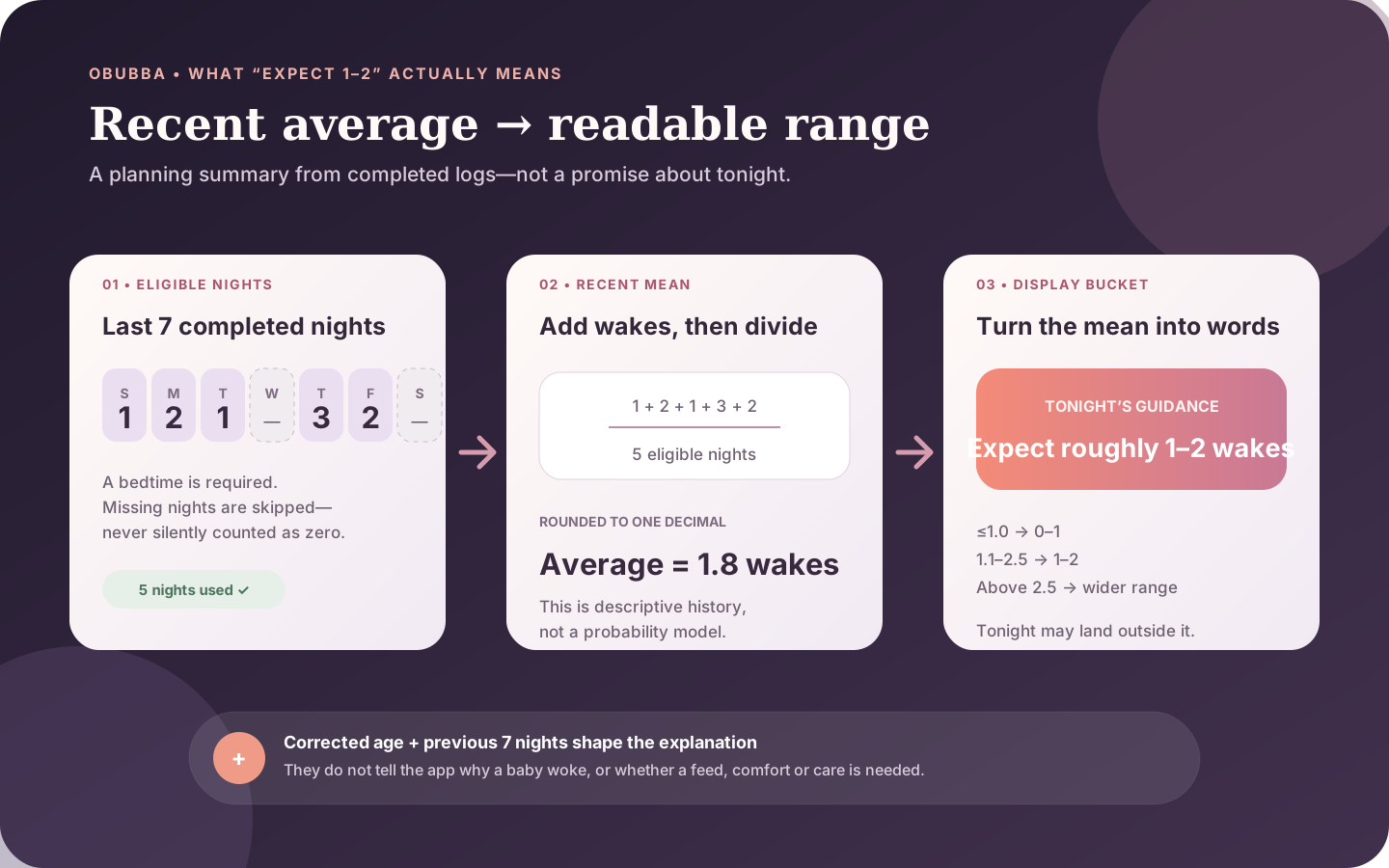
The range does not use a microphone, movement sensor, cry detector or hidden medical data. It cannot observe an unlogged wake, know why the baby woke or calculate the chance of each possible outcome.
How does “1–2 wakes” get calculated?
Imagine these are the eligible wake counts from five completed nights:
| Night | Logged wakes | |---|---:| | Sunday | 1 | | Monday | 2 | | Tuesday | 1 | | Wednesday | 3 | | Thursday | 2 |
The average is 1.8 wakes per night. OBubba rounds the average to one decimal place and passes it through its display rule:
- average of 1.0 or below → 0–1 wakes
- average above 1.0 and up to 2.5 → 1–2 wakes
- average above 2.5 → a wider range from roughly one below the average to the rounded-up average
So 1.8 becomes “Expect roughly 1–2 wakes tonight.” An average of 3.6 would display as roughly 2–4 wakes.
This is not a formal confidence interval. It is not saying there is a calculated 80% chance of one or two wakes. It is a friendly bucket derived from a recent mean.
That distinction matters because the word expect can sound more scientific than the calculation is. A more literal translation would be:
> “Across the completed recent nights available, the average sits in this range.”
Why does OBubba need three nights?
One night is a story, not a pattern.
A vaccination day, a new tooth, an unusually late nap, travel, noise, illness, a missed feed or no obvious reason at all can change a single night. Requiring at least three eligible nights reduces the chance that one unusual night becomes tonight’s headline.
Three is still a small sample. It is a minimum for a lightweight planning sentence, not enough to prove that a stable rhythm exists. Six or seven genuinely complete nights usually describe the week better than three—but only if those nights reflect what actually happened.
The app also has a broader gate: Tonight’s Guidance stays absent until at least three of the most recent 14 nights contain some history. That prevents a brand-new profile from receiving a fully personalised-sounding briefing after one evening of logging.
Which nights count—and which quietly disappear?
For the wake average, the current provider reconstructs each night and includes it only when it has a bedtime. It looks at the seven past completed nights, not tonight in progress.
That protects the calculation from treating an empty night as zero wakes. However, it creates another important bias: a missing or incomplete night is skipped, not represented.
Suppose a partner handled a difficult night but none of its wakes were logged. The average may be built from the calmer nights surrounding it. Conversely, a family may log intensely only when sleep is difficult, making the record look rougher than ordinary life.
Before trusting the range, ask:
- Were most bedtimes recorded?
- Did both carers log wakes in the same shared timeline?
- Are nursery, travel or illness nights missing?
- Was a wake timer left running or a brief stir logged twice?
- Does “wake” mean the same thing across the week?
OBubba can organise consistent records. It cannot repair a systematically incomplete sample by itself.
Why does corrected age change the explanation?
The same wake average does not mean the same thing for every baby. The engine uses corrected age for a premature baby where available, then changes the supporting sentence across broad bands.
Under about four months
The guidance frames repeated waking and night feeds as normal and healthy. The app explicitly says the aim is not to chase zero wakes or remove feeds a young baby needs.
Around four to six months
It acknowledges that many babies still wake once or twice to feed and focuses on protecting the early part of the night rather than declaring feeds a bad habit.
From about six months
When the average is low, the app celebrates the steadier pattern. When the average is higher, the present code can describe wakes as looking more like habit or a sleep association and therefore “workable”.
That older-baby conclusion is too confident for wake count and age alone. A six-, nine- or twelve-month-old may wake because of hunger, pain, illness, temperature, breathing, feeding changes, development, separation, an individual growth concern or many overlapping causes. A mean cannot decide that a wake is not a real need.
Read the age wording as general context, not a diagnosis. Respond to the baby in front of you and follow any individual feeding or medical plan.
What does the previous week change?
OBubba separately calculates the average for nights 8–14 ago when at least three of those nights are eligible.
If the current average is more than 0.5 wakes lower than that comparison average, improvement takes priority over the standard age explanation. The guidance may say the nights are consolidating and encourage the family to protect the steadiness.
For example:
| Window | Average logged wakes | |---|---:| | Previous eligible nights | 3.0 | | Recent eligible nights | 2.2 |
The fall is 0.8, so the improving-trend explanation qualifies. A move from 3.0 to 2.6 does not clear that threshold.
This is a comparison of recorded windows, not evidence that a routine change caused the improvement. Teething may have eased. A cold may have passed. One carer may have logged more consistently. Celebrate the easier nights without assigning a cause the data cannot support.
What if tonight has zero wakes—or five?
Nothing has failed.
A range summarises the centre of recent history; individual nights can land outside it. If the baby sleeps through after a 1–2 forecast, enjoy it. If the baby wakes four times, respond to what is happening and log the important events if that will help tomorrow. Do not keep trying to force the night back into the forecast.
The next calculation will absorb the new completed night. One outlier may move the average slightly; several similar nights may move the range. That is the app learning from a changing record, not correcting a parent or baby.
Can OBubba predict the first wake time too?
The same Tonight’s Guidance system can show a separate line such as “First wake usually around 11pm (4h after bedtime).” That appears only when:
- at least three recent completed nights have a usable first stretch longer than an hour; and
- tonight has a bedtime anchor, either already logged or currently predicted.
The app averages the duration from bedtime to the first wake, then adds that duration to tonight’s bedtime anchor.
This is more specific than the wake-count range, but it remains an average. It can help a parent decide whether to go to bed early or prepare a handover. It should not have everyone staring at the clock at 10.58pm.
If the baby wakes before or after that time, respond normally. A forecast is not a settling schedule and never requires delaying comfort until the predicted minute.
The genuine OBubba screen
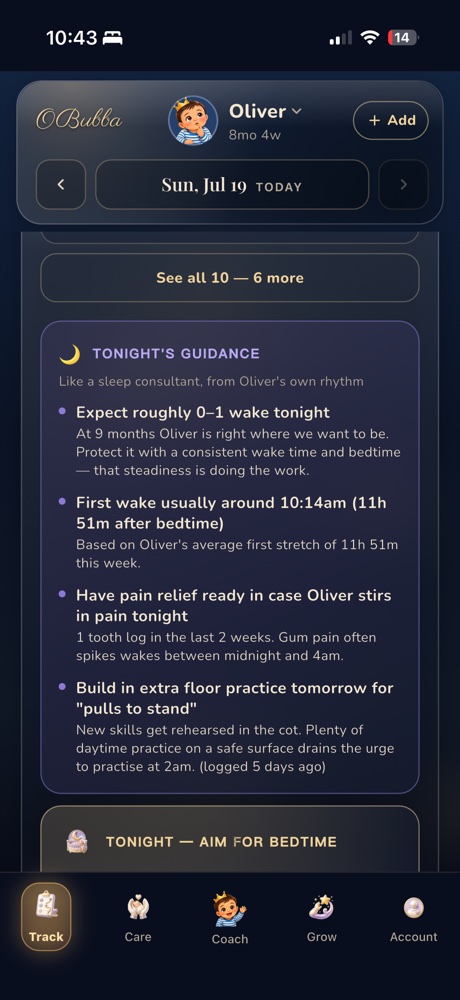
The current Track screen presents these thoughts as a swipeable story called “Tonight, in Luna’s voice.” Each card has a short headline and a Why Luna thinks this explanation. The briefing is capped at six lines even when more signals are available.
Possible lines include:
- an estimated bedtime based on today’s sleep
- the recent wake-count range
- an average first-wake time
- a personally learned wake window when enough samples exist
- a relevant pattern such as false starts or split nights
- recent disruption or recovery context
The ordering matters. Bedtime and the wake range usually appear before lower-priority context. If six lines are already filled, later signals may not appear at all. Silence about teething, a food or medicine does not mean the app assessed and excluded it.
What the range is genuinely useful for
Planning the adults’ night
If the recent pattern is one or two wakes, carers can agree who responds first, whether the off-duty adult uses earplugs safely in another room and when each person might get a protected block of rest.
Taking the emotion out of one rough night
A range can remind you that four wakes last night sit beside calmer nights too. The weekly centre is often less frightening than the most memorable night.
Making handovers clearer
“The recent range is one to two; there were four last night” gives a partner, grandparent or professional both baseline and change.
Noticing a real shift
If the range moves across several complete nights, look at the whole context: naps, feeds, illness, temperature, settling and development. The shift is a question to investigate, not proof of one cause.
What it must never be used for
A wake limit
Do not decide that the second wake is legitimate but the third should be ignored. Babies need responsive care, and the NHS says babies have individual sleep patterns and waking at night is normal.
A night-weaning decision
The range does not measure milk transfer, daytime calories, hydration, growth or a clinician’s plan. NHS responsive-feeding guidance says babies are likely to need night feeds for at least the first few months, with feeds reducing as babies get older. Use a separate readiness conversation for night weaning rather than a wake forecast.
Evidence that a baby should “sleep through”
A 0–1 range is not a developmental badge. A higher range is not a parenting failure. The NHS notes that some babies sleep for longer stretches as they grow and some do not.
A safety monitor
OBubba is not a baby monitor, breathing monitor or medical device. It cannot hear a cry, detect an unsafe sleep space or tell whether a baby is unwell.
A safer way to respond to any predicted night
Prepare for the range; respond to the reality.
- Keep the sleep space safe. Place baby on their back in a clear, flat, separate cot or Moses basket with a firm mattress. The NHS recommends room-sharing for at least the first six months.
- Keep night care calm. Low light, a quiet voice and minimal stimulation can help preserve the difference between day and night.
- Check the baby, not the number. Hunger cues, temperature, pain, illness and distress matter more than the forecast.
- Feed responsively. Never delay or withhold a needed feed because the app expected fewer wakes.
- Log only what helps. A bedtime, wakes, feeds and morning rise often answer more than a perfect minute-by-minute diary.
- Ask for help when the change is concerning. Speak with your health visitor or GP about persistent sleep difficulty, feeding concerns, breathing, pain or a baby who seems unwell. Seek urgent help for emergency symptoms.
How OBubba could make this line more trustworthy
The current engine gets several important things right: it waits for several nights, skips empty nights instead of counting them as zero, uses corrected age and gives the parent an explanation rather than a naked number.
The next improvements should make uncertainty even more visible:
- label it “recent logged range” rather than sounding like a true forecast
- show “based on 5 eligible nights” directly on the card
- expose which calendar nights were included or skipped
- avoid inferring habit or sleep association from age and wake frequency alone
- separate the recorded average from the broader age guidance visually
- state that a predicted range never overrides hunger, distress or an individual care plan
Trustworthy personalisation is not the app sounding certain. It is the app showing enough of its working that a tired parent can judge how much weight to give the result.
The one-sentence translation
When OBubba says “Expect roughly 1–2 wakes tonight,” read it as:
> “The eligible nights you logged recently averaged in this broad range, so it may be useful to prepare for something similar—but tonight can be different, and your baby’s needs come first.”
That is still useful. It turns a week of scattered timestamps into a shared expectation without pretending the future is known.
Try OBubba free → — keep sleep, feeds, nappies, weaning and real-life disruptions in one shared timeline, then get a small explained plan for tonight rather than another unexplained score.
Sources
- NHS: Helping your baby to sleep
- NHS: Feeding on demand and night feeds
- NHS: Safer sleep for babies
- NHS: Baby myths and facts
Quick questions
Why is there no wake forecast yet?
Tonight’s Guidance needs history across at least three of the latest 14 nights, and the current seven-night average needs at least three nights with a reconstructed bedtime. Keep logging honestly; do not invent missing wakes to unlock the card.
Why did my range change after one night?
The calculation uses a rolling seven-night window. A new completed night enters while the oldest leaves, so a large difference can move the average and its display bucket.
Does 0–1 wakes mean my baby should not feed at night?
No. It only summarises recent logged wake counts. Respond to hunger and follow your baby’s feeding and clinical guidance.
Is the first-wake time exact?
No. It is tonight’s bedtime anchor plus the average first stretch from at least three eligible recent nights. Use it for rough adult planning, not as a deadline.
What counts as a night wake?
In practice, consistency matters most: record the wakes where the baby fully wakes or needs care in the same way across nights. A brief stir that resolves without intervention need not become a logged event unless that is the specific pattern you are studying.
Ready to try OBubba?
Use OBubba to track feeds, sleep, naps, nappies, growth, milestones and family handovers in one calm baby tracker app.