The baby finally falls asleep. The room is quiet. You have been desperate for this moment, and now your body will not follow.
You listen for every breath. You replay the last feed. You calculate how long remains before the next wake. Your heart feels alert even though your eyes burn.
Not being able to sleep when your baby sleeps is not a failure to “relax properly”. Sometimes it is a short-lived response to broken nights, physical recovery and a nervous system that has learned to stay on duty. Sometimes persistent insomnia is part of postnatal anxiety, depression, trauma or another health problem that deserves treatment.
The important distinction is not whether you followed the perfect bedtime routine. It is whether you are getting any restorative sleep, how you feel between sleep opportunities, and whether other symptoms are appearing.
The short answer
If you are exhausted but cannot switch off:
- arrange a real off-duty period rather than being “on call while resting”
- stop watching the clock or trying to force sleep
- write down the checks or worries your brain is rehearsing
- reduce late caffeine and bright scrolling where realistically possible
- use rest as the immediate goal; sleep is allowed to arrive rather than becoming a test
- tell your GP, midwife or health visitor if this keeps happening, affects coping, or comes with persistent anxiety, low mood, irritability or loss of enjoyment
- seek urgent same-day assessment for sudden inability or lack of need to sleep alongside racing thoughts, extreme energy, confusion, unusual beliefs, hallucinations or markedly out-of-character behaviour
- call 999 if you think you or your baby may be in immediate danger
“Sleep when the baby sleeps” is not a treatment plan. You deserve practical help and clinical support when sleep is unavailable even after somebody creates the opportunity.
Sleep deprivation or insomnia?
These overlap, but they are not identical.
Sleep deprivation means there has not been enough opportunity to sleep. A newborn wakes frequently; feeding, expressing, pain, another child, household work or being the only available carer can repeatedly interrupt rest.
Insomnia means you regularly struggle to fall asleep, stay asleep or return to sleep despite having an opportunity. You may feel exhausted during the day but become tense or fully alert when you lie down.
| What happened | More like interrupted opportunity | More like insomnia or hyperarousal | |---|---|---| | Baby wakes after 40 minutes | Sleep was externally interrupted | Either can still be present | | Another adult takes over, but you remain awake for two hours | Opportunity exists | Insomnia, anxiety or hyperarousal may be involved | | You fall asleep quickly whenever somebody reliably covers care | Opportunity is the main barrier | Severe sleep debt is likely | | You repeatedly check the baby despite a safe setup and reassurance | Vigilance is preventing rest | Anxiety may need support | | You feel unusually energised and do not feel a need for sleep | Not ordinary tiredness | Urgent assessment is needed, especially with other changes |
This table cannot diagnose anything. Pain, feeding needs, medication, thyroid problems, sleep apnoea, restless legs and other physical or mental-health factors can affect sleep. A clinician can look at the whole picture.
The NHS guide to tiredness after having a baby specifically says that being unable to sleep even when the baby is asleep can be a sign of postnatal depression. One symptom does not prove depression, but it is worth taking seriously.
Why can your brain stay awake after the baby sleeps?
You are still on duty
“My partner has the baby” is not always the same as believing you are fully off duty. If you expect to be summoned for every noise, decide whether the baby needs feeding, or supervise the person helping, your brain may keep monitoring.
A useful handover is specific:
> “For the next 90 minutes, you handle every wake, nappy and resettle. Wake me only if the baby needs a feed I must provide, or for a genuine safety concern.”
The other adult needs the information and confidence to act without repeatedly checking. OBubba's baby-care handover guide can help turn “please help” into a clear shift.
Your body has learned to scan
After weeks of waking to tiny sounds, the body can react to the first grunt before conscious thought begins. Normal newborn active sleep is noisy. A safe cot can still feel impossible to stop checking.
Use the baby's safe sleep setup as the completed check: on their back, in a clear separate sleep space, with the appropriate room conditions and no loose items. The current NHS safer-sleep guide explains the full setup. If you find yourself rechecking despite knowing it is unchanged, tell a health professional, especially if the checking is frequent, distressing or expanding into other rituals.
You are afraid of wasting the window
The thought “I have only 47 minutes left” creates a performance test. Clock-watching turns the remaining opportunity into a countdown, and the frustration of not sleeping increases alertness.
The NHS advises not to force sleep. If you are safely off duty and lying awake is making you more tense, sit somewhere dim and comfortable for a few minutes, listen to something quiet or read, then return when sleepiness grows. In the early postnatal period, keep this gentle and practical. You do not need a perfect adult sleep schedule while responding to a newborn.
Your mind finally has room to process
During the day, feeds, nappies, visitors and decisions occupy every minute. Quiet can release the thoughts that were postponed:
- Was the birth supposed to feel like that?
- Is the baby feeding enough?
- What if I miss something dangerous?
- How will I cope tomorrow?
- Why do I not feel how I expected?
Write the thoughts down without solving them at 2am. Mark each as tomorrow, ask someone, or urgent now. A real urgent symptom gets action; everything else is allowed to wait outside your head.
Pain and physical recovery are interrupting you
Perineal pain, a caesarean wound, breast discomfort, headaches, reflux, sweating, itching or needing to pass urine can make rest difficult. Do not assume every postnatal sleep problem is psychological.
Tell your midwife, health visitor, GP or pharmacist what is waking you and what medicines or supplements you are using. Seek urgent medical advice for symptoms such as severe or worsening pain, heavy bleeding, chest pain, breathlessness, severe headache, fever, leg swelling or other postnatal warning signs. Follow your discharge instructions and local maternity advice.
Anxiety, depression or birth trauma may be present
The current NHS postnatal-depression guidance includes difficulty sleeping even when there is time to rest, alongside symptoms such as persistent low mood, loss of enjoyment, hopelessness, guilt, anxiety, irritability, poor concentration and difficulty bonding.
Postnatal anxiety may feel like constant threat-scanning, panic, a racing heart, catastrophic “what if” thoughts, repeated checking or an inability to trust anyone else with the baby. Trauma can make sleep feel unsafe because letting go resembles losing control.
You do not need to decide which label fits before asking for help.
A plan for tonight
This is not a cure for a mental-health condition. It is a way to reduce avoidable alertness and gather useful information.
1. Protect one defined rest block
Choose a realistic window, even 60 to 90 minutes, and assign another capable adult as the active carer. If breastfeeding, they can handle the nappy, settling and bringing the baby to you only when a feed is needed. If bottles are already part of your safe feeding plan, agree who prepares and gives them.
Do not abruptly stretch or replace medically important feeds, particularly for a newborn, a premature baby, weight-gain concerns or when protecting milk supply. Ask your midwife, health visitor or feeding specialist how to create rest without undermining the baby's plan.
2. Complete one safety check
Check the baby's sleep space once. Hand over responsibility. Turn down a monitor that amplifies every harmless sound if another adult is actively watching and it is safe to do so.
The goal is not to ignore the baby. It is to stop two adults performing the same watch while nobody rests.
3. Remove the countdown
Turn the clock away. Put the phone face down and out of reach if possible. If you need it for emergency contact or feeding, use a dim night setting and avoid repeatedly checking the time.
Replace “I must sleep now” with:
> “I am off duty. Rest still counts. My body can take sleep when it comes.”
4. Empty the mental queue
Write no more than three lines:
- what I am worried about
- who can help tomorrow
- the one thing that truly cannot wait
If the same fear returns, remind yourself that it has already been scheduled. Persistent or intrusive fears still deserve professional support; a notebook is not the treatment.
5. Use a longer exhale
Try breathing in gently for four, holding only if comfortable, and breathing out for six. Repeat for a few minutes without trying to produce a particular feeling.
Slow breathing may reduce immediate physical arousal. It cannot treat depression, OCD, trauma, mania or psychosis, and it should never be used to delay calling for help.
6. If sleep does not come, stop wrestling
If you become increasingly frustrated, change position or sit somewhere safe and dim. Listen to familiar audio, read something undemanding or simply rest. Return to bed when you feel sleepier.
Avoid taking an over-the-counter sleep product, herbal remedy or somebody else's medication without checking with a doctor or pharmacist, particularly while breastfeeding, recovering from birth, taking other medicines or needing to respond safely to a baby.
What to change tomorrow, not at 2am
Bring the night into daylight
Tell somebody plainly: “I had a chance to sleep and could not.” That is more clinically useful than “I am tired.” Add:
- how long this has happened
- roughly how much you have slept in 24 hours
- whether you feel exhausted or strangely energised
- whether worry, panic, low mood, pain or racing thoughts are present
- whether you feel safe caring for yourself and the baby
Reconsider caffeine timing
Caffeine can be the tool that keeps a depleted parent functioning, so shame is unhelpful. Notice the amount and timing rather than banning it impulsively. Move the last caffeinated drink earlier if possible and ask a professional about breastfeeding guidance if you are unsure.
Get daylight and gentle movement
Morning light and a short walk can support circadian rhythm and mood when recovery allows. This is not a demand to “exercise away” distress. Ten minutes by a bright window or outside with support is enough to begin.
Make the support shift repeatable
One rescue nap helps, but a predictable daily or alternate-night block gives the nervous system evidence that rest will return. Write down:
- who is on duty
- when the shift begins and ends
- how feeding will work
- what genuinely requires waking you
- where the off-duty parent will sleep
If there is no partner, tell your health visitor or GP that lack of practical support is part of the problem. Friends, family, Home-Start and local services may be able to help; needing a protected rest window is not indulgent.
When to contact a health professional
Speak to a GP, midwife or health visitor promptly if:
- you repeatedly cannot sleep despite having an opportunity
- poor sleep is making it hard to function or care safely
- anxiety, panic, low mood, numbness, guilt or irritability is persistent
- you cannot enjoy things or feel connected to everyday life
- checking or intrusive thoughts are taking over
- you dread night approaching
- symptoms last beyond the first two weeks, are worsening, or worry you at any point
You can choose whichever professional feels easiest. The NHS explains that they can refer to a specialist community perinatal mental-health team where appropriate. In England, eligible adults can also self-refer to NHS Talking Therapies for anxiety and depression. Find current NHS perinatal mental-health support.
Partners can also experience depression, anxiety and severe sleep disruption after a baby arrives. They should contact their GP or NHS mental-health services rather than assuming support is only for the person who gave birth.
The urgent distinction: tired but unable to sleep versus not needing sleep
Most exhausted parents who struggle to sleep do not have postpartum psychosis. But sudden sleeplessness can be an early warning sign when it appears with major changes in mood, energy, thought or behaviour.
The NHS describes postpartum psychosis as a medical emergency, usually beginning suddenly in the first two weeks after birth, although it can occur later. Seek an urgent assessment the same day if a recently postpartum person:
- cannot sleep and seems not to need sleep
- becomes unusually energetic, elated, agitated or overactive
- has racing thoughts or speaks much faster than usual
- seems confused or markedly unlike themselves
- becomes suspicious or holds unusual beliefs
- hears, sees, smells or feels things others do not
- shifts rapidly between extreme moods
The person may not recognise that they are unwell. A partner, friend or relative should act. Contact the GP urgently, call NHS 111 if you cannot reach appropriate care, or follow an existing perinatal crisis plan. Go to A&E or call 999 if there is imminent danger.
Call 999 if you think there is a risk you might harm yourself or your baby. Do not stay alone while waiting for help.
How OBubba supports the parent, not only the baby's sleep
Most baby trackers ask how long the baby slept and stop there. OBubba's real app also includes a Parent Room because a technically perfect baby log is not enough when the adult holding the night together is struggling.
Inside Parent Room, a parent can:
- name how today feels, from “Great” to “I need help”
- use a guided 4-in, 4-hold, 6-out breathing cycle
- open short grounding, quiet-minute and unclenching exercises
- read clear baby-blues and postnatal-depression guidance
- find region-aware professional and crisis contacts
- take a private two-minute wellbeing check-in based on the recognised Edinburgh Postnatal Depression Scale (EPDS)
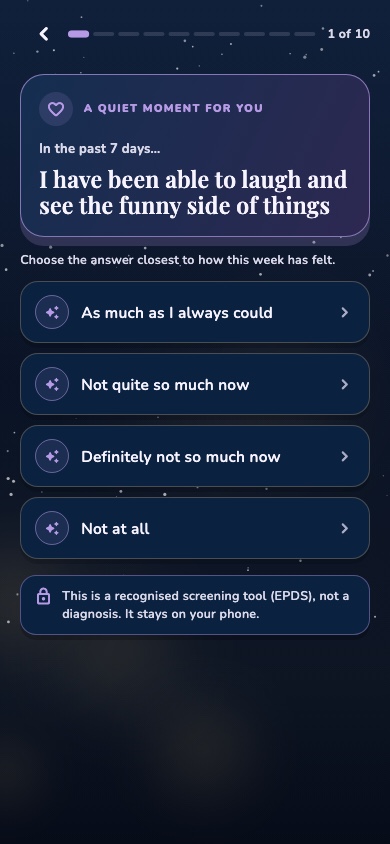
The check-in asks all ten questions one at a time and will not calculate an artificially reassuring result from unanswered items. Any positive response to the self-harm question triggers urgent support regardless of the total score. Results stay on the phone.
That safeguard matters. A screening questionnaire can organise a conversation, but it cannot diagnose depression, exclude anxiety or psychosis, assess immediate safety, or decide that somebody is well enough to continue alone.
OBubba's sleep timeline can show how fragmented the nights have been; Parent Room asks whether the parent is coping with them. Together, those views create a better handover to a partner, health visitor or GP:
> “The baby woke three times, but I stayed awake after each wake and could not sleep during my protected two-hour block. I have felt panicky most evenings this week.”
That is more useful than another generic instruction to sleep when the baby sleeps.
Parent Room and its wellbeing check-in are available without Premium. They are support and reflection tools, not a crisis service or a replacement for human assessment.
Put the parent's wellbeing beside the baby log →
Frequently asked questions
Why am I wide awake as soon as the baby falls asleep?
Your body may still be monitoring, anticipating the next wake or processing worry that had no space during the day. Caffeine, pain, physical illness, medication, anxiety, depression and trauma can also contribute. Persistent symptoms deserve assessment.
Is postpartum insomnia normal?
Broken sleep is common with a newborn. Repeated inability to sleep despite a real opportunity is not something you simply have to endure. It can be short-lived, but it may also accompany a treatable physical or mental-health problem.
Should I avoid all daytime naps?
Generic insomnia advice often discourages naps, but newborn care may make daytime the only safe sleep opportunity. Do not sacrifice urgently needed recovery to follow a rigid rule. Ask a GP or health professional for advice adapted to postpartum life if insomnia persists.
Can I take a sleep aid while breastfeeding?
Ask a GP or pharmacist who knows the exact product, dose, other medicines, your health and the baby's age. “Natural” does not automatically mean safe, and sedation may affect your ability to respond to a baby even when milk transfer is not the main concern.
What if I feel too alert to sleep but not tired?
Sudden lack of need for sleep, especially with high energy, racing thoughts, confusion, unusual beliefs, hallucinations or out-of-character behaviour, needs urgent same-day assessment after birth.
Will tracking more help?
Only if it answers a useful question. Record broad sleep opportunities and significant symptoms, not every minute awake. If tracking makes you watch the clock or increases anxiety, stop. Human assessment matters more than a complete chart.
The bottom line
If the baby is asleep but you cannot switch off, the answer is not to try harder. Create a genuine off-duty block, remove the countdown, lower stimulation and let rest be enough for the moment.
Then look at the pattern. Persistent inability to sleep, especially with anxiety, low mood, intrusive thoughts, pain or difficulty coping, deserves a conversation with a GP, midwife or health visitor. Sudden sleeplessness with extreme energy, racing thoughts, confusion, unusual beliefs or hallucinations is urgent.
Your sleep is not the leftover part of baby care. It is part of keeping the whole family safe.
Sources
- NHS: Sleep and tiredness after having a baby
- NHS: Postnatal depression
- NHS: Find mental-health care before, during and after pregnancy
- NHS: Postpartum psychosis
- NHS: Safer sleep advice for babies
- NHS Every Mind Matters: Fall asleep faster and sleep better
OBubba provides records, general education and a private screening tool. It cannot diagnose insomnia, anxiety, depression, trauma or postpartum psychosis, assess immediate safety, prescribe treatment or replace a GP, midwife, health visitor, perinatal mental-health team or emergency service.
Ready to try OBubba?
Use OBubba to track feeds, sleep, naps, nappies, growth, milestones and family handovers in one calm baby tracker app.