You are tired enough to sleep, but your brain has opened seventeen tabs: the scan, the birth, the cot, the list you have not finished, a sensation you noticed ten minutes ago and the question you promised yourself you would not search at 1am.
A breathing guide can create a small pause inside that noise. It cannot tell you that you or your baby are medically well.
That distinction is the whole point of OBubba’s pregnancy breathing tool. Open the pregnancy experience, choose Wellbeing, then scroll to Take a breath. The current app guides a repeating 16-second loop: breathe in for four seconds, hold for four, breathe out for four, then hold for four.
Use one loop to make enough room for the next honest decision: settle back down, write the worry down, tell someone, or call your maternity team.
> A calmer feeling is useful. It is not a safety result.
The 30-second answer
If this is an ordinary thought spiral and you otherwise feel well:
- Sit or lie somewhere comfortable and safe.
- Tap Start breathing.
- Follow one cycle only if the pace feels comfortable.
- Stop if holding your breath feels unpleasant, you become lightheaded or you simply prefer normal slow breathing.
- Ask: Has the worry softened, or does it still need action?
If there is a pregnancy warning sign, a change in your baby’s usual movements, or a feeling that something is wrong, skip the exercise and contact the appropriate maternity service. Do not use breathing to wait for a symptom to disappear.
Why worry becomes louder at night
Night removes many of the things that keep thoughts in proportion. There is less conversation, less movement and less evidence that ordinary life is continuing. Physical pregnancy changes can also make sleep harder: needing the toilet, reflux, pelvic discomfort, baby movements, temperature changes and finding a comfortable position.
Then the mind adds a second problem: I must get back to sleep now.
The NHS pregnancy sleep guide notes that unusual dreams and worries about labour or the baby can happen, and that relaxation or breathing techniques may help with anxiety. It also says to speak to a midwife or doctor when sleep problems are troubling you, particularly when low mood or loss of interest is present.
Breathing is therefore best treated as a transition, not a cure. It can move you from automatic scrolling and catastrophic thinking into a moment where you can choose what you need.
What the OBubba loop actually does
We traced the live widget rather than describing a generic meditation feature.
The exercise has four equal phases:
| Phase | On-screen cue | Time | Circle movement | |---|---|---:|---| | 1 | Breathe in… | 4 seconds | Expands | | 2 | Hold… | 4 seconds | Stays open | | 3 | Breathe out… | 4 seconds | Contracts | | 4 | Hold… | 4 seconds | Stays small |
The full cycle lasts 16 seconds and repeats until you press Stop. Stopping resets the animation to its resting state. There is no audio, streak, score, completion target or claim that one cycle has solved the worry.
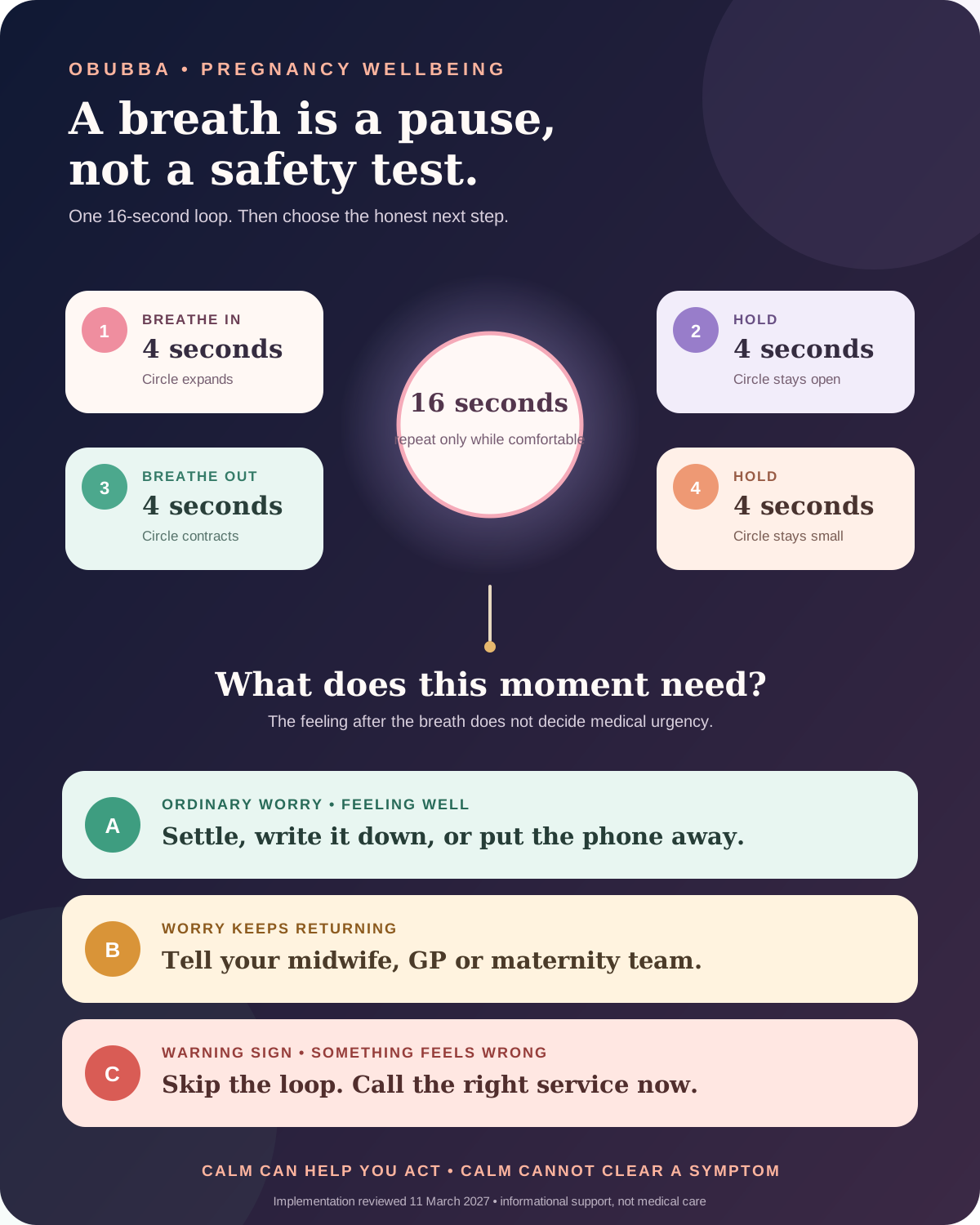
The expanding circle gives your eyes one simple object to follow. That matters on a tired night: the parent does not have to count, remember the next phase or unlock a separate meditation subscription.
But the exact 4–4–4–4 pattern is OBubba’s interface choice. NHS guidance supports breathing and relaxation techniques in pregnancy and labour generally; it does not prescribe this exact box-breathing rhythm for every pregnant person. If breath holds feel uncomfortable, stop and breathe normally. If your midwife or antenatal teacher has given you a different technique, follow that advice.
A genuine view from the current app
The visual below is a direct widget capture from the current pregnancy Wellbeing code, taken while the two-second point of the Breathe in… phase was active.
The surrounding Wellbeing tab begins with five feelings: Good, Calm, Tired, Anxious and Low. Choosing one reveals a short supportive response for that moment. The selection is not a diagnosis, an anxiety score or a replacement for speaking to someone. It simply acknowledges that the pregnant person belongs in the care picture too.
That is a product principle worth protecting. A pregnancy app should not only count weeks and compare a baby to fruit. It should help the person carrying the pregnancy pause, prepare and know when an app is no longer the right tool.
Three ways to use the pause honestly
1. The planning spiral
You remember the hospital bag, an email, a name you have not agreed on and a pram part you still need.
Try one loop, then put the thought somewhere external. Write one line in a note: “Tomorrow: check the car-seat instructions.” The aim is not to finish the task at night. It is to show your brain that the task has a home.
If another job appears, do the same once. Do not turn the breathing tool into a gateway to a two-hour planning session.
2. The recurring anxiety spiral
You feel well, there is no new physical concern, but worry repeatedly stops you sleeping or functioning during the day.
One loop may lower the immediate intensity. The next step is still to tell someone. The NHS anxiety-in-pregnancy guide describes persistent, hard-to-control worry that affects daily life as something support and treatment are available for. It includes breathing exercises among self-help options, alongside talking to a midwife or doctor and using perinatal mental-health support when needed.
Breathing and professional help are not competing choices. The exercise can help you make the call; it should not become a reason to postpone it.
3. Early labour, after checking the plan
The app describes the loop as an option for anxious moments or early labour. NHS labour guidance also presents breathing and relaxation as possible ways to stay calm and manage early labour sensations. These techniques do not work for everyone and do not replace pain relief or maternity advice.
If you think labour may be starting, use the contact plan your maternity team gave you. The NHS signs-of-labour guide says to call for guidance when you think you are in labour and urgently for circumstances including waters breaking, vaginal bleeding, reduced movements or possible labour before 37 weeks.
Use the breathing guide while waiting for an appropriate response only if you are comfortable and have not been told to act immediately. It is not a contraction timer; OBubba has a separate pregnancy tool for that.
When the app should get out of the way
Do not complete a breathing round before asking for help when there is a reason to call now.
Examples include:
- your baby is moving less, has stopped moving or has changed their usual movement pattern
- vaginal bleeding or your waters breaking
- possible labour before 37 weeks
- a severe headache, vision changes, pain below the ribs, sudden swelling or feeling very unwell
- chest pain, severe breathing difficulty, fainting or another emergency symptom
- any concern your maternity team has already told you to contact them about
The NHS baby-movements guidance says to contact your midwife or maternity unit immediately when movements reduce, stop or change—without waiting until the next day. The NHS pre-eclampsia guide explains that severe headache, visual disturbance, pain below the ribs, sudden swelling and feeling very unwell need immediate checking.
An animation cannot listen to a heartbeat, measure blood pressure, check oxygen, assess labour or observe fetal wellbeing. Feeling calmer after sixteen seconds does not alter that boundary.
What if holding the breath makes me more anxious?
Stop. Let your breath return to normal and look around the room.
Some people dislike breath holds, especially when already breathless, nauseated or panicky. You can use a gentler version without the app: breathe in comfortably, then let the out-breath be easy and unforced. Do not chase a deep breath or repeatedly over-breathe, because that can make lightheadedness and tingling worse.
If breathlessness is new, severe, accompanied by pain or otherwise concerning, seek medical advice rather than assuming it is anxiety.
Can this help me sleep?
Possibly, as part of winding down. Not predictably, and not because the app makes sleep happen.
Use one or two comfortable rounds with the screen dim, then put the phone down. If you keep checking whether you are sleepy yet, the exercise becomes another performance test. A better success measure is: I paused instead of feeding the spiral.
For persistent sleep difficulty, discuss it with your midwife, GP or maternity team. Sleep disruption can be physical, emotional or both, and the useful response depends on the cause.
Why this belongs inside the same family app
Parents should not have to assemble one app for pregnancy dates, another for breathing, another for labour tools, another for newborn feeds and another for baby sleep.
OBubba keeps the breathing pause beside pregnancy preparation, mood support, baby-movement information, contraction timing and the journey into newborn tracking. After birth, the same calm design language continues into feeds, sleep, nappies, weaning, milestones, Parent Room support and shared care.
The value is not “more features”. It is fewer moments where an exhausted family has to decide which app holds the next part of their story.
Try OBubba free → — pregnancy wellbeing, practical preparation and the transition into one calmer baby-care home.
Quick answers
How long is one OBubba breathing cycle?
Sixteen seconds: four seconds in, four holding, four out and four holding. It repeats until you tap Stop.
Do I have to hold my breath during pregnancy?
No. This is an optional relaxation prompt, not a medical requirement. Stop or use ordinary comfortable breathing if the holds do not suit you.
Does feeling calmer mean my symptom is harmless?
No. Emotional intensity and medical urgency are different. Contact your maternity team for warning signs or whenever you are unsure.
Can I use it during labour?
You may find breathing useful, but follow your maternity team’s advice and your own comfort. The tool does not assess contractions, labour progress or the baby.
What should I do if anxiety keeps returning?
Tell your midwife, GP or maternity team. Help is available, and you do not need to wait until anxiety becomes unbearable.
Sources and implementation notes
- NHS: Anxiety in pregnancy
- NHS: Tiredness and sleep problems in pregnancy
- NHS: Pain relief during labour
- NHS: Signs that labour has begun
- NHS: Your baby’s movements
- NHS: Pre-eclampsia
- Current OBubba implementation reviewed: `pregnancy_wellbeing.dart`, `pregnancy_home.dart` and `pregnancy_ui_compile_test.dart`
OBubba provides general information, organisation and wellbeing prompts. It does not monitor a pregnancy, diagnose anxiety, confirm that a symptom is safe, assess labour or replace a midwife, maternity unit, GP, NHS 111 or emergency care.
Ready to try OBubba?
Use OBubba to track feeds, sleep, naps, nappies, growth, milestones and family handovers in one calm baby tracker app.