You start solids on Monday. By Friday, your baby wakes once instead of three times. Or the opposite happens: nights become busier just as their tiny spoon, highchair and new foods arrive.
It is natural to join those dots. But two changes happening together do not prove that one caused the other.
OBubba’s Weaning Progress screen compares average night wakes before and after the first solid food was logged. It can show whether the recorded pattern moved down, stayed steady or rose—but it cannot tell you that purée, porridge or any other food caused the change.
That distinction makes the comparison more useful, not less. It gives you a precise question to investigate without turning a family timeline into a feeding claim.
The short answer: solids are not a sleep-through switch
The current NHS first-solid-food guidance is clear: waking more at night is not necessarily a sign that a baby is ready for solids, and starting solids does not make a baby more likely to sleep through.
Begin complementary feeding when the three readiness signs appear together from around six months—not because the night was difficult. A baby should be able to stay sitting with a steady head, coordinate eyes, hands and mouth, and swallow food rather than pushing it back out.
There is research worth understanding. A 2018 secondary analysis of the EAT randomised trial found small average sleep differences between groups offered solids earlier and those following standard introduction advice. At the point of greatest difference, the early-introduction group slept about 16.6 minutes longer and woke 0.27 fewer times per night. That is an interesting group-level result, not a reason to start before your baby is ready and not a promise for one family. The NHS recommendation remains to begin at around six months when developmentally ready.
So if OBubba shows fewer wakes after weaning began, read it as “the logged nights changed around this time”, not “solids fixed sleep.”
What the app actually calculates
This is not a generic marketing chart. The current code builds the comparison from the same family record used by the sleep and weaning features.
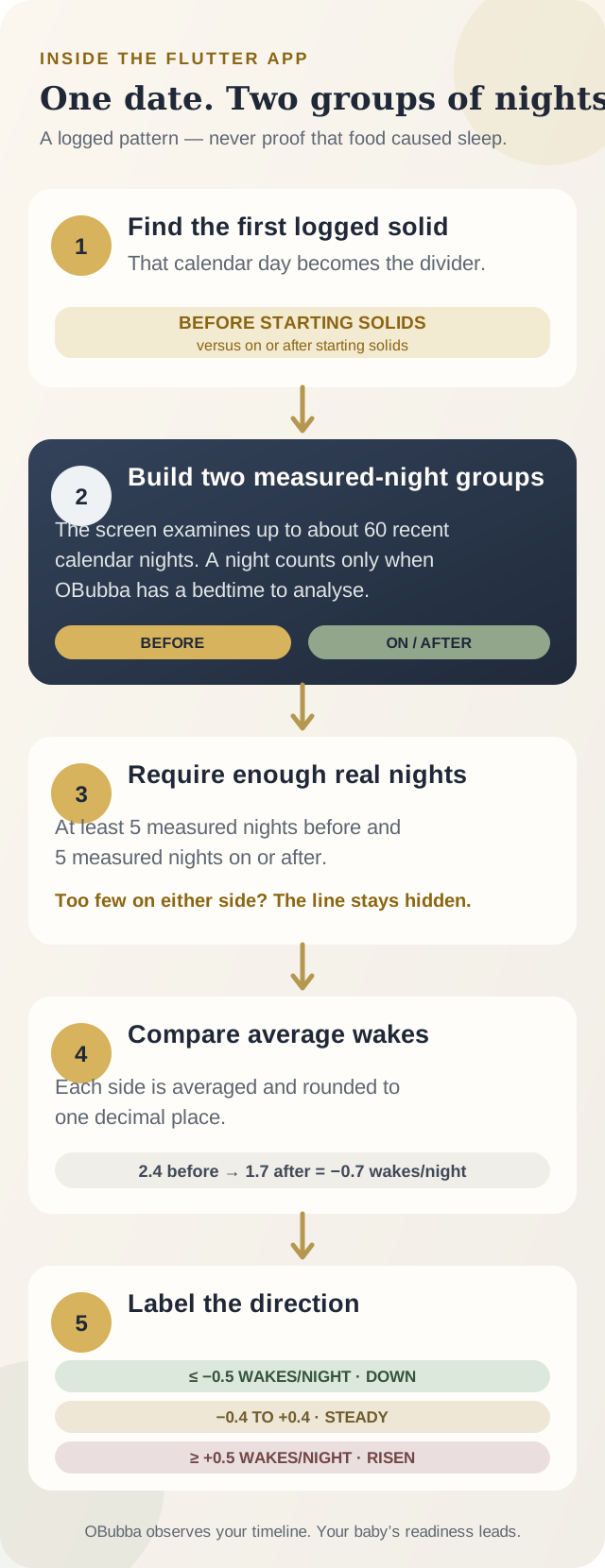
1. It finds the earliest logged solid
The first dated solids entry becomes the dividing line. Nights before that date form one group; nights on or after it form the other.
OBubba preserves the earliest-ever solids date in its lifetime summary, so “days weaning” can keep counting even after older detailed records move outside the app’s hot history window.
2. It examines recent nights with an analysable bedtime
The Weaning screen asks the sleep engine for up to about 60 recent calendar nights. A night is included only when the app has a bedtime to analyse. It does not silently convert an untracked night into zero wakes.
That matters. If you tracked four difficult nights but skipped six calm ones, the average represents the four measured nights—not the whole ten-night period.
3. It needs at least five nights on both sides
The sleep line stays hidden unless there are at least five measured nights before the first solid and five on or after it.
This is why one parent may see texture, iron and food-variety statistics but no sleep comparison. The app is withholding a thin result, not malfunctioning.
It may also stay hidden if solids began before the recent sleep window. The app can still know how many days you have been weaning while no longer holding enough recent pre-weaning nights for a fair before-and-after calculation.
4. It averages wakes per measured night
OBubba calculates the mean for each group and rounds each figure to one decimal place. If the result changes from 2.4 wakes before to 1.7 after, the displayed comparison is based on a difference of −0.7 wakes per measured night.
The label uses three bands:
| Difference after weaning began | What the card says | |---|---| | down by 0.5 wakes/night or more | “Night wakes are down since weaning began” | | between −0.4 and +0.4 | “Night wakes are steady since weaning began” | | up by 0.5 wakes/night or more | “Night wakes have risen a little since weaning began” |
The threshold prevents a tiny rounding wobble from being presented as a meaningful direction.
Where to find it in OBubba
Open Care → Weaning, then scroll to Weaning progress. The card appears after at least one solid has been logged. It combines the age-stage texture guide with iron-rich meals, unique foods, days since weaning began and, when there is enough sleep evidence, the before-and-after night-wake line.
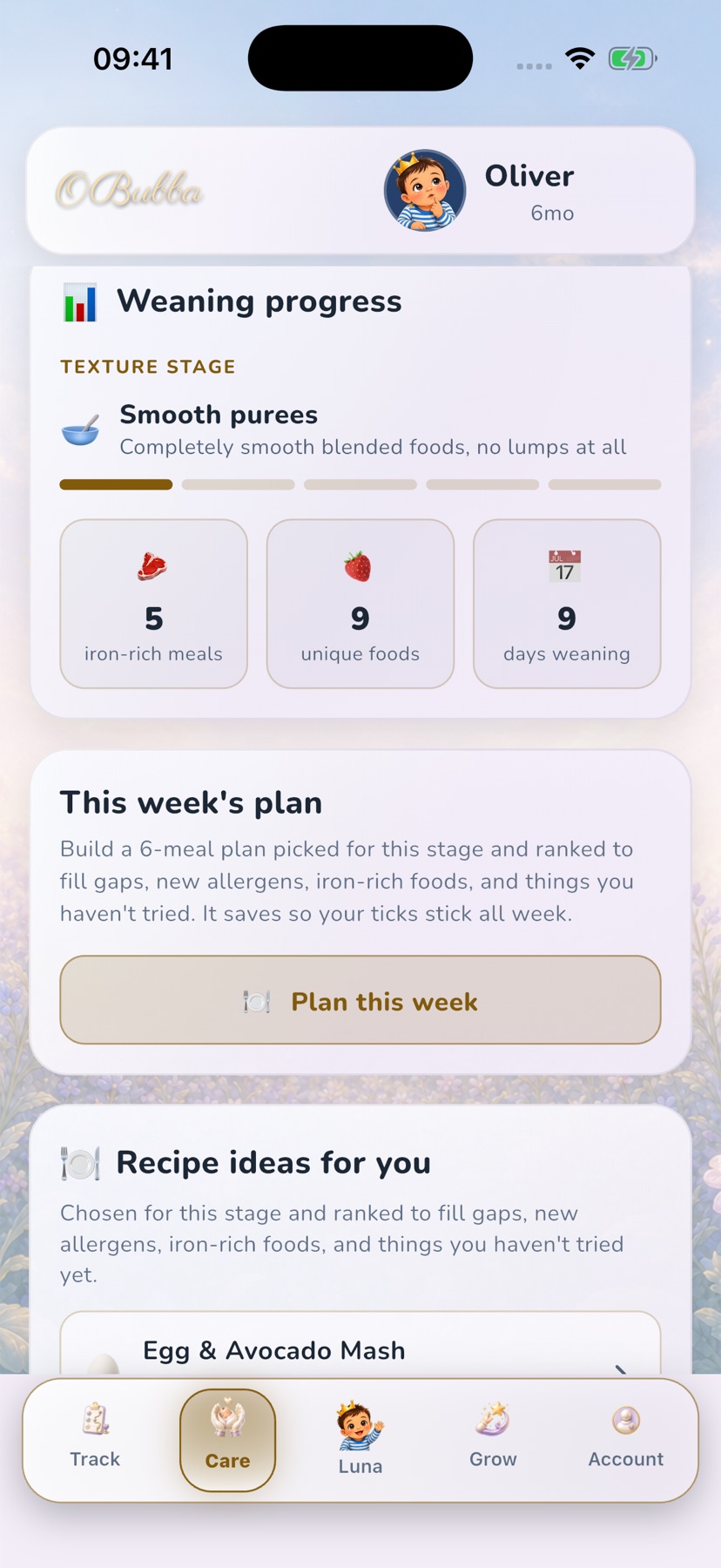
This is one reason a joined-up tracker can be more useful than separate food and sleep notes: the comparison is possible without asking an exhausted parent to rebuild two timelines from memory.
Try OBubba free → — log sleep, night wakes, milk and solids in one family timeline, then let the app surface the patterns with enough evidence to be worth checking.
If night wakes went down
Enjoy the easier nights without giving dinner all the credit.
Several things may have changed at the same time:
- your baby matured and linked sleep cycles differently
- bedtime or nap timing shifted
- a developmental disruption passed
- the sleep environment or settling routine became more consistent
- an illness, teething spell or travel period ended
- milk feeding moved during the day
- logging itself became more complete
Keep milk feeding responsive. At the beginning of weaning, babies still get most of their energy and nutrients from breast milk or first infant formula, and milk remains their main drink through the first year.
Do not increase portions, add cereal to a bottle or rush texture progression in an attempt to preserve the lower number. A helpful sleep pattern does not override feeding readiness or safety.
If night wakes went up
An increase does not mean your baby “cannot tolerate solids”, and it does not prove that a particular food disturbed sleep.
Start with context:
- Did naps or bedtime change during the same week?
- Were more wakes logged because tracking became easier?
- Was your baby teething, congested or unwell?
- Did milk intake drop sharply as solids were added?
- Was there constipation, discomfort, vomiting, diarrhoea or a possible reaction?
- Did you introduce meals very close to bedtime?
- Were the two groups of measured nights similar in completeness?
Keep new foods earlier in the day when practical, especially allergens, so the baby is awake and you can observe them. Continue usual milk feeds, start with small amounts and follow your baby’s cues.
If your baby seems unwell, is difficult to wake, has breathing changes, repeated vomiting, swelling, widespread hives, fewer wet nappies or another urgent symptom, use current medical guidance rather than waiting for the trend to settle.
For ordinary unsettled sleep with an otherwise well baby, gather a few more comparable nights before changing feeding. One busy night after broccoli is a story; a repeated, well-recorded pattern is evidence worth discussing.
How to make the comparison more trustworthy
Log the first taste on the day it happens
The earliest solids date is the divider. Backdating it later moves nights from one group to the other. If you are reconstructing the date from memory, treat the output as approximate.
Track bedtime and wakes consistently
A night without an analysable bedtime is excluded. You do not need perfect tracking, but similar effort before and after weaning produces a fairer comparison.
Record context, not just numbers
Useful notes include “teething”, “cold”, “late nap”, “travel”, “constipated”, “new nursery day” or “milk feed missed”. These do not alter the simple wake average, but they help you interpret it.
Avoid changing five things at once
If possible, keep the bedtime routine familiar while first tastes begin. You do not need an experiment-perfect household; you just want enough stability to understand the direction.
Look at duration and settling too
Wake count is only one dimension. Two brief wakes can feel very different from one two-hour split night. The Weaning Progress line compares counts, so use the rest of OBubba’s sleep record for longest stretch, timing and awake duration.
What the comparison cannot know
OBubba does not know:
- whether a baby truly swallowed the logged solid
- the calories or portion consumed
- whether hunger caused any particular wake
- whether discomfort came from food, teething, illness or timing
- what happened on nights that were not tracked
- whether a lower average will continue
It also does not adjust for age, naps, bedtime, illness or milk changes inside this particular before-and-after calculation. Those factors are available elsewhere in the app, but the weaning line itself is intentionally simple.
This candour is part of useful personalisation. A trustworthy app should show what it measured, stay silent when the sample is too small and stop short of a diagnosis.
A calm seven-day check
If the line surprises you, try this for one week:
- Keep age-appropriate solids small, safe and responsive.
- Continue normal breast or formula feeds.
- Log bedtime, wakes and morning wake consistently.
- Note naps, illness, teething, stool discomfort and unusual schedule changes.
- Avoid adding cereal to a bottle or starting early for sleep.
- Review the whole week, not the most memorable night.
- Ask a health visitor or GP about feeding, growth or health concerns.
The aim is not to make the graph go down. It is to understand what your baby needs without blaming a food or forcing a routine.
Frequently asked questions
Why can I see Weaning Progress but not the sleep line?
The app needs at least five analysable nights before the first logged solid and five on or after it. If either group is smaller—or the pre-weaning period has moved outside the roughly 60-night screen window—the line stays hidden.
Does “night wakes are down” mean solids helped?
No. It means the average was lower in the measured nights after the first solid than before it. Timing, development, naps, illness, milk feeds and tracking completeness may also explain the change.
Should I start solids because my baby wakes frequently?
No. Night waking is not one of the three readiness signs. Follow NHS guidance to start at around six months when the developmental signs appear together.
Why does OBubba include the comparison at all?
Because parents already wonder whether sleep changed around weaning. Showing the real recorded direction—with sample gates and limits—is more useful than relying on exhausted memory or making a universal promise.
Does a night with no logged wakes count as zero?
Only an analysable night with a bedtime enters this comparison. An entirely untracked night is excluded rather than assumed to contain zero wakes.
What if my baby wakes more and also has symptoms after a food?
Treat symptoms as a health question, not a sleep trend. Stop the suspected food when appropriate, follow your allergy or medical plan and seek urgent help for breathing difficulty, swelling, collapse or other severe symptoms.
The useful question is not “did food fix sleep?”
Ask: what changed in our baby’s whole day when weaning began?
OBubba can hold the sleep, milk and food timelines together, calculate the recorded difference and tell you when there is not enough evidence. You bring the context. Your baby brings the readiness cues.
That is a far more honest foundation for a calmer next step than promising a fuller tummy will deliver a full night.
Sources
- NHS: Your baby’s first solid foods
- NHS Best Start in Life: Feeding from around 6 months
- Perkin et al., JAMA Pediatrics: early introduction of solids and infant sleep
- PubMed record for the EAT sleep secondary analysis
This article provides general information for UK families. It does not replace individual feeding, sleep or medical advice. OBubba is a tracking and pattern-support app, not a medical device.
Ready to try OBubba?
Use OBubba to track feeds, sleep, naps, nappies, growth, milestones and family handovers in one calm baby tracker app.