Yesterday the first nap began at 9:08. Today it was 9:42. Tomorrow you have somewhere to be at 10. Does your baby have a schedule, or are you seeing order in three ordinary naps?
The short answer: a useful rhythm is a range, not an appointment. Look for the same broad nap windows, a similar number of naps and a reasonably repeatable bedtime across at least a week. Newborn sleep is usually too changeable for a clock-led schedule, and even an established rhythm will wobble with short naps, illness, travel, development and nap transitions.
You do not need to make the data neater than the baby. The goal is to know what is likely next while staying responsive to the child in front of you.
Rhythm, schedule and wake window are not the same thing
| Term | What it means | A helpful way to use it | |---|---|---| | Nap rhythm | the repeated shape that appears in real days | “The first nap usually begins between about 9:00 and 9:45.” | | Schedule | planned sleep opportunities at particular times | “We will offer a nap around 9:15, then adjust if today began early.” | | Wake window | the time between waking and the next sleep | use it as context alongside cues, not a countdown that must reach zero |
A rhythm is observed. A schedule is proposed. A wake window helps explain why today's proposal may move.
That distinction matters because false precision creates unnecessary failure. A baby who sleeps at 9:36 has not “missed” a 9:30 nap. A 30- to 60-minute band is often more honest and more useful than one average time.
When do babies develop a nap schedule?
There is no universal week when naps become predictable. The NHS says every baby is different and that sleep patterns change as babies grow, sometimes just as a routine begins to feel settled.
Newborns commonly sleep in short and long bursts around feeding. Day and night can be irregular, and a rigid clock schedule is rarely a sensible test of how well anybody is doing.
Over the following months, many families begin to notice anchors: morning starts land in a similar area, the first nap becomes easier to anticipate, and bedtime occupies a recognisable band. Age alone cannot tell you whether this baby's rhythm is stable.
Think in phases rather than deadlines:
- Early weeks: follow feeding needs, tired cues and medical advice; record only if it lightens your mental load.
- Emerging rhythm: one part of the day, often the first nap or bedtime, starts repeating while later naps remain mobile.
- Settled rhythm: several nap windows recur and the usual nap count is fairly clear.
- Transition: two valid day shapes coexist while a nap is being dropped; an occasional extra or missing nap is not bad data.
For a baby born prematurely or following an individual feeding, growth or medical plan, follow the neonatal or paediatric team's advice where it differs from a general guide.
Six signs a real rhythm may be emerging
Look for a cluster, not a single tidy day.
- Morning wake time lives in a broad band. It does not have to be identical, but the day has a recognisable starting zone.
- The first nap is becoming easier to anticipate. Its start repeats even when the rest of the day varies.
- The usual number of naps is becoming clear. Most comparable days contain the same count, with understandable exceptions.
- Sleepy cues gather at similar points. The baby becomes quieter, less engaged, red-eyed or harder to entertain around the same window.
- Bedtime has a centre of gravity. It moves after short or late naps but no longer feels random.
- Different carers can recognise the pattern. A shared record makes “usually around then” visible rather than dependent on one exhausted person's memory.
One long nap followed by one short nap is not a broken schedule. Neither is a nursery day that looks different from a home day. The question is whether like-for-like days have a repeated shape.
The seven-day rhythm check
For one ordinary week, record what happened without trying to improve it.
| Note | Why it helps | |---|---| | morning wake time | separates an early-start day from a genuinely early nap | | every sleep start and end | catches short pram, carrier or feeding dozes that reshape the day | | where the nap happened | helps compare home, nursery and travel days fairly | | bedtime and time actually asleep | distinguishes starting the routine from starting sleep | | unusual context | illness, vaccinations, visitors, teething, travel and nursery explain outliers |
Then ask three questions:
- Which nap appears on at least three days?
- What is its middle range, after keeping unusually early and late days visible?
- Do days with the usual nap count tell a clearer story than all days mixed together?
Do not enter “zero naps” for a day you forgot to log. Missing data means unknown, not no sleep. Likewise, a three-minute accidental timer should not be allowed to redefine the baby's routine.
A worked example
Suppose the first nap started at 9:05, 9:12, 9:20, 9:31, 9:38, 9:46 and 10:18. The most useful human summary is not “9:33 exactly”. You might call the middle cluster:
> First nap usually starts around 9:15 to 9:45. Earliest observed: 9:05. Latest observed: 10:18.
That tells a carer when the nap often begins while preserving the truth that the day sometimes shifts. OBubba deliberately rounds its displayed middle band out to whole-hour boundaries, so these same observations would appear as roughly 9:00 to 10:00, with 9:05 and 10:18 retained as the full observed range. If all seven times scatter widely, the honest answer is that the rhythm is still settling.
What if every day looks different?
Variation is information. Before concluding that sleep is chaotic, check whether unlike days have been blended together:
- home days versus nursery days
- two-nap days versus three-nap days
- normal mornings versus unusually early wakes
- cot naps versus short naps on the move
- well days versus illness or teething days
- days during a clocks change, holiday or developmental leap
An emerging schedule can also disappear temporarily. The NHS notes that babies' sleep patterns change as they grow; returning to observation for a week is often more useful than stretching every wake window at once.
Avoid waking, delaying a feed or withholding responsive comfort simply to make a chart look regular. Some babies have individual feeding, growth or medical plans that include waking them; follow those professional instructions rather than a generic schedule article.
How the real OBubba app learns a rhythm
OBubba's free Care → Reports → Learn the rhythm section is deliberately more cautious than a timetable generator.
The current engine:
- waits until a nap slot has appeared on at least three days before describing it
- shows a broad usual start band built from the middle half of observed times
- keeps the earliest and latest real starts visible instead of deleting inconvenient days
- describes timing as clockwork, steady or still settling according to how much it drifts
- finds the typical nap count from the most common day shape, breaking a tie towards fewer naps rather than inflating the schedule
- compares like-for-like days when there is a stable nap count, and admits when mixed day shapes cannot be separated honestly
- treats an unlogged day as unknown, never as a zero-nap day
- ignores sleeps shorter than five minutes so a timer mistake does not become a new nap
- keeps bedtime as its own band, because bedtime may be learnable before daytime sleep is
- rounds durations to the nearest quarter hour and complete data history down to whole weeks, avoiding pretend precision
If there is not enough information, the report stays in a gathering state and explains what to log. It does not fill the space with a generic age schedule or hide the lesson behind a paid lock.
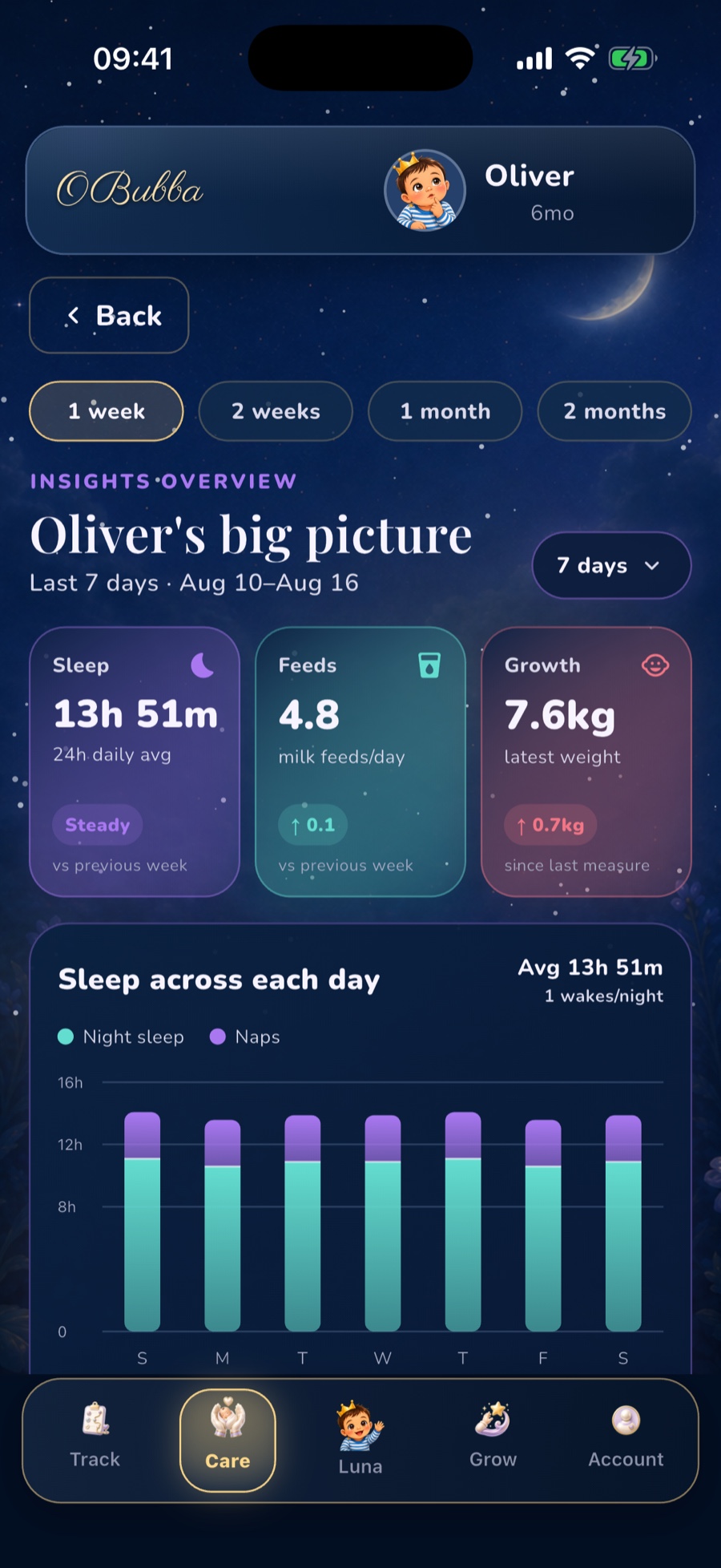
The live sleep clock on Track answers a different question: what may help today? It uses the current day and recent pattern to update the next sleep and bedtime guidance. The Reports rhythm answers: what has this baby actually been doing? Keeping prediction and observation separate makes it easier to notice when the baby's pattern has changed.
Neither surface diagnoses a sleep problem. The app cannot know about pain, breathing, hunger, growth or an unlogged nap from timing alone. It is a calm memory and pattern tool, not a substitute for the baby, the parent or a health professional.
Try OBubba free → to see the next sleep in context, learn the rhythm from real days and keep one shared record with the people helping care for your baby.
Keep every nap safer
A convenient schedule never overrides safer sleep. Current NHS safer-sleep advice says the safest place for a baby to sleep for the first six months is in a cot or Moses basket, on their back, in the same room as a parent or carer. Use a firm, flat, waterproof mattress and keep pillows, cot bumpers, toys, pods, nests and loose bedding out of the sleep space.
Do not leave a baby sleeping unattended in a car seat. After travel, move them to a firm, flat sleep surface as soon as practical. Follow current sling and carrier safety guidance and keep the baby's face visible and airway clear.
Seek advice from your health visitor or GP if sleep changes suddenly alongside illness, your baby is unusually difficult to wake, feeds poorly, has fewer wet nappies, is not growing as expected, or regularly snores, gasps or pauses in breathing. Call 999 for severe breathing difficulty, blue or grey colour, unresponsiveness or another emergency.
Frequently asked questions
Should naps happen at the same time every day?
Not exactly. A repeatable range is more realistic than a minute-perfect time. The morning start, the previous nap, feeds and the baby's cues can all move the next sleep.
Is the first nap the best place to start?
Often, because it is less affected by earlier daytime naps. But some babies reveal bedtime first. Start with whichever anchor repeats naturally.
How many days of data do I need?
Three appearances are enough for OBubba to begin describing a nap slot, but a week gives better context and two weeks can help during a transition. More data does not make illness, nursery and travel days interchangeable.
Should I use wake windows or clock times?
Use both as clues. Clock bands reveal the family rhythm; time awake helps adjust after an early wake or short nap; sleepy cues tell you about the baby in front of you. None should operate alone.
What if the app's prediction is wrong?
Follow the baby, not the card. Log what actually happened. A mismatch is useful evidence that the day or the underlying rhythm has changed.
Reliable UK sources
- NHS: Helping your baby to sleep
- NHS Best Start in Life: Safer sleep advice for babies
- The Lullaby Trust: Safer sleep overview
This UK-oriented article provides general information, not individual medical advice. Baby sleep varies widely. Follow advice from your health visitor, GP, neonatal team or paediatric team where it differs from general guidance.
Ready to try OBubba?
Use OBubba to track feeds, sleep, naps, nappies, growth, milestones and family handovers in one calm baby tracker app.