Nursery says your baby slept beautifully. You bring them home, repeat the usual bedtime—and spend the night resettling them.
Or the opposite happens: naps looked patchy on the handover, yet the baby gives you the calmest night of the week.
It is tempting to decide that nursery either “ruins sleep” or magically fixes it. One night cannot support either conclusion. The useful question is narrower: when your baby has a nursery day, do their nights repeatedly look different from their ordinary home-day nights?
Keep the nursery handover factual, label the day and compare several like-for-like nights. A childcare day may be followed by more wakes, fewer wakes or no meaningful change. OBubba’s current app is deliberately built to allow all three answers—and stays quiet until it has enough home and away nights to compare.
The short answer
Nursery can change the ingredients that shape a night:
- naps may happen at different times or last a different length;
- the day may contain more movement, daylight, noise and social stimulation;
- feeds may be smaller, larger or spaced differently;
- the journey home can add a brief car or buggy doze;
- the baby may need more reconnection after separation; and
- illness, teething or a developmental change may coincide with the childcare day.
None of those means nursery is bad for sleep. A busy day may leave one baby overtired and another comfortably ready for bed. A well-timed nursery nap may improve the night; a late nap may shift bedtime; and some babies show no reliable difference at all.
Start by comparing what actually happened, not the label “nursery”.
Do this before changing bedtime
Ask the childcare setting for four pieces of information:
- When did each nap actually begin and end? “Slept after lunch” is too broad for a bedtime decision.
- How did the baby wake? Calm, still sleepy or upset can add context, although it does not diagnose the cause.
- What and when did they feed? A tired evening may also be a hungry evening.
- Did anything unusual happen? A five-minute car doze, a fire alarm, a new room, illness symptoms or a missed nap can matter more than the nursery label.
Then record the real evening:
- arrival-home time;
- any journey doze;
- final feed;
- wind-down start;
- the time sleep actually begins—not merely when the routine starts; and
- each genuine night wake.
Do not ask nursery to cap every nap after one difficult night. First work out whether the repeated pattern looks more like too little sleep, too much or late sleep, a feed gap, an unusual transition—or ordinary variation.
Three patterns that need different responses
| What repeats after nursery | More useful interpretation | First gentle response | |---|---|---| | Short or missed naps, frantic evening, very fast crash, false starts or more distressed wakes | Baby may be carrying overtiredness into the night | Bring the wind-down modestly earlier and protect the next available nap | | Long or late final nap, cheerful bedtime resistance, long settle or a bright-eyed early wake | There may not be enough sleep pressure at the usual bedtime | Keep the routine calm; consider a slightly later sleep attempt or a small change to only the final nap | | Similar naps and feeds, but extra clinginess or protest after collection | Reconnection or stimulation may matter more than the schedule | Add calm one-to-one time and keep the familiar bedtime sequence | | Smaller daytime feeds followed by full, purposeful night feeds | Hunger may be contributing | Review the handover and offer responsive daytime or evening feeding; do not remove a needed night feed | | Nursery nights and home nights vary by about the same amount | No dependable day-type effect | Leave the schedule alone and look for a different pattern |
These are hypotheses, not diagnoses. Overtired and undertired babies can both fight sleep, and a baby can be hungry and overtired at the same time.
A nursery nap is still real sleep
Parents sometimes discount a nap because it happened in a buggy, a busy sleep room or for only twenty minutes. For timing purposes, count the sleep that happened.
A short doze may not be restorative, but it can still change the next awake stretch. Equally, a long nursery nap does not automatically need cutting if bedtime and the night are working.
Try to capture:
- nap start and end rather than “morning nap”;
- whether the child woke naturally or was woken;
- a micro-nap during the journey home;
- whether the baby fell asleep during the bedtime feed; and
- actual sleep onset after put-down.
If the handover time is approximate, record it as approximate in a note. False precision is not better data.
How to test the pattern without blaming childcare
Use a simple two-week comparison when the baby attends nursery regularly.
1. Label each day honestly
Mark nursery days as nursery or daycare, ordinary days as Home, and grandparents or travel separately. Keep Sick for illness rather than treating it as another kind of busy day.
2. Log both the day and the following night
The night belongs with the day that led into it. A 2am wake after Tuesday’s nursery day is evidence about Tuesday’s context, even though the clock now says Wednesday.
3. Compare outcomes, not perfection
Look at:
- number of genuine wakes;
- time to settle;
- false starts in the first hour;
- first unbroken stretch;
- morning mood; and
- how much help was needed to resettle.
Wake count is easy to compare, but it is not the whole night. Three brief resettles may be easier for a family than one two-hour wake.
4. Change one lever only
If nursery days repeatedly precede rougher nights, choose the most plausible small response:
- start the same wind-down 10–15 minutes earlier after a low-nap day;
- protect a calm feed and reconnection after collection;
- ask whether the final nap can end slightly earlier only when it repeatedly crowds bedtime; or
- keep bedtime unchanged but reduce stimulating errands on the way home.
Hold the change across comparable days before judging it. If settling or night sleep worsens, restore the previous approach.
What the real OBubba app does
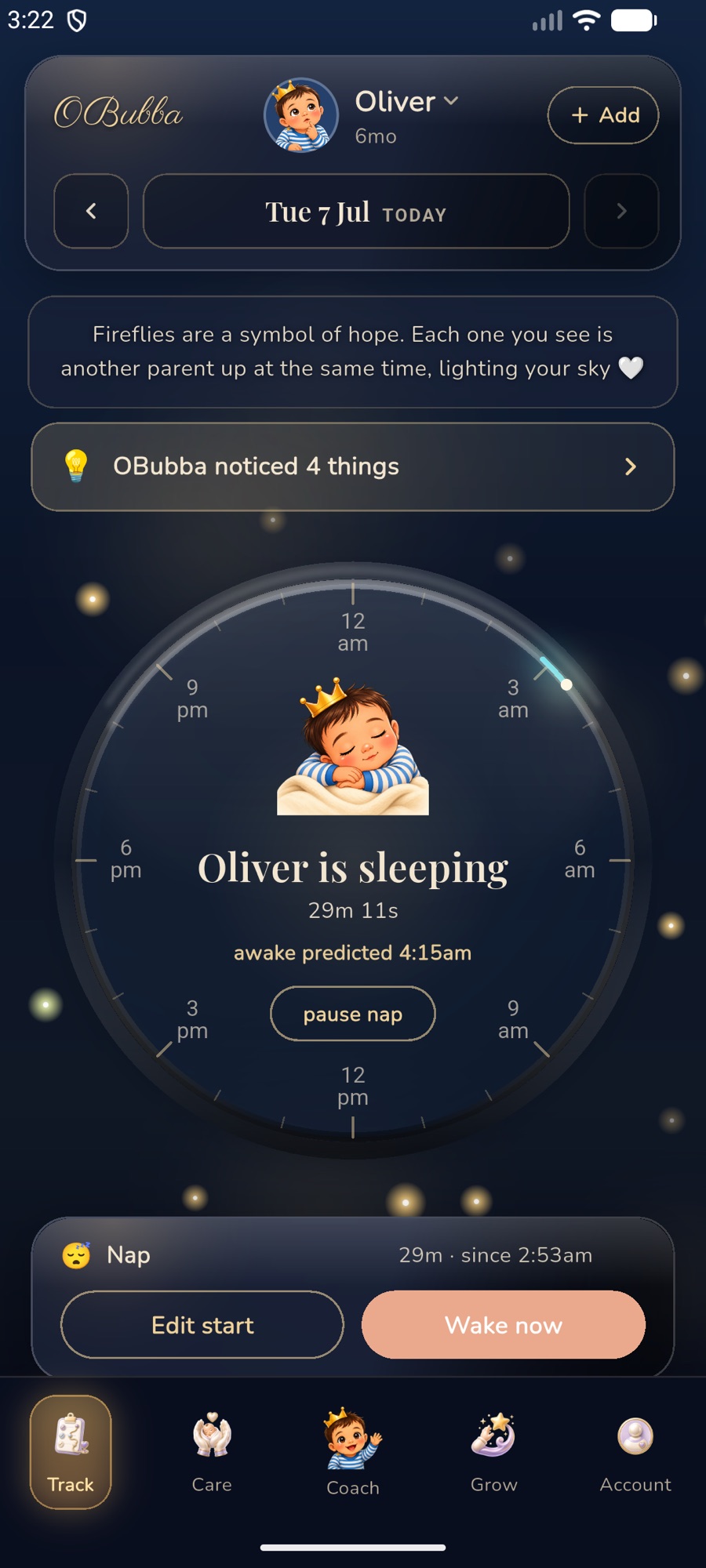
The current app has a Today type card in Track → Today type → Change. It can label the selected day Home, Daycare, Grand, Travel or Sick, including a past day when you are correcting the record.
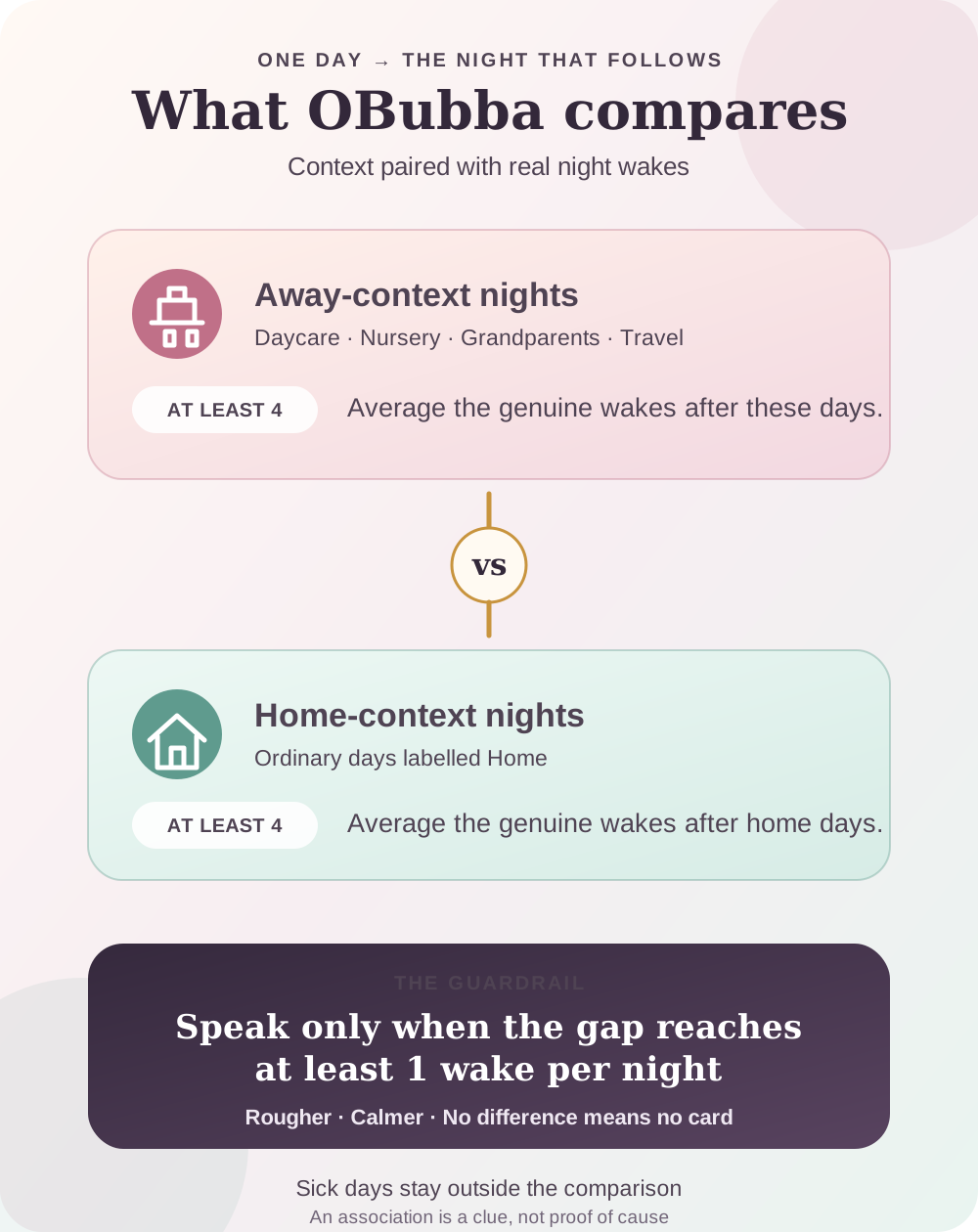
That label does more than decorate a calendar. In the sleep brain, OBubba pairs each recent night with the type of day that came before it. The dedicated `dayTypeNightPattern` detector then:
- reviews up to 28 recent day-and-night pairs;
- includes only nights with both a bedtime and a morning wake;
- groups Daycare, Nursery, Grandparents and Travel as “away” contexts;
- keeps Sick outside the home-versus-away comparison because illness is a health confounder;
- requires at least four away nights and four home nights;
- compares the average number of night wakes in each group;
- stays silent when the difference is less than one wake per night; and
- names the most common away type in the result, so a mainly nursery pattern is not labelled vaguely as “days out”.
The detector is two-sided. If nursery nights average 3.0 wakes and home nights 1.0, the card can say “Nights run a little rougher after a daycare day.” If grandparents nights average 0.0 wakes and home nights 2.0, it can instead say “Nights are calmer after a day with grandparents.”
If both groups look similar, there is no card. Silence is a valid result.
What the insight means—and what it does not
A difference is an association in this baby’s recent log. It does not prove that nursery caused the wakes.
Nursery days may also be weekdays, earlier-wake days, commuting days or days when another carer handles bedtime. A new childcare start may overlap with separation awareness, illness exposure, teething or a nap transition. Missing home-night wakes can also make the comparison look cleaner than it was.
Treat the insight as a better question:
> What is consistently different on these days that we can make gentler?
For rougher away nights, the current app suggests leaning on the wind-down and considering a slightly earlier bedtime. That is a cautious starting point, not an order. If the handover shows a large late nap and the baby is cheerful at bedtime, earlier may be the wrong direction.
For calmer away nights, the app encourages you to notice what might be helping—perhaps more activity, fresh air, social contact or a steadier rhythm—and borrow a realistic part of it at home. It does not suggest reproducing a full nursery timetable seven days a week.
A useful childcare handover script
You do not need a specialist sleep report. Try:
> “We are comparing how evenings go after different days. Could you tell me the actual start and end of each nap, any little doze, roughly when feeds happened and whether today felt unusual? We are looking for our baby’s pattern, not asking you to force a schedule.”
For the return handover, share only what is useful:
> “After short-nap days we have noticed bedtime is harder, so we are trying a slightly earlier wind-down. Please keep meeting sleep cues—we are not asking you to keep the baby awake.”
That wording keeps carers and parents on the same team.
What if nursery sleep is very different from home sleep?
Different does not automatically mean worse. Babies can accept one settling pattern with nursery staff and another with a parent. The room, sound, light, routine and other children are different cues.
Focus on whether the overall arrangement is safe and workable:
- Is the baby getting enough opportunity to sleep?
- Does the setting follow safer-sleep guidance?
- Is the handover accurate enough for the evening decision?
- Is the baby coping, feeding and behaving broadly as expected?
- Are the nights manageable for the family?
The Lullaby Trust’s guidance for early-years settings says babies should sleep on a clear, flat, separate sleep space such as a cot, crib, travel cot or carrycot, with a firm, flat mattress. Safer sleep applies in nursery just as it does at home.
When the pattern is not a scheduling problem
Pause sleep experiments and assess the baby when there is:
- fever, breathing difficulty or unusual drowsiness;
- poor feeding or fewer wet nappies;
- repeated vomiting or diarrhoea;
- a cry that sounds unusual or cannot be soothed;
- a sudden major sleep change with illness signs; or
- any concern from the parent or childcare team that the baby is not themselves.
Follow the child’s healthcare plan and seek advice from a health visitor, GP or NHS 111 as appropriate. Call 999 in an emergency.
The NHS notes that babies’ sleep patterns vary and change, and that teething, illness and growth can affect sleep. A simple, soothing bedtime routine may help settling; keeping that familiar sequence after an unpredictable day also makes your comparison cleaner.
The point is a calmer decision, not a perfect dataset
The win is not proving that nursery causes one extra wake. It is replacing a worried hunch with a small, reversible response:
- “Low-nap nursery days need an earlier wind-down.”
- “The late journey nap shifts sleep onset, so we stop forcing 7pm.”
- “Grandparent days are actually calmer; outdoor time may be helping.”
- “There is no meaningful difference. We can stop blaming childcare.”
That last finding may be the most reassuring of all.
Try OBubba free → — label the day, log the night that follows and let the app compare your baby’s real home and away patterns without assuming which should be better.
Frequently asked questions
Should I put my baby to bed earlier after nursery?
Only when the day supports it. A missed or short nap and a distressed, overtired evening may justify a modestly earlier wind-down. A long late nap and a cheerful baby may need the usual bedtime or a slightly later sleep attempt. Avoid using “nursery day” as the entire diagnosis.
Does nursery make babies overtired?
It can for some babies, especially during settling-in or when naps are shorter than at home. Other babies nap well there or sleep better after the activity. Compare the actual nap pattern and several following nights.
Should nursery copy our home nap schedule exactly?
Share the baby’s cues and useful timing, but expect some environmental difference. The aim is safe, responsive care and enough sleep—not identical minutes on every clock.
What if the car nap happens on the way home?
Log it, even if it lasts only a few minutes. It may take the edge off overtiredness or reduce sleep pressure before the usual bedtime. Test the evening from the real nap end.
Why does OBubba need four nursery and four home nights?
The current detector is designed not to speak from one or two dramatic nights. Four in each group is still a modest sample, so the result remains a pattern clue rather than proof.
Does OBubba include sick nursery days in the comparison?
Not when the day is labelled Sick. The detector treats illness as a confounder rather than an ordinary away-day routine. Use the most accurate day label.
Can the app tell whether the nap room caused the wakes?
No. It can compare recorded day types and wake counts, but it cannot observe the nursery environment, tired cues, feed quality or a missing event. Use the finding to ask better questions of the handover.
Reliable UK sources
- NHS: Helping your baby to sleep
- NHS Best Start in Life: Your baby’s sleep patterns
- The Lullaby Trust: Safer sleep in early years settings
- The Lullaby Trust: Keeping a clear cot
This article offers general information for UK families. It is not a medical assessment or an instruction to restrict sleep, and OBubba is not a medical device. Follow your baby’s individual feeding and healthcare advice, and raise safety or wellbeing concerns with the childcare setting and an appropriate health professional.
Ready to try OBubba?
Use OBubba to track feeds, sleep, naps, nappies, growth, milestones and family handovers in one calm baby tracker app.