A feed can feel suspiciously short when another took most of an hour. One breast may be enough at 10am and both may be wanted at 10pm. Add a timer and it is easy to start reading the number as a score: longer must mean more milk, equal sides must mean better balance, and a neat average must mean feeding is going well.
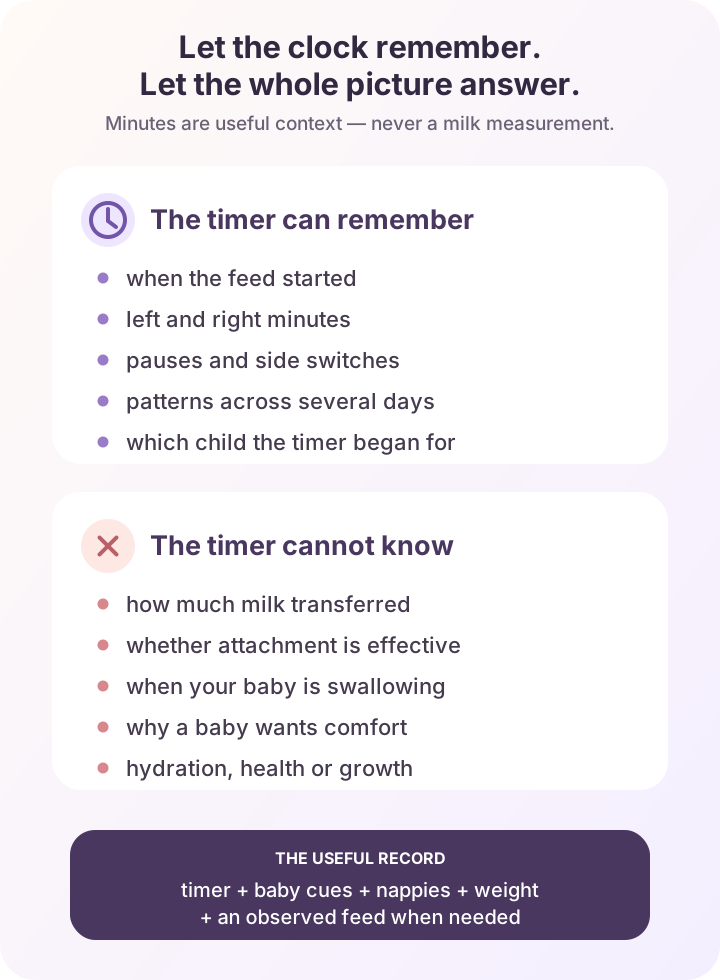
There is no single correct length for a breastfeed. The NHS advises letting your baby feed as often and for as long as they want. What matters more than a target number is the whole picture: comfortable attachment, active sucking and swallowing, how your baby behaves, wet and dirty nappies, and weight gain over time.
A timer can still be genuinely helpful. It can remember when a feed began, which side was used and what has been happening across several days. It cannot see milk transfer, assess attachment or tell you that a baby has had “enough”.
The short answer
Some effective feeds are short. Some normal feeds are long, especially in the early weeks or during cluster feeding. Duration also changes with age, milk flow, alertness, illness, distraction and whether a baby is feeding for food, comfort or both.
Instead of asking whether the stopwatch reached the right number, ask:
- can I see or hear rhythmic swallowing after the first quick sucks?
- do my baby's cheeks stay rounded rather than hollowing in?
- is feeding comfortable after the first few strong tugs?
- does my baby seem calm and come off the breast independently?
- are nappies and weight following the expected pattern for this baby?
One local NHS newborn guide describes roughly five to 40 minutes as a broad observation range, not a target. A feed outside that range is not automatically wrong. Repeated very short or very long feeds become useful information when they sit beside other concerns—not because a clock has diagnosed a problem.
Why two feeds from the same baby can look completely different
Babies do not drink at a constant rate. At the start of a feed, quick sucks may stimulate milk flow. Deeper, rhythmic sucks with pauses and visible or audible swallows suggest active milk transfer. Later, sucking may slow; a baby may pause, return to active drinking or continue for comfort.
That means 12 minutes of active swallowing and 12 minutes of sleepy flutter-sucking are not equivalent. A timer records both as 12 minutes because it has no way to know what the mouth, tongue and milk flow were doing.
Age matters too. A newborn is learning the skill and may feed very frequently. An older baby may become faster, then temporarily more distracted by the room. In the evening, feeds may bunch together. During illness, a developmental change or a growth spurt, the familiar pattern may change again.
None of this makes the clock useless. It explains why the clock must stay in its proper role: remembering, not judging.
Does a short feed mean my baby did not get enough?
Not by itself. A short feed may include efficient, active drinking. Your baby may also return sooner for another feed. Look for swallowing during the feed and the wider signs that milk intake is going well.
The NHS signs include your baby appearing calm while feeding, coming off the breast independently, having a moist mouth, and your breasts feeling softer afterwards. After the first few days, nappy output becomes especially useful. From day five, the NHS says at least six heavy wet nappies in 24 hours is expected, alongside the changing stool pattern described for the baby's age. Steady weight gain after the first two weeks is another important sign.
These are pieces of one assessment, not boxes an app can approve. Nappy expectations differ in the first days, and premature or unwell babies may have an individual plan. If you are worried, ask a midwife, health visitor, GP or infant-feeding specialist to look at a whole feed.
Does a long feed mean something is wrong?
Not automatically. Early feeds can take time. Cluster feeding can create an evening that feels like one long feed with short breaks. Babies also breastfeed for closeness and regulation; comfort is a valid need, not a failed meal.
But a repeated pattern of very long feeds deserves a closer look when it comes with another concern. Ask for feeding support if your baby:
- feeds for long periods, takes only a short break and seems hungry again every time
- clicks, slips off repeatedly or cannot maintain a deep attachment
- is unusually sleepy, difficult to wake for feeds or rarely seems to swallow
- has fewer wet nappies than expected or is not gaining weight as expected
- leaves you with nipples that are flattened, wedged, blanched, cracked or bleeding
- causes pain that continues through feeds rather than easing after the initial tugs
Tongue-tie can be one reason for long, unsettled feeds, but the NHS notes that the same signs can also come from positioning and attachment. A timer cannot tell the difference. An observed feed is far more informative than a duration screenshot alone.
Must my baby feed for the same time on both breasts?
No. Offer the first breast and let your baby feed. When they come off or stop active feeding, you can offer the second. They may want it, refuse it or take only a little. The breasts do not need matching minutes.
At the next feed, offering the side used second—or the side that feels fuller—can be a practical memory prompt. It is not a rule that overrides the baby or your own comfort. Some babies routinely take one side per feed; others take both.
If one side consistently gets much less feeding, first check the ordinary explanations: position, preference, flow, soreness or which side was offered first. Seek support for a persistent preference accompanied by pain, a breast problem, poor intake or difficulty turning the head. Do not extend a feed purely to make two app bars symmetrical.
What timing is actually good for
A breastfeeding timer earns its place when it reduces mental load. At 3am, “Which side did we start on?” is a much better question for software than “Did the baby transfer enough milk?”
Useful jobs include:
- remembering the start time when the evening blurs together
- keeping separate left and right durations after switching sides
- showing a partner or clinician the pattern you have observed
- noticing that feeds are repeatedly getting longer, shorter or more frequent
- preserving context during a handover between carers
- prompting which side you may want to offer first next time
The pattern can help you describe a concern precisely: “For three days, most feeds have lasted much longer, I rarely hear swallowing, and wet nappies have fallen,” is more useful than “the app says feeding is bad.” The observation—not a score—is the point.
Five traps a timer should never set
1. Minutes equal millilitres
They do not. Milk flow varies during and between feeds. Duration cannot be converted into a reliable volume.
2. Longer always means better
A long feed may be lovely, comforting, sleepy, efficient, inefficient or a mixture. The number cannot choose between those meanings.
3. Equal sides are the goal
Breasts and babies are not identical machines. Comfort, effective feeding and the whole pattern matter more than matching bars.
4. A missed log means a missed feed
It means only that no log was saved. Families forget timers, especially during demanding days. Do not let an incomplete record overwrite what you know happened.
5. The timer should control the baby
Do not detach a baby who is actively feeding because a target has been reached, or delay a responsive feed because an interval has not elapsed. Follow your baby's cues and any individual clinical plan.
How the current OBubba timer really works
OBubba's live breastfeeding timer is two-sided. Start on Left or Right, switch sides without losing the first duration, pause and resume, or edit the start time if you began feeding before reaching the phone. The running timer is saved on the device, so temporarily leaving the app does not erase it.
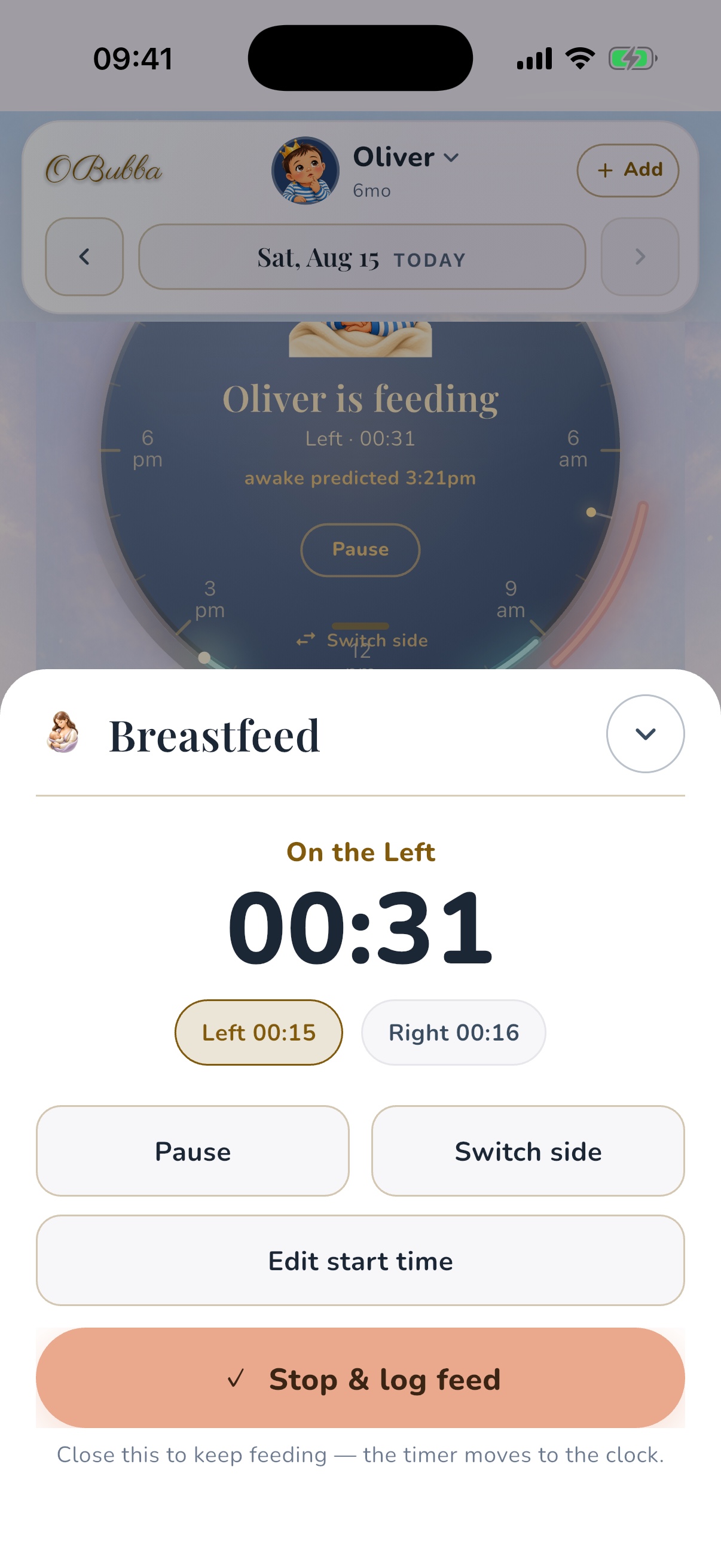
When minimised, the active timer remains available from Track; supported devices can also show a Live Activity or persistent notification. When you stop and save, OBubba stores the rounded left/right split for the child the timer began for. That child lock matters in a twins or siblings profile: switching the visible child mid-feed should not silently give the record to someone else.
The next-side hint looks at the most recent feed with side information and suggests the other side. It is a memory aid, never an instruction. OBubba can also surface a gentle seven-day imbalance observation after there is enough logged history, but it is still reporting minutes—not measuring supply or declaring that one breast is “working better”.
OBubba deliberately does not estimate milk volume from time. It cannot hear swallowing, inspect a nipple after feeding, count nappies you did not log, weigh a baby or diagnose tongue-tie, mastitis or low supply.
Try OBubba's calm feeding tracker free → — remember the side and time without turning either into a verdict.
A useful log is brief and observable
If everything feels ordinary, the timer entry may be enough. When you want to remember a change, add plain observations:
> 2:14am — Left 8 min, right 6 min. Clear swallowing on left; sleepier on right. Came off independently and settled.
If you are concerned:
> 10:35am — 42 min total. Clicking and repeatedly losing attachment. Nipple flattened afterwards; feed painful. Calling the feeding team today.
Avoid writing “low supply”, “bad latch” or “not enough milk” as though the timer proved it. Record what you saw, heard and felt. That gives a professional better evidence to assess.
When to get help
Seek early feeding support rather than waiting for the durations to become more extreme. Contact your midwife or health visitor, a breastfeeding support service, GP or NHS 111 as appropriate if feeding is persistently painful, nipples are damaged, your baby struggles to stay attached, you rarely notice swallowing, nappies reduce, your baby is difficult to wake, or weight gain is a concern.
Get urgent medical help if your baby appears seriously unwell, has breathing difficulty, is floppy or unresponsive, or shows signs of significant dehydration. For breast symptoms, seek prompt advice for a hot, painful or swollen area, flu-like symptoms or fever; these can fit mastitis. The NHS advises calling 111 if mastitis symptoms are worsening or are not improving within 12 to 24 hours of home care.
The National Breastfeeding Helpline is available on 0300 100 0212. A call, an observed feed and your baby's clinical record can answer questions a stopwatch never will.
Frequently asked questions
Should I wake my newborn if a feed is short?
Follow the plan given by your maternity or neonatal team. Some newborns, including babies who are premature, jaundiced, sleepy or not yet gaining well, may need scheduled waking. For a thriving baby, responsive feeding guidance may be different. A timer cannot decide which plan applies.
When do I start and stop the timer?
Start when feeding at the breast begins and stop when the feed ends for your family. Exact second-level consistency is less important than using roughly the same convention when you want to compare patterns. If you forget, edit the start time or add a simple manual entry.
Should I pause during a burp or nappy change?
You can pause if you want the record to reflect time at the breast, or leave a short interruption inside the session if that is simpler. Be consistent enough for the log to make sense to you; there is no medical prize for perfect stopwatch technique.
Can a breastfeeding timer tell me my supply?
No. Duration alone cannot measure milk production or transfer. Feeding behaviour, nappy output, weight and a skilled feeding assessment are more informative.
My baby feeds faster now. Is my supply dropping?
Not necessarily. Babies often become more efficient, and feed length naturally varies. Check the whole picture. If faster feeds accompany less swallowing, fewer wet nappies, persistent distress or weight concerns, ask for an assessment.
Do comfort feeds count?
They count as part of your baby's day and relationship, but you do not have to time or label every one. Track only what helps. OBubba should reduce the remembering burden, not turn closeness into admin.
Reliable UK sources
- NHS: Breastfeeding—how to tell your baby is getting enough milk
- NHS: Positioning and attachment
- NHS: Tongue-tie and breastfeeding
- NHS: Sore or cracked nipples
- NHS: Mastitis
- Cambridge University Hospitals: Signs your baby is getting enough milk
This article gives general information for UK families. It is not a feeding, growth or medical assessment, and OBubba is not a medical device. Follow the individual advice of your baby's healthcare team.
Ready to try OBubba?
Use OBubba to track feeds, sleep, naps, nappies, growth, milestones and family handovers in one calm baby tracker app.