You lower your baby onto the play mat. They lift their head for twelve determined seconds, make one deeply offended noise, then bury their face and demand a rescue. Does that count — and how are you supposed to reach half an hour like this?
For babies who are not yet mobile, UK guidance says to aim for at least 30 minutes of tummy time in total, spread across their awake day. It does not need to happen in one session. You can begin from birth with just 1 or 2 minutes at a time and build gradually as your baby becomes more comfortable.
Twelve calm seconds still count as practice. The aim is regular, supervised opportunity — not making a baby endure the floor until a timer turns green.
What counts as tummy time?
Tummy time means placing your baby on their front while they are awake, alert and directly supervised. It gives them a chance to move their head, neck, shoulders, arms, back and trunk against gravity.
The classic version is on a firm play mat on the floor, but a newborn can start more gently:
- tummy-down on your chest while you are awake and securely reclined
- lying across your lap while you support them and keep their face clear
- on a firm mat with you down at eye level
- briefly over your shoulder as they practise lifting and turning their head
Reaching, kicking and other supervised floor play are valuable parts of an active day too. The 30-minute UK target, however, refers specifically to tummy time for babies who are not yet mobile.
How much tummy time by age?
There is no single perfect session length for each month. Temperament, feeding comfort, prematurity, health and previous practice all affect what a baby can enjoy. Treat this as a gradual path, not a developmental test.
From birth: begin with tiny moments
Try 1 or 2 minutes on your chest, lap or a firm floor surface, perhaps a few times across the day. Pick a moment when your baby is awake and settled rather than hungry, exhausted or fresh from a large feed.
In the early months: add minutes, not pressure
Offer short sessions more often. A baby might manage two minutes in the morning, four after a later nappy change and another minute before their next nap. As head control and tolerance grow, some sessions will naturally become longer.
Before crawling: work towards the daily total
The NHS aim is at least 30 minutes spread through the day for a baby who is not yet mobile. More active play can be welcome when the baby is content, but 30 minutes is not a quota to force through tears and does not have to be recorded precisely.
Once a baby rolls, pivots or crawls, floor play often becomes self-directed. Keep offering safe space to move rather than repeatedly repositioning a happily mobile baby to satisfy an app total.
If you would prefer to try movement or play with other families, our guide to finding a baby class that suits your baby's age and your actual week covers timing, trial sessions, free local options and permission to leave early.
A realistic way to reach 30 minutes
Think in ordinary moments instead of one workout. For example:
- Two minutes on your chest after getting dressed.
- Three minutes on the mat after a morning nappy change.
- Five minutes with a mirror or high-contrast card before the next feed.
- Four minutes across your lap in the afternoon.
- Six minutes face-to-face with another carer.
- Ten minutes of mat play later, if your baby is still comfortable.
That example totals 30 minutes, but a newborn may need many more micro-sessions and an older baby may do most of it in one happy stretch. Stop earlier when your baby has had enough. Tomorrow is another day; there is no tummy-time debt to repay.
Linking a brief attempt to a familiar cue can make it easier to remember: after a nappy change, while waiting for a bottle to warm or before a feed when your baby is calm. Avoid putting them on their tummy immediately after feeding, particularly if they are uncomfortable or prone to bringing milk up.
What if my baby hates tummy time?
Many babies protest because the position is hard, unfamiliar or badly timed. Crying does not mean you should abandon tummy time forever, but it is a good reason to pause and change the setup.
Try one adjustment at a time:
- Come closer. Put your face at floor level and talk or sing.
- Change the angle. Start on your chest or across your thighs before trying the mat again.
- Bring the interesting thing nearer. A mirror, face or high-contrast card should be easy to see without a heroic head lift.
- Free the arms. Gently bring the elbows forward so the forearms are not trapped underneath the body.
- Choose a better moment. Try after sleep and before a feed rather than when your baby is hungry or overtired.
- Keep it tiny. Thirty comfortable seconds repeated later is more useful than a long battle.
A small rolled towel under the upper chest and armpits can sometimes make the position easier. Use it only during hands-on, awake supervision, keep the nose and mouth completely clear, and remove it when play ends. It is never a sleep prop.
Watch the whole baby rather than only the stopwatch. Fussing, tiring arms and lowering the head can mean “finished for now”. Stop immediately if breathing or colour changes, the face becomes obstructed, your baby seems unusually distressed or you are worried.
Tummy time and reflux
A full stomach pressed against the floor can feel unpleasant. Leave a comfortable gap after feeding and begin with a more upright option, such as tummy-down against your chest or over your lap. Shorter, more frequent attempts may be easier than one long session.
Normal posseting can still happen. If your baby is frequently distressed during or after feeds, refuses feeds, has forceful or green vomit, is not gaining as expected or seems unwell, ask a health visitor or GP for advice. A different tummy-time position cannot diagnose or treat reflux.
Tummy time, flat heads and safe sleep
Awake tummy time reduces the amount of time the back of the head is resting against a surface and is one part of preventing or improving positional flattening. You can also vary which side you hold and feed from, place interesting objects on different sides and avoid unnecessary long periods in car seats or prams when you are not travelling.
Do not change your baby's sleep position to treat a flat head. Always place them on their back for every sleep. Tummy sleeping and supervised tummy time are completely different situations.
If your baby falls asleep during tummy time, move them to a clear, flat sleep space and place them on their back. Never leave a sleeping baby on a sofa, adult bed, your chest or a propped towel.
The safety rules worth remembering
- tummy time is for awake, alert babies only
- stay close and supervise continuously
- use a firm, stable surface with the face and airway clear
- keep loose bedding, pillows, cords, pets and small objects away
- never leave a baby alone on an adult bed, sofa or changing surface
- stop when your baby is tired, distressed or falls asleep
- place your baby on their back for every sleep
If another adult takes over, say clearly that the baby is doing awake tummy time and needs continuous supervision. A running timer is not a substitute for a watching adult.
How OBubba turns tummy time into a small, useful moment
The current OBubba app keeps development support inside Grow → Activities. It uses your baby's age context, including corrected age where relevant, to choose a play band and offers ideas across movement, sensory, social, language and thinking skills. The heading says what the feature is designed to be: “playful, useful, never a test.”
For the youngest band, the Tummy Time card starts with a deliberately manageable suggestion: 1 to 2 minutes, 2 or 3 times a day, with an adult beside the baby. That is a starting micro-session, not the full UK daily aim. Build towards at least 30 minutes in total as your baby tolerates it.
To record a session, tap Log play, choose Tummy Time, then select a simple duration or start the live timer. The timer stays visible while you look through the activity ideas; Stop & log records the elapsed session in whole minutes in your child's timeline. You can cancel it at any time.
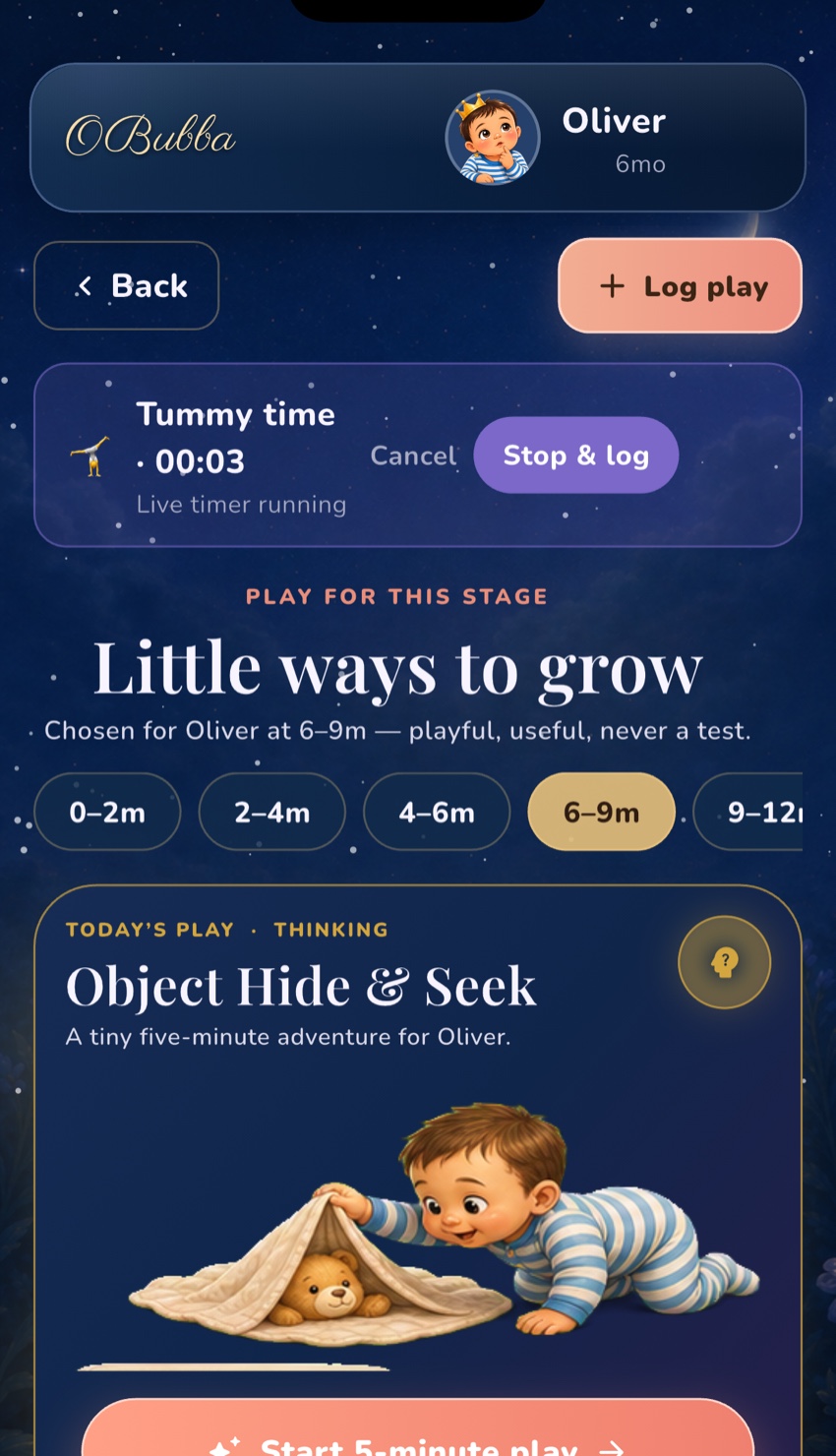
Activity cards include a short “how” and “why”. You can save an idea, mark the play as done or choose Too hard today without turning the experience into a failed milestone. Suggestions change with the age band, but they are ideas rather than a clinical programme.
Try OBubba free → — keep play beside sleep, feeding, nappies, weaning and milestones, without making one difficult afternoon look like a developmental verdict.
When to ask for help
Mention tummy-time difficulties to your health visitor, GP or children's physiotherapist if your baby:
- always keeps their head turned or tilted to one side
- finds it difficult to turn their head both ways
- has a head shape that worries you
- seems unusually stiff or floppy
- repeatedly uses one side very differently from the other
- is not gradually gaining head-lifting ability for their stage
- loses a movement skill they previously had
You do not need to wait for a checklist item if something feels wrong. For babies born early or with a medical, musculoskeletal or developmental condition, follow the individual advice from their neonatal, paediatric or therapy team.
Sources and further reading
- NHS: Physical activity guidelines for children under 5 years
- UK Chief Medical Officers: Physical activity guidelines
- NHS: Flat head syndrome
- Bedfordshire and Luton Children's Health: Learning to move
- Children and Family Health Devon: Fun ways to play — tummy time
OBubba supports organisation, play ideas and parent education. It does not monitor breathing, assess muscle tone or development, diagnose reflux or head-shape conditions, or replace advice from a health visitor, physiotherapist, neonatal team, paediatrician or GP.
Ready to try OBubba?
Use OBubba to track feeds, sleep, naps, nappies, growth, milestones and family handovers in one calm baby tracker app.