The night after a long afternoon nap has four wakes. Two days later, another long-nap day ends with one peaceful stretch.
A tired parent remembers the four-wake night. A responsible app has to remember both.
That is the question behind OBubba’s What OBubba’s noticed feed: when is a coincidence strong enough to become a pattern card—and when should the app stay quiet?
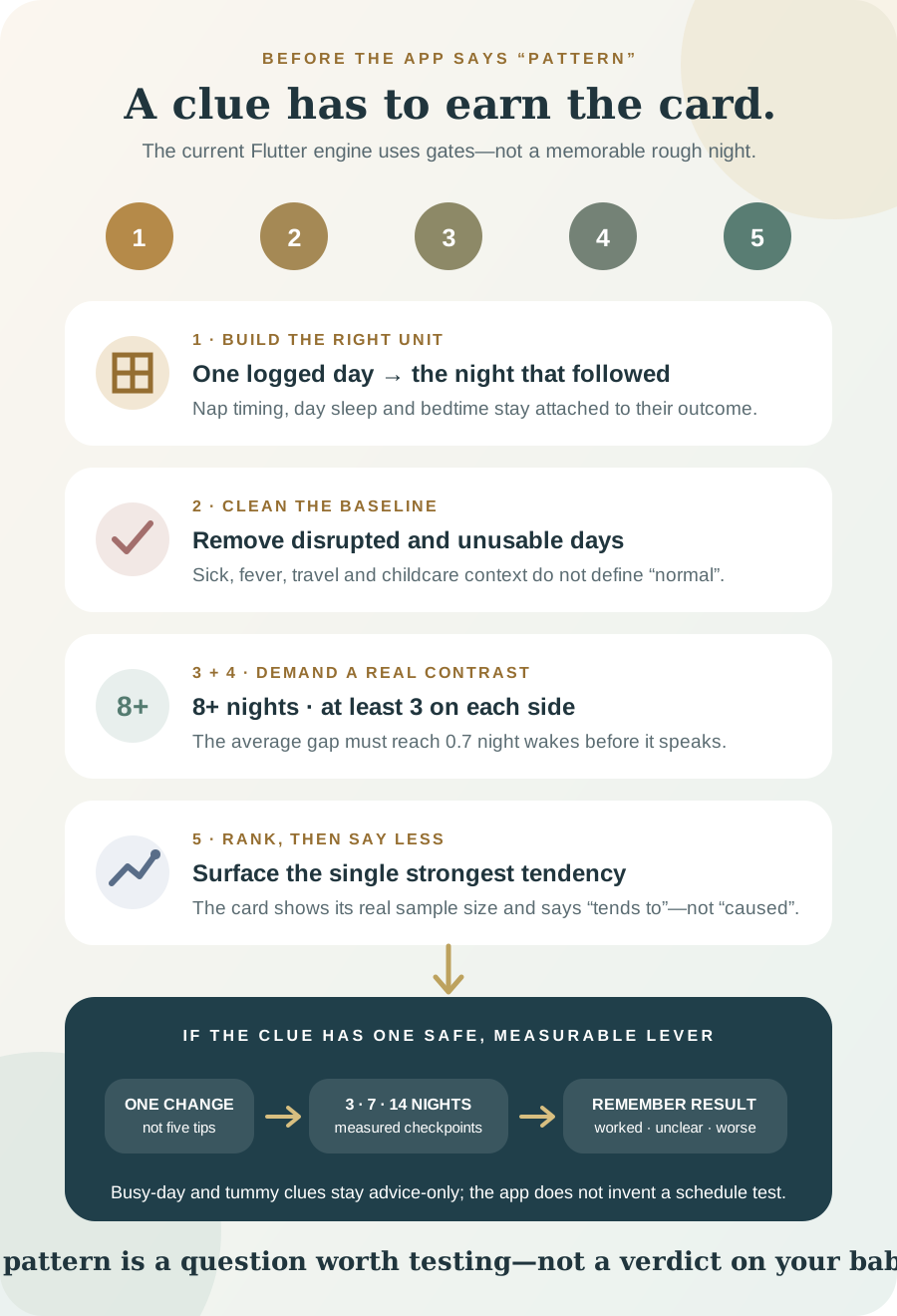
We inspected the current correlation and intervention engines for this guide. OBubba does not label two memorable nights a cause. It pairs each logged day with the physical night that followed, removes disrupted baseline days, waits for enough comparable records, requires a meaningful difference and surfaces only the strongest tendency. If that tendency has one clean, measurable lever, the parent can choose to test it. The result then becomes part of the baby’s history.
The short answer: an observation, a pattern and a cause are different things
OBubba treats them differently:
| Stage | What it means | What the app should say | |---|---|---| | Observation | one day was followed by one kind of night | “This happened” | | Repeated relationship | one daytime factor repeatedly appears beside a different night outcome | “This tends to line up with…” | | Experiment | the family changes one measurable lever and watches the right outcome | “Let’s test whether this helps” | | Cause | other explanations have been adequately ruled out | not something a family tracker can prove from routine logs |
This is more than careful wording. The current code uses numeric gates that stop a small or flat dataset producing a confident-sounding insight.
First, the app builds the right day-to-night pair
The unit is not a calendar square in isolation. It is one day joined to the night that began after it.
For each of up to 21 recent days, the current builder can assemble:
- the longest awake stretch
- when the final nap ended
- total completed daytime sleep
- evening bottle or expressed-milk volume when logged
- a count of logged play or activity sessions
- whether a concerning stool texture was recorded
- the number of wakes in the following physical night
The physical-night link matters around midnight and daylight-saving changes. A 3am wake belongs to the bedtime-to-morning night, not to a new daytime routine simply because the date changed.
The app also uses its canonical sleep calculations rather than naïvely adding every arc. Overlapping partner logs are merged, duplicate wakes are handled and a mid-nap awake period can be deducted from the sleep total. Otherwise a sync duplicate could manufacture “extra day sleep” and then appear to explain a rough night.
Then it removes days that should not define normal
A feverish Tuesday can be useful care history without being useful schedule training.
The correlation path excludes relevant days tagged sick, travel or childcare, along with fever days. This matches the baseline rules used elsewhere in the sleep engine. It prevents an illness week or a time-zone disruption from flipping the ordinary day-to-night relationship.
An empty day is not automatically evidence either. If nothing useful was logged, the app does not turn absence into “zero naps” or “no activity”. Missing data is allowed to remain missing.
This is why context tags are not cosmetic. They tell the engine, keep the record, but do not mistake this for an ordinary day.
The exact gate for a general correlation card
For continuous factors such as total day sleep, final-nap timing or the longest wake window, the current engine applies the same structure:
- At least eight recent nights must carry a usable value for that factor.
- The values are ordered and divided around a personalised middle boundary.
- There must be at least three nights below that boundary and three at or above it.
- The higher-factor group must average at least 0.7 more night wakes than the lower group.
- If several factors pass, only the relationship with the largest wake difference becomes the top card.
Suppose eight nights carry complete day-sleep totals. Four lower-sleep days average 1.0 wake and four higher-sleep days average 1.8 wakes. The 0.8 gap can pass the effect gate. If the groups average 1.0 and 1.4, the app stays quiet even though the higher group is technically worse.
That 0.7 threshold is not a universal scientific boundary. It is a product safeguard: the app demands a difference large enough to be useful before interrupting a parent with it.
Why the engine splits by value, not by date order
This small implementation detail protects against a surprisingly convincing false pattern.
Imagine a parent logs one bath every evening. Every day therefore has the same activity count: one. If the app simply divided the most recent four days from the older four, it could mistake natural improvement over time for an effect of “more activities”—even though the activity value never changed.
The current engine splits by the actual value and insists on populated groups on both sides. If every value is tied, one group is empty and no correlation is produced.
In other words, the factor itself has to vary. A baby merely getting older cannot masquerade as evidence that the identical bedtime bath suddenly changed the nights.
Which relationships can the app examine?
The general day-to-night engine currently checks six questions:
- Were nights rougher after the day’s longest wake window crossed this baby’s own dividing point?
- Were nights rougher when the last nap ended later?
- Were nights rougher after more total day sleep?
- Were nights rougher after a larger logged evening bottle or expressed-milk total?
- Were nights rougher after more logged activities?
- Were nights rougher after a day with a watery, mucousy or pellet-like stool?
These are questions the available logs can support. The app does not pretend to mine a rich mood-to-sleep history if it does not store that time series reliably. A narrower honest engine is more useful than an impressive list built from invented inputs.
OBubba also has specialised, separately gated checks for relationships such as room temperature, medicine days and recorded allergen exposures. Those remain correlations. A medicine log cannot tell the app whether the underlying illness, the medicine, timing or another change affected the night.
Never change a prescribed medicine, feeding plan or allergy plan because of an app pattern. Discuss concerning or repeated symptoms with the relevant clinician.
“What helps good nights?” uses a different comparison
Another feature asks a more positive question: what tended to happen on days before the baby’s better nights?
It looks across up to 13 recent day-to-night pairs and divides them into:
- good nights: one wake or fewer
- harder nights: two wakes or more
Before speaking, it requires at least three nights in each group. It then needs a meaningful average difference: at least 20 minutes in total nap time or 15 minutes in bedtime.
That can produce wording such as “Good nights followed shorter nap days” or “Good nights had an average bedtime of…” The sentence deliberately says followed or had, not were caused by.
One baby’s good nights may follow longer nap days; another’s may follow shorter ones. The point is not to push every family toward less daytime sleep. It is to show the contrast present in this baby’s own complete records.
Why OBubba shows only one strongest general pattern
Eight factors on one screen would feel scientific while making the next decision harder.
The current general engine ranks the passing relationships by the difference in night wakes and surfaces the strongest. Its evidence label uses the sample size for that specific factor—not the size of the whole history window. If 18 nights exist but only eight include an evening volume, the card should not imply an 18-night feeding comparison.
The card also receives a stable identity based on its underlying lever. That allows the app to recognise a genuinely new pattern later instead of treating every card with the generic title A pattern in baby’s sleep as the same old notice.
The genuine insight surface
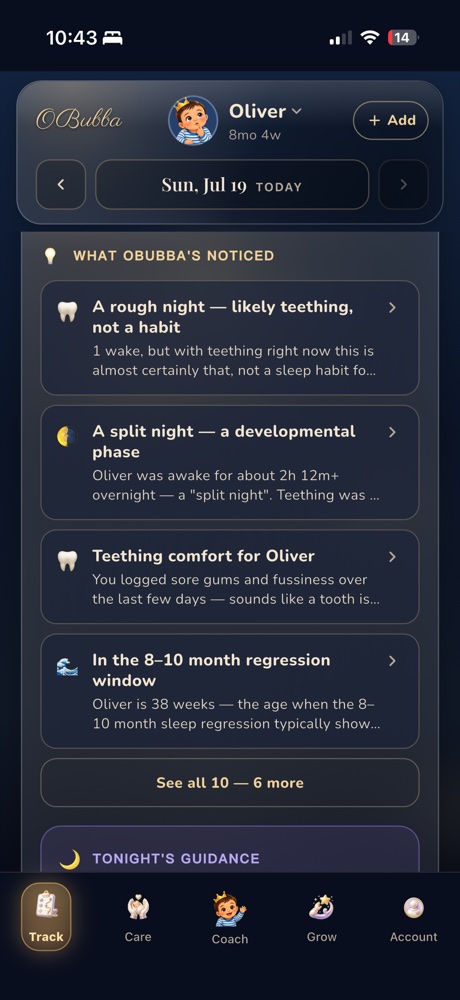
The screen above contains different kinds of insight—recent event interpretation, developmental context and multi-day patterns. They share one feed, but they do not share one evidence rule.
A teething clue should not need the same history as a median-split day-sleep correlation. A prediction-confidence label should not be reused as a medical-confidence label. The current architecture routes each question through its own detector and evidence gate before the feed prioritises it.
That distinction is part of the product: one calm surface, several purpose-built engines underneath.
Correlation becomes useful only when the next step is safe to test
Passing the pattern gate does not automatically create a schedule experiment.
The current app can turn these strongest sleep-timing relationships into one measurable proposal:
- a long-wake-window pattern can propose shorter wake windows
- a late-final-nap pattern can propose an earlier nap cap
- a high-day-sleep pattern can propose a gentle day-sleep cap
- a large-evening-volume pattern can propose splitting the last feed rather than one larger bottle
A busy-day relationship or concerning-stool relationship stays advice-only. The app does not invent a rigid activity restriction or a schedule experiment for a potentially clinical clue.
Even the clean sleep levers are optional hypotheses. A parent can decline, and a live sleep-debt signal can suppress a “trim day sleep” proposal when the app is simultaneously saying naps need protection. Contradictory advice should be reconciled before it reaches the family.
For young babies, babies with feeding or growth concerns, or any family following an individual clinical plan, do not reduce milk or needed sleep to satisfy an experiment. The care plan wins.
What happens when a parent starts the test
An active OBubba experiment stores:
- the one change being tried
- the hypothesis behind it
- the start date
- the baby’s pre-test baseline
- checkpoints after 3, 7 and 14 nights
- the outcome metric appropriate to that change
That final point prevents a misleading verdict. An earlier-bedtime test may be judged by night wakes. A final-nap or day-sleep test is judged by the longest unbroken stretch. A morning-anchor test is judged by morning wake time. A night-feeding test, where appropriate, is judged by night feeds.
The app does not call a longer first stretch a failure merely because the raw number of wakes stayed the same.
After the first two nights, the state remains gathering. At a checkpoint, at least roughly half of the relevant nights need usable outcome data; otherwise the result is need a few more logged nights, not an invented verdict.
The result can then be:
- working — the correct metric moved by a meaningful amount
- no clear signal — it stayed around the baseline
- worse — it moved meaningfully in the wrong direction
- missing data — there is not enough complete follow-up
The app remembers what worked for this baby
When a test ends, the outcome goes into the baby’s experiment history. A recently failed lever is held back for about 60 days rather than immediately being prescribed again under another route. If the same underlying “cap day sleep” action appears from two different detectors, the outcome memory treats them as the same practical change.
A lever that has worked remains eligible because it has personal evidence behind it. An old failure can eventually expire because babies develop and circumstances change.
The outcome history is included in the synced child data, so the learning can survive a reinstall and remain available to a connected caregiver. This is the difference between a tracker that notices and a system that closes the loop:
observe → compare → propose → measure → remember.
How to give the pattern engine useful data without logging everything
You do not need to document every song and cuddle. Complete the boundaries behind the question.
For nap and wake-window relationships
Record the morning wake, real nap starts and ends, and bedtime. An unfinished nap cannot supply a reliable duration or final wake anchor.
For day-to-night comparison
Record the wakes that genuinely happened, including feed-linked wakes where appropriate. Consistent logging matters more than trying to make a hard night look tidy.
For one specific question
Log that factor consistently across several days. If you are asking about evening bottle volume, sporadic volume records will leave a smaller valid sample even when the sleep history is long.
For disrupted days
Use the sick, travel or childcare context. Do not delete the day; help the app avoid calling it normal.
Try OBubba free → — keep the day and following night connected, see which relationships earn an evidence-labelled insight, and test one change without losing the baseline.
Frequently asked questions
Why did OBubba not show a pattern after three similar nights?
The general correlation engine needs at least eight nights carrying that factor, with at least three observations on both sides of a meaningful split. Three nights may be a clue, but they do not pass this card’s gate.
Does eight nights always produce an insight?
No. The factor has to vary, both comparison groups need enough nights, and the gap must reach at least 0.7 wakes. Often the correct result is silence.
Why did the insight disappear?
Recent history changes as new nights arrive, disrupted days are tagged or the relationship falls below its effect gate. A pattern card is a current read, not a permanent diagnosis.
Can OBubba prove that long naps caused wakes?
No. It can show that higher day-sleep days in this sample tended to precede more wakes. Teething, illness, feeds, development or another unlogged factor may still explain some or all of the difference.
Why is the dividing time different for another baby?
The continuous-factor boundary comes from the middle of that baby’s own recent values. It is a personal comparison point, not a universal nap cap.
Why can I test some insights but not others?
Only a relationship with one clean, measurable lever becomes an experiment. Busy-day and concerning-stool clues remain advice-only because forcing them into a schedule test would overstate what the data can support.
What if a test makes sleep worse?
Stop or ease off. The app can classify the appropriate metric as worse and remember the outcome. You never need to continue a change that feels wrong for the baby or family merely to complete seven nights.
Will the app keep recommending a failed change?
A recent failure is suppressed, including equivalent day-sleep-cap actions proposed by different engines. The hold eventually expires because a baby’s needs can change with age.
A pattern never overrides the baby in front of you
The NHS notes that every baby is different and sleep changes with growth; teething, hunger and illness can disturb it. That variability is exactly why an app should use repeated comparisons rather than one-size-fits-all conclusions.
Safer sleep also stays outside the experiment loop. Follow current guidance for every sleep: place baby on their back in a clear cot or Moses basket with a firm, flat mattress; for the first six months, the safest place is in the same room as you.
Do not hold an unwell baby awake, cut clinically needed feeds or change prescribed care to improve an app metric. Seek advice for concerning sleep, breathing, feeding, hydration, pain, stools, reactions or development.
The most trustworthy insight may be no insight yet
A persuasive baby app could produce a theory after every difficult night. A useful one knows when the comparison is too small, too flat or too disrupted to say anything.
OBubba’s pattern system is designed to earn the right to interrupt: pair the correct day and night, protect the baseline, demand a real contrast, name the sample and speak in tendencies. Then—only when there is one reasonable lever—help the parent test it and remember the result.
That is not certainty. It is something more valuable at 3am: a smaller, testable question built from this baby’s own history.
Sources and further reading
- NHS Best Start in Life: Your baby's sleep patterns
- NHS: Helping your baby to sleep
- NHS Best Start in Life: Safer sleep advice for babies
OBubba is a tracking, planning and education tool, not a medical device or proof of causation. Its insights and experiments are optional estimates from logged history. Follow safer-sleep guidance and your baby's individual clinical plan.
Ready to try OBubba?
Use OBubba to track feeds, sleep, naps, nappies, growth, milestones and family handovers in one calm baby tracker app.