Your baby was weighed last week, but today they fed less than usual and the home scale is sitting in the bathroom. Would another number reassure you — or give normal day-to-day variation too much power?
For most babies after the first 2 weeks, the NHS advises weighing no more than once a month up to 6 months, once every 2 months from 6 to 12 months, and once every 3 months after their first birthday. Weigh more often only when a health professional recommends it or there is a concern about health or growth.
The useful information is the pattern across well-spaced, accurate measurements — not whether today's number is a few grams above or below yesterday's.
Why the first weeks are different
It is normal for babies to lose some weight during the first few days after birth. They are weighed during their first 2 weeks so the midwife or health visitor can check that they are regaining it. Most babies are back to their birthweight by around 3 weeks.
If weight loss is larger than expected or birthweight has not been regained, the clinical team will look at the whole picture: feeding, attachment and milk transfer if breastfeeding, general health, nappies and the baby's measurements. Follow their individual weighing plan rather than the routine intervals in this article.
Premature babies, babies with medical needs and babies being monitored for feeding or growth concerns may also need a different schedule. Their neonatal, paediatric or health-visiting team should set it.
The NHS weighing intervals at a glance
After the first 2 weeks, and unless you have been advised otherwise:
- Birth to 6 months: no more than once a month
- 6 to 12 months: no more than once every 2 months
- Over 12 months: no more than once every 3 months
These are maximum routine frequencies, not appointments you must arrange on the exact day. Your baby's checks and local clinic arrangements may supply the measurements you need.
If your baby seems unwell, is feeding poorly, has fewer wet nappies or you are worried about growth, ask a health visitor or GP. Do not wait for the next planned weigh-in simply to keep the spacing tidy.
Why weighing too often can mislead
A baby is not a static object. A recent feed, wee or poo; clothing or nappy weight; a different scale; and slightly different positioning can all alter a reading. Over a day or two, that noise can be larger than the change you are trying to measure.
Plotting two noisy points close together can create an alarming-looking “drop” or a dramatic weekly gain that is not a real trend. RCPCH guidance also notes that frequent weighing can be misleading and cause unnecessary worry.
More data is not automatically better data. Leave enough time for genuine growth to become visible, then compare measurements taken with appropriate equipment and technique.
Avoid the feed–weigh–panic loop
A smaller feed does not require an immediate weigh-in. Appetite naturally varies across a day, especially during teething, minor illness, hot weather and weaning. Look at feeding across the day alongside wet nappies, responsiveness and the established growth pattern.
Likewise, one restless night does not prove a “growth spurt”, and one longer night does not prove your baby ate enough. Sleep, feeds and growth are connected parts of the baby's story, but none can diagnose the others from a single event.
What does a centile actually mean?
A centile shows how a measurement compares with children of the same age and sex in the chart reference. Roughly half of children are below the 50th centile and half are above it. The 50th is not a target, grade or prediction of future health.
A healthy baby can be naturally small, middle-sized or large. Their weight and length may sit on different centiles, although they are often reasonably similar. The meaningful question is whether the pattern makes sense for that child over time.
Measurements do not need to trace one printed line perfectly. The NHS says moving up or down by one centile line can happen; crossing two centile lines is less common and should be discussed with a health visitor.
That is a conversation prompt, not a diagnosis. Illness may temporarily slow weight gain and many babies return to their previous pattern within 2 to 3 weeks. A clinician can consider feeding, length, head growth, birth history and the baby's wellbeing rather than interpreting one line in isolation.
How to get a more useful measurement
Professional technique matters. RCPCH guidance recommends suitable electronic baby scales, weighing a baby naked and using proper equipment such as a length board or mat for length. Head circumference needs a narrow, non-stretch tape and correct placement.
That is why a clinic measurement is not directly interchangeable with standing on bathroom scales while holding your baby or stretching a tape measure along a wriggling leg.
If a clinician asks you to weigh at home:
- use the equipment and method they recommend
- use the same scales where possible
- measure at a similar time and in similar clothing conditions
- record the actual date and value without rounding to the number you expected
- tell the clinician that it was a home measurement
Never delay seeking help because you cannot obtain a home weight. Feeding and illness concerns need a clinical assessment, not a perfect spreadsheet.
Keep the Red Book as the clinical record
Your baby's Personal Child Health Record — usually called the Red Book in England — contains the clinical UK-WHO growth charts. Take it to baby clinics, developmental reviews and GP appointments so trained professionals can record and interpret measurements in context.
A family app can make the pattern easier to revisit between visits, but it cannot verify the scales, measurement technique or whether a centile change needs investigation. If an app and the Red Book disagree, use the professionally plotted record and ask the health visitor to explain it.
Growth after starting solids
Growth normally slows as babies move beyond the rapid first 6 months and become more active. Starting solids at around 6 months does not mean weight should suddenly jump, and a centile is not a target to chase with bigger portions.
Keep offering milk and a varied, responsive weaning diet appropriate for your baby's stage. Let appetite cues guide the meal rather than using today's weight to pressure an extra spoonful. If growth, intake or swallowing is worrying you, bring the feeding and nappy context to a health visitor or GP instead of changing the diet around an app result.
How the current OBubba app handles growth
In Grow, the Growth card keeps the latest weight, length and head circumference together. Tap Log to add any one of those measurements or all three. The date can be back-dated to the day the clinic measured your baby, and your chosen pounds/inches or metric display is converted into consistent underlying units for the chart.
Recent measurements remain visible in the log sheet. If a typo would distort the curve, you can remove that individual measurement and enter the correct one rather than leaving the bad point in the history.
Tap See the full growth read to view the current Growth insight. For babies with the information needed to calculate it, OBubba shows the latest values and places points on local WHO weight, length and head-circumference curves through 24 months.
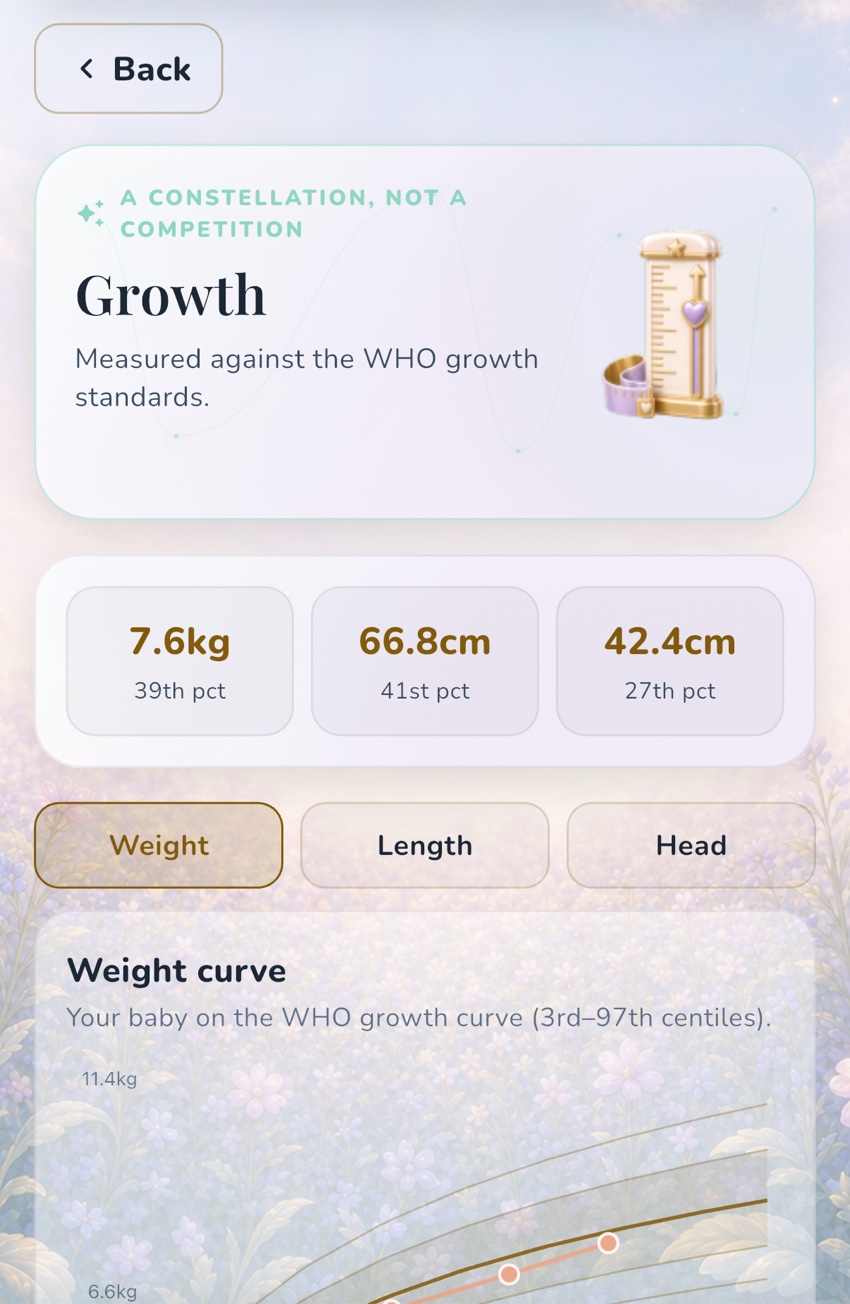
OBubba uses the measurement date rather than today's age when placing an older point. It also applies corrected-age context for eligible preterm babies and withholds a centile before term-equivalent age rather than comparing a very premature newborn with a term newborn. Clinical growth charts use gestation-specific rules, so the neonatal or health-visiting team's chart still takes priority.
After 24 months, OBubba deliberately stops calculating against its infant WHO tables instead of extending the final line and inventing a centile. The raw measurements can still build a personal history.
The full read can describe whether the recorded points appear steady, rising or easing and may suggest discussing a notable line crossing with a health visitor. Treat that wording as a prompt to look at the Red Book, not as reassurance, a diagnosis or a decision to change feeding.
Try OBubba free → — keep growth beside feeds, nappies, sleep, weaning and milestones, so the next conversation starts with the pattern rather than a number remembered from a tired afternoon.
A five-minute growth check-in
When a new professional measurement is available:
- Copy the exact value and measurement date from the clinic record.
- Check whether it was weight, lying length, standing height or head circumference.
- Add it to OBubba without re-measuring at home for comparison.
- Look at the wider sequence, not only the newest centile.
- Put any question for the health visitor into words: “This crossed two lines — does the Red Book show the same pattern?”
Then close the chart. A growth record should support parenting, not become another task to refresh every morning.
Sources and further reading
- NHS: Your baby's weight and height
- NHS: Your baby's health and development reviews
- RCPCH: Information about growth charts for families
- RCPCH: UK-WHO growth-chart measuring and plotting guidance
- RCPCH: Growth-chart questions for parents, including prematurity
OBubba supports organisation, tracking and parent education. It does not verify measurements, assess feeding adequacy, diagnose growth faltering or replace the Red Book, health visitor, neonatal team, paediatrician or GP.
Ready to try OBubba?
Use OBubba to track feeds, sleep, naps, nappies, growth, milestones and family handovers in one calm baby tracker app.