At 7pm the nursery feels stuffy, the weather app says 27°C and three different sleep-bag charts appear to give three different answers. Should your baby wear a vest, a sleepsuit, a 0.5 TOG bag—or only a nappy?
The short answer: dress for the temperature where your baby is sleeping, not the outdoor forecast or the season. Use a room thermometer, begin with lighter fitted sleepwear in a warm room, follow the instructions for your particular sleeping bag and check your baby's chest or the back of their neck. If the skin feels hot, sweaty or clammy, remove a layer.

Start with the room, not the weather app
Outdoor temperature explains why the bedroom may be warm, but it does not tell you the temperature beside the cot. A shaded ground-floor room can be several degrees cooler than a sunny upstairs nursery. The room can also cool quickly after midnight even when bedtime was hot.
The NHS and The Lullaby Trust recommend a room temperature of 16–20°C for baby sleep. In summer that range may be difficult to achieve. The useful response is not to panic or keep adding cooling products: measure the actual room, reduce clothing and bedding, cool the room safely where possible and check the baby rather than relying on a chart alone.
Put a simple room thermometer near the sleep area, away from direct sunlight, a radiator, an open window or the fan's airflow. Check it before the bedtime routine and again before you go to sleep if the weather is changing.
A practical TOG starting point
TOG describes the thermal insulation of a sleeping bag; it is not the room temperature and it does not include the warmth of the clothing underneath. Materials, fit and manufacturer testing differ, so the instructions supplied with your baby's particular bag should come first.
NHS Best Start in Life gives these common commercial sleeping-bag ranges:
- 2.5 TOG: standard room temperatures of 16–20°C
- 1.0 TOG: warmer rooms of 20–24°C
- 0.5 TOG: hot weather and rooms of 24–27°C
Use those as broad categories, not a mathematical prescription. At the boundary between bands, your baby's clothing, the bag and how they actually feel matter more than whether the thermometer reads 23.9 or 24.1.
If the room is hotter than 27°C, strip the setup back further and follow current safer-sleep and manufacturer guidance. Depending on the conditions and the baby, that may mean one very light layer or only a nappy, without a sleeping bag. Check frequently rather than assuming the outfit chosen at bedtime will remain right all night.
Do not combine a sleeping bag with extra blankets unless its manufacturer and your health professional specifically advise that setup. A sleeping bag should fit well around the shoulders and neck so the baby's head cannot slip inside. Never add a duvet, pillow, weighted blanket, hot-water bottle or electric blanket.
How to check whether your baby is too hot
Feel the baby's chest or the back of the neck. Warm is fine. Hot, sweaty or clammy means remove one or more layers. Damp hair and flushed skin can also suggest overheating.
Hands and feet often feel cooler than the rest of a baby's body, so they are a poor guide to whether another layer is needed. Do not add socks, mittens or a thicker bag just because the feet feel cool while the chest feels comfortably warm.
A room thermometer and a skin check answer different questions:
- the room thermometer tells you about the sleep environment
- the chest or neck check tells you how the baby is coping in their current clothing
Neither is a reason to disturb a safely sleeping baby every few minutes. Check while settling, after a meaningful temperature change and before your own bedtime. If your baby seems unwell, use a digital thermometer to measure body temperature rather than trying to diagnose a fever from the room reading or by touch alone.
A hot-night routine you can repeat
During the afternoon
Keep direct sun out of the bedroom by closing curtains or blinds on the sunny side. If it is safe, open windows when the outside air becomes cooler. Think about cords, window restrictors and whether an older baby can reach anything from the cot.
Before bedtime
Measure the room. Choose the lightest appropriate sleepwear and bag for that temperature, then check that the bag fits correctly. Remove hats and outdoor layers as soon as the baby comes indoors, even if that briefly wakes them.
While settling
Keep the routine familiar but reduce activities that make the baby hotter. A lukewarm wash may be calming; an energetic bath can have the opposite effect. Offer normal feeds. Fully breastfed babies under 6 months do not need extra water, though they may want to breastfeed more often in hot weather. NHS guidance says formula-fed babies under 6 months may need small sips of cooled boiled water alongside their usual milk feeds.
Before you sleep
Check the room again and feel the baby's chest or neck. If the room has cooled substantially, adjust with one appropriate fitted layer rather than piling loose bedding into the cot. If it remains hot and the baby feels sweaty, remove a layer.
Can you use a fan in the baby's room?
The Lullaby Trust says a fan can be used to cool the room, but it should not be aimed directly at the baby. Position it well away from the cot with its cable completely out of reach. Use it to move air through the room, not to create a continuous draught over the sleep space.
A fan does not reduce the number on a thermometer in the same way as air conditioning; it moves air and can make people feel cooler. Keep checking the actual room and the baby. Do not drape a wet cloth over a fan, place bowls of water where they could spill or attach cooling products to the cot.
Keep the cot away from direct sunlight, heaters and radiators. Do not cover a pram or sleep space with a blanket or muslin to create shade: coverings can reduce ventilation and trap heat.
Keep every other safer-sleep step the same
Hot weather does not change the basic sleep space. Place your baby on their back in a clear, flat, separate cot or Moses basket with a firm, flat mattress. The NHS advises that the safest place for the first 6 months is in the same room as a parent or carer.
Keep the baby's head uncovered. Do not use cot bumpers, pillows, duvets, nests, pods, positioners or soft toys. If you use a lightweight cellular blanket instead of a sleeping bag, follow current NHS guidance: place the baby's feet near the foot of the cot and tuck the blanket in firmly, no higher than the shoulders, without doubling it over.
Never fall asleep with a baby on a sofa or armchair, even when moving to a cooler room. If travel changes the routine, move the baby from a car seat into a suitable flat sleep space when the journey ends.
Heat, fever and illness are not the same thing
A warm room can make a baby's skin feel warm, but a fever is a body temperature of 38°C or higher. Use a digital thermometer in the armpit if you suspect illness.
NHS guidance says to call 111 or your GP surgery urgently if a baby under 3 months has a temperature of 38°C or higher, or if you think they have a high temperature. For a baby aged 3–6 months, get urgent advice at 39°C or higher. Seek help sooner for breathing difficulty, unusual sleepiness, a non-fading rash, poor feeding, dehydration or whenever you are seriously worried.
Do not wrap an unwell baby in extra clothes to “sweat out” a fever, and do not undress or sponge them down as a fever treatment. Follow NHS or clinician advice for the illness.
How OBubba's current Safe Sleep guide works
Open Care → Safe Sleep in the current OBubba app. The Tonight's sleepwear section asks for the indoor room temperature in °C or °F and offers context choices: Usual night, Warm night, Heatwave, Window open or Cold snap.
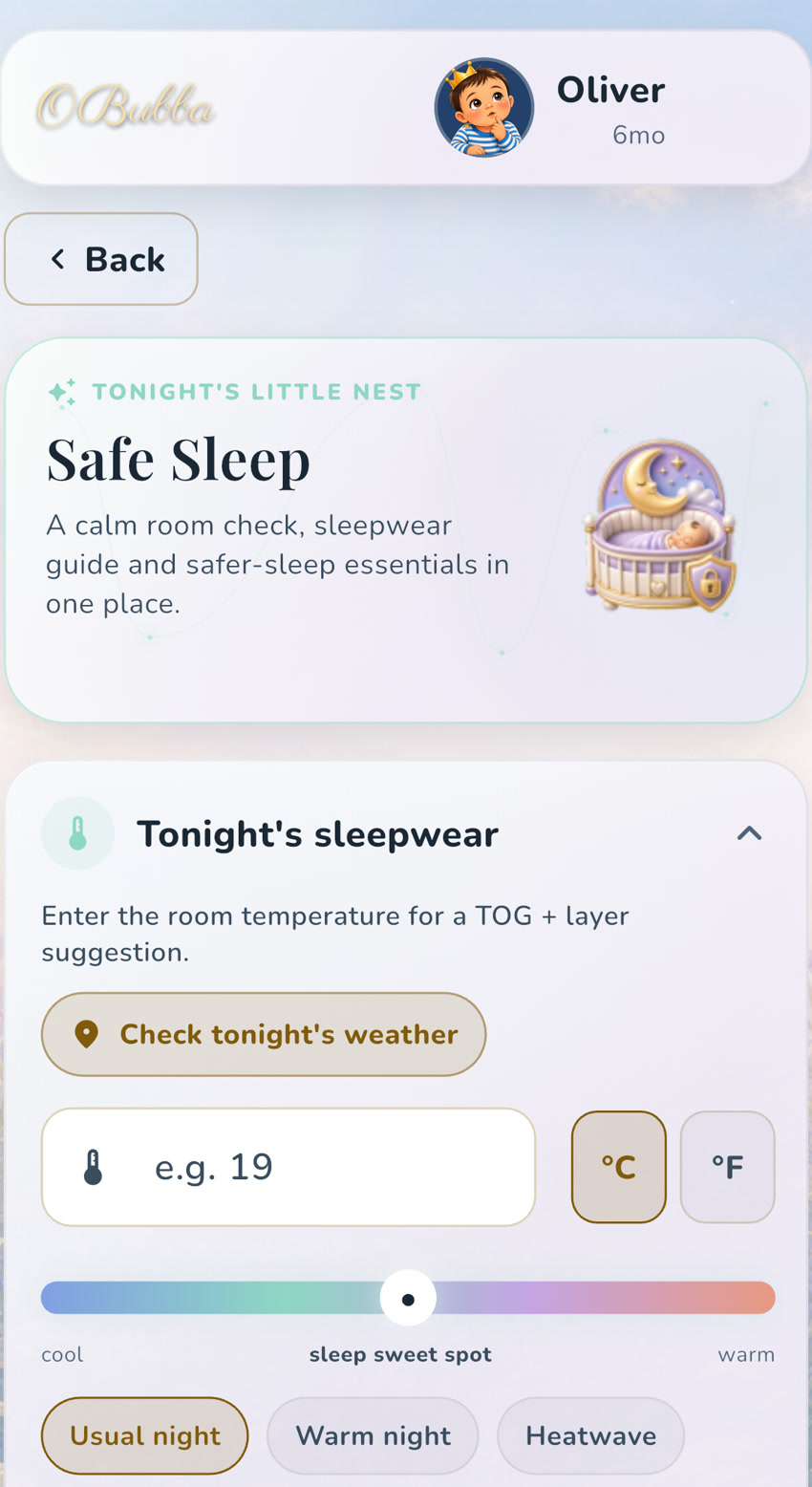
Enter the room reading and OBubba returns a colour-coded starting point for:
- the temperature band
- a sleeping-bag TOG range
- fitted clothing layers
- the main thing to check that night
Your last room temperature, unit and context are stored on the device so the setup survives leaving the screen. The Check tonight's weather button can add a warm-, mild- or cold-night nudge, but the app deliberately does not copy the outdoor temperature into the indoor field. The room reading still drives the sleepwear suggestion.
The wider Safe Sleep screen includes the reference table, clear-cot essentials and reminders to check the chest or back of the neck. OBubba does not measure the nursery temperature, the baby's body temperature or the actual insulation of a sleep bag. It cannot know whether one manufacturer’s “1.0 TOG” product fits or performs like another.
Use the result to reduce late-night guesswork, then apply the product instructions and the real-world check: room, layers, baby. If they disagree, respond to the baby and current professional guidance—not the app's colour band.
Try OBubba free → — sleep tracking, room-temperature guidance and calmer bedtime decisions in the same baby-care app.
Sources and further reading
- NHS Best Start in Life: Safer sleep advice for babies
- NHS: Sudden infant death syndrome (SIDS)
- The Lullaby Trust: Room temperature
- The Lullaby Trust: Hot weather
- NHS: Drinks and cups for babies and young children
- NHS: High temperature (fever) in children
OBubba supports tracking, routines and parent education. It does not measure room or body temperature, certify sleepwear, diagnose illness, replace the manufacturer's instructions or make an unsafe sleep environment safe.
Ready to try OBubba?
Use OBubba to track feeds, sleep, naps, nappies, growth, milestones and family handovers in one calm baby tracker app.