It is 2am at your destination. Your baby is wide awake, smiling as though the day has started, while every adult in the room is pleading silently with the curtains to stay dark. By lunchtime, the same baby can barely keep their eyes open.
Baby jet lag is a mismatch between the body clock and the local clock after crossing time zones. You cannot switch it off in one night, but you can make the new time easier to learn: use local daylight, meals, feeds, naps and the bedtime routine as consistent clues, while protecting enough sleep to avoid a spiral of overtiredness.
For a trip across several time zones, start nudging the routine two or three days before departure if practical. On arrival, move daily anchors toward destination time, allow a short rescue nap when needed and expect imperfect nights. Keep every sleep safe, even when everyone is exhausted.
A quick baby jet-lag plan
| When | What to do | Why it helps | |---|---|---| | 2–3 days before an eastward trip | Move bedtime, wake time and meals 15–30 minutes earlier each day | Begins moving the rhythm toward the earlier destination clock | | 2–3 days before a westward trip | Move the routine 15–30 minutes later each day | Begins moving the rhythm toward the later destination clock | | During the journey | Use destination time as a loose guide; offer feeds, comfort and sleep responsively | Starts introducing the new pattern without expecting a perfect flight | | Local morning | Open curtains and get outside in daylight | Light is a powerful body-clock signal | | Local daytime | Offer feeds, meals and activity around local times | Daily routines reinforce the new time zone | | Overwhelming daytime sleepiness | Use a short rescue nap rather than forcing a distressed baby awake | Takes the edge off without turning the whole local day into night | | Local evening | Dim lights and repeat the familiar bedtime sequence | Familiar cues say “night” even in a strange room | | Night waking | Keep responses calm, dark and boring; feed when genuinely needed | Meets the baby's needs without turning 2am into playtime | | Coming home | Return to home daylight, meals and routine, then repeat the process | The body clock must adjust again after the return flight |
This is a flexible framework, not a promise about how many nights adjustment will take. Age, sleep debt, direction, number of time zones, temperament, illness and the length of the trip all matter.
What does jet lag look like in a baby?
The CDC defines jet lag as temporary desynchronisation between the internal biological clock and local time after rapid travel across time zones. In adults it can affect sleep, alertness, mood and digestion. Babies cannot describe that feeling, so parents see the changed pattern.
Possible signs include:
- waking for a long, cheerful stretch in the middle of the local night
- falling asleep much earlier or later than local bedtime
- unusually early waking
- longer or more frequent daytime naps
- fussiness and difficulty settling
- feeds or hunger appearing at home-time hours
- temporary appetite or bowel-pattern changes
- a familiar routine seeming to stop working
Jet lag is not the only explanation for poor sleep on holiday. An unfamiliar room, heat, noise, teething, illness, missed naps and a busy day can all contribute. If your baby has a fever, breathing difficulty, repeated vomiting, signs of dehydration, unusual lethargy or another concerning symptom, seek medical advice rather than assuming it is the time zone.
How long does baby jet lag last?
There is no dependable baby-specific “one day per time zone” rule. The number is a planning shorthand, not a deadline.
Adults often adapt more easily westward than eastward because moving bedtime later tends to fit the natural tendency of the body clock better. The CDC cites average adult adjustment rates of roughly 1.5 hours per day westward and one hour per day eastward, but those figures are not infant predictions.
For a baby, think in ranges:
- a one-hour clock change may be barely noticeable or take a few days
- a two- or three-hour shift may disrupt naps and bedtime without producing a fully reversed night
- a large eastward or westward trip can take several days or longer to feel settled
- the return journey creates another adjustment
Improvement is rarely linear. Night two can be harder than night one after the excitement and accumulated tiredness of travel.
East versus west: which way should the routine move?
Travelling east
The destination clock is ahead. A local 7pm bedtime may feel like afternoon to the baby's body. Before travel, move bedtime and wake time earlier in small increments where possible.
At the destination, morning daylight and a local morning feed help establish that the new day has begun. Evening should become dim and quiet at local bedtime.
Travelling west
The destination clock is behind. Local evening can feel like the middle of the night. Before travel, move the routine later in small increments.
On arrival, daylight and gentle activity later in the local day can help the baby remain awake until a reasonable bedtime, but do not push a young, distressed baby through hours of exhaustion merely to reach the clock time.
Crossing only one or two hours
For a longer stay, most families can move directly onto local time and let routine cues do the work. For a very short trip, partially keeping home time may be less disruptive, but only if it fits meals, daylight, accommodation and family plans.
Do not build a complicated schedule for a difference your baby has barely noticed.
What to do before travelling
The American Academy of Pediatrics advises adjusting a child's sleep schedule for two or three days before departure. With a baby, small shifts are usually more realistic than moving everything by an hour overnight.
Start with the anchors
Move these together by 15–30 minutes each day:
- morning wake and first bright light
- first milk feed or breakfast
- naps
- evening meal or final feeds
- bedtime routine and bedtime
If naps vary from day to day, anchor morning and bedtime first. A perfect pre-flight schedule is not required for the trip to go well.
Protect sleep before the journey
Do not deliberately exhaust your baby in the hope they will sleep through the flight. Sleep loss can make settling harder, and a travel day already contains queues, noise, missed cues and unfamiliar handling.
Aim for an ordinary-enough day, accept a contact or pram nap if that is what travel logistics allow, and pack the bedtime cues that are safe and portable.
Pack cues, not an entire nursery
Useful familiar signals include:
- the usual sleeping bag in the correct TOG for the destination room
- the normal short bedtime book
- the same quiet song or phrase
- white noise used at a safe volume and distance
- fitted travel-cot sheets that match the correct mattress
Do not add sleep positioners, nests, cot bumpers, pillows or weighted products to make an unfamiliar cot feel cosier.
What should happen on the flight?
A flight is transport, not a controlled sleep laboratory. Follow the airline's infant-restraint and bassinet rules, keep feeds responsive and let sleep happen when it reasonably can.
Once you board, set one phone or watch to destination time. Use it as a gentle reference for light, feeds and sleep, not as a reason to deny a hungry or exhausted baby.
Practical steps:
- offer breast, bottle or a dummy during descent if your baby wants it; swallowing can help equalise ear pressure
- change nappies before the cabin becomes dark if practical
- use normal sleep clothing rather than overdressing for a cold-feeling cabin
- keep the face clear and check for overheating
- avoid forcing a baby to stay awake for hours
- keep medicines in hand luggage with their original labels
The CDC says air travel is safe for most infants and children, but babies with chronic heart or lung conditions, sickle cell disease or current respiratory symptoms may need clinical advice before flying.
The first local morning matters
Light is the clearest external signal for the body clock. Open the curtains when you want local morning to begin and, if practical, spend some time outside.
The goal is ordinary daylight, not staring into strong sun. Protect the baby from UV exposure and heat. Morning light can be combined with a feed, walk or breakfast so several daily anchors arrive together.
If your baby woke at 3am, you do not have to begin a bright, playful day then. Keep the environment dim and calm until a survivable local morning time. The first days may require compromise, such as starting at 5:30am rather than insisting on 7am.
Use feeds and meals as time cues
Milk remains responsive. A hungry baby should be fed, including at an inconvenient body-clock hour. Jet-lag adjustment is not a reason to stretch feeds beyond what is appropriate for the baby's age or feeding plan.
During local daytime:
- offer normal milk feeds responsively
- serve solids near local breakfast, lunch and evening-meal times
- offer water with meals once solids have started
- use a highchair or upright safe feeding position
- keep familiar foods available while appetite adjusts
At local night, keep necessary feeds quiet and low-lit. Feed, burp or hold as needed without adding bright screens or a long play session.
Travel can also change nappies and digestion. Track the overall picture of feeds, wet nappies, stools and alertness rather than worrying about one smaller meal.
Should you wake a jet-lagged baby from a nap?
Sometimes, but gently and selectively.
A very long late-day sleep can preserve the home-time “night” and make local bedtime harder. However, preventing all daytime sleep can create an overtired baby who also cannot settle.
Use this decision guide:
- How young is the baby? Newborn sleep is irregular; rigid nap capping is inappropriate.
- How much sleep was lost? A baby who slept almost nothing during travel needs recovery.
- How late is the nap locally? A long sleep near bedtime is more likely to shift the night.
- Can you wake gently? Open curtains, speak softly, change the nappy and offer a feed rather than startling them.
- What happens after waking? Use daylight and calm activity, then bring bedtime slightly earlier if needed.
For an older baby, a short rescue nap can bridge to local bedtime. If the baby is ill, premature or follows a clinician-led schedule, use that individual advice.
Keep bedtime familiar but flexible
The clock time is new; the sequence does not have to be.
A short travel bedtime might be:
- dim the room
- feed
- fresh nappy and sleepwear chosen for the room temperature
- one familiar story or song
- cuddle and the usual settling method
- place baby on their back in the clear sleep space
You may need to provide more support than at home. Holding, rocking or feeding more often during the first nights does not erase every sleep skill. Once the baby's clock and environment feel familiar, you can move gradually back toward the usual settling pattern.
What to do during a 2am jet-lag party
First, check ordinary needs: hunger, nappy, temperature, illness, pain and the sleep environment.
Then keep “night” consistent:
- use the lowest practical light
- keep voices soft and interaction boring
- avoid television and phone light near the baby
- feed if needed
- offer calm settling without repeatedly checking the clock
- take turns with another caregiver if possible
If your baby is fully awake and becoming distressed by endless attempts to force sleep, use a quiet reset: hold them in a dim room, read one calm book or sit together briefly, then try again. The aim is not to reward waking; it is to avoid turning the whole night into a battle.
Safer sleep still applies on holiday
Extreme parental tiredness can make improvisation tempting. Plan the sleep space before arrival.
The Lullaby Trust's holiday guidance recommends following safer-sleep principles for every sleep, day and night. A suitable travel cot should have its original firm, flat mattress in good condition, with no added folded blanket, quilt or unofficial replacement mattress that creates gaps.
Check hotel or borrowed equipment before use:
- mattress firm, flat, waterproof and undamaged
- fitted sheet secure
- no pillows, duvets, bumpers, nests or toys
- cot away from blind cords, heaters and direct sun
- room temperature checked
- baby placed on their back
- baby in the same room as a caregiver for the first six months
A thin travel-cot mattress can look uncomfortable to an adult but is designed that way. Do not pad it.
Can you give a baby melatonin for jet lag?
Do not give a baby melatonin, an antihistamine or another sedating product for jet lag unless an appropriate clinician has specifically assessed the child and prescribed or advised it.
In the UK, melatonin is prescription-only. The NHS notes that specialists sometimes prescribe it for longer-term sleep problems in some children; that is not the same as an over-the-counter baby jet-lag remedy.
Adult jet-lag pages may discuss melatonin, caffeine or sleeping tablets. Those sections are not dosing guidance for infants. Avoid gummies or products bought online, and never use medicine merely to make a baby sleep during a flight.
How to handle the return journey
Coming home is another time-zone change, not an instant return to normal.
On the first home morning:
- open curtains and get local daylight
- resume home meal and milk patterns
- place naps approximately back on the home clock
- keep any rescue nap short enough to preserve bedtime
- restart the familiar bedtime sequence
Do not expect the first night home to prove whether the holiday “ruined sleep”. Unpack, recover and give the body clock several consistent days.
If the sleep disruption continues well beyond the expected adjustment, look again for illness, teething, a developmental change, an unsuitable schedule or a new sleep association rather than attributing everything to the flight.
Common baby jet-lag mistakes
Keeping the room dark all morning
Morning daylight helps identify the start of the local day. Use shade for sun safety, but do not recreate night until midday.
Forcing local time from the first minute
The destination clock is a direction, not a test. A hungry, exhausted baby still needs feeding and sleep.
Letting one nap become the whole local day
Recovery sleep matters, but an older baby's five-hour late-afternoon sleep can make local night much harder. Use a shorter rescue nap when appropriate.
Changing every settling method at once
Travel already changes light, sound, smell and space. Keep familiar bedtime cues where you can.
Using adult jet-lag medication advice for a baby
Never translate an adult dose or internet gummy recommendation into infant care.
Abandoning safer sleep because it is only one night
Fatigue and unfamiliar accommodation increase the need to inspect the cot and plan where everyone will sleep.
How the current OBubba app helps
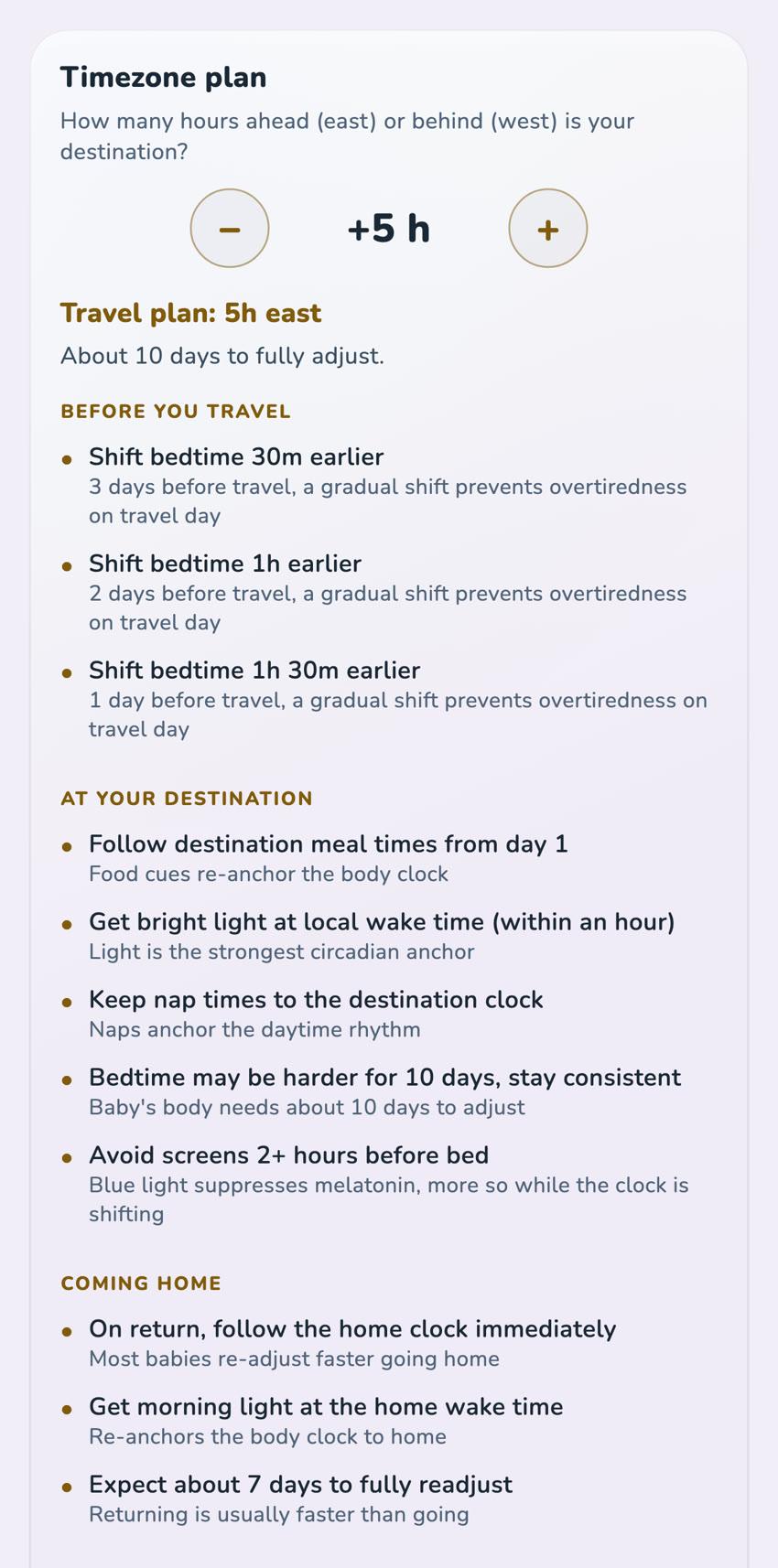
OBubba's Care → Travel → Timezone plan gives the family one place to hold the direction of travel and the next useful anchors.
The current implementation:
- accepts a destination from 12 hours behind to 12 hours ahead of home
- distinguishes eastward from westward travel
- creates 30-minute pre-travel bedtime shifts for up to three days
- recommends destination meal times from day one
- prompts bright light near local wake time
- keeps naps on the destination clock as a planning anchor
- includes a coming-home sequence
- saves one active plan on the device when the parent taps Start this plan today
- shows live “day N of about M” progress after saving
Its “days to fully adjust” figure is deliberately conservative planning maths: the offset divided into 30-minute daily steps. It is not a sensor reading, diagnosis or prediction of when a particular baby's circadian rhythm will settle. A five-hour offset therefore displays about ten days, even though one baby may feel much better sooner and another may take longer.
The app also cannot know the flight itinerary, whether the baby slept onboard, how bright the morning was, whether a nap happened or whether illness is driving the waking. It does not automatically observe or confirm that any suggested step happened. Parents should adapt the plan to the real child, keep milk feeds responsive and seek clinical advice when symptoms are concerning.
The value is continuity: the direction, small shifts, destination anchors and return plan remain visible when a tired parent can no longer remember whether “east means earlier”. The Travel planner is free. Premium adds deeper personalised sleep analysis and planning after the early-free period. The whole app is unlocked during pregnancy and through your baby's first two corrected-age months.
Build a gentler timezone plan → Keep the time-zone plan beside naps, feeds, nappies, weaning and tonight's wider sleep context.
A two-minute travel-sleep checklist
Before departure:
- Calculate the destination offset from home.
- Decide whether a short trip needs full adaptation.
- Shift the routine by 15–30 minutes for two or three days if useful.
- Confirm the travel cot or hotel cot before arrival.
- Pack the sleeping bag, fitted sheet and familiar short routine cues.
- Keep necessary medicines and feeding supplies in hand luggage.
At the destination:
- Start local morning with daylight.
- Offer meals and activity on the local clock.
- Keep milk feeds responsive.
- Use a short rescue nap when needed.
- Dim the evening and repeat the familiar bedtime sequence.
- Keep every sleep space firm, flat and clear.
The bottom line
Baby jet lag is a body-clock mismatch, not a parenting failure. Use local daylight, feeds, meals, naps and bedtime cues to make the destination clock predictable. Shift gently before a big trip, avoid creating extreme overtiredness and expect a few imperfect nights.
Do not use adult medication advice on a baby. Do not relax safer-sleep standards because the room is temporary. And remember to plan for the journey home.
OBubba can keep the east/west direction and daily anchors clear. Your baby, not the estimate, is the measure of how quickly to move.
This article offers general information for healthy babies and is not a substitute for advice from your GP, health visitor, paediatrician, neonatal team, travel clinic or another qualified professional. Seek advice before flying with a very young newborn or a baby with heart, lung or other medical conditions, and seek urgent help for breathing difficulty, unusual lethargy, dehydration or serious illness.
Ready to try OBubba?
Use OBubba to track feeds, sleep, naps, nappies, growth, milestones and family handovers in one calm baby tracker app.