Introducing egg, peanut or yoghurt can make an ordinary spoonful feel like an exam. Which food was it? How much did your baby eat? Was that redness already there? And once a food goes well, how do you remember to serve it again?
The short answer: begin when your baby is ready for solids, usually around six months; introduce foods that can trigger allergy one at a time and in very small amounts; use an age-appropriate form; and record only the food, time, amount and response. If tolerated, keep the food in your baby's usual varied diet. If your baby has eczema, an existing food allergy or a strong family allergy history, speak to your GP or health visitor first.
First, check that your baby is ready for solids
Allergen introduction belongs inside ordinary weaning, not before it. NHS guidance says the three readiness signs should appear together from around six months:
- your baby can stay sitting and hold their head steady
- they can coordinate their eyes, hands and mouth to bring food to their mouth
- they can swallow food rather than pushing it back out
Night waking, chewing fists or wanting extra milk are not readiness signs by themselves. Milk remains important during the first year, and starting solids does not make a baby more likely to sleep through.
If your baby was born prematurely, ask your health visitor or clinical team how corrected age applies. If they already have diagnosed food allergy or eczema, or your family has a history of food allergy, eczema, asthma or hay fever, get individual advice before introducing allergenic foods.
“One at a time” is about clarity, not fear
The NHS recommends introducing foods that can trigger allergic reactions one at a time and in very small amounts. This makes any response easier to connect to the food.
Choose a day when:
- your baby is well
- you can watch them rather than rushing out
- the rest of the meal is familiar
- another brand-new allergenic food is not being introduced at the same sitting
Offer a tiny taste, then continue only if your baby remains comfortable. Do not smear food on their skin as an allergy test. Skin contact does not reproduce eating the food and can create confusing redness around the mouth.
The aim is not to race through a checklist. One calm, traceable introduction is more useful than several new ingredients in a complicated recipe.
Which foods are usually introduced?
NHS infant-weaning guidance includes:
- cows' milk in cooking or mixed into food
- egg
- foods containing gluten, including wheat, barley and rye
- nuts and peanuts, served crushed, ground or as safely thinned smooth butter
- seeds, served crushed or ground
- soya
- fish
- shellfish, fully cooked rather than raw or lightly cooked
Other foods can also cause allergy. The UK's 14 regulated allergen groups are a food-labelling framework used on packaged and catered food: celery, cereals containing gluten, crustaceans, egg, fish, lupin, milk, molluscs, mustard, tree nuts, peanuts, sesame, soya and sulphites above the legal threshold.
That 14-group label list is useful when reading ingredients and keeping records. It is not a universal order in which every baby must deliberately eat all 14. Use NHS weaning advice and any plan from your baby's clinician to decide what is appropriate.
Safe first forms matter as much as the ingredient
An allergy-safe introduction still needs to be choking-safe.
Egg
Offer cooked egg in a texture your baby can manage, such as a little mashed hard-boiled egg, well-cooked scrambled egg or a soft strip of fully cooked omelette. Follow current UK egg-safety advice for the eggs you use.
Peanut and tree nuts
Never offer whole nuts to a baby. Thin smooth nut butter with warm water or your baby's usual milk, or stir a small amount through a familiar purée or porridge. A thick spoonful of nut butter is a choking hazard.
Milk
Pasteurised full-fat plain yoghurt or cows' milk mixed into food can be offered from around six months. Cows' milk should not replace breast milk or first infant formula as the main drink before 12 months.
Fish and shellfish
Cook thoroughly. Remove every bone from fish and prepare a texture your baby can manage. Do not serve shellfish raw or lightly cooked.
Sesame and seeds
Use finely ground seeds or smooth tahini thinned into a familiar food. Avoid thick sticky spoonfuls.
Always sit your baby upright, supervise closely and learn the difference between gagging and choking. Allergy symptoms and choking require different responses.
What should an allergen record include?
Keep the first-taste record short enough that you will actually use it:
- exact food and ingredients
- preparation, such as well-cooked egg or thinned smooth peanut butter
- date and time
- approximate amount offered and eaten
- any symptoms and when they began
- a photo of a visible symptom, if safe and useful
- what advice you sought and what you were told
For a packaged food, retain or photograph the ingredients label and batch information if there is a suspected reaction. “Porridge” is less useful than “oat porridge made with cows' milk and smooth peanut butter.”
Do not use an unsettled night, a normal change in poo or a single refusal as proof of allergy. Record what happened without diagnosing the cause.
What can a food-allergy reaction look like?
Allergic reactions often happen within minutes and can occur within two hours, although some — including some cows' milk reactions — may be delayed.
Possible symptoms include:
- swollen lips or face
- an itchy raised rash or worsening eczema
- red, itchy or watery eyes
- coughing, wheezing or breathing difficulty
- vomiting, tummy pain, diarrhoea or constipation
- a runny or blocked nose
Stop the food if you think your baby is reacting and seek medical advice. Do not re-offer a suspected food to “check” the reaction unless a qualified professional has told you how to proceed. A diary can support a clinical conversation; it cannot confirm an allergy.
When to call 999
Call 999 immediately in the UK if your baby has signs of a severe allergic reaction, including:
- sudden swelling of the lips, mouth, throat or tongue
- very fast or difficult breathing, wheezing, choking or gasping
- a tight throat or difficulty swallowing
- blue, grey or pale lips, tongue or skin
- unusual floppiness, drowsiness or unresponsiveness
If your child has a prescribed adrenaline auto-injector, follow their allergy action plan, use it as instructed and call 999 even if they appear to improve.
A tolerated food is not “finished”
Once a food has been introduced and tolerated, NHS guidance recommends keeping it in your baby's usual varied diet. That is the part parents most often lose track of: the first taste is memorable, while the ordinary repeat serving disappears into the week.
You do not need to turn meals into a laboratory. Put tolerated foods into familiar rotations — egg at breakfast, yoghurt with fruit, thinned nut butter in porridge, fish in a family meal — using portions and textures that suit your baby.
If your baby refuses a food, that is not an allergic reaction. Keep the meal pressure-free and offer it another time unless there was a suspected reaction or you have been advised to avoid it.
A simple four-week rhythm
This is an organisational example, not a medical prescription:
- Choose one suitable new allergenic food from your baby's individual plan.
- Offer a very small amount in a safe form on a calm day.
- Record the food and response.
- If tolerated, include it again as part of the usual diet while introducing other foods one at a time.
The important pattern is introduce, observe, record, repeat if tolerated. There is no prize for completing a grid quickly.
How OBubba reduces the mental load
In the current app, Care → Weaning → Allergen journey keeps a living record alongside the Food journal. When you log solids, OBubba can recognise common allergen ingredients in the food name and add the relevant groups to the journey. You can also mark a food introduced before you began tracking.
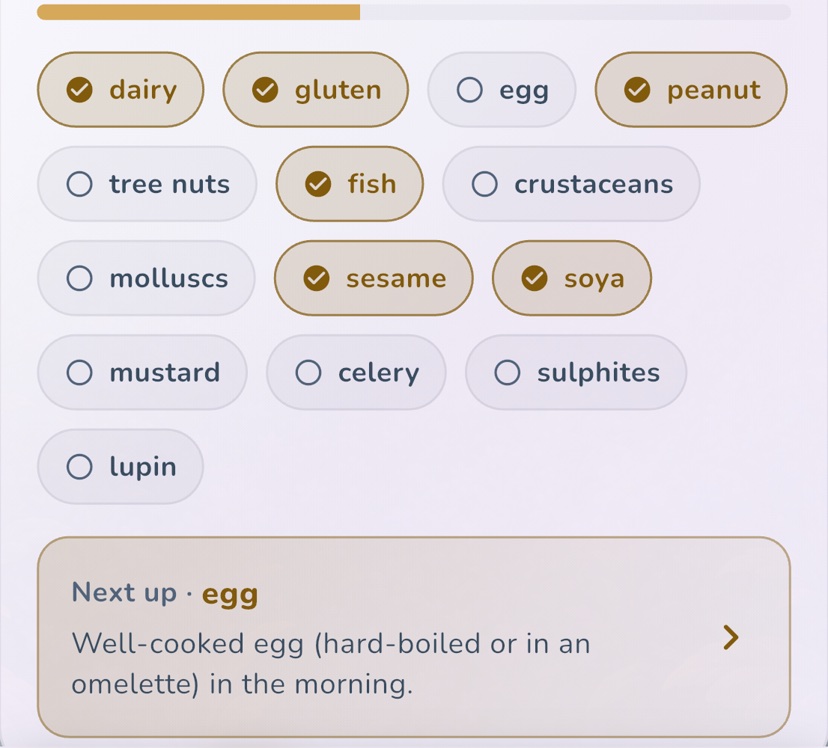
The app keeps introduced groups in the baby's long-term record. If a reaction is logged, that group is kept visible and filtered from future recipe and first-food suggestions; the screen tells the parent to pause and seek medical advice before offering it again. The First Foods guide adds serving and choking-safety prompts, while the weekly meal plan can help bring tolerated foods back into ordinary meals.
OBubba's 14-group view mirrors the broader UK labelling framework. It does not mean your baby needs every group on a fixed schedule, and automatic ingredient recognition cannot replace checking the packet or advice from an allergy professional.
Try OBubba free → — first foods, ingredients, reactions and tolerated-food reminders alongside the rest of your baby's day.
Sources and further reading
- NHS Best Start in Life: Introducing foods that could trigger an allergic reaction
- NHS: Food allergies in babies and young children
- NHS: Food allergy
- NHS Best Start in Life: Foods and drinks to avoid
- GOV.UK: Understanding allergen labelling
OBubba is a tracking and education tool, not medical advice or an allergy test. If you suspect a food allergy, speak to your GP, health visitor or allergy team. Call 999 for signs of a severe reaction.
Ready to try OBubba?
Use OBubba to track feeds, sleep, naps, nappies, growth, milestones and family handovers in one calm baby tracker app.