With twins, the difficult question is rarely “Did a baby feed?” It is “Which baby, how much, and was that the feed I already wrote down?”
At 2am, two similar vests, two half-finished bottles and a change of carer are enough to scramble a confident memory. The answer is not to document every breath. It is to build a tiny shared system that still treats each baby as an individual.
> Keep one household rhythm, but two baby records. Before starting a timer or saving an event, check the active baby's name. Copy an event to both only when it truly happened to both.
That rule makes the log useful for handovers without forcing twins into matching feeds, naps or milestones.
The quick twin-tracking rule
| Event | Usually log separately? | Why | |---|---:|---| | Breastfeed, bottle or tube feed | Yes | Side, duration, volume, tolerance and advice can differ | | Nap, bedtime or night wake | Yes | One twin may settle, wake or finish sleeping earlier | | Wet or dirty nappy | Yes | Output is part of each baby's feeding and wellbeing picture | | Medicine or dose | Always | Baby, medicine, dose and time must never be assumed from a shared entry | | Temperature, symptom or reaction | Always | The observation belongs to the baby who had it | | New food or allergen | Always | Readiness, amount eaten and reactions can differ | | Weight, tooth or milestone | Always | Development is individual, even for twins | | A shared care moment | Sometimes | Copy only if the same event genuinely happened to both |
“Log for all” should mean this happened to both babies, not I want their days to look the same.
Set up the system before the next tired handover
The best twin log starts outside the app. Give each baby one unmistakable visual cue and use it everywhere: for example, sage for Amara and lavender for Bea. Put the colour on bottle labels, the paper note by the changing mat and the family shorthand in messages. Do not rely only on “Twin 1” and “Twin 2” if carers are more likely to remember names.
Then agree on three house rules:
- Look at the baby, then the active record. Say the name in your head before tapping start.
- The person who finishes the task saves it. This reduces two carers logging the same bottle.
- Correct uncertainty honestly. “About 70 ml” or a note that a time is approximate is more useful than invented precision.
Keep the physical setup simple too. Give unfinished bottles a labelled place. Keep separate nappy-change markers if output is being monitored. During a handover, say the exceptions first: “Bea fed at 1:40; Amara is still due,” rather than reciting the whole day.
What matters enough to track?
In the newborn period, a minimal record often includes:
- feed time, type and any measured amount
- breastfeeding side or pumping details when these help the feeding plan
- wet and dirty nappies for each baby
- sleep start and finish if sleep is currently useful to understand
- medicines and doses, recorded with extra care
- symptoms, temperatures or instructions from the maternity or neonatal team
You may need more detail when a baby was premature, is gaining weight slowly, is jaundiced, has a feeding plan or is still under neonatal follow-up. Use the fields your clinical team asks for; an app template is not a substitute for their plan.
You may also need less. If both babies are thriving and detailed sleep entries are making family life harder, keep only the information that changes a decision or improves a handover.
Feeds: coordinate the opportunity, not the outcome
The NHS guide to feeding twins and multiples explains that families may feed together, separately or responsively. There is no single arrangement that suits every pair or every stage.
If both babies cue at once, a simultaneous feed may be practical once you have safe positioning and support. If one feeds more effectively, needs a different teat, tires sooner or follows a top-up plan, separate entries keep that difference visible.
For each measured bottle, record the amount that baby actually took, not the amount prepared for both. For breastfeeding, duration and side can jog memory, but minutes do not measure milk transfer. Look at active swallowing, attachment, comfort, nappies and the growth picture, and seek feeding support when concerned.
Avoid a shared feed entry unless the event really is identical enough to remain useful. Even when both began at 10:00, one baby may stop at 10:12 and the other continue. Two records let you correct the finishes without rewriting a fictional synchronized feed.
A practical simultaneous-feed note
When the moment is hectic:
- start or note the first baby's feed
- start the second baby's record when their feed actually begins
- label measured bottles before feeding
- save what happened, not what was planned
- add one short note for the exception: “sleepy after 40 ml” is more useful than a paragraph
If keeping the phone open is unsafe or distracting, feed first and add an approximate entry afterwards. Baby care takes priority over a perfect timestamp.
Nappies: make “whose was it?” answerable
A wet or dirty nappy can become anonymous surprisingly quickly. Log it while the baby is still at the changing place, or move a named physical marker that reminds the next carer to add it.
Individual nappy records are especially useful when clinicians have asked you to watch hydration, stool colour or feeding effectiveness. If you accidentally lose track once, write “uncertain” in the handover rather than assigning it to the twin who has fewer entries.
Seek professional advice based on the baby in front of you, not on whether an app chart looks neat. A baby who is difficult to wake, feeding poorly, has noticeably fewer wet nappies, seems dehydrated or appears unwell needs prompt assessment. Follow your maternity or neonatal discharge instructions; contact your midwife, health visitor, GP or NHS 111 when concerned, and call 999 in an emergency.
Sleep: twins can share a routine without sharing a clock
The NHS twins and sleep guidance notes that a routine may help, while sleep can be more complicated when babies were premature, feed frequently or have several carers. It suggests that some families try to coordinate night feeds early on, but one twin may begin sleeping through before the other.
That is the useful middle ground: offer familiar anchors such as morning light, feeds, winding down and bedtime, without treating one baby's wake as proof the other must wake too.
Log sleep separately because:
- one baby may fall asleep before the other
- one may wake briefly while the other remains asleep
- nap lengths can diverge even when they start together
- illness, teething, feeding or development can affect only one twin
- one baby's “night” context may already have begun while the other's has not
Separate data prevents a synchronized-looking chart from hiding the baby who is regularly waking, missing feeds or struggling to settle.
Safe sleep matters more than coordination. Put each baby down on their back for every sleep, use a firm, flat, clear sleep space, keep the room smoke-free and follow current safer-sleep guidance. The NHS advises that babies sleep in the same room as a parent for the first six months. If you are considering co-bedding twins, follow the specific NHS guidance and the advice of your maternity or neonatal team, especially if either baby was premature or small at birth.
Weaning: same birthday does not mean same readiness
Twins commonly reach the weaning season together, but they do not become ready on the same morning. The NHS advises starting solid foods at around six months and looking for developmental signs together: staying in a sitting position with a steady head, coordinating eyes, hands and mouth to pick up food, and swallowing food rather than pushing it back out.
One twin may show these signs before the other. The NHS feeding twins guidance explicitly notes that one baby may be ready for solids before their sibling.
Keep each baby's food and allergen record separate. Log what that baby ate and any reaction. Never copy an allergen exposure, symptom or medicine entry to a sibling because they sat at the same meal.
This is where individual records are more than organisation: they help you tell a clinician which baby had which food, when, and what followed.
How the actual OBubba app handles multiple babies
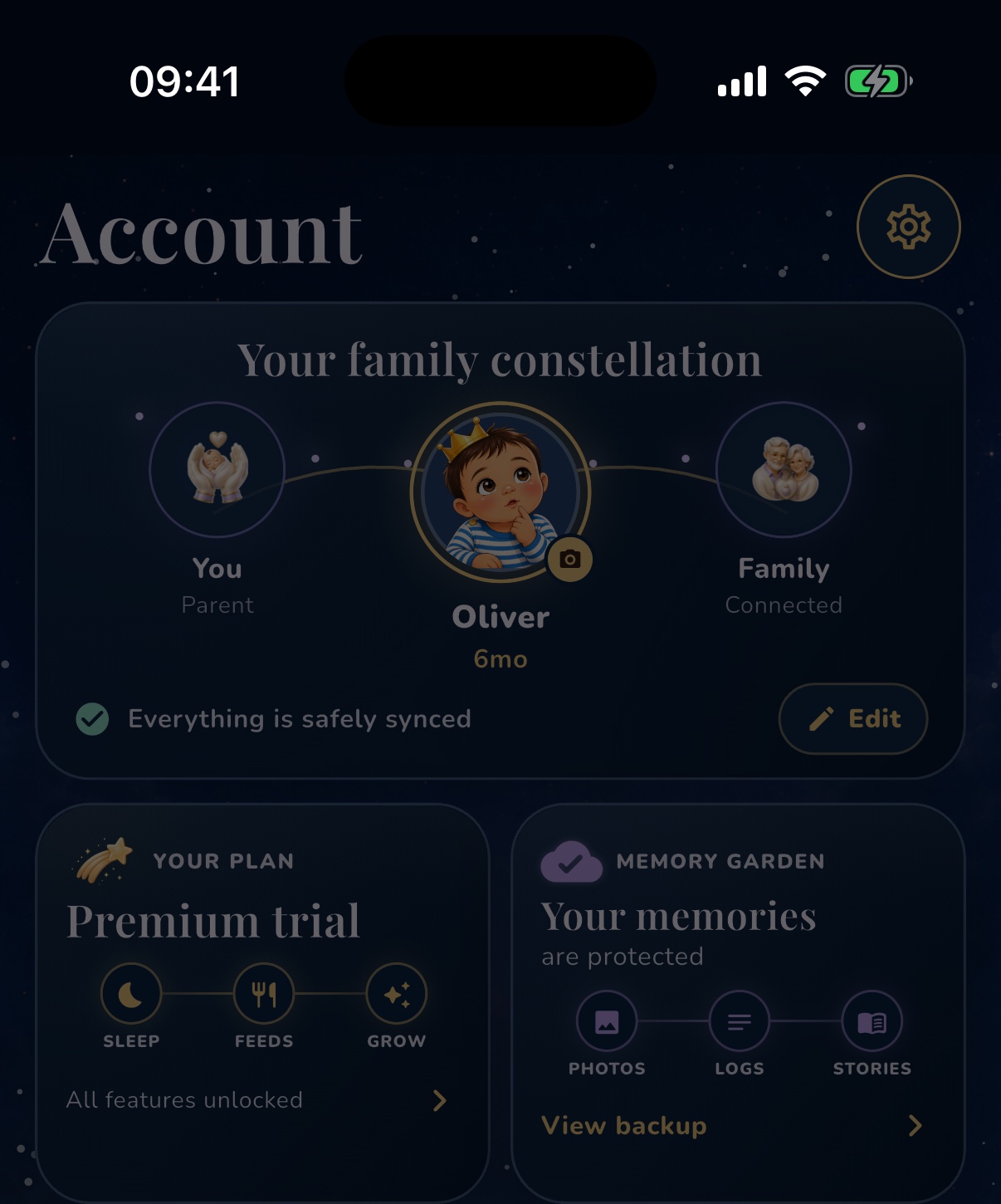
OBubba's current app stores a baby roster on the device and gives every child a stable identity. Two unnamed babies with the same birthday are not collapsed into one record just because their basic details match.
From Account → Babies, the active baby has a check mark. Tap Switch beside the other baby, or Add another baby to extend the family. The first baby is free; adding a second or more is part of Premium's unlimited-babies support.
The app's real tracking behaviour is deliberately child-aware:
- a live breastfeeding timer remains pinned to the baby who started it, even if you switch the active profile before saving
- an event copied with Log for all becomes a separate entry for each baby rather than one ambiguous shared object
- each copied event gets its own identity, so one can be corrected without silently rewriting the sibling's history
- sleep and night context are recalculated for each child, because twins may be out of sync
- Undo includes the sibling entries created by that action
- one failed sibling save does not pretend the entire group failed and invite duplicate retries
The same boundary continues beyond the daily log. Day tags, sleep history, sleep plans, night-weaning work, weaning readiness, milestones, teeth, photos and reminders stay attached to the relevant child.
That means a family can coordinate care without flattening the babies into a single average.
OBubba does not currently put both babies into one side-by-side dashboard. You switch the active baby when their entries differ and use Log for all only when the event genuinely matches. That extra name check is an important part of keeping each history clear.
Keep each baby's day clear in OBubba →. Start free with one baby's feeds, nappies, sleep and memories, then add unlimited babies with Premium when the multi-baby workflow fits your family.
When “Log for all” genuinely helps
Group logging is best for the narrow moments that truly happened together. Perhaps both babies had the same shared care moment, or you began an intentionally coordinated routine at the same recorded time.
Before using it, ask:
- Did this event happen to both babies?
- Are the important details genuinely the same?
- Would I be comfortable showing this entry to a clinician as part of either baby's history?
If any answer is no, log separately.
Do not use a group shortcut for medicines, temperatures, symptoms, allergic reactions, measured intake, growth or developmental milestones. With feeds and nappies, individual entries are usually clearer even when the events happen close together.
A handover that takes under one minute
A useful twin handover does not need a spoken spreadsheet. Use this order:
- Safety or clinical instructions: medicine due, symptoms, feeding plan or who needs waking.
- The next likely task: “Amara is due a bottle; Bea just finished.”
- The exception: “Bea's last nappy was dry,” or “Amara refused the new food.”
- Where the record lives: confirm that the incoming carer can see and update the right babies.
OBubba's connected-family view and child-specific records can support that handover, but the app cannot identify which baby is in your arms. The adult still checks the name before starting or saving.
What if you logged something to the wrong twin?
Correct it as soon as you notice. Do not create a second compensating entry and leave both in place if you can edit or remove the mistake; that makes totals harder to interpret.
Tell the next carer if the correction affects a medicine, measured feed, symptom or clinical plan. For a medicine error or uncertainty about whether a dose was given, do not guess or repeat the dose based on the chart. Check the medicine instructions and seek urgent professional or pharmacy advice appropriate to the situation.
An imperfect log is recoverable. Hidden uncertainty is the larger risk.
How to know whether tracking is helping
Keep the system if it helps your family answer real questions:
- Which baby is due the next feed or medicine?
- Did each baby have wet nappies?
- Is one twin waking much more often?
- Which food did each baby try?
- What changed before the difficult evening?
- Can a partner, grandparent or nursery worker take over without reconstructing the day?
Scale it back if carers spend more time reconciling timestamps than looking after the babies, or if normal variation starts to feel like competition. Twins are two developing people, not a matched experiment.
Frequently asked questions
Should I wake one twin when the other wakes to feed?
Some families coordinate feeds, particularly early on, but the right choice depends on age, prematurity, weight gain, feeding plans and what is workable. Follow your maternity or neonatal team's advice. Do not change a prescribed waking plan because an app predicts a longer stretch.
Should twins follow the same sleep schedule?
A shared rhythm can reduce family workload, but exact naps and nights may differ. Use common anchors where helpful and record actual sleep separately. One baby's pattern should not erase the other's cues.
Can I use one record and write both names in the notes?
That becomes difficult as soon as amounts, timings or symptoms diverge. Two child records are clearer, safer to hand over and more useful when reviewing one baby's history.
What if the twins have the same birthday and no names yet?
Give each a stable temporary label and colour, and use it consistently. OBubba uses a child identity behind the scenes, so siblings are not treated as the same baby merely because names or birth dates match.
Does OBubba keep a timer with the right baby if I switch profiles?
Yes. The current breastfeeding timer retains the child identity that started it. Profile switching does not silently move that running feed to the other baby.
Is a twin baby tracker a medical record?
No. It is a parent-held memory and handover tool. It cannot confirm intake, diagnose illness, verify a dose, assess safe sleep or replace neonatal, midwifery or medical advice.
Sources and further support
- NHS: Twins and sleep
- NHS: Feeding twins and multiples
- NHS: Your newborn twins
- NHS: Helping your baby to sleep
This UK-oriented article is general information, not individual feeding, sleep or medical advice. Follow the plan from your maternity or neonatal team, especially after premature birth or when weight gain, jaundice, medicines or feeding are being monitored. Contact your midwife, health visitor, GP or NHS 111 when concerned; call 999 in an emergency.
Ready to try OBubba?
Use OBubba to track feeds, sleep, naps, nappies, growth, milestones and family handovers in one calm baby tracker app.