You check the pregnancy app, then the maternity notes, then search the same symptom again. The answer reassures you for ten minutes, but the worry returns before breakfast.
Some worry and stress are common in pregnancy. Anxiety deserves support when it is difficult to control, keeps returning, or starts changing how you sleep, concentrate, work, eat, attend appointments or enjoy ordinary life. You do not need to wait until it becomes unbearable, and you do not need an app to confirm that it is “bad enough”. Tell your midwife or GP what is happening.
The aim is not to eliminate every uncertain thought. It is to notice when worry has stopped being useful information and started running the day.
Common worry or time to ask for help?
| What it may look like | A sensible next step | |---|---| | A specific worry that settles after reliable information or an appointment | note the question once, use one trusted source and bring it to the next routine conversation | | Worry that is there much of the time, difficult to control or affecting daily life | contact your midwife or GP; support is available and you will not be judged | | Panic attacks, repeated checking, avoiding appointments, severe fear of birth, distressing intrusive thoughts or anxiety that stops you functioning | ask for a prompt mental-health assessment rather than relying on self-help alone | | You think there is a risk you may harm yourself or your baby, or you cannot keep yourself safe | call 999 or go to A&E now; ask another person to stay with you and make the call if needed |
This is not a diagnostic table. Anxiety can sit beside depression, obsessive-compulsive symptoms, trauma, a previous mental-health condition, pregnancy loss, fertility treatment, a difficult pregnancy or practical pressures. A professional can help work out what kind of support fits.
What anxiety in pregnancy can feel like
The NHS describes perinatal anxiety as stress or worry that affects daily life and is difficult to control. It may show up as:
- feeling tense and unable to relax
- worrying about the pregnancy much of the time
- repeatedly seeking reassurance but not staying reassured
- struggling to concentrate or make ordinary decisions
- being unable to sleep because thoughts will not slow down
- avoiding scans, appointments, travel, food or normal activities because they feel unsafe
- palpitations, dizziness, teeth grinding or panic attacks
- imagining every bodily sensation as evidence that something is wrong
Pregnancy itself can also cause breathlessness, palpitations, dizziness, nausea and disrupted sleep. Do not automatically label a new or severe physical symptom as anxiety. Contact your maternity unit, midwife, GP or NHS 111 when you are unsure; call 999 for an emergency.
Why pregnancy creates so many convincing worries
Pregnancy combines uncertainty with responsibility. Your body changes quickly, advice can conflict, appointments carry emotional weight, and the person you most want to protect cannot tell you how they feel.
Common worry themes include:
- miscarriage, baby movements, scans or growth
- labour, pain, interventions or loss of control
- a previous difficult birth, pregnancy loss or fertility treatment
- medicines, food, exercise and accidental exposure to risk
- money, work, housing, relationships or parental leave
- whether you will bond with the baby or know what to do
- becoming unwell again after a previous mental-health difficulty
None of those worries makes you ungrateful. The important question is not whether the subject is understandable. It is whether the worry is proportionate, temporary and responsive to support, or whether it keeps demanding more checking and certainty than anyone can supply.
The one-question test
Ask:
> Is this thought helping me take one sensible action, or asking me to perform the same safety check again?
Useful worry may lead to one clear step: call maternity triage about reduced movements, write a question for the midwife, check one NHS page, or ask the pharmacist about a medicine.
Anxiety often refuses to close the loop. You call, receive reassurance, then search for an exception. You check a date, then check whether you checked it correctly. You avoid something safe because the feeling of uncertainty remains.
That pattern is worth describing to a professional. “I know I have been reassured, but I cannot stay reassured” is clinically useful information.
A ten-minute reset for a non-emergency worry
This is a pause before the next decision, not treatment and not a reason to delay maternity advice.
Minute 0 to 1: name the worry exactly
Write one sentence:
> “I am worried that ___ because I noticed ___.”
Separate what you observed from what anxiety predicts. “I have not felt movement since lunch” is an observation that needs action according to maternity guidance. “The baby will definitely be unwell because I ate one ingredient” is a prediction.
Minute 1 to 3: decide whether it belongs to maternity care
If the concern involves baby movements, bleeding, fluid loss, severe pain, a severe headache, vision changes, feeling very unwell or another pregnancy warning sign, use your maternity unit's advice now. A breathing exercise must never become a waiting test for an obstetric symptom.
For a mental-health crisis or risk of harm, call 999 or go to A&E. For urgent mental-health help that is not an immediate emergency, call NHS 111 and select the mental-health option where offered locally.
Minute 3 to 5: make the body a little less alarmed
Put both feet or your back against something supportive. Unclench your jaw. Breathe in gently, then let the out-breath be comfortable and unforced. Repeat for about a minute.
If counting helps, use a slow pattern. If breath-holding, deep breathing or focusing on the body makes you dizzy or more anxious, stop and breathe normally. Look around and name five things you can see instead.
Breathing can lower the volume enough to choose a next step. It cannot prove that you or the pregnancy are medically well, and it does not replace treatment for persistent anxiety.
Minute 5 to 8: choose one source and one action
Use the NHS, your maternity unit or a professional who knows your pregnancy. Avoid opening six forums to calculate a majority vote.
Choose one action:
- call the midwife or maternity triage
- ask for a GP appointment
- write the question for your next appointment
- ask a trusted person to stay with you while you call
- put the phone down and return to the next ordinary task
Minute 8 to 10: close the loop
Record the action, not another page of evidence: “Called triage at 14:20; advised ___.” Then stop searching unless the situation changes or you were told to monitor something specific.
If you cannot close the loop repeatedly, that itself is the reason to ask for anxiety support.
You do not have to wait two weeks
“See how you feel in a fortnight” is not a universal rule. The current NHS advice is to see a GP or midwife if you are pregnant and feel anxious all the time. Daily-life impact and difficulty controlling the worry matter more than reaching an arbitrary day count.
Ask sooner if:
- anxiety is affecting sleep, eating, work, relationships or appointments
- you are having panic attacks
- you are avoiding necessary pregnancy care
- checking, cleaning, counting or reassurance rituals take over the day
- a previous mental-health condition is returning
- you have stopped or changed prescribed medicine because of pregnancy worries
- intrusive thoughts are frequent, frightening or changing your behaviour
- the people close to you say you no longer seem like yourself
You can choose the professional who feels easiest: midwife or GP during pregnancy, and a health visitor after birth. The NHS perinatal mental-health support guide explains that they can refer to specialist community perinatal mental-health care where needed. In England, adults can also self-refer to NHS Talking Therapies in many areas.
What to say to the midwife or GP
You do not need to diagnose yourself. Try:
> “I am pregnant and worry is affecting my daily life. It happens most days, I am checking or seeking reassurance repeatedly, and it is affecting my sleep/concentration/appointments. I would like help with anxiety during pregnancy.”
Add:
- when it began and whether it is getting worse
- what the worry is making you do or avoid
- panic attacks or physical symptoms
- intrusive thoughts, even if they feel shameful or unlike you
- previous anxiety, depression, OCD, trauma, bipolar disorder or psychosis
- current and previous medicines or therapy
- whether you feel safe now
Questions are asked to find the right help, not to catch you out. NHS treatment may include cognitive behavioural therapy (CBT), delivered in person, online or by phone. If distress is more severe, a specialist can discuss other options, including the risks and benefits of medicine.
Do not stop a prescribed mental-health medicine suddenly because you discover you are pregnant. Speak to the prescriber promptly so the risks of treatment, changing treatment and untreated illness can be considered together.
What about intrusive thoughts?
An intrusive thought is an unwanted thought, image or impulse that arrives without permission. Having a frightening thought is not the same as wanting it or planning to act. Many people feel distressed precisely because the thought conflicts with what they value.
Still, tell a midwife, GP or mental-health professional. They can ask about the thought, the distress it causes, any compulsions or avoidance, and whether there is a safety risk. Hiding it tends to make the fear more powerful.
If you believe you may act on a thought, cannot keep yourself or the baby safe, have made a plan, or there is an immediate risk, call 999 or go to A&E now. The NHS explicitly advises emergency help when there is a risk of harm to yourself or your baby.
How a partner or trusted person can help
Support is more useful when it reduces the work of getting help.
- Listen without debating whether the worry is logical.
- Ask, “Do you want comfort, help checking one fact, or help making a call?”
- Sit beside them while they contact the midwife or GP.
- Take over practical tasks that protect food, rest, daylight and appointments.
- Avoid becoming an all-day reassurance service; repeated checking can keep the anxiety loop alive.
- If they may be unsafe, stay with them and get urgent help.
A partner can say: “This has been affecting your sleep and daily life for a week. We do not have to decide what it is. We can tell the midwife exactly that.”
How the real OBubba app supports pregnancy wellbeing
OBubba's current pregnancy experience gives the pregnant parent a visible place alongside the baby's week, appointments and preparation.
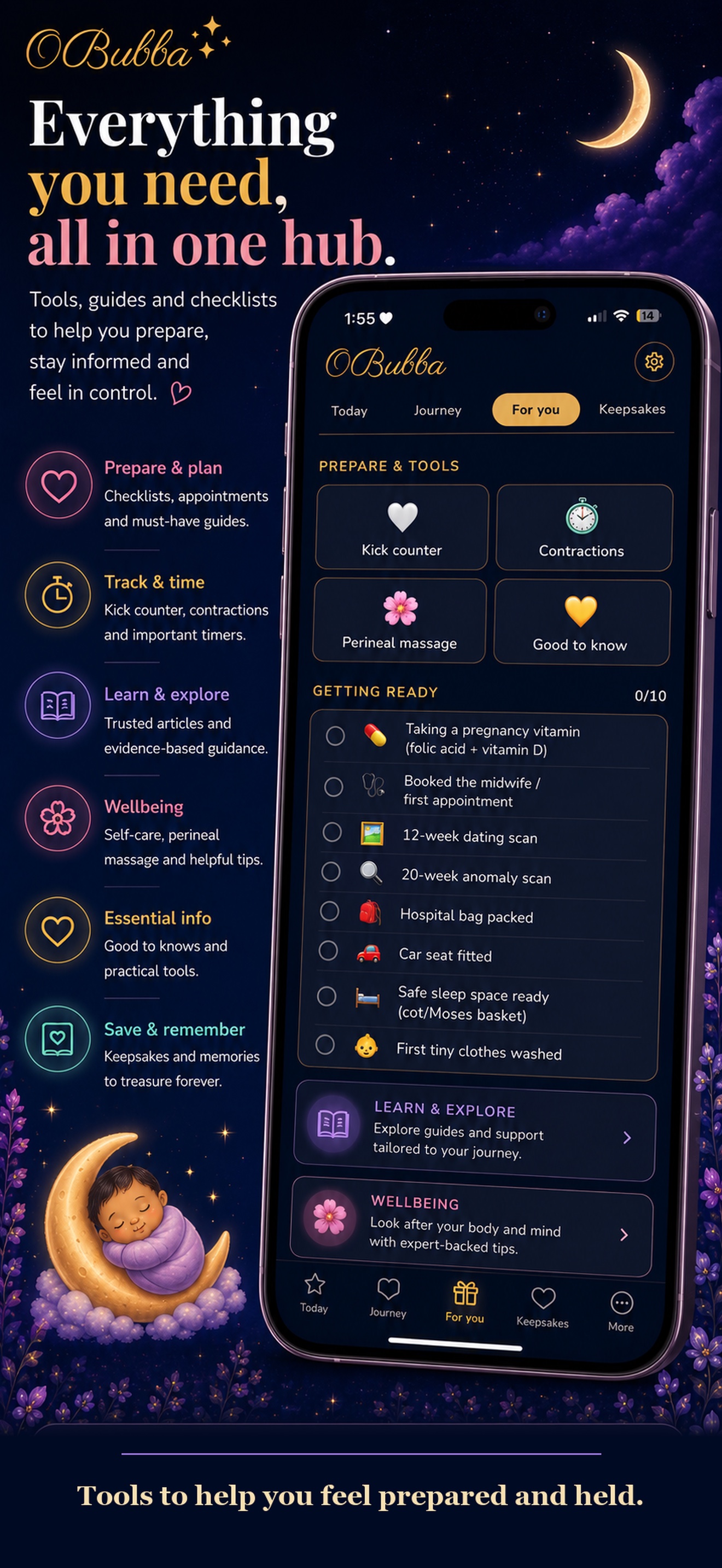
In the live pregnancy journey, the For you wellbeing space offers five ordinary states: Light, Calm, Tired, Worried and Low. One selection per day is saved to the maternal wellbeing record; choosing again replaces that day's entry rather than manufacturing multiple bad days.
The same screen includes a one-minute expanding-and-settling flower with gentle breathing labels, a three-breath “moment together” that does not ask the parent to achieve anything, and an explicit I need a little more support action. The breathing visual can be paused and is offered as a calming moment, not a medical result.
That record is deliberately kept on the device and outside the shared child sync record. A partner or carer does not automatically receive sensitive mental health check-ins simply because they share the baby's care. Signing out clears the maternal wellbeing record from that device.
The wellbeing feature is a self-reflection tool, not a clinical screening instrument. It computes no depression or anxiety score and returns no diagnosis. The separate I need a little more support action opens contacts selected for the device region and tells the parent to speak to a midwife or GP. In the UK list, crisis help includes 999 or NHS 111. It is still a signposting screen, not an assessment of whether someone is safe.
Important limits remain:
| OBubba can help with | OBubba cannot know | |---|---| | pausing long enough to name today's feeling | whether you have an anxiety disorder | | keeping one daily feeling check-in for personal reflection | whether you or the pregnancy are medically well | | keeping the check-in out of the shared baby timeline | who can see your phone or device backups | | making support information easier to reach | whether you are safe without asking and assessing you directly | | guiding one minute of breathing | whether breathing, therapy or medicine is the right treatment |
Use the check-in to begin a sentence, not end the investigation: “I feel worried most days, and the worry is affecting my sleep. I want to tell my midwife.”
Try OBubba free →. Pregnancy wellbeing, appointments, preparation and keepsakes continue into sleep, feeds, nappies, weaning, growth and shared care after birth.
Frequently asked questions
Can anxiety harm my baby?
Do not use this question to blame yourself or start another search loop. The useful action is to get support for symptoms affecting you now. A midwife or GP can consider your mental health and pregnancy together and discuss treatment safely.
Are panic attacks dangerous in pregnancy?
Panic attacks can feel intense and frightening. New chest pain, severe breathlessness, collapse or another concerning physical symptom still needs medical assessment; do not assume it is “only panic”. Tell your midwife or GP about repeated panic attacks even when they pass.
Can I self-refer for therapy?
In England, NHS Talking Therapies often accepts self-referral for anxiety and depression. Your midwife or GP can also explain local and specialist perinatal services. Arrangements differ elsewhere in the UK.
Does OBubba share my mood with my partner?
The current maternal wellbeing record is stored locally and is deliberately excluded from the shared child-sync record. Anyone with access to the unlocked device may still be able to see the app, so use the device privacy protections that fit your situation.
Is the breathing tool enough if I feel anxious every day?
No. It may help create a calmer minute, but persistent or daily-life-limiting anxiety deserves a conversation with a midwife or GP. A soothing animation is not an assessment or treatment plan.
Reliable UK sources
- NHS: Anxiety in pregnancy
- NHS: Find mental-health care before, during and after pregnancy
- NHS: Help for suicidal thoughts
- NICE CG192: Antenatal and postnatal mental health
This UK-oriented article gives general information, not a diagnosis or individual medical advice. Tell your midwife or GP when anxiety is difficult to control or affecting daily life. Call 999 or go to A&E if there is an immediate risk of harm to you or your baby.
Ready to try OBubba?
Use OBubba to track feeds, sleep, naps, nappies, growth, milestones and family handovers in one calm baby tracker app.