It is 11:47am. Your baby has been awake for a while. Lunch is somewhere on the horizon, the last milk feed feels both recent and ages ago, and you cannot remember when anyone checked the nappy.
The question is not really “What time is it?” It is:
> What might my baby need next—and which signal deserves attention first?
OBubba’s live readiness meter is designed for that exact moment. It brings the next predicted nap or bedtime together with timely feed, solids and nappy heads-ups on the Track screen. The most imminent need rises first. You still look at your baby; the app simply reduces the mental arithmetic behind the glance.
This is not a biological scanner, a feeding schedule or a promise that sleep will happen. It is a planning layer built from the day you record.
The 30-second answer
- The main bar is about sleep. It moves from Not yet to Nap window, then Watch cues or Sleep cues likely as the predicted window passes.
- Bedtime can take over. When bedtime is close, OBubba stops pushing another nap and makes the evening the main event.
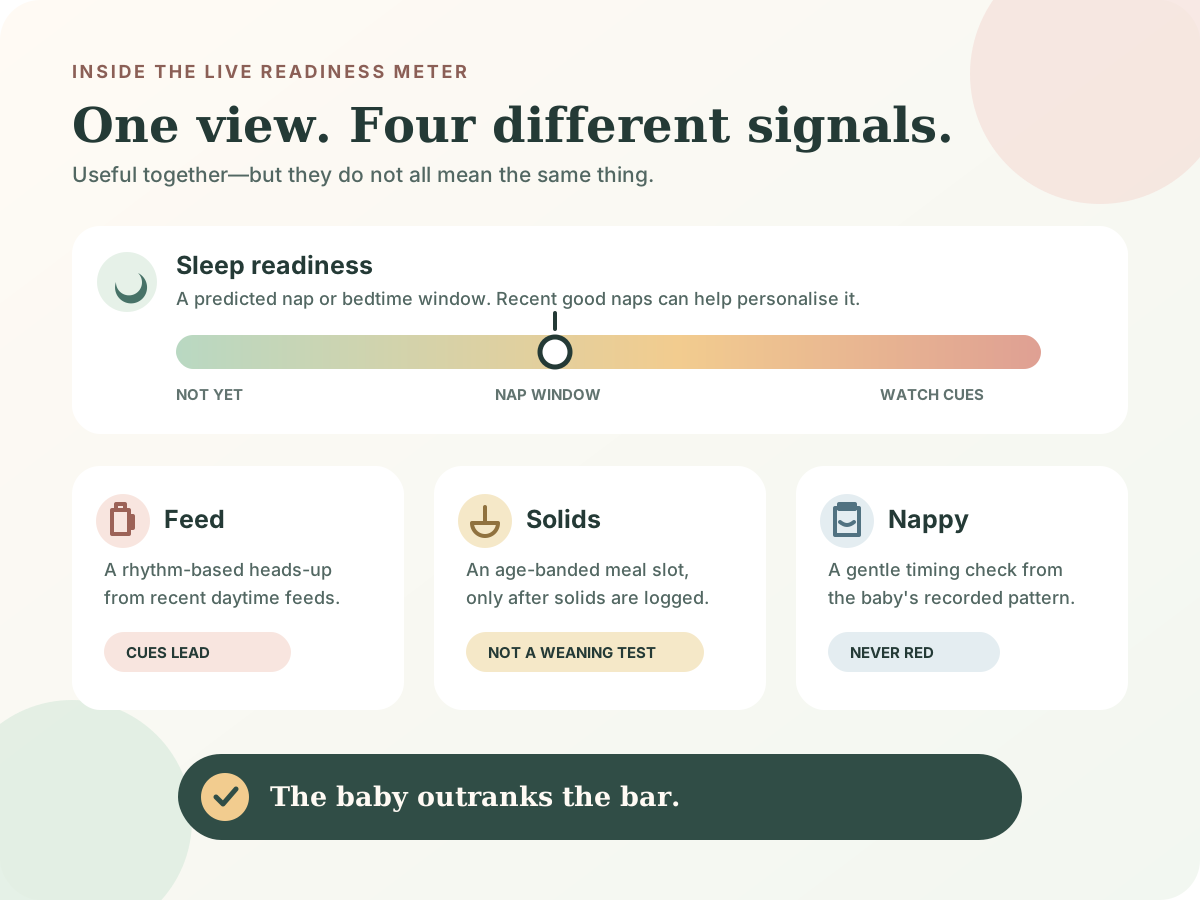
- Need chips are different. Feed, solids and nappy prompts use their own logic; they are not three more sleep predictions.
- Your baby always wins. Hunger, tiredness, illness and nappy cues outrank any timer.
- The family can share one countdown. During a live care session, OBubba can publish the same readiness prediction for the carer view instead of asking another screen to guess again.
What the current app actually calculates
We traced the production app through its readiness engine, Track screen and carer-session payload. The detail matters because a beautiful coloured bar can look more certain than it is.
1. Sleep is the main readiness signal
The meter appears when you are viewing today, the baby is recorded as awake and OBubba has a wake anchor to work from. It prefers the app’s live nap prediction. Where there is enough usable history, recent successful naps can help it learn a personal wake-window range; otherwise it falls back to age-aware timing.
Personal sleep learning looks back across up to 14 recent days. Days marked sick, fever, travel, daycare or grandparents are excluded from that personal wake-window learning because an unusual day should not quietly become the new normal.
The labels deliberately describe a window, not a verdict:
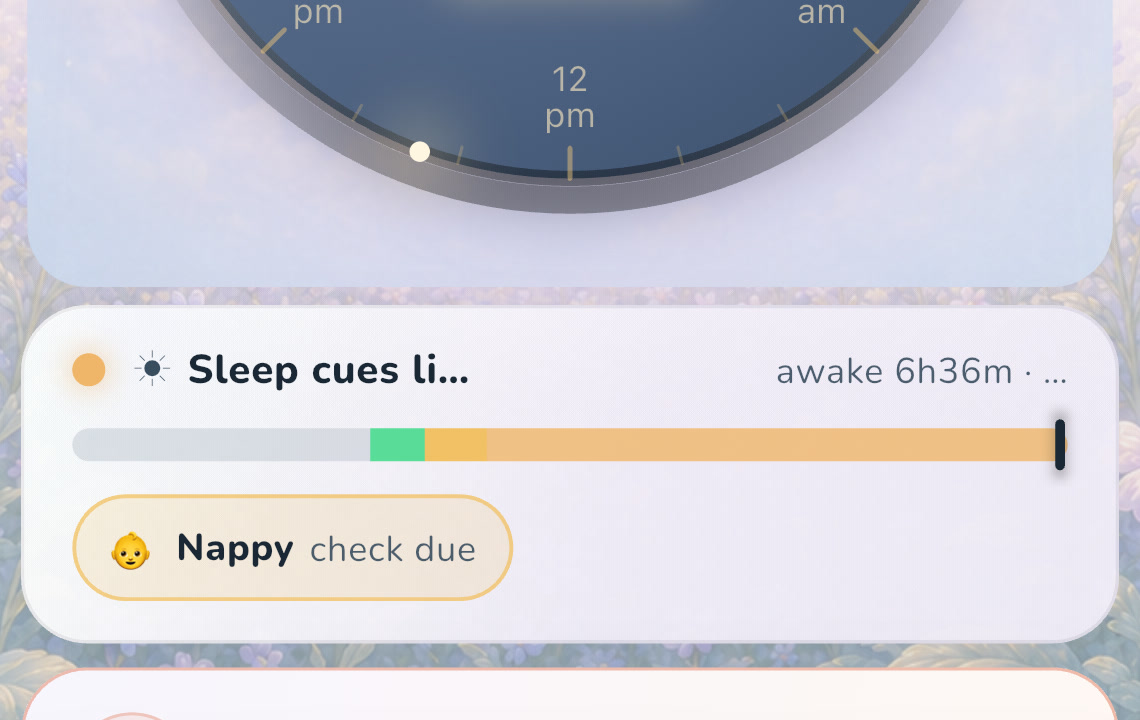
| Meter state | Plain-English meaning | |---|---| | Not yet | The predicted window is still ahead | | Nap window | The predicted start window has arrived | | Watch cues | The predicted window is passing; check the baby, not just the colour | | Sleep cues likely | The estimate is substantially late, so cues may be easier to spot |
Green does not mean “safe” and amber or red does not mean “danger”. The colours are planning shorthand. They never justify keeping a clearly tired baby awake to satisfy the graph.
OBubba also avoids inventing a nap when its predictor says naps are finished and the day plan contains no next nap. When predicted bedtime comes within roughly 90 minutes, bedtime takes priority. That helps prevent the classic late-afternoon mistake: treating every fussy stretch as a request for one more full nap.
2. Feed is a cue-led rhythm heads-up
The feed chip uses the recent daytime feeding pattern and adapts its label to the feeding style recorded in the app—Feed, Bottle or Milk. It can give an early heads-up, enter a ready window and later show that the usual interval has passed.
That does not turn responsive feeding into clock feeding. The NHS advises parents to follow early feeding cues and not force a baby to finish a bottle; babies do not need a strict feeding schedule. If your baby shows hunger cues before OBubba’s estimate, feed the baby. If the timer arrives and the baby is not interested, the number is information, not an instruction.
3. Solids is a meal-planning prompt—not a readiness-to-wean test
The solids chip has two important gates in the current app: the baby must be at least 22 weeks old, and solids must already appear in recent records. A recent solids meal also suppresses another prompt for a while.
Once those gates are met, the app uses simple age-banded meal slots:
- under 30 weeks: a late-morning/lunch slot;
- 30 to 38 weeks: breakfast and lunch slots; and
- from 39 weeks: breakfast, lunch and early-evening slots.
That is helpful for remembering an emerging routine, but it is not a claim that OBubba has learned the baby’s preferred lunch time. More importantly, it cannot decide whether a baby is developmentally ready to begin solids.
NHS guidance says complementary foods usually begin from around 6 months when three readiness signs appear together: staying in a sitting position with steady head control, coordinating eyes/hands/mouth to pick up food and bring it to the mouth, and swallowing food rather than pushing it back out. Babies do not need three meals immediately, and breast milk or first infant formula remains their main drink during the first year.
4. Nappy is a gentle memory jog
The nappy chip only appears after at least one nappy has been recorded today. With enough valid recent gaps, it uses the baby’s pattern; without that history, it uses a neutral fallback interval. It only surfaces near the likely check time.
Unlike the sleep signal, the nappy prompt deliberately never escalates to red. That is a thoughtful boundary. OBubba does not know whether a nappy is wet, whether your baby has opened their bowels, or whether hydration is adequate. Smell, feel, the baby’s comfort and health advice matter more than a chip.
Why putting four signals together helps
A single-purpose nap timer can answer “How long have they been awake?” A feed tracker can answer “When was the last bottle?” A note can hold “Nappy at 9:15.” Parents still have to combine those answers while carrying a baby.
OBubba does the joining-up on one screen. That creates a more useful question:
> Is this an approaching sleep window, or is another ordinary care need more imminent?
The chips are sorted by urgency, so a near-term feed can rise above a later nappy check. Tracking preferences also matter: if your family does not track a category, OBubba does not need to manufacture a prompt for it.
The interaction is practical too. Tap the main readiness meter to begin a nap or bedtime timer. Tap a need chip to open the matching feed or nappy log. It shortens the distance between noticing, acting and recording—the point where family trackers often become too fiddly to keep using.
One countdown for parents and carers
Readiness becomes more valuable at handover.
Imagine a parent leaves for an appointment at 12:05 and says, “Nap should be soon.” Without a shared calculation, the carer may reconstruct the day from messages, remember the last wake time differently or run a separate timer.
In OBubba’s current architecture, the parent app converts its sleep-readiness result into absolute clock times and a marker position, then includes that result in the live care-session payload. The carer side does not independently recalculate the wake window. That reduces the chance of one view saying 40 minutes while another says two hours.
This sharing is best-effort and depends on a live care session and working connection. It is not a substitute for a spoken handover, particularly for medicines, illness, allergies or urgent instructions. But for the ordinary question “When might sleep be next?”, one source of truth is much calmer than two competing guesses.
When the meter should be ignored
Ignore or override the timing when:
- your baby shows clear hunger or tired cues;
- your baby is unwell, unusually sleepy, difficult to wake or not behaving normally;
- a nappy is clearly soiled or uncomfortable;
- a clinician or your child’s care plan gives different instructions;
- a prediction is based on a missed, mistimed or future-dated log; or
- the day is simply different from the recent pattern.
Baby sleep changes with growth, teething and illness, and every baby has an individual pattern. Prediction should reduce cognitive load, not erase context.
If the meter looks wrong, first check the inputs: Was wake-up logged? Did a nap end at the right time? Was a feed accidentally saved twice? OBubba can be only as accurate as the record it receives.
Readiness does not replace safer sleep
A perfectly timed nap still needs a safer sleep space. The Lullaby Trust recommends placing babies on their backs in their own clear, flat, firm sleep space, in the same room as a parent or carer for at least the first six months. Keep pillows, duvets, cot bumpers, pods, nests and soft toys out of the sleep space.
The readiness bar answers when sleep may fit. It does not change how sleep should be made safer.
A calmer way to use it today
Try this three-glance habit:
- Look at the baby. What cues can you actually see or hear?
- Look at the meter. Does the predicted sleep window support that observation?
- Look at the first need chip. Is a feed, meal or nappy check the more immediate practical step?
If the app and baby disagree, trust the baby and correct the record later. Used that way, readiness is not another score to optimise. It is a quiet second pair of hands for the family’s working memory.
The live readiness meter is available during an OBubba trial or premium plan. The value is not a colourful countdown by itself. It is sleep, milk, solids, nappies and shared care using the same day—so parents spend less time reconstructing what happened and more time responding to the child in front of them.
Try OBubba free → — bring sleep, feeds, first foods, nappies and carer handovers into one calm family record.
Frequently asked questions
Is the OBubba readiness meter a wake-window timer?
It includes wake-window timing, but goes further. The main sleep estimate can use the live nap predictor and recent successful naps, while separate chips surface relevant feed, solids and nappy timing. It is a planning tool, not a medical or physiological measurement.
Does red mean my baby is overtired?
No colour can diagnose overtiredness. The late state means the app’s estimated sleep window has passed and sleep cues may be more likely. Observe the baby and the wider day.
Will it tell me when to feed?
It can predict when a feed may be approaching from recent daytime rhythm. Responsive feeding still comes first: follow hunger and fullness cues and never force a baby to finish a bottle.
Does the solids chip mean my baby is ready to start weaning?
No. The chip only appears after an age gate and recent solids records. Starting complementary foods is a separate developmental decision, usually from around 6 months when the NHS readiness signs appear together.
Why can’t I see the meter?
The full meter needs today’s view, an awake baby and a known wake time. It is a trial/premium feature. Tracking preferences and the day’s logs also determine which need chips can appear.
Can another carer see the same prediction?
During a live care session, OBubba can publish the parent app’s current readiness timing to the carer view. Sync is best-effort and connection-dependent, so keep spoken handover for anything safety-critical.
Sources and further reading
- NHS: Feeding on demand
- NHS: Your baby’s first solid foods
- NHS: Helping your baby to sleep
- The Lullaby Trust: Safer sleep overview
OBubba is a tracking and education tool, not medical advice, a diagnostic device or an emergency service. Contact your GP, health visitor or NHS 111 for non-emergency concerns; call 999 in an emergency.
Ready to try OBubba?
Use OBubba to track feeds, sleep, naps, nappies, growth, milestones and family handovers in one calm baby tracker app.