Yesterday your baby took three naps. Today the last one has vanished, bedtime is drifting later and everyone is wondering whether to keep trying, go for a rescue walk or simply call it an early night.
The short answer: do not drop a nap because of one difficult day or a birthday on a schedule chart. Look for the same nap being refused or pushing bedtime too late for roughly one to two weeks. Then stretch the day gradually, keep an earlier bedtime available and expect a mixture of old-schedule and new-schedule days while your baby adjusts.
What “dropping a nap” really means
A nap transition is not a baby suddenly needing less care or less sleep. Their sleep is consolidating: they can stay comfortably awake for longer, so the available daytime sleep fits into fewer, often longer, naps.
Age can give you context, not a deadline. Current HSE guidance says children commonly reduce to two naps between 6 and 9 months and usually have one midday nap by 12 to 15 months. NHS community guidance similarly describes babies aged 6 to 12 months as usually having two naps, with young toddlers gradually moving from two naps to one. There is wide individual variation around those points.
Look at the whole 24 hours rather than trying to force a particular number of naps. NHS guidance repeatedly emphasises that some babies need more sleep and some less; their pattern changes as they grow.
Five signs the current nap count may no longer fit
One sign alone is weak evidence. A cluster that repeats is much more useful.
1. The same nap is consistently refused
Your baby is offered the nap at a sensible time and in their usual sleep environment but remains awake, content or playful. This happens to the same nap across many days, not just after visitors, teething or a poor night.
2. The final nap pushes bedtime too late
The nap still happens, but only late enough that your baby is not ready for bed at their usual time. You end up choosing between waking them shortly after they fall asleep or accepting a bedtime that slides later and later.
3. Falling asleep takes much longer
When the preceding awake period is now too short, your baby may chat, roll or practise new skills rather than settle. That can be a sign of too little sleep pressure — but only after checking hunger, discomfort, light, noise and the sleep routine.
4. Existing naps are shortening without obvious distress
Sometimes the day has too many sleep opportunities for the amount of sleep a baby currently needs. A formerly reliable nap becomes a brief doze while your baby otherwise seems well rested.
5. Longer awake periods are genuinely comfortable
Your baby can reach the later nap calmly, rather than arriving wired, crying or falling asleep over a feed. Comfortable stamina matters more than whether they technically stayed awake.
What can look like a nap transition but is not one?
Pause before changing the schedule if the refusal began alongside:
- illness, pain, reflux or teething discomfort
- travel, nursery changes or an unusual day
- a very early morning or several disrupted nights
- a developmental burst such as rolling, crawling or pulling to stand
- a bright, noisy or unfamiliar nap space
- hunger or a feed that has shifted
- a wake window that was stretched too far already
An overtired baby can fight sleep just as fiercely as an undertired baby. The difference is usually in the approach: undertired often looks alert and sociable; overtired can look frantic, clumsy, tearful, wired or unusually difficult to soothe. Those are clues rather than a diagnosis, so use several days of actual times instead of one impression.
The one-to-two-week test
Before removing a nap, log seven to fourteen ordinary days:
- morning wake time
- every nap start and end
- how long settling took
- which nap was refused
- bedtime and time actually asleep
- night waking and early rising
- illness, travel, nursery or teething context
Do not chase a perfect average. You are looking for a repeated shape: the same nap no longer fits, even after reasonable timing adjustments.
If the pattern appears only on nursery days, after poor nights or during travel, the answer may be a flexible day type rather than a permanent nap transition.
Moving from three naps to two
This transition often begins with the third nap becoming awkward. The first two naps may be reasonable, while the final catnap is refused or lands too close to bedtime.
A gentle approach
- Keep the morning anchored. Start the day within a reasonably consistent range so you can see whether the nap pattern is changing rather than the whole day drifting.
- Add only 10 to 15 minutes at a time. Stretch the first and second awake periods gradually every few days, watching how your baby settles and wakes.
- Protect the first two naps. A very short first nap can make a two-nap day unrealistic. Use the old three-nap rhythm when the early naps collapse.
- Use the third nap as a bridge, not a battle. On difficult days, a short supervised pram or carrier nap may help your baby reach bedtime. Transfer to a safe sleep space when appropriate and follow current sling and car-seat safety guidance.
- Bring bedtime earlier when the bridge nap does not happen. An earlier night is often kinder than forcing a long final awake stretch.
The transition does not need to be linear. Two naps on a good-nap day and three on a short-nap day is normal while the new rhythm settles.
Moving from two naps to one
This change can be less tidy because a toddler may manage one nap beautifully one day and fall apart before lunch the next.
A gentle approach
- Move the morning nap later by about 10 to 15 minutes every few days, rather than jumping directly to lunchtime.
- Offer lunch earlier while the nap shifts, so hunger does not become the reason settling fails.
- Let the remaining nap become the main midday sleep instead of tightly limiting it from the start.
- On a very early-wake or short-nap day, use a brief second nap or quiet rest if needed.
- Use an earlier bedtime on one-nap days until your toddler can comfortably manage the final awake period.
HSE guidance says babies commonly move to one midday nap at 12 to 15 months, while NHS community guidance describes the change from two naps to one as gradual. That variation is exactly why a repeated pattern is more useful than a calendar date.
What should I do when today’s nap is not happening?
Make a decision for today without declaring a permanent transition:
Try again shortly
End the struggle, reset with 10 to 15 calm minutes, then offer the nap again. This works well when the timing may simply be a little early.
Use a rescue nap
A brief walk or drive may bridge an overtired gap. Never leave a baby sleeping unattended in a car seat, and move them to a firm, flat sleep surface as soon as practical after travel.
Offer quiet rest
For an older baby or toddler, 20 minutes of low-pressure cot or bedroom rest can lower stimulation. It may become a nap; it may simply make the afternoon easier.
Skip it and protect the night
If it was the last nap, bedtime is reasonably close and your child is coping, stop repeatedly trying and bring bedtime earlier. Keep the evening calm and watch for tired cues.
How OBubba helps you decide from a pattern
The current app does more than count naps. Care → Reports → Learn the rhythm builds honest time bands from naps seen on at least three days. It shows each nap's usual range, duration, days seen and whether that slot is anchored or still settling. Mixed two- and three-nap days stay visible instead of being averaged into a falsely neat schedule.
On Track → Today’s plan, OBubba projects how many naps fit the baby’s current age, recent rhythm and learned wake windows, then recalculates bedtime as the day unfolds.
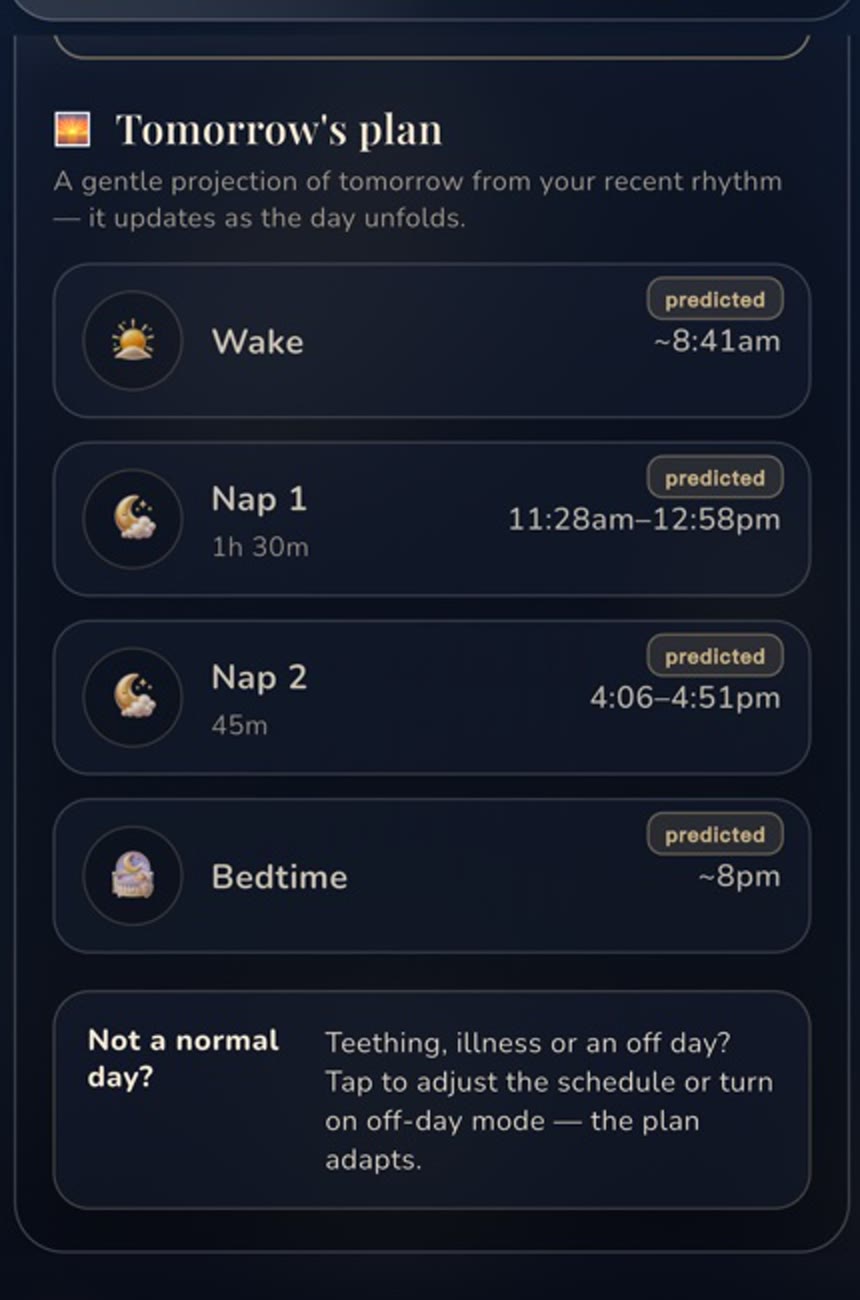
When a predicted nap is overdue, the Nap not happening? card offers four honest choices: try again in 15 minutes, start a short rescue nap, take 20 minutes of no-pressure rest, or skip the last nap and head toward an earlier bedtime. The on-device engine highlights the option that best fits the current wake window, distance to bedtime, sleep debt and whether it is the final planned nap.
For a deliberate transition, use Track → Today’s plan → Adjust to change the nap count and let the clock re-plan the day. Care → Sleep Consultant can read bedtime, nap totals, wake windows and night disruption together so one refused nap is not mistaken for a permanent new schedule.
The app cannot know whether your child is ill, in pain or unsafe from timings alone. Use the context tags, check your child and seek professional advice when something does not feel like an ordinary sleep change.
Try OBubba free → — nap logs, learned rhythm bands, live next-nap timing and a bedtime that adapts when the day changes.
Keep every nap safe
A schedule decision never overrides safer sleep. For babies, use a clear, firm, flat sleep space and place them on their back. NHS guidance says the safest place for the first six months is a cot or Moses basket in the same room as you, for day and night sleep. Keep pillows, bumpers, toys, pods and loose bedding out of the sleep space.
Speak to your health visitor or GP if your baby is unusually difficult to wake, persistently sleepy, feeding poorly, not growing as expected, frequently snoring, gasping or pausing in their breathing, or if sleep changed suddenly alongside illness. Call 999 for severe breathing difficulty, blue or grey colour, unresponsiveness or another emergency.
Sources and further reading
- NHS Best Start in Life: Your baby's sleep patterns
- HSE: Naps for babies and toddlers
- Black Country NHS: Sleep advice for babies and toddlers
- NHS Best Start in Life: Safer sleep advice for babies
- NHS: Sleep and young children
OBubba provides tracking, education and personalised planning support. It does not diagnose sleep or medical conditions and is not a substitute for advice from your health visitor, GP or paediatric team.
Ready to try OBubba?
Use OBubba to track feeds, sleep, naps, nappies, growth, milestones and family handovers in one calm baby tracker app.