When another night feed begins at 2am, it is understandable to wonder whether your baby still needs the milk or simply expects the familiar way back to sleep. The honest answer rarely comes from age alone — and it cannot be proved by one wake.
The short answer: some babies between 6 and 12 months may no longer need every night feed, while others still wake hungry. Before changing anything, look at your baby's age and health, daytime milk intake, growth and nappies, then observe several ordinary nights. Night weaning should be a gradual response to a reassuring pattern, not a deadline.
Night waking does not automatically mean hunger — or habit
Babies wake for many overlapping reasons: hunger, discomfort, teething, illness, temperature, a developmental change, or simply reaching the end of a sleep cycle. Feeding may settle a baby quickly whether or not hunger caused the wake, because feeding is also warm, familiar and regulating.
That means neither of these conclusions is safe after one night:
- “They drank, so every wake must be hunger.”
- “They only fed briefly, so they cannot need night milk.”
Look for a repeatable pattern instead. A sudden increase in feeds after several settled weeks deserves curiosity before reduction. Your baby may be unwell, going through a growth or developmental change, feeding less during busy days, or temporarily needing more closeness.
Readiness check 1: age is context, not permission
The NHS says that for some babies aged 6 to 12 months, night feeds may no longer be necessary. “Some” matters. Six months is not an automatic instruction to remove night milk, and sleeping through is not a developmental test your baby has failed.
Do not begin reducing night feeds for a young baby. If your baby was born prematurely, has faltering growth, feeding difficulties, a medical condition, fewer wet nappies, or you are unsure whether their intake is adequate, speak to your health visitor, GP, paediatrician or feeding specialist first. Use corrected age where your clinical team recommends it.
If breastfeeding is still being established or milk supply is a concern, get individual feeding support before dropping feeds. Night feeding can contribute to milk production, particularly in the early months.
Readiness check 2: daytime milk is genuinely established
Starting solids is not the same as replacing milk. During the first year, breast milk or first infant formula remains an important part of your baby's nutrition. A few spoonfuls at lunch do not prove that a baby can comfortably lose milk overnight.
Before trying any change, ask:
- Are daytime milk feeds offered responsively and without rushing?
- Is my baby alert and generally themselves when awake?
- Are wet nappies normal for my baby?
- Has growth been reassuring at appropriate health reviews?
- Has daytime feeding stayed steady rather than shrinking because the world is suddenly too interesting?
Do not force a larger bottle or add cereal to milk in the hope of buying more sleep. A very large feed does not guarantee a longer gap, and responsive feeding means following hunger and fullness cues rather than asking a baby to finish a target amount.
If nappies become noticeably drier, feeding falls, your baby is unusually sleepy, or you are worried about weight or hydration, pause the experiment and seek professional advice.
Readiness check 3: establish the real night, not the remembered night
Broken sleep makes recollection unreliable. “They feed constantly” may mean two feeds on most nights and four during one difficult night. “They hardly take anything” may describe the first wake but not the early-morning feed.
For three to five nights, change nothing. Record only what is useful:
- bedtime and morning wake time
- each waking that led to a feed
- breast or bottle, and the amount or approximate duration if you already track it
- whether a brief cuddle, pat or reassurance was tried first
- how your baby behaved during the feed
- daytime feeds and wet nappies
- illness, teething or an unusually disrupted day
This is a baseline, not a score. It shows where you are starting and prevents one terrible night from becoming the whole story.
Readiness check 4: decide what you are actually changing
“Night weaning” can mean very different things:
- removing one predictable feed
- shortening or reducing one feed gradually
- offering a brief resettle before feeding at one waking
- moving from several feeds towards one
- stopping all night feeds
Those are not interchangeable goals. For a baby under 12 months, moving towards fewer feeds may be more appropriate than aiming for none. A baby may also continue waking after a feed changes; night weaning is not a promise of uninterrupted sleep.
Choose the smallest clear change. Do not reduce every feed at once, change the bedtime routine, alter naps and start solids all in the same week. When several variables move together, you cannot tell what helped — and your baby has much more to adapt to.
A gentle first step
Once the readiness picture is reassuring, choose one ordinary waking rather than the hardest night of the week.
- Keep the bedtime feed calm, responsive and unhurried.
- At the chosen waking, pause long enough to observe your baby rather than automatically preparing milk.
- Offer brief reassurance — a cuddle, pat or quiet voice — if there are no clear hunger cues.
- Feed if hunger cues remain, your baby becomes more distressed, or the attempt does not feel right.
- Keep the room dim and interaction quiet so the message is still “night-time,” not playtime.
- Repeat the same small step for several nights before deciding whether it is helping.
A responsive pause is not ignoring a baby. It is a short check followed by comfort. If your chosen approach involves another caregiver settling your baby, agree in advance when they will offer milk or bring the baby to you, so nobody is improvising while exhausted.
When to pause night weaning
Pause and respond normally when your baby is ill, has a fever, is feeding poorly, has fewer wet nappies, is going through a major disruption, or seems genuinely hungry. Also pause if your own instinct says the pace is wrong.
Other reasons to step back include:
- distress escalating night after night
- daytime intake not increasing or becoming less reliable
- breastfeeding discomfort or supply concerns
- growth concerns or a clinician-led feeding plan
- a premature or medically complex baby whose team has not advised the change
- a parent becoming so exhausted that safe night care is harder
Progress can include learning that now is not the right week. Nothing has been ruined by returning to a feed.
Keep night feeds safe and boring
Whether you are feeding or resettling, use the same safer-sleep principles every night. Put your baby down on their back in a clear, flat, separate sleep space. Keep lights low and avoid play. If you might fall asleep while feeding, plan the night setup before you are exhausted and follow current safer-sleep guidance; never sleep with a baby on a sofa or armchair.
Ask a partner or trusted adult to take a safe shift where possible. A plan that depends on one depleted parent making perfect decisions at 3am is not a gentle plan.
What success actually looks like
Success is not necessarily seven silent nights. It may look like:
- one feed moving later
- a feed becoming shorter without distress
- one waking settling with a cuddle
- steadier daytime feeding
- recognising that two feeds are currently genuine and stopping the guesswork
- both caregivers knowing the same response plan
Judge the pattern over several nights. Teething, illness and developmental changes can temporarily increase waking even after a calmer week.
How OBubba makes readiness visible
In the current app, Care → Night Weaning begins with “Three gentle green lights”: age context, daytime feeding and recent nights. OBubba reads the latest logged nights to show your real starting point rather than assuming every baby begins with the same number or amount of feeds.
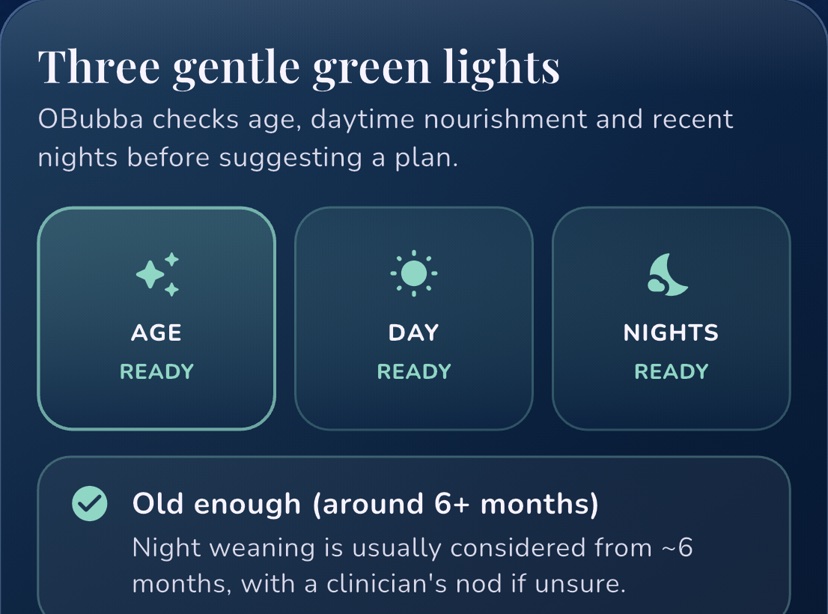
When all three lights are present, the app can organise a gradual seven-night pathway, keep each night paced to a real calendar night, and let you pause or stop. The first night is deliberately a baseline: feed as normal and log what happens before changing anything.
Those lights are organisational support, not medical clearance. OBubba cannot assess milk transfer, hydration, growth or an underlying health problem. That is why your baby's nappies, growth, behaviour and professional advice still sit above any in-app plan.
Try OBubba free → — connected feeds, wakes, sleep and a readiness-first Night Weaning path in one calm place.
Sources and further reading
- NHS: Helping your baby to sleep
- NHS Best Start in Life: Responsive bottle feeding
- NHS: Is my baby getting enough breast milk?
- NHS: Your baby's weight and height
- UNICEF UK Baby Friendly Initiative: Caring for your baby at night
OBubba is a tracking and education tool, not medical advice. If you are concerned about your baby's feeding, hydration, growth, health or readiness to reduce night feeds, speak to a qualified health professional.
Ready to try OBubba?
Use OBubba to track feeds, sleep, naps, nappies, growth, milestones and family handovers in one calm baby tracker app.