You set up the pump, watch the bottle and wait. The amount is smaller than yesterday—or smaller than somebody else’s freezer photo—and suddenly it feels like a verdict on your body.
It is not.
One pumping session is not a breast-milk supply test. A pump shows what that pump removed, from those breasts, under those conditions, at that moment. It does not show exactly what your baby can remove at the breast, how much milk they took today or whether one lower session predicts tomorrow.
Pump output can still be useful. The trick is to treat it as one data point inside a bigger feeding picture, not a score.
Is there a normal amount to pump?
There is no single normal amount for every parent or every session.
A person expressing colostrum in the first days, pumping after a breastfeed, replacing a missed feed, building a small workday supply and exclusively expressing for a premature baby are doing different jobs. Their bottles should not be compared as if they were the same test.
Output may vary with:
- how recently milk was removed by the baby, hand or pump
- the time of day and your usual milk-making rhythm
- whether you are expressing one breast or both
- how established lactation is
- your pump, settings, flange fit and condition of its parts
- comfort, pain and whether milk lets down readily
- illness, medicines, hormonal changes and individual health
- whether the session replaces a feed or comes after one
The NHS advises parents not to worry too much about the amount and notes that expressing can take practice. The useful comparison is usually your own pattern in comparable sessions, alongside the baby’s feeding and health—not a stranger’s bottle.
What pump output can tell you
Over time, a consistent record may help you notice practical patterns:
- one flange or pump setting is more comfortable
- morning sessions tend to produce more than evening sessions
- replacing a feed looks different from pumping just after one
- double pumping changes the time or volume for you
- output dropped after missed sessions, illness or a worn valve
- one side usually expresses more than the other
Those are observations, not diagnoses. Left and right breasts do not have to produce equal numbers. A difference may simply be your normal anatomy or response to the pump.
A trend matters most when the sessions are reasonably comparable. Comparing Monday at 7am before a feed with Tuesday at 9pm just after cluster feeding is mostly comparing two different circumstances.
What it cannot tell you
How much milk your baby removes at the breast
Babies and pumps remove milk differently. A baby who is effectively attached can sometimes remove milk that a particular pump does not, while a baby with ineffective transfer may need help even if pumping produces a reassuring amount.
Use swallowing, attachment, nappies, alertness and weight trend to assess the wider feeding picture. Our guide to cluster feeding versus low milk supply explains those checks in detail.
How much your baby drank
Milk expressed out is not automatically milk consumed. It may be stored, spilled, divided between bottles or left unfinished.
If you are tracking both pumping and bottle feeds, keep them as separate events:
- Pump: milk removed from the parent
- Bottle: milk offered to or taken by the baby
Adding pump volume directly to the baby’s intake can make the record look safer than reality. The same milk would effectively be counted twice if it is later logged as a bottle.
Whether your supply is “good” or “bad”
A single low result can follow a recent breastfeed, a rushed setup, an uncomfortable flange or a let-down that did not happen easily. A large result can follow a long gap and does not prove that the baby is transferring milk effectively.
Supply concerns deserve a full feeding history and, when relevant, observation of a feed or pumping session—not a pass/fail line on one bottle.
First decide what the pump session is for
The meaning of the number depends on the job.
Occasional milk for a future bottle
You may express at a convenient time and collect milk across more than one session. A small amount is still useful. You do not have to create a large freezer supply to be prepared.
Replacing a feed while away from your baby
Here, timing and frequency may matter more than any single bottle because milk removal helps maintain supply. The US CDC suggests pumping about as often as the baby drinks breast milk when you are apart or exclusively pumping, but your plan should fit your baby’s age, your circumstances and any clinical advice.
Establishing or protecting supply
After premature birth, illness, separation, sleepy feeding or a clinical top-up plan, early and frequent expression may be important. Neonatal guidance is deliberately more structured than advice for an occasional home pump.
Follow the plan from your maternity or neonatal team. Do not borrow a schedule or daily-volume target intended for another parent or a different clinical situation.
Relieving uncomfortable fullness
The aim may be comfort rather than emptying the breast. NHS breast-pain guidance says that when expressing for engorgement, expressing only enough to relieve discomfort can avoid driving more milk production.
Before interpreting the bottle, write down the session’s purpose. “After-feed comfort pump” tells you far more than “42 ml”.
Seven checks before blaming your supply
1. Check the flange fit
The flange—also called a breast shield or funnel—should be comfortable. The nipple should sit centrally and move freely in the tunnel without rubbing. Too small can cause rubbing; too large can draw in too much surrounding tissue. Either can cause pain, swelling and reduced milk removal.
Cambridge University Hospitals’ current flange-fitting guidance recommends asking a midwife for help with pump fit if you are unsure. You may need a different size on each side, and fit can change.
2. Use comfortable—not maximum—suction
More suction is not automatically more milk. Start gently and increase only to a level that remains comfortable and supports flow. Pumping may feel like a pull, but it should not cause sharp pain, pinching, broken skin or bleeding.
Turn the pump off before breaking the seal or removing the flange. If pain continues, stop and seek help rather than trying to tolerate it for a higher number.
3. Check the simple equipment failures
Inspect the manufacturer’s setup instructions. A loose connection, incorrectly assembled valve, damaged membrane, moisture where it should not be or worn part can affect suction.
Do not share an open-system personal pump or use second-hand parts without checking the manufacturer’s hygiene and reuse guidance. Hospital-grade hire and closed systems have different rules.
4. Give let-down a chance
Milk flow can take time. The NHS suggests getting comfortable, gently massaging the breasts and having the baby nearby or looking at their photo. Rushing or watching every millilitre can make a session feel harder.
Warmth is not a requirement, and very hot compresses can irritate inflamed tissue. Comfort and a familiar routine matter more than an elaborate ritual.
5. Compare like with like
If you want to understand a pattern, compare sessions with similar context:
- roughly the same time of day
- a similar gap since breastfeeding or expressing
- the same pump and flange
- one side versus both recorded accurately
- similar duration
Do not force every day to match. The context makes the trend interpretable; it does not turn normal variation into failure.
6. Include hand expression where it helps
Hand expression can be especially useful for small amounts of colostrum, when a pump is unavailable or to finish comfortably after pumping. The NHS provides a step-by-step hand-expression guide.
Ask someone to demonstrate if the technique feels confusing. A video cannot correct your hand position in real time.
7. Look beyond the bottle
If the baby also feeds at the breast, check effective swallowing, attachment, wet and dirty nappies, alertness and weight trend. If exclusively pumping, compare total milk-removal opportunities, output across the day and the baby’s actual bottle intake—not a single session in isolation.
Clinical plans may use daily totals, especially in neonatal care. Those targets belong inside professional follow-up because birth history, age, health and feeding route all matter.
A low-output troubleshooting note that is actually useful
Instead of writing “bad pump,” record:
> 14:10 — both sides, 18 min, 58 ml total. Baby breastfed 45 min earlier. Right flange rubbed; stopped early on that side.
That note provides four possible explanations and a practical next step. A bare “58 ml” provides anxiety with almost no context.
A lightweight template is:
- When: start time
- Why: replace feed / after feed / comfort / supply plan
- Where: left / right / both
- Amount: each side where useful, plus total
- Duration: optional
- Context: last feed, comfort, fit, illness or equipment change
You do not need every field forever. Track only what answers your current question.
When to get help
Ask a midwife, health visitor, infant-feeding specialist or lactation professional to review a pumping session if:
- pumping hurts, causes rubbing, swelling, cracks or bleeding
- the nipple does not move freely in the flange
- output has fallen substantially and stays lower across comparable sessions
- milk is not increasing as expected within a clinical expressing plan
- you cannot express enough to meet a medically advised feeding plan
- you have recurrent blocked areas, breast redness, worsening pain, fever or flu-like symptoms
- pumping is consuming so much time or anxiety that the plan feels unsustainable
Get prompt clinical help if the baby has fewer wet nappies, is difficult to wake, is not feeding normally, is not gaining as expected or otherwise seems unwell. Do not wait for another pumping session to decide.
The UK National Breastfeeding Helpline is available 24 hours a day on 0300 100 0212. Your maternity, neonatal or local infant-feeding team may also be able to watch a session and check the pump fit.
Safe milk handling still lives outside the chart
A pumping log does not replace labelling the container itself.
Wash your hands before expressing, follow the pump manufacturer’s cleaning instructions and use suitable sterilised containers or breast-milk storage bags. Label stored milk with the expression date and use current NHS storage guidance for your fridge or freezer.
The NHS currently says breast milk can be stored in a fridge at 4°C or below for up to eight days and in a freezer at −18°C or below for up to six months. If you are unsure of the fridge temperature, the NHS advises using the milk within three days. Premature or unwell babies may have stricter hospital instructions.
Read the full NHS guidance on expressing and storing breast milk rather than relying on a remembered number.
How pumping works in OBubba’s actual app
Open Track → Log details → More logs → Pump.
Choose Left, Right or Both. For one side, enter the expressed amount. For both sides, OBubba provides separate left and right fields and calculates a live total. You can switch between ml and oz, add an optional duration and write a note before tapping Log pump.
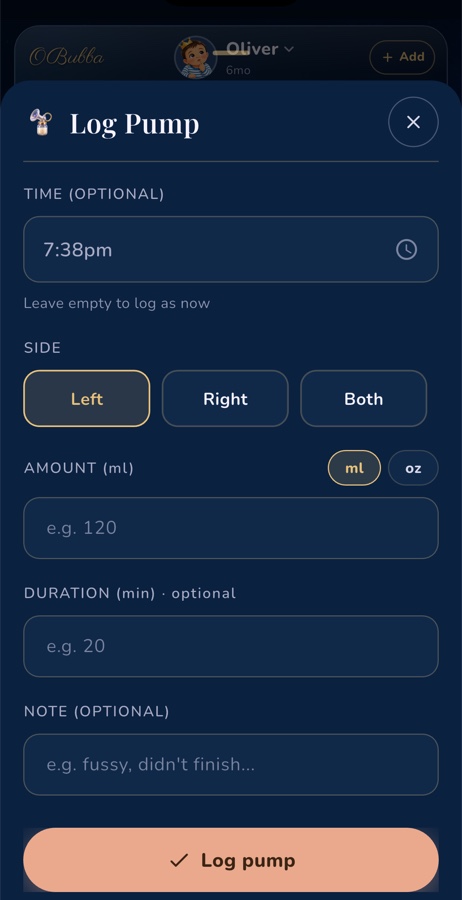
The timeline can then show the total, the per-side amounts and session duration. OBubba also checks for an implausibly high per-side entry before saving, helping catch an accidental extra zero.
Most importantly, the data engine keeps pumping separate from feeding:
- pump volume is expressed output, not baby intake
- a pump session does not inflate bottle totals
- a pump does not become the baby’s “last feed”
- overnight pumping does not count as a night feed or wake caused by hunger
That distinction protects the conclusions parents see. OBubba can help reveal your own pumping pattern, but it cannot assess flange fit, know why output changed, manage a clinical supply plan or guarantee that stored milk is still safe.
Try OBubba free → — pumping, breastfeeds, bottles, nappies, sleep and shared-care context without counting the same milk twice.
Quick answers
Is 30 ml a bad pumping session?
Not by itself. The meaning depends on the baby’s age, why and when you pumped, whether the baby fed first, the equipment and your usual pattern. One amount cannot diagnose low supply.
Should both breasts pump the same amount?
No. Many people have a side that usually expresses more. Record each side if the difference is useful, but do not force equal numbers.
Does pumping longer always produce more milk?
No. Milk flow, fit, comfort, pump performance and timing matter. Very long or painful sessions are not automatically more effective. Follow your equipment instructions and individual feeding plan.
Does a higher suction setting increase supply?
Not necessarily. Use the highest setting that remains comfortable and supports flow, not the maximum setting by default. Pain or tissue damage needs troubleshooting.
Can I count pumped milk as my baby’s intake?
Only when the baby actually receives it should it be logged as a bottle feed. The pumping event records milk removed from the parent; the bottle event records what was offered or taken.
When should I worry about a sudden drop?
Check timing, recent feeds, flange fit, pump assembly, parts, illness and medicines. Seek feeding support if the drop persists across comparable sessions, affects a clinical feeding plan or comes with pain, breast symptoms or concerns about the baby.
Sources and further reading
- NHS Best Start in Life: How to express your breast milk
- NHS: Breastfeeding—Is my baby getting enough milk?
- NHS: Breast pain and breastfeeding
- Cambridge University Hospitals: Expressing and storing milk
- Guy’s and St Thomas’: Expressing with a pump
- UNICEF UK Baby Friendly: Breastmilk-expression assessment guidance
- CDC: Pumping breast milk
OBubba provides records and general educational content. It cannot measure milk supply or transfer, assess pump fit, manage a clinical feeding plan, diagnose breast problems or replace advice from a midwife, health visitor, GP, neonatal team or infant-feeding specialist.
Ready to try OBubba?
Use OBubba to track feeds, sleep, naps, nappies, growth, milestones and family handovers in one calm baby tracker app.