Nobody warns you quite how strange a healthy newborn can look and sound.
They grunt in their sleep, sneeze without a cold, hiccup after a feed, fling both arms into the air and turn tomato-red while trying to poo. Their eyes may briefly wander in different directions. Their skin peels. Their breathing changes pace. Then, just when you think you have checked everything, they cry as though something must be terribly wrong.
Many of these surprises can be part of adapting to life outside the womb. But “common” never means “ignore your instincts”, and a list on the internet cannot tell whether your baby is well.
The most useful question is not simply, “Is this normal?” It is:
> Is this a brief, familiar newborn behaviour in a baby who is breathing comfortably, waking, feeding and producing nappies, or is there a change in breathing, colour, responsiveness, feeding or temperature that needs help?
This guide gives you that boundary. If your baby seems seriously unwell, call 999. For urgent concerns that are not immediately life-threatening, contact your midwife, health visitor, GP or NHS 111. Babies under six months can be difficult to assess remotely, so trust your instinct and seek care when something feels wrong.
The two-minute newborn check
Before trying to name the behaviour, look at the whole baby.
| Check | More reassuring | Get medical help | |---|---|---| | Breathing | Comfortable between brief noises or pauses | Working hard, persistently fast, grunting with each breath, nostrils flaring, ribs or tummy pulling in, or unable to feed because of breathlessness | | Colour | Usual colour for your baby | Blue, grey, very pale, blotchy or ashen; on brown or black skin, check lips, tongue, gums, palms and soles too | | Response | Wakes, looks around or reacts normally | Floppy, unusually difficult to wake, unresponsive, stiff for a prolonged period or having rhythmic jerking | | Feeding | Feeding in their usual newborn pattern | Suddenly not interested, repeatedly unable to feed, or much less effective than usual | | Nappies | Wet and dirty nappies follow their established pattern | Much drier nappies, no wet nappy for 12 hours, or worrying stool or urine colour | | Temperature | Body feels comfortable and measured temperature is not concerning | 38°C or higher in a baby under three months, below 36°C, or baby feels unusually hot or cold and seems unwell |
The NHS urgent-help guide for babies and young children emphasises breathing, colour, responsiveness, feeding and nappies because those changes can matter more than whether one isolated noise has a reassuring name.
1. Grunts, snorts and uneven breathing
Newborn breathing is not metronomic. A settled baby may breathe faster for a short spell, slow down, pause for a few seconds and make an extraordinary collection of snorts, whistles and gurgles. Their nasal passages are tiny, so a little mucus can sound dramatic.
The NHS Nottingham and Nottinghamshire guide to what is normal in a new baby says brief pauses and short periods of rapid breathing can occur while breathing becomes more regular over the early weeks.
The distinction is effort. Occasional sleep noise is not the same as grunting with every outward breath. Call 999 if your baby is struggling to breathe, turns blue or cannot wake. Get urgent medical help for persistent rapid breathing, nostril flaring, skin sucking in under the ribs, repeated grunting, breathlessness that interrupts feeding or any breathing pattern that worries you.
Do not diagnose “periodic breathing” from a stopwatch and wait through a concerning episode. If you are watching the clock because a pause feels too long, or your baby's colour or responsiveness changes, seek emergency help.
2. Sneezing and hiccups
Frequent sneezing can be a newborn's way of clearing small nasal passages; it does not automatically mean they have a cold. Hiccups are also common. They can happen before birth and may appear during or after feeds.
You usually do not need to stop ordinary hiccups. If they happen around feeds, slow the pace, pause when your baby cues for a break and keep feeding responsive. Do not give water or home remedies to a newborn.
Look beyond the sneeze. A baby with a blocked nose who cannot feed effectively, is breathing hard, has a temperature or is unusually sleepy needs assessment. A cough, repeated choking, colour change or breathing difficulty is not “just hiccups”.
3. Jerky movements and the startle reflex
A sudden sound, a position change or the sensation of falling can trigger the Moro, or startle, reflex: both arms fly out, the hands open and then the arms draw back in. Newborn movements can also look uncoordinated because their nervous system is still maturing.
Brief, stimulus-linked startles that settle are different from a seizure. Seek urgent help if movement is rhythmic and keeps going when you gently hold the limb, affects one side repeatedly, comes with eye deviation or colour change, or your baby is stiff, floppy, unresponsive or unusually difficult to wake. Call 999 for a first seizure or an unresponsive baby.
Never restrain a seizure or put anything in a baby's mouth. Move hazards away, note the time and call for emergency help.
4. Wandering eyes and a short focus distance
Newborn vision is still developing. Their eyes may occasionally drift apart, and their sharpest social view is close, roughly the distance to your face during a feed. That can make their gaze seem fleeting.
The NHS squint guide says an occasional squint can be common in babies younger than three months. Ask your health visitor or GP if one eye is constantly turned, if an occasional squint continues after three months, or if you notice a white reflection in photographs, redness or swelling.
You do not need flash cards to make vision develop. Your face, voice, gentle movement and ordinary close interaction are enough.
5. Peeling skin, milk spots and newborn rashes
Flaking wrists, ankles and feet can look uncomfortable, but the outer skin is adapting. Babies born after their due date may peel more because much of the protective vernix has already been absorbed.
The NHS advises plain water for bathing during at least the first month and avoiding unnecessary cleansers, lotions and medicated wipes. Do not pick peeling skin or squeeze newborn spots. Ask your midwife, health visitor or GP before applying oils or medicated products, especially to broken, weeping or inflamed skin.
Rashes are common, but behaviour matters. Seek help promptly if a rash comes with poor feeding, unusual sleepiness, irritability or fever. Call 999 for a red or purple rash that does not fade when pressed with a clear glass, particularly if your baby seems unwell.
6. The pulsing soft spot
The diamond-shaped soft spot near the front of a baby's head is the anterior fontanelle. The skull bones have not fused yet, leaving room for brain growth. It is covered by a strong membrane, so gentle washing and normal handling will not damage it.
It may look more visible when your baby cries, and you may notice a subtle pulse. What needs assessment is a fontanelle that stays tense or bulging while the baby is calm and upright, or looks deeply sunken alongside dry nappies, a dry mouth, unusual sleepiness or poor feeding.
A soft spot is one clue, not a home hydration gauge. Use it with the baby's feeding, wet nappies, behaviour and professional advice.
7. Swollen breasts, genitals or a tiny vaginal bleed
Hormones transferred before birth can temporarily make a newborn's breasts or genitals look swollen. Baby girls can have a small amount of white discharge or a brief period-like bleed. The NHS describes these hormone-related changes as something that can happen in the first weeks.
Do not squeeze swollen breast tissue. Mention redness, heat, obvious tenderness, pus, worsening swelling or a discharge that concerns you to a health professional. Heavy, persistent or unexpected bleeding needs assessment rather than reassurance from an article.
8. Grunting and going red before a soft poo
Some newborns strain, cry, grunt and turn red before passing a soft stool. They are learning to coordinate pushing with relaxing the pelvic floor. The effort can look like constipation even when the poo is not hard.
Use texture and the whole pattern, not facial expression alone. Hard pellet-like poo, a swollen or painful tummy, repeated vomiting, blood, poor feeding or a baby who seems unwell deserves medical advice. Green vomit is an emergency sign.
Newborn stool colour also changes quickly: dark sticky meconium comes first, then stools transition. Very pale, chalky or creamy poo, red blood or black tar-like poo after the meconium stage needs prompt medical assessment. Keep a photograph or sample if a clinician asks, but do not delay seeking help to make a perfect record.
9. Feeding again just after feeding
Cluster feeding can make a parent believe that the previous feed “did not count”. In the early weeks, frequent feeding, especially in the evening, can be a normal way for a baby to regulate intake and stimulate milk supply.
Frequency alone does not prove low supply, reflux or a sleep problem. Look at effective feeding, swallowing, comfort, weight and wet nappies with your midwife or feeding professional. Seek timely support for pain, damaged nipples, difficulty attaching, a baby who is too sleepy to feed, fewer wet nappies, repeated forceful vomiting or concern about weight gain.
Our cluster feeding versus low milk supply guide explains which observations are more useful than timing every minute.
10. Sleeping all day and waking all night
Newborns do not arrive with an adult day–night rhythm. They have small stomachs, need frequent feeds and may sleep in stretches of only two or three hours across day and night. That is exhausting, but it is not evidence that you have ruined sleep.
The NHS tips for new parents recommends recognising that newborns are not yet tuned into day and night. Keep daytime light and ordinarily interactive, and make nights dim, quiet and boring while still feeding responsively. Do not keep a newborn awake, cut naps or delay feeds to force a longer night.
For every sleep, follow NHS safer-sleep advice: place baby on their back in a clear cot or Moses basket with a firm, flat mattress, in the same room as you for the first six months.
11. Crying that you cannot solve
Crying often increases from the second week and commonly peaks during the early months. Sometimes a feed, nappy change, cuddle, skin-to-skin contact, movement or less stimulation helps. Sometimes nothing works immediately.
That does not mean you have failed. It also does not mean every long cry is harmless. Contact your GP or NHS 111 if the cry is constant and cannot be consoled or distracted, sounds unlike your baby's usual cry, or comes with fever, poor feeding, vomiting, drier nappies or another concerning change.
If the crying is overwhelming you, use a safe pause. Put your baby on their back in their clear cot, leave the room briefly, breathe, call somebody and return when you feel calmer. The current NHS crying guidance explicitly allows a short safe break and is unequivocal: never shake a baby.
If you are frightened that you might hurt your baby or yourself, put the baby somewhere safe and get immediate help from another adult or emergency service. Asking for rescue is protective parenting.
12. Yellow skin or eyes
Newborn jaundice is common, usually appears around days two or three and often improves as the baby's liver matures. Yellowing can be harder to see on brown or black skin, so check the whites of the eyes, gums or inside the cheeks in good light.
Jaundice still needs the correct clinical route. The NHS jaundice guide says to seek urgent midwife, GP or NHS 111 advice if you think a baby over 24 hours old is jaundiced, if diagnosed jaundice worsens, or if urine is dark or poo is pale and creamy. Jaundice in the first 24 hours needs immediate assessment.
Call 999 or go to A&E if a jaundiced baby is difficult to wake, not feeding, floppy or stiff, having jerking movements, not producing wet nappies, struggling to breathe, or has a temperature of 38°C or more or 36°C or less.
A clear line for urgent help
Call 999 if your baby:
- stops breathing, is struggling to breathe or turns blue
- will not wake, is unresponsive or suddenly floppy
- has a first seizure
- has a red or purple rash that does not fade under a glass and seems unwell
- has a severe allergic reaction
Seek urgent same-day advice from your midwife, GP or NHS 111 for a baby under three months with a temperature of 38°C or higher, or for concerning changes in feeding, nappies, breathing, colour, vomiting, jaundice, behaviour or crying, even if they do not fit a neat list.
Do not give paracetamol to a baby under two months or ibuprofen to a baby under three months or under 5kg unless a clinician has prescribed it. Do not use an app, chatbot or symptom checker to overrule your concern.
What is useful to record for a clinician
When the situation is not an emergency, a short factual record can make a conversation clearer:
- when the behaviour started and whether it is getting more frequent
- whether it happens awake, asleep, during feeds or after feeds
- temperature and how it was measured
- recent feeds and whether they were effective
- wet and dirty nappies
- vomiting, rash or colour changes
- a short video of a breathing noise or movement, if it is safe to take one
- what is different from your baby's usual pattern
Never delay calling 999 to film, count breaths or complete a log. In an emergency, the useful record is the one you can remember while help is coming.
How OBubba turns 3am searching into a calm pathway
The current app includes Grow → Is this normal?, a newborn-focused reassurance hub that remains available as a reference at every age.
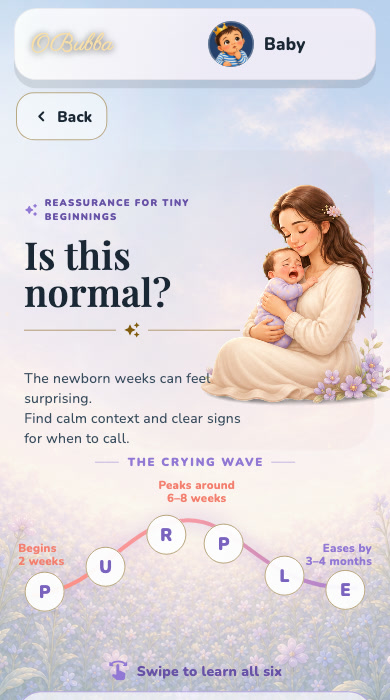
The screen is built around three decisions tired parents actually need:
- Could this be a common newborn surprise? Eighteen expandable answers cover grunting, sneezing, wandering eyes, breathing patterns, peeling skin, the fontanelle, hiccups, startles, jaundice, vitamin D, poo, early vision, cluster feeding, evening fussiness, newborn spots, cradle cap, trembling and cord care.
- What if the crying is overwhelming me? A prominent safe-pause action reminds a parent that placing baby safely in the cot and stepping away briefly is allowed, and that shaking is never safe.
- When should I stop reading and get help? A separate urgent-help action surfaces breathing difficulty, colour change, fever in a young baby, seizure, a non-fading rash, a bulging fontanelle and unusual floppiness or difficulty waking.
The app also presents the normal early crying curve through the six-part PURPLE Crying framework: crying can peak, be unexpected, resist soothing, look pain-like, last a long time and cluster in the evening. Its most important message is not an acronym. It is: a baby can resist soothing without the parent causing it or failing them.
OBubba does not listen to breathing, inspect a rash, measure a temperature or diagnose illness. It cannot decide that a symptom is safe. Its job is to replace a chaotic search spiral with calm context, a visible safety boundary and the correct prompt to contact a human professional.
Around that hub, the same app keeps feeds, nappies, sleep, temperature, medicine, growth and crying notes in one timeline. That gives a parent a more useful answer to “What changed?” and a cleaner handover to a partner, midwife, health visitor or doctor.
Turn a 3am question into a calm next step in OBubba's free Grow area. You can also keep feeds, nappies, sleep and care notes together for a clearer picture of what has changed.
Your 3am plan
Save this sequence before you need it:
- Look at the whole baby: breathing, colour, response, feeding, nappies and temperature.
- Act on red flags: call 999 for emergency signs; use your midwife, GP or NHS 111 for urgent concerns.
- Do one calm check, not twenty searches: note what happened and what is different.
- Use a safe pause if crying overwhelms you: baby on their back in a clear cot, step away briefly and call someone.
- Trust your instinct: nobody will be annoyed that you asked about a very young baby.
Newborns are noisy, unfinished and startlingly good at looking mysterious. You do not have to know the name of every reflex or rash. You need a reliable way to notice the difference between an ordinary surprise and a baby who needs help, and permission to ask whenever you are unsure.
This UK-oriented article is general information, not a diagnosis or individual medical advice. Newborns can become unwell quickly. Follow your baby's discharge plan and your maternity or neonatal team's advice. Call 999 for an emergency; contact your midwife, GP, health visitor or NHS 111 when you are concerned.
Ready to try OBubba?
Use OBubba to track feeds, sleep, naps, nappies, growth, milestones and family handovers in one calm baby tracker app.