It is 2am and your hands are itching again. There is no obvious rash, but your palms feel impossible to ignore—and perhaps the soles of your feet do too. Is this just another uncomfortable pregnancy symptom, or should you call someone?
Tell your midwife or maternity unit about persistent itching in pregnancy, especially when it affects your palms or soles, is worse at night, or happens without a rash. Do not wait for your next routine appointment.
Most itching in pregnancy is not caused by a serious condition. However, this particular pattern can be a symptom of intrahepatic cholestasis of pregnancy (ICP), also called obstetric cholestasis. ICP is checked with blood tests. You cannot confirm or rule it out from the location or intensity of the itch alone.
If your baby's movements have reduced or changed, contact your maternity unit straight away, day or night. Do not wait to see whether the itching settles first.
The short decision guide
| What you notice | What to do | | --- | --- | | Itching on your palms or soles, particularly without a rash or worse at night | Contact your midwife or maternity unit today and describe the pattern | | Persistent or widespread itching elsewhere in pregnancy | Tell your midwife or maternity team; they can assess the skin and decide whether blood tests are needed | | A first blood test was normal but the itching continues | Contact the team again; bile acids and liver tests may need repeating | | Reduced or changed baby movements | Contact your maternity unit straight away, day or night | | Yellow skin or eyes, very dark urine, pale stools, or feeling significantly unwell | Seek prompt maternity or medical advice | | A life-threatening emergency | Call 999 |
You do not need to decide whether your symptoms “sound severe enough.” The purpose of the call is to let the maternity team make that assessment.
Why does pregnancy cause itching?
Itching is common during pregnancy. Skin stretches, becomes drier and may react differently to heat, sweat, products or fabrics. Existing eczema can change, and pregnancy-specific rashes can also occur.
The Royal College of Obstetricians and Gynaecologists (RCOG) says itching affects about 25 in 100 pregnant women. Most will not have ICP.
That is reassuring, but it is not a reason to self-dismiss persistent symptoms. ICP may begin with itching before anything is visible on the skin. The useful question is not “How likely is the worst possibility?” It is “Does this pattern deserve the simple check available?”
What is intrahepatic cholestasis of pregnancy?
ICP is a condition that affects how the liver works during pregnancy. Bile acids, which the liver makes to help digest fats, build up in the body and can become raised in the blood.
According to RCOG, ICP:
- usually develops towards the end of pregnancy, often after 28 weeks, although it can begin earlier
- causes itching that may be mild or intense
- often involves the palms and soles and may be worse at night
- classically causes itching without a primary rash
- usually improves after the baby is born
- is uncommon, affecting roughly 7 in 1,000 pregnancies in the UK
Scratching can leave marks, and it is possible to have ICP alongside a separate skin condition. A rash therefore should not be used as a home rule-out. Let a clinician look at the whole picture.
What does ICP itching feel like?
There is no single sensation that proves ICP. People describe itching that is persistent, deep, prickly, crawling or simply relentless. It may begin in the hands and feet or occur elsewhere across the body. Night-time can feel particularly difficult, and broken sleep can make the following day exhausting.
Patterns worth describing include:
- whether your palms, soles or both are affected
- whether there is a visible rash before scratching
- whether the itch becomes worse in the evening or overnight
- when it began and whether it is spreading or intensifying
- whether cool air, moisturiser or changing clothes affects it
- any yellowing of the eyes or skin, dark urine, pale stools or upper abdominal discomfort
- how your baby has been moving today
This is information for the call, not a score you need to complete before calling.
Who should I call—and what should I say?
Use the contact instructions in your maternity notes. Depending on your stage of pregnancy and local service, that may be your community midwife, maternity triage, assessment unit or labour ward.
You can say:
> “I am [number] weeks pregnant and I have persistent itching, especially on my palms/soles. It is worse at night and I cannot see a rash. It started [when]. My baby's movements are [normal for me / reduced / changed]. What assessment do I need?”
If you cannot reach your usual contact, follow the out-of-hours number in your notes or the advice from your maternity service. The NHS pregnancy warning-sign guidance specifically includes itchy skin because it can sometimes be ICP.
Do not worry that you are wasting anyone's time. A call that ends in reassurance is still a useful call.
How is ICP checked?
The maternity team will ask about your symptoms and may examine your skin for other causes. RCOG says the main blood tests are:
- Bile acids, measuring the level of bile acids in your blood
- Liver function tests (LFTs), looking at markers of how the liver is working
Bile acids can be abnormal even when liver function tests are normal. Other conditions can also affect these results, so diagnosis belongs with the maternity team.
One particularly important point: itching can begin days or weeks before blood tests become abnormal. If the first results are normal but the itch persists and no other cause is found, RCOG advises that bile acids and liver tests should be repeated.
Do not let “the test was normal” become “I must stop mentioning it.” Report continuing or worsening symptoms and ask what repeat-testing plan your team recommends.
If ICP is diagnosed, what happens next?
Care is personalised. RCOG says someone diagnosed with ICP should be under obstetric care, with repeat blood tests and a plan based on bile-acid levels, gestation, symptoms and other pregnancy factors.
The team may discuss:
- repeat bile-acid and liver-function testing
- medicines or skin treatments to reduce itching
- keeping a close watch on your baby's usual movement pattern
- whether other checks are appropriate
- the safest timing and place of birth for your individual situation
- follow-up blood tests after birth
The level of risk is not the same for every ICP diagnosis. RCOG separates mild, moderate and severe ICP using peak bile-acid levels and explains that only severe ICP has a clearly increased stillbirth risk. Other factors—such as a multiple pregnancy, gestational diabetes or pre-eclampsia—also influence recommendations.
This is why alarming internet summaries are not useful substitutes for your actual results. Ask your obstetric team what your bile-acid level means for your pregnancy and how it affects the plan.
What can help the itch while I wait for advice?
Comfort measures do not treat or rule out ICP, but they may make the waiting and night-time more manageable. RCOG lists options such as cool baths, loose cotton clothing and simple skin creams, sometimes with menthol. Antihistamines may occasionally be offered to help with sleep, and ursodeoxycholic acid may slightly reduce itching for a small number of people.
While awaiting advice, you could try:
- a cool or lukewarm shower rather than a hot one
- loose, breathable layers
- an unperfumed moisturiser kept cool
- short nails and gentle pressure rather than scratching skin raw
- a cooler bedroom and light bedding
- asking a pharmacist or maternity clinician before taking any medicine in pregnancy
Do not use improvement after cream, cooling or sleep as proof that blood tests are unnecessary. Ordinary dry skin can improve with moisturiser; ICP itching can also fluctuate.
Common myths that can delay a call
“There is no rash, so there is nothing to show them”
No rash is part of the reason the symptom matters: ICP often causes itch without a primary rash. You do not need photographic evidence.
“The itching is not unbearable”
The intensity of itching does not diagnose the condition or tell you the bile-acid level. Mild symptoms are still worth reporting.
“It is only my bump itching”
Stretching and dryness are common explanations, but persistent itching anywhere in pregnancy can be mentioned to your midwife. Palms, soles, no rash and night-time worsening are useful clues—not entry requirements.
“My first tests were normal, so it cannot be ICP”
Symptoms may precede abnormal blood tests. Continuing itch deserves another conversation and may require repeat tests.
“My baby is moving, so I can wait until the next appointment”
Normal movements are reassuring in the moment but do not replace assessment of persistent itching. If movements reduce or change, contact the maternity unit straight away.
A calm note for partners
Night-time itching can be physically and emotionally draining. A partner or support person can help without trying to diagnose:
- find the maternity notes and correct phone number
- note when the itching started and where it is strongest
- check how baby has been moving compared with their usual pattern
- make the call together if that feels easier
- write down any blood-test plan and when to chase results
- help create a cool room, loose clothing and protected time to rest
“It is probably nothing” may be intended as comfort, but “Let us get it checked so you do not have to carry the uncertainty” is more useful.
How OBubba handles pregnancy warning signs
OBubba's pregnancy experience includes a Good to know safety guide inside the For you hub, alongside the kick counter, contraction timer, perineal-massage guide and preparation checklist.
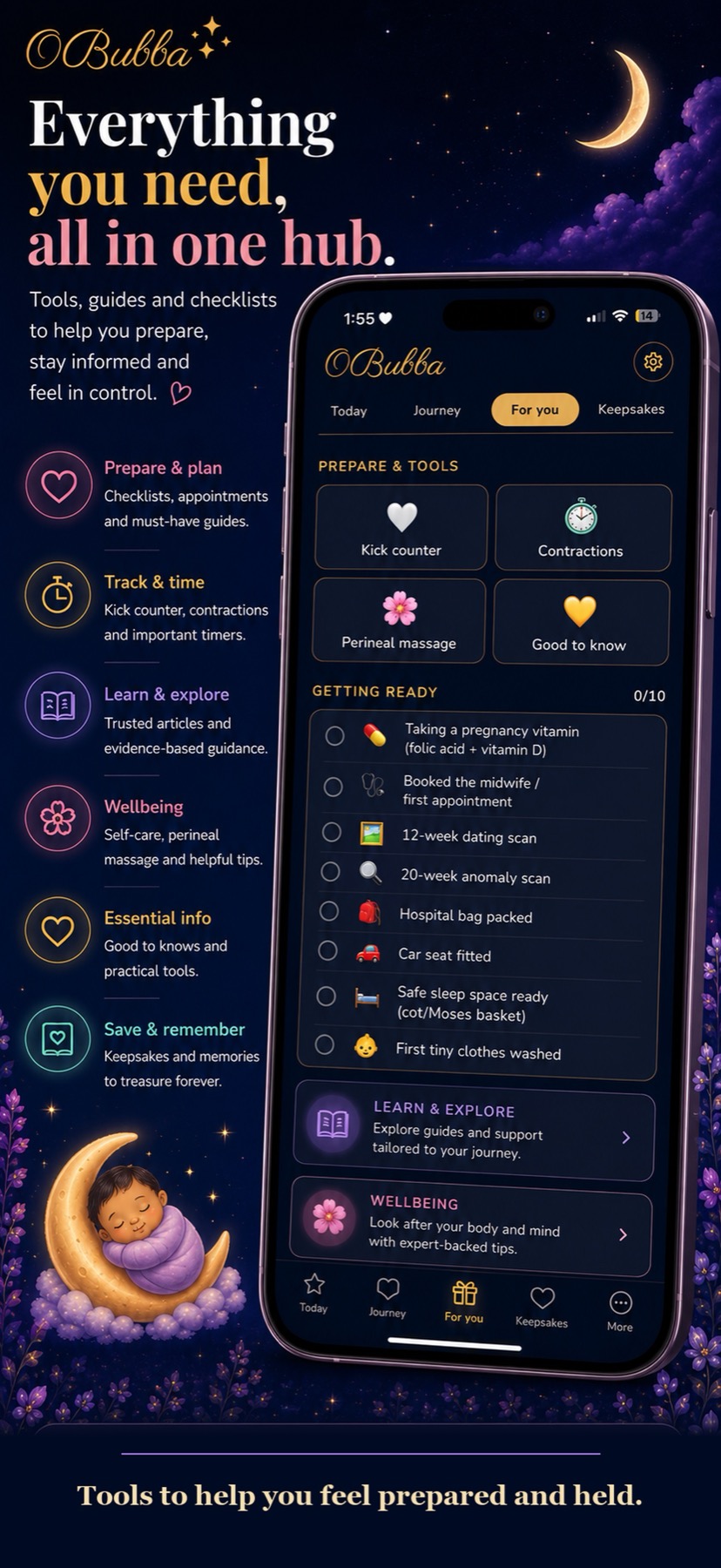
We inspected the current code while preparing this article. The guide:
- opens with “You're never a bother” and explains that checking is appropriate
- presents one sign at a time rather than a frightening wall of symptoms
- includes “Itching, especially palms and soles” and explains the no-rash, night-time pattern
- says ICP is checked with a blood test and is not something to wait out
- displays the maternity contact wording appropriate to the selected region
- keeps the emergency number visible for situations that feel seriously wrong
- never claims to diagnose ICP or replace a midwife
OBubba does not ask you to score the itch or watch a countdown. The useful action is outside the app: contact the maternity team. The app's job is to make the signal easier to recognise and the next step harder to second-guess.
Pregnancy mode also keeps week-by-week context, wellbeing check-ins, preparation, memories and the handoff into newborn tracking in one place. Explore OBubba's pregnancy and baby tracker—and always use your maternity team's advice for individual health concerns.
The answer to remember tonight
Itching is common in pregnancy, and most people who itch will not have ICP. But persistent itching—especially on the palms or soles, without a rash, and worse at night—is worth a call and a blood test.
Contact your midwife or maternity unit rather than waiting for the next routine appointment. If the first tests are normal and the itching continues, report it again and ask about repeat testing. If your baby's movements reduce or change, contact the maternity unit straight away.
You are not expected to diagnose yourself. You only need to notice the change and make the call.
This article gives general information for UK families and is not medical advice for an individual pregnancy. Follow your maternity team's instructions. Call 999 in a life-threatening emergency.
Frequently asked questions
Are itchy palms always cholestasis in pregnancy?
No. Many conditions can cause itching, and most itching in pregnancy is not ICP. However, palms or soles, no obvious rash and worsening at night are recognised ICP clues, so tell your midwife or maternity unit and let blood tests guide the assessment.
Can ICP start before the third trimester?
Yes. It most often begins after 28 weeks but can start earlier. Unusual or early symptoms may prompt the team to investigate other possible causes as well.
Can I have ICP with normal liver-function tests?
Yes. RCOG notes that bile acids can be abnormal even when liver-function tests are normal. Both are relevant, and your team will interpret the results together.
What if both bile acids and liver tests are normal?
If the itching continues and no other cause is found, contact the maternity team again. Symptoms can begin before blood tests change, so repeat testing may be recommended.
Does a rash rule out ICP?
No. ICP classically causes itching without a primary rash, but scratching can mark the skin and a person can have ICP alongside eczema or another skin condition. A clinician should assess the pattern rather than relying on a photograph.
Does ICP go away after birth?
It usually improves after birth. RCOG advises checking at the six-week postnatal appointment that itching has resolved and arranging blood tests to confirm liver tests and bile acids have returned to normal.
Can OBubba tell me whether I have ICP?
No. OBubba provides a calm warning-sign reference and routes you towards the appropriate maternity contact. It cannot examine your skin, measure bile acids, diagnose ICP or decide your care plan.
Ready to try OBubba?
Use OBubba to track feeds, sleep, naps, nappies, growth, milestones and family handovers in one calm baby tracker app.