The baby woke at 4:07am. You fed them and got everyone back to bed. At breakfast you remember the feed, but not whether it began at 4:07, 4:17 or sometime after that.
Does the missing entry make the tracker pointless?
No. Honest, incomplete records can still answer useful questions. Log the anchors you genuinely know, leave forgotten events unknown and collect only the detail needed for the decision in front of you. Do not turn a hazy night into a precise-looking fiction.
> Track the decision, not your baby's entire existence.
Perfect tracking is not the goal. A record should reduce mental load, make handovers easier and reveal patterns that are hard to see when days blur together. If it is making you watch the app instead of your baby, the record is asking too much.
The smallest useful baby record
Start with the question you want the record to answer. Different questions need different anchors.
| The question | Log these anchors | Usually safe to skip | |---|---|---| | When might the next nap fit? | morning wake, nap starts and ends | every yawn, cuddle and settling attempt | | Why is bedtime difficult? | last nap end, bedtime attempt, sleep onset, important context | every protest or dummy replacement | | Is a night feed changing? | genuine night wakes, wake-driven feeds, morning wake and enough ordinary nights | every stir your baby resettles from | | Is bottle intake shifting? | feed time, milk type and amount actually taken | the amount prepared but left behind | | Which breast might be next? | feed time and side offered | invented milk-transfer estimates |
The minimum is not the same for every family or stage. A healthy older baby's casual sleep pattern and a newborn's feeding or nappy check do not carry the same stakes. Follow any neonatal, growth, feeding, allergy or medicine plan you have been given.
Missing is not zero
This distinction protects the whole record.
- Zero means you observed the period and the event did not happen.
- Missing means you do not know whether it happened.
- Estimated means you remember an approximate event, but not its exact timing or amount.
If a grandparent forgot to record the afternoon, do not enter “0 naps” or “0 feeds”. That converts uncertainty into a confident claim and can distort an average. Leave it blank or ask the carer for the few anchors that matter.
The same rule applies after a foggy night. A rough time you genuinely remember is more truthful than 4:07am chosen because it looks plausible. If you do not know whether a wake included milk, record only the wake or leave both unknown.
Three lighter ways to track
You do not have to use one logging intensity forever.
1. Baseline week
Use this when you have no idea what the current rhythm looks like. For sleep, capture morning wake, naps, bedtime and genuine night wakes for about a week. For feeding, add only the feed details connected to your concern.
The aim is a sketch of real life, not a flawless laboratory week.
2. Question mode
Track one focused question for a bounded period:
- three to seven days to understand a current daily rhythm
- seven ordinary days to compare weekdays and weekends
- enough logged nights for the specific comparison the app is making
Decide the question before adding more fields. “Does a late final nap push bedtime later?” has a much smaller record than “capture everything my baby does”.
3. Maintenance mode
Once you know the pattern, keep only the anchors that still earn their place. That may be naps and bedtime during a transition, bottle amounts during a feeding question, or the breast side last offered. You can increase detail again when the question changes.
You are allowed to graduate from tracking. A useful app should help you make decisions, not make itself another baby-care obligation.
How to repair a gap without corrupting the pattern
When you notice a missed event:
- Add what you know. “Nap ended at 2:30pm” can still help bedtime planning even if the start was forgotten.
- Use an approximation only when it is genuinely useful. Choose the closest time you honestly remember rather than assigning false precision.
- Do not invent amounts. For a bottle, record what was actually taken if known, not what was made. Never estimate direct breast-milk transfer from feeding minutes or pump output.
- Check the date around midnight. A 2am feed belongs to the morning after the evening it followed, even though exhausted brains often place it on the previous calendar day.
- Mark disrupted days. Illness, vaccination, travel, nursery or unusual care can explain why that day should not define the baseline.
- Move on. One missed entry does not require reconstructing an entire week.
For medicine, allergy reactions, hydration concerns or a clinician-requested record, accuracy matters more. Do not use a casual catch-up estimate for a safety-critical record. Follow the written care plan and get professional advice when information is missing.
What is worth logging for sleep?
For a practical sleep pattern, four anchors do most of the work:
Morning wake. This starts the day's rhythm. Log the point the day truly began, not every early stir that resettled.
Nap start and end. These define nap duration and the awake interval before the next sleep. If nursery gives only a rough time, keep it rough rather than polishing it into certainty.
Bedtime and sleep onset. “Routine began” and “asleep” are different moments. For bedtime-resistance questions, the difference matters more than logging every soothing technique.
Genuine night wakes. Count the wakes that required meaningful help. A grunt heard through the monitor is not automatically a wake, and a feed attached to one wake should not become a second wake.
Avoid assigning “hunger”, “overtired” or “teething” merely because one explanation feels likely.
What is worth logging for feeds?
Follow the baby first. The NHS recommends responsive feeding: offer milk in response to hunger cues and let the baby pause or finish, rather than feeding to a rigid app schedule.
For bottles, log the milk type, time and amount taken. For direct breastfeeding, side and duration may help a handover, but they do not reveal the amount transferred. For either method, comfort, swallowing, responsive cues and the wider clinical picture matter more than a streak of completed fields.
If intake, growth or hydration is a clinical concern, a casual partial record is not enough for reassurance. Follow the complete record your midwife, health visitor or feeding team asks for, and seek advice if your baby is feeding poorly or seems unwell.
How the real OBubba app handles imperfect history
The current OBubba app does not require a perfect diary before it can help. Several of its sleep and feeding summaries are designed around the difference between no event and no evidence.
It can start with an age-based sleep baseline
With a known age and a current wake anchor, the nap predictor can begin from an expert age baseline while it learns this baby's rhythm. Personal history then changes the estimate and its confidence. No app can personalise from events it has never seen, but useful guidance does not have to wait for a month-long perfect streak.
A blank day does not become a zero day
Weekly sleep, wake and feeding averages use days carrying relevant data rather than treating every blank day as an observed zero. Night-feed comparisons require nights that actually carry records on both sides of the comparison.
Thin evidence can end in not enough data
For experiments and several pattern checks, thin evidence can produce not enough data rather than a result. That safeguard does not make every explanation a diagnosis, and parents should treat pattern suggestions as possibilities rather than clinical conclusions.
Catch-up entries go to the day they actually happened
You can add a past event later. The current bucketing logic handles the easy-to-misplace early-hours case: a 2am wake entered while reviewing the previous evening is attached to the morning-after date. It also re-buckets an edited event when its corrected time crosses into another day.
Quick Log reduces the taps
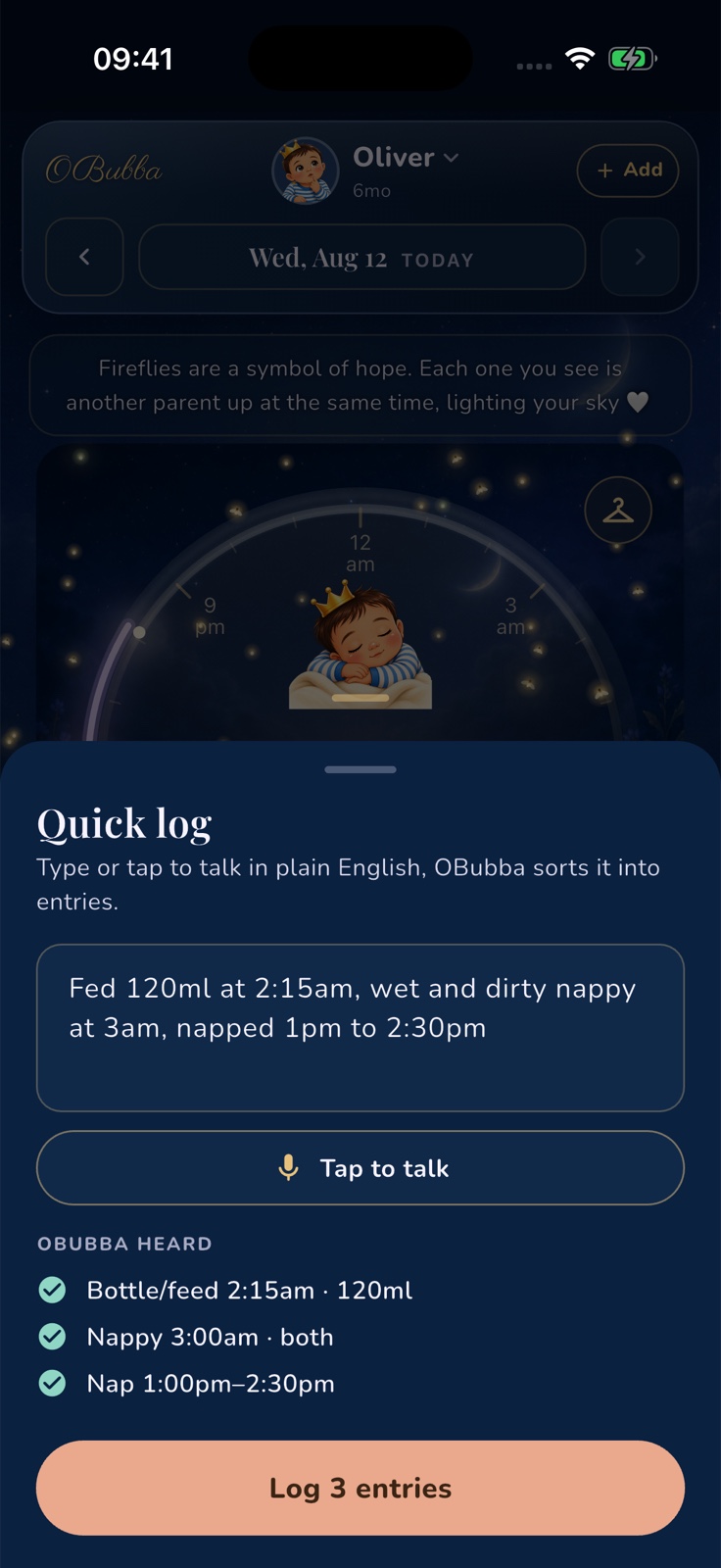
Type or say one plain-English sentence, such as “fed 120ml at 2:15am, napped 1pm to 2:30pm”. Quick Log separates it into a preview list so you can check the types, times and amount before saving. If speech input is unavailable, typing still works.
That preview matters. Fast logging should reduce friction without turning a misunderstood sentence into unquestioned history.
Context can protect the baseline
Days marked sick, travel, nursery or another unusual context can be kept out of baseline learning where appropriate. The disrupted day still happened and can remain visible; it simply does not have to teach the app that an exceptional rhythm is the new normal.
What OBubba still cannot know
OBubba cannot detect every omitted event, reconstruct an exact forgotten time, measure milk transferred at the breast or diagnose a feeding or sleep problem. Some product routes use different completeness rules, so a partial log must never be treated as clinical reassurance. Its guidance is only as specific as the relevant evidence allows.
Try OBubba's lighter, pattern-first baby tracker →
A two-minute reset for tonight
If your current record feels overwhelming, simplify it now.
- Write the one question you want answered this week.
- Choose no more than four anchors that answer it.
- Tell every carer what counts and what can be skipped.
- Use Quick Log or catch-up entry for known events.
- Leave forgotten stretches missing rather than filling them with zeros.
- Review after the agreed period, then stop or reduce the record.
For a bedtime question, that could be as small as: morning wake, naps, bedtime asleep and genuine night wakes. For a bottle question: feed time, amount taken and comfort during the focused period.
Frequently asked questions
Will one missed nap ruin the prediction?
No. The next estimate can still use age, the known current wake anchor and the history that exists. A missing nap may make the personal picture less complete, so correct it if you know the time; otherwise let it remain unknown.
Should I estimate a forgotten feed time?
Use the closest time you honestly remember if the rough timing genuinely helps. Do not create minute-level precision you do not remember. Never estimate a bottle amount or direct breast transfer simply to complete a chart.
How many days do I need before tracking becomes useful?
It depends on the question. Today's wake time can help with today's nap planning immediately. A daily rhythm often becomes clearer across several ordinary days. A change in night feeding needs more logged nights and careful interpretation. OBubba uses feature-specific evidence gates rather than one universal “data complete” score.
Can my partner or another carer fill the gaps?
Yes, if they observed the event. Agree on a small shared vocabulary: asleep time rather than cot time, amount taken rather than prepared, and genuine wake rather than every sound. A truthful rough time from the person who was there is better than a precise guess from someone who was not.
Do I need to track forever?
No. Stop when the question is answered, the routine is easy to remember or the record costs more attention than it returns. Restart temporarily during a nap transition, feeding concern, illness handover or another period when the pattern matters again.
What if tracking makes me more anxious?
Reduce the fields, shorten the experiment or pause. Ask whether each entry changes a decision or improves a handover. If the chart is driving repeated checking or distress, speak with someone you trust and a health professional. Your baby's care is not measured by logging completeness.
The bottom line
Tracking is still worth it when a small, honest record answers a real question. It is not worth turning ordinary care into constant data entry.
Keep the anchors. Leave the unknowns unknown. Use catch-up tools for what you remember, context for exceptional days and a bounded tracking period for each decision. Then put the phone down.
The best baby record is not the fullest one. It is the lightest one that helps your family act with more confidence.
Sources
OBubba is a record, pattern and education tool. It cannot assess hydration, milk transfer, growth, allergy, medicine safety, illness or sleep disorders, and it does not replace an individual care plan or advice from a midwife, health visitor, feeding specialist, pharmacist, GP, NHS 111 or emergency services.
Ready to try OBubba?
Use OBubba to track feeds, sleep, naps, nappies, growth, milestones and family handovers in one calm baby tracker app.