Perineal massage can sound either clinical, awkward or like one more item on an already crowded third-trimester list. It is actually an optional birth-preparation technique that you, or a partner you trust, can try privately during the last few weeks of pregnancy.
The short version is:
- begin from around 34–35 weeks, unless your maternity team recommends something different
- aim for a few minutes several times a week; daily is optional, not a pass mark
- use clean hands, short nails, a comfortable position and suitable unscented lubricant
- expect firm pressure or a stretching sensation, not sharp pain
- stop if it hurts, bleeds or does not feel right
- do not massage if your waters may have broken, you have a vaginal infection, or your midwife has advised against it
- remember that it may lower some risks, but it cannot guarantee a tear-free birth
You do not have to do it. Missing sessions does not mean you are unprepared, and choosing not to touch this part of your body is completely valid.
What is the perineum?
The perineum is the area of skin and muscle between the vaginal opening and anus. During a vaginal birth, this tissue stretches as the baby's head and body are born.
Sometimes the tissue tears. Tears vary from small skin injuries to deeper tears involving muscles around the anus. An episiotomy is a cut made by a midwife or doctor when there is a clinical reason to widen the vaginal opening.
Perineal massage uses gentle, sustained pressure and a U-shaped movement to help you become familiar with the stretching sensation before labour. It is preparation, not a way to force the tissue to stretch.
Does perineal massage prevent tearing?
It may reduce the chance of some perineal trauma, particularly for a first vaginal birth. That is different from promising that it prevents every tear.
The Royal College of Obstetricians and Gynaecologists (RCOG) says perineal massage from 35 weeks may reduce the risk of tearing and may be particularly beneficial for first-time mothers. Cambridge University Hospitals' current patient guidance says evidence supports a lower likelihood of episiotomy and tears requiring stitches when massage begins from 34 weeks.
The evidence does not mean:
- every tear is preventable
- massage controls how labour unfolds
- more pressure produces more benefit
- a person who tears performed the massage incorrectly
- vaginal birth without tearing is a measure of success
Baby size and position, the speed of birth, an instrumental birth, individual tissue and many factors nobody can predict may affect tearing. Preparation can influence risk without controlling the outcome.
When should you start perineal massage?
UK services commonly recommend starting at 34 or 35 weeks. There is no need to begin earlier.
Guidance varies slightly on frequency:
- RCOG describes daily massage from 35 weeks when possible
- Cambridge University Hospitals recommends three or four times a week for three to five minutes, while noting that once or twice a week may still help
- Harrogate and District NHS Foundation Trust suggests around three or four times a week from 35 weeks
This variation is reassuring: there is no single perfect streak. A practical routine might be five minutes after a bath or shower, two to four times a week. Stop sooner if you are uncomfortable.
If you are planning a caesarean birth but there is a possibility of labour or vaginal birth, ask your midwife whether the technique is relevant to your individual plan. If you have had previous perineal trauma, pelvic pain, genital surgery, vaginismus or trauma associated with touch, individual guidance from a midwife or pelvic-health physiotherapist may be much more useful than a general tutorial.
What do you need?
Keep it simple:
- privacy and enough time not to feel rushed
- clean hands and short, smooth nails
- a mirror, if seeing the area makes positioning easier
- pillows or another stable support
- a small amount of suitable, unscented lubricant
- a clean towel for comfort and spills
RCOG lists lubricants such as vitamin E, almond or olive oil. NHS maternity guidance also commonly suggests unscented plant-based oil or a water-based lubricant. Avoid scented products, and do not use an oil you are allergic or sensitive to. Cambridge University Hospitals advises against baby oil, mineral oil and petroleum jelly.
Products vary, and pregnancy can make tissue more sensitive. Your midwife can advise if you are uncertain about a product, latex barrier contraception, a skin condition or an allergy.
How to do perineal massage step by step
The description below is general education. Ask your midwife to explain or demonstrate with a model if written instructions are hard to translate into movement.
1. Prepare and get comfortable
Empty your bladder, wash your hands and check that your nails are short. A warm bath or shower beforehand can make relaxing easier.
Try a supported semi-reclined position with knees bent, or stand securely with one leg supported. You should be able to reach without straining your back, holding your breath or balancing precariously.
There is no prize for managing alone. A partner can help if you actively want them to, you feel safe and communication is easy.
2. Use enough lubricant
Apply a small amount to your clean thumbs and around the vaginal opening. Add more if there is friction. The aim is slow pressure on the tissue, not rubbing dry skin.
3. Press down and out
Gently place your lubricated thumbs just inside the vaginal opening. If a partner is helping, they can use clean index fingers.
Press downwards towards the anus and slightly out towards the sides until you feel a firm stretch or mild tingling. Hold that pressure for about a minute while breathing slowly and relaxing your jaw, bottom and pelvic floor.
This may feel unusual or uncomfortable. It should not feel sharply painful, burning in a way that concerns you, or as though you must endure it.
4. Make a slow U shape
Keeping the pressure controlled, sweep gently along the lower half of the vaginal opening in a slow U-shaped movement for two or three minutes. RCOG describes repeating this movement two or three times; other NHS leaflets suggest a shorter total session.
Start with less. Technique does not improve because you push harder or continue longer.
5. Stop deliberately
Finish after a few minutes, wipe away excess lubricant and notice how you feel. Mild awareness of the area can happen immediately afterwards; continuing pain, bleeding or symptoms that worry you are reasons to stop and contact your maternity team.
What should it feel like?
Possible normal sensations include:
- pressure
- stretching
- tingling
- a mild burning or warm stretching sensation that eases when pressure stops
- awkwardness while you learn the position
Stop for:
- sharp, severe or escalating pain
- bleeding
- numbness or loss of control over the pressure
- dizziness, feeling faint or feeling unwell
- distress, panic or a sense that you do not want to continue
Consent applies even when a partner is helping with a health-related technique. Agree on a word that means stop, check in throughout, and stop immediately when asked. A partner's job is to follow your feedback, not interpret it or persuade you to continue.
When should you not do perineal massage?
Do not perform it if:
- you think your waters may have broken
- you have active thrush, genital herpes or another vaginal infection
- you have unexplained vaginal bleeding
- your midwife or doctor has advised you to avoid vaginal insertion or massage
Contact your maternity unit rather than massaging if you have possible waters breaking, bleeding, reduced baby movements, regular contractions before 37 weeks, or another concern about you or your baby.
There may be individual reasons to avoid or adapt the technique that a generic list cannot cover. Ask before starting if you have a cervical stitch, placenta concerns, a high-risk pregnancy, ongoing pelvic pain, a history of preterm labour or any specific restriction in your maternity plan.
Can your partner do it?
Yes, if you want them to. A partner may find the angle easier, especially when reaching around a late-pregnancy bump is uncomfortable.
Make the boundaries explicit:
- You choose whether the session happens.
- They wash their hands and smooth short nails.
- You direct the position, pressure and pace.
- They use index fingers rather than thumbs if that is easier.
- They stop immediately when you say stop.
It does not need to be romantic, and it does not need to involve a partner. It can be practical, brief and private. If partner involvement feels complicated for any reason, leave it out.
What else may reduce severe tearing?
Massage is only one possible part of perineal care. RCOG also describes measures during birth that may reduce the severity of tearing:
- a warm compress held against the perineum by a healthcare professional
- a slow, controlled birth of the baby's head
- manual perineal support where appropriate
- positions such as kneeling, all fours or side-lying
These are discussion points, not guarantees or demands. Some options depend on the birth setting and circumstances; for example, manual perineal protection is not performed during a water birth.
You can add a simple preference to your birth plan: “Please discuss warm compresses, position and perineal support with me during birth where clinically appropriate.” Preferences can change in the moment.
How OBubba makes this easier to revisit
OBubba's real pregnancy experience includes a dedicated Perineal massage guide alongside its week-by-week journey, preparation tools and “Good to know” safety information.
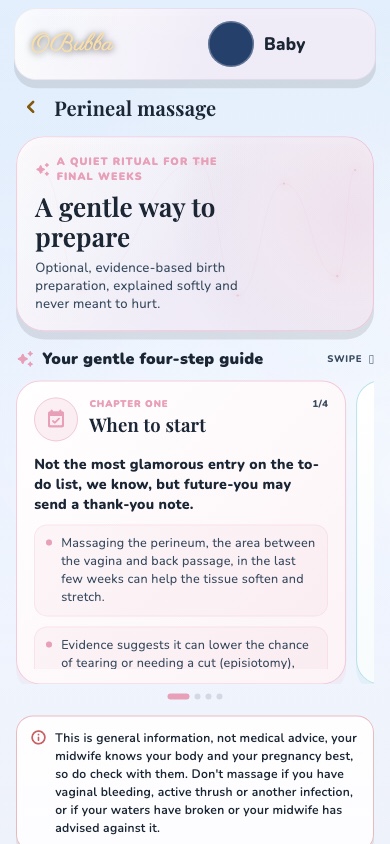
The guide is intentionally structured as four short chapters:
- When to start: around 34–35 weeks, without turning missed days into failure.
- Getting comfy: clean hands, warmth, support and unscented lubricant.
- How to do it: gentle down-and-out pressure followed by a slow U shape.
- Be kind to yourself: stop if it hurts; this is not a test of birth readiness.
Its safety note says not to massage with bleeding, active thrush or another infection, after waters break, or when a midwife has advised against it. That boundary matters more than a reminder streak.
OBubba does not record intimate details or grade a session. Its job is to keep trustworthy preparation close to the other parts of the journey, so a parent can read it when ready and then put the phone down.
The same pregnancy space carries forward after birth into feeds, nappies, sleep, medicines, growth, appointments and shared care. Parents do not need a separate app for every chapter or have to rebuild context while exhausted.
The whole app is unlocked during pregnancy and remains on OBubba through the first eight corrected weeks after birth. After that early-free period, the app shows current eligibility and storefront options before any purchase.
Keep pregnancy preparation and baby tracking together →
A realistic five-minute routine
If you decide to try it:
- Choose two or three calm evenings this week.
- Put the lubricant and clean towel somewhere private but easy to reach.
- Use warmth and support to get comfortable.
- Spend one minute finding gentle pressure, then two or three minutes on the U-shaped movement.
- Stop while the sensation is still manageable.
- Ask your midwife at the next appointment if anything felt confusing.
Do not make up missed sessions. Do not continue through pain. Do not compare your flexibility or comfort with somebody else's body.
Frequently asked questions
Is 37 weeks too late to start?
No. Starting later gives you fewer sessions, but the practice can still help you become familiar with pressure and relaxation. It is optional at every stage.
Can perineal massage bring on labour?
It is not intended to induce labour. If massage seems to trigger contractions, you have bleeding, your waters may have broken or you feel concerned, stop and contact your maternity unit.
Do I need a special perineal massage tool?
No. Clean fingers and suitable lubricant are enough. Harrogate and District NHS Foundation Trust notes a lack of evidence for pelvic-floor training devices as perineal protection.
Should it burn?
A mild stretching or tingling sensation can be expected. Sharp pain or a sensation that makes you want to pull away is a reason to reduce pressure or stop. You never need to “push through”.
What if I cannot reach?
Change position, use a mirror, ask a consenting partner, or skip it. Your midwife or pelvic-health physiotherapist may offer more accessible suggestions. Difficulty reaching is not a failure.
Will it stop me needing an episiotomy?
It may reduce the likelihood, especially in a first vaginal birth, but it cannot guarantee the outcome. An episiotomy may still be recommended for clinical reasons during birth.
The bottom line
Perineal massage is an optional, evidence-supported technique for the final weeks of pregnancy. Start around 34–35 weeks, use clean hands and suitable lubricant, keep the pressure controlled, and stop if it becomes painful.
It may reduce the chance of an episiotomy or a tear needing stitches, particularly for a first vaginal birth. It does not control birth, prove preparedness or guarantee that tearing will not happen.
The best preparation is informed and kind: understand the option, check individual questions with your midwife, and choose what feels right for your body.
Sources
- RCOG: Reducing your risk of perineal tears
- Cambridge University Hospitals: Antenatal perineal massage
- Harrogate and District NHS Foundation Trust: Perineal massage in pregnancy
This article provides general UK education, not individual medical advice. Follow your maternity team's guidance and contact your midwife or maternity unit if you have bleeding, possible waters breaking, infection symptoms, reduced baby movements, pain or any concern about your pregnancy.
Ready to try OBubba?
Use OBubba to track feeds, sleep, naps, nappies, growth, milestones and family handovers in one calm baby tracker app.