The internet's perfect baby bedtime routine begins with a peaceful bath, includes a massage, a full feed, two books and a lullaby, and ends with a smiling baby drifting off on cue. Your real evening begins late because the final nap ran over, the bath makes your baby wildly excited and someone has lost the clean sleeping bag.
The short answer: a useful bedtime routine does not need to be long or elaborate. Choose three repeatable cues — meet the immediate needs, lower the stimulation and use the same final goodnight cue — then place your baby in their safer sleep space. Keep the order familiar, but shorten or adapt it when life requires.
What a bedtime routine can—and cannot—do
NHS guidance says a simple, soothing bedtime routine may help a baby settle and can provide valuable one-to-one time. Repetition makes the approach to sleep more predictable: the lights dim, voices soften, the same short actions happen and the day closes.
That does not make a routine a promise that your baby will:
- fall asleep at the same minute every night
- stop needing feeds or comfort
- sleep through normal waking
- settle independently before they are ready
- ignore pain, illness, hunger or an unsuitable bedtime
A routine is a sequence of cues, not sleep training and not a test of parenting. You can respond, cuddle, rock or feed your baby and still have a recognisable routine.
The three-part routine that fits most evenings
Instead of starting with a shopping list of activities, build around three jobs.
1. Meet the practical needs
Offer the age-appropriate feed your baby needs. Change the nappy if required. Put on night clothes and a correctly fitting sleeping bag or suitable bedding for the room temperature.
This is the functional part of the evening. It does not have to feel magical. If your baby has reflux, follow the feeding and positioning advice given by your health professional; a routine should fit clinical guidance, not compete with it.
2. Lower the stimulation
Dim the lights, put lively play away and make voices quieter. Choose one calm activity: a cuddle, a brief massage, one board book or a familiar song.
NHS guidance suggests keeping lights low, voices quiet and interaction minimal at night. The useful contrast is between a bright, social day and a calmer night—not a perfectly silent house.
3. Use one final cue
End with the same small signal: close the book, say the same goodnight phrase, sing the last line of a song or give a kiss and cuddle. Then place your baby on their back in the normal safer sleep space.
If they need more help, help them. The cue can still be the same even when the settling after it looks different.
How long should a baby bedtime routine be?
Long enough to create a change of pace; short enough to repeat on a bad day.
For many families, 10 to 25 minutes is workable. A bath, full feed or medical care may make some evenings longer. A newborn may need a two-minute version between frequent feeds. The best duration is not the one in a book—it is the one your household can deliver without racing or resentment.
Watch what each step does. If a bath reliably winds your baby up, move it earlier or stop making it a nightly requirement. If a massage becomes a wrestling match, remove it. If three books become negotiations with an older sibling, choose one.
Consistency comes from the shape of the sequence, not its length.
Three routines to copy and adapt
A very young baby: 3 to 8 minutes
- Feed and wind as needed.
- Fresh nappy and sleep clothing.
- Lights low, short cuddle and quiet phrase.
- Back into the clear sleep space when ready.
Newborn waking and feeding are normal. Do not hold a very young baby to a clock or delay a feed to preserve the routine. In the early weeks, feeding to sleep is common; the NHS explicitly notes that breastfed babies may doze during feeds.
An older baby: 15 to 25 minutes
- Milk feed in a calm environment.
- Nappy, night clothes and tooth brushing if a tooth has appeared.
- One book or song.
- Cuddle and the same goodnight words.
- Into the safer sleep space on their back.
If separating the feed from the final moment works for your family, put the feed near the beginning. If it does not, do not force a change merely to make the routine look more “independent”.
The emergency version: 4 minutes
- Feed if due.
- Nappy and sleep clothing.
- Lights down, cuddle, one verse or phrase.
- Safe sleep space.
Use this after a late car nap, nursery pickup, illness, travel or a parent running on empty. A shortened routine is still the routine. Skip optional steps; do not skip safety.
When should the routine start?
Work backwards from a bedtime range, not a single compulsory minute. If the sequence normally takes 15 minutes and your baby tends to be ready for sleep between 7:00 and 7:30, begin the wind-down around 6:45 to 7:15 depending on the final nap and their cues.
Signs the start may be too late include:
- the baby becomes frantic or inconsolable during every step
- feeding is repeatedly too disorganised to finish
- they fall asleep before the routine has really begun
- the whole sequence feels like an urgent race
Signs it may be too early include:
- the baby stays bright, playful and engaged throughout
- they consistently take a long time to settle without distress
- the last nap ended later than usual
Change the start in small amounts and judge several comparable evenings. Do not move bedtime by an hour because of one strange nap day.
If the routine has stopped working
First decide what “not working” means.
Your baby protests at one step
Change that step. A routine is allowed to grow. Swap bath for a warm face-and-hands wash; replace massage with a cuddle; let a mobile baby choose between two short books.
Your baby completes it but will not sleep
The sequence may be fine and the timing may be wrong. Check the final nap, the length of the final awake period and whether your baby is showing genuine sleepiness. Track the actual sleep onset rather than only the time the routine began.
Your baby suddenly wakes more
Look for discomfort, illness, teething, a developmental change, hunger or an unusual day before redesigning bedtime. Keep familiar cues while offering more support. If your baby seems unwell, has breathing difficulty, is unusually hard to wake, feeds poorly or you are worried, seek medical advice.
The adults cannot sustain it
Cut it down. Write the essential order somewhere visible and make sure another carer can follow it. A six-step performance delivered by only one exhausted parent is less useful than three clear steps that either caregiver can repeat.
Keep safer sleep inside every version
The routine finishes with the same safety principles every night and for every nap. NHS Best Start in Life advises that the safest place for a baby in the first 6 months is a cot, lying on their back, in the same room as a parent or carer.
Use a firm, flat mattress and keep the sleep space clear of pillows, cot bumpers, pods, nests, toys and loose bedding. If you use a sleeping bag, make sure it fits properly at the shoulders and is appropriate for the room temperature.
If you are feeding or cuddling in an armchair, stay alert to your own tiredness. Falling asleep with a baby on a sofa or chair substantially increases risk. Put your baby back in their cot before you sleep.
No app routine, music, monitor or expensive “sleep” product makes an unsafe sleep setup safe.
How OBubba's current bedtime routine works
Open Care → Bedtime ritual to see a step-by-step path through the evening. The current default example contains bath, nappy and pyjamas, optional massage, final feed, story or song, and into bed. OBubba totals the minutes and presents one step at a time so a tired carer does not have to remember the whole list.
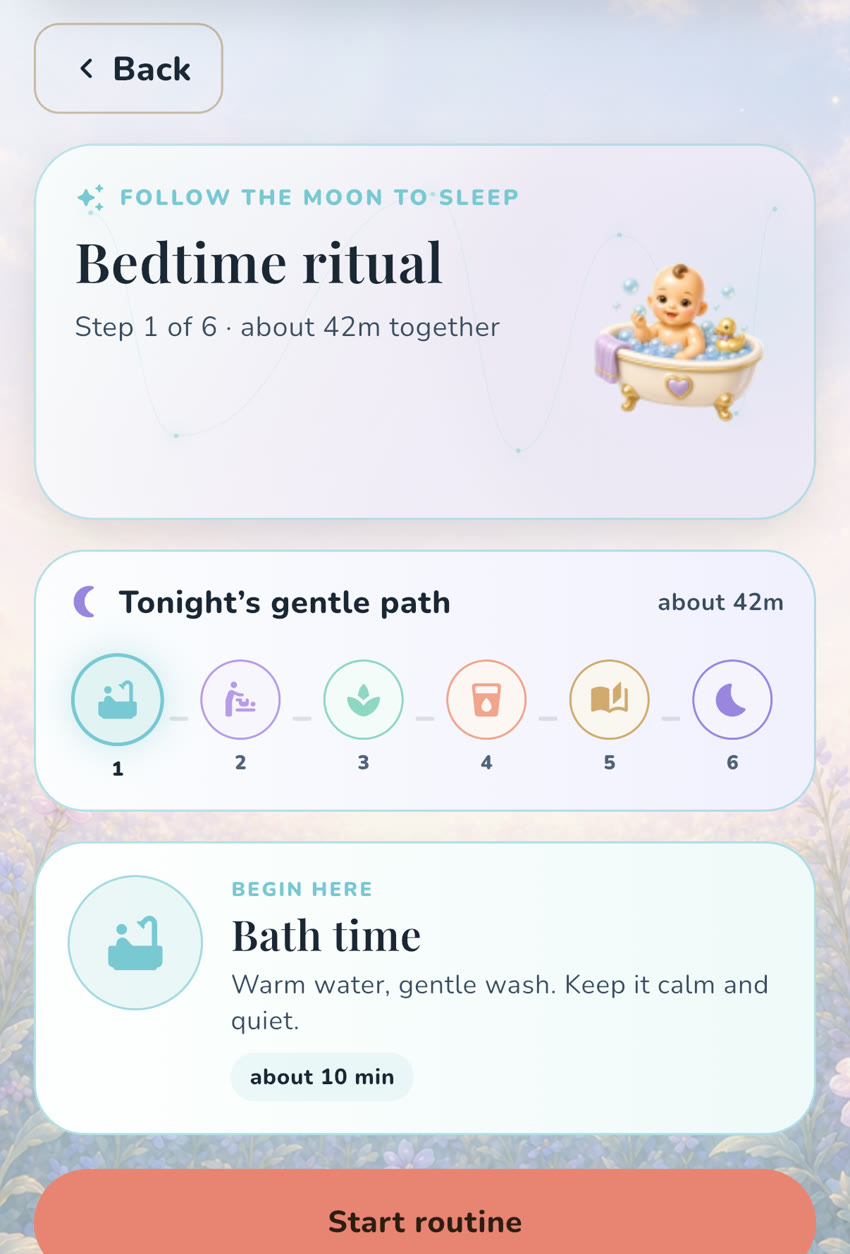
Tap Customise routine to:
- reorder the steps
- remove anything that does not fit
- edit a name, note or duration
- add a family's own cue
- reset to the built-in example
The routine is stored separately for each child on the device. If a “bath every night” template is unrealistic, delete it. If tooth brushing, a care step prescribed by a clinician, prayer, a particular song or another caregiver's phrase belongs in your evening, add the cue in language everyone recognises. Keep medicine names, doses, timings and consent in the proper medicine record rather than relying on a routine note.
Completing the guide does not pretend the baby is asleep. OBubba tells the parent to tap start bedtime on the Track clock when the baby is actually down. That separation matters: planned routine time and real sleep timing are not the same event.
The wider Track view can then use the day's actual naps and final wake to estimate the likely bedtime. The routine helps you work backwards from that range; it does not override hunger, cues or the sleep that truly happened. On teething, illness, nursery and travel days, shorten the optional steps and keep the final familiar signals.
Try OBubba free → — a custom bedtime path, live sleep tracking and a routine that bends with real family life instead of asking the family to bend around a template.
Sources and further reading
- NHS: Helping your baby to sleep
- NHS Best Start in Life: Safer sleep advice for babies
- NHS: Looking after your baby's teeth
OBubba supports tracking, planning and parent education. It does not guarantee sleep, diagnose a sleep problem, replace clinical feeding or positioning advice, or make an unsafe sleep environment safe.
Ready to try OBubba?
Use OBubba to track feeds, sleep, naps, nappies, growth, milestones and family handovers in one calm baby tracker app.