Your baby ate fish pie at nursery, pesto pasta at home or three spoonfuls of family curry. The meal has one name, but it may contain milk, wheat, egg, sesame, nuts, fish or none of those—depending on the recipe.
How should one meal become a useful allergen record?
Log the meal once, then name the important ingredients that were actually in it. Record roughly what your baby ate, when they ate it and how they responded. Do not treat a familiar dish name as proof of its allergens: fish pie can be wheat-free, pesto can be nut-free and pasta can be made with or without egg.
If several ingredients are brand new, the record may show what was eaten but cannot tell you which ingredient caused a later symptom. For planned first introductions, NHS guidance is still to offer foods that can trigger allergy one at a time and in very small amounts from around six months, so a reaction is easier to spot.
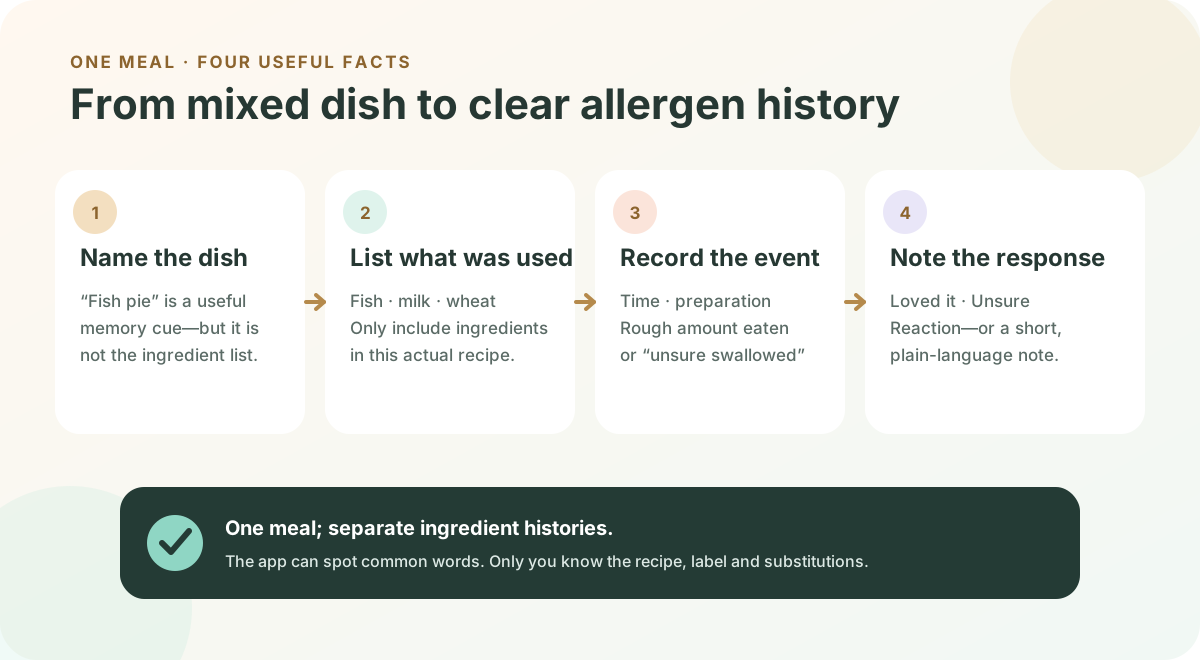
The two-layer record: meal first, ingredients second
Think of the log as two connected layers.
- The event: “fish pie at 12:15; ate about four spoonfuls; loved it.”
- The ingredient history: “contained cod, cows' milk and wheat flour.”
The event keeps the day understandable. The ingredient layer helps you answer later questions: Was milk genuinely in that serving? Had wheat been eaten before? Which foods were present when the rash appeared?
“Fish pie” alone cannot answer those questions. Neither can a list of allergen ticks with no meal, time or response.
What common mixed dishes might contain
These are prompts to check—not universal recipes.
| Dish name | Possible allergens | What to verify | |---|---|---| | Fish pie | fish, milk, wheat; sometimes egg | fish species, sauce ingredients, topping and stock | | Pesto pasta | wheat; often milk and tree nuts; pasta may contain egg | pasta label, cheese, pine nuts or another nut, and any nut-free substitution | | Omelette fingers | egg; sometimes milk or cheese | what was added to the egg and how it was cooked | | Hummus on toast | sesame and wheat | tahini in the hummus and bread ingredients | | Family curry | recipe-dependent: milk, nuts, mustard or others | paste, stock, yoghurt, coconut products and the full packet label | | Pancake | often wheat, egg and milk | whether it was vegan, dairy-free, gluten-free or made from a different flour |
Write what this serving contained. “Usually contains” is not the same as “baby ate”. A dairy-free fish pie should not create a milk exposure; a cashew-free pesto should not create a cashew exposure. Because an automatic dish match may still represent the typical recipe, use ingredient-level wording when your version is different.
For packaged foods, read the full label every time the product or recipe changes. If your child has a diagnosed allergy, the NHS advises avoiding food when you are unsure whether it contains that allergen and reading labels carefully.
A mixed meal is easier after the ingredients are established
There is an important difference between a mixed family meal and a mixed first introduction.
When every allergen is already familiar
If your baby has already eaten the relevant ingredients separately without a suspected reaction, combining them in an ordinary meal is practical. NHS guidance says tolerated allergenic foods should remain part of the baby's usual diet.
Record the dish and actual ingredients, but there is no need to pretend each lunch is a new “test”. A repeat exposure is useful history, not a pass–fail exam.
When one allergen is new
Keep the other ingredients familiar where practical. For example, use a familiar porridge to offer a small amount of a new, safely thinned nut butter. Your record then has one genuinely new allergen to follow.
When several allergens are new
The NHS one-at-a-time advice implies a simple limitation: if egg, milk and wheat are all new in one pancake and symptoms follow, the meal history cannot attribute the response to one of them. That is an inference from the guidance, not a claim that combining foods creates an allergy.
If the mixed meal already happened and your baby is well, do not panic or recreate it as a home test. Record the ingredients and response honestly, then make future first introductions clearer. If symptoms occurred, stop the suspected food or mixture and seek medical advice rather than trying to identify the cause yourself.
The five details worth keeping
A useful mixed-meal entry can be one sentence:
> 12:15 — Homemade fish pie: cod, cows' milk and wheat flour; soft mashed texture; ate about four small spoonfuls; loved it; no immediate symptoms noticed.
Keep these five details when you can:
- dish and actual ingredients — including a brand or recipe when relevant
- preparation — for example baked egg, smooth sauce or finely flaked fish
- rough amount eaten — “two spoonfuls”, “tasted” or “unsure swallowed” is enough
- time — especially useful if symptoms appear later
- response — what you saw, not a diagnosis
“No immediate symptoms noticed” is more accurate than “safe”. One uneventful meal cannot guarantee future tolerance, and an app cannot diagnose food allergy.
What the actual OBubba app does
The current app turns this advice into a short logging flow rather than a separate spreadsheet.
Under Track → Feed → Solids, the parent types the food in free text. While they type, OBubba's `detectAllergens` logic checks known family dishes and ingredient words. It recognises examples such as fish pie, macaroni cheese, lasagne, pancakes, yoghurt, hummus, peanut butter, milk, wheat, egg, cashew, fish, sesame, soya and mustard. Detected groups appear before the entry is saved.
The response field stores one of three parent choices: Loved it, Unsure or Reaction. The saved food, allergen groups and response then appear in Care → Weaning → Food journal.
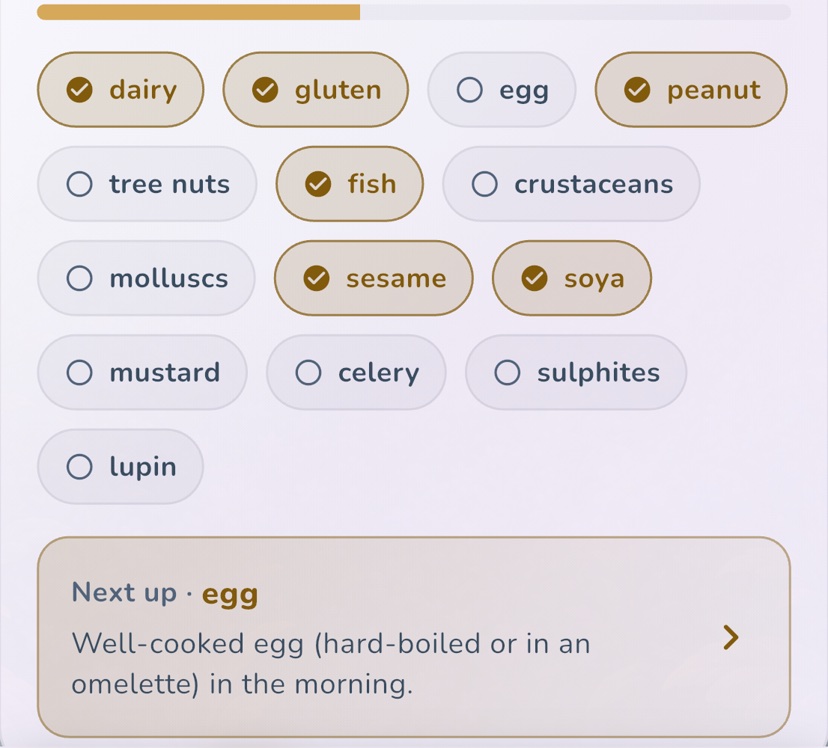
The Allergen journey combines allergen groups recognised in logged solids with any groups a parent marks manually. Its lifetime summary preserves “ever tried” information beyond the recent timeline. A group linked to a meal marked Reaction is also kept in the lifetime reacted set, hidden from future first-taste suggestions and shown with a pause-and-check-with-a-doctor message.
That is more useful than a one-off checkbox—but it is deliberately not a medical verdict.
Where automatic recognition stops
The detector is a convenience layer, not an ingredient scanner.
- It cannot see a homemade recipe, a nursery recipe or a packet label.
- A dish table represents common versions, not every substitution.
- A vague entry such as “lunch” or “green pasta” may produce no allergen labels.
- “Pesto” alone does not reveal which nut, seed or cheese was used.
- It cannot measure how much allergen protein was eaten.
- It cannot tell whether a rash, cough or vomit was caused by the food.
The app handles some explicit qualifiers—for example, vegan or dairy-free wording can prevent a typical dish from being tagged as milk—but the parent still owns the ingredient truth.
The practical fix is simple: type the meaningful ingredients into the solids description. “Pesto pasta with wheat pasta, cheese and cashew” gives the detector more real information than “pesto lunch”. Check the labels shown before saving and keep a short note if the recipe needs more detail.
If there may have been a reaction
Safety comes before logging.
Food-allergy reactions often begin within minutes and can take up to two hours to appear; some reactions, including some cows' milk reactions, can be delayed for longer. Possible signs include swelling, an itchy raised rash, vomiting, coughing, wheezing, breathing difficulty or a change in alertness.
Call 999 immediately for breathing problems, a swollen throat or tongue, marked floppiness, collapse or another suspected severe allergic reaction. Follow your child's allergy action plan and use prescribed adrenaline as directed. Do not delay emergency help to complete an app entry.
For a milder suspected reaction, stop the food, keep your baby with you, seek medical advice and do not offer the suspected food again to “check” unless a qualified clinician has given you a plan. Once your baby is safe, record the exact ingredients, time, amount, symptoms and what happened next. Keep the wrapper or photograph its full label when relevant.
Our baby food-allergy reaction guide gives a more detailed action-and-record checklist.
A one-minute mixed-meal routine
- Name the dish.
- Check the recipe or packet.
- Add the allergens and important ingredients actually present.
- Record roughly what reached the mouth and the meal time.
- Choose Loved it, Unsure or Reaction; add a plain note when needed.
- Treat the resulting history as a memory aid, never an allergy test.
This is enough to make the record useful without counting every crumb.
Try OBubba free → — keep the meal, its ingredients, the response and the wider baby day in one calm timeline, with a real Allergen journey built from what your family actually logs.
Frequently asked questions
Should I log one mixed meal several times—once per allergen?
No. Keep one meal event and include the actual ingredient names in its description. OBubba can attach several detected allergen groups to the same solids entry.
Does fish pie always count as fish, milk and wheat?
No. That is a common recipe pattern and the current app recognises it that way, but homemade and packaged versions vary. Check the actual recipe. When your version differs, log the real ingredients—such as “cod, potato and dairy-free sauce”—rather than relying on “fish pie” alone, and check the labels OBubba shows before saving.
Does pesto always contain nuts?
No. Traditional and commercial pestos vary, and some are nut-free or use different nuts or seeds. Check the label or recipe and record the ingredient that was actually present.
Can I serve several already-tolerated allergens together?
Yes. Once ingredients have been introduced separately and tolerated, mixed meals can help keep them in the usual varied diet. Follow any individual plan for a higher-risk baby or diagnosed allergy.
What if I do not know the nursery recipe?
Ask for the ingredient or allergen information rather than guessing. Log “nursery fish pie; recipe requested” and update your note when you receive the details. For a child with diagnosed allergy, the nursery should follow the child's allergy plan and food policies.
Can OBubba tell me which ingredient caused a reaction?
No. It can preserve the meal, detected groups, time and parent-labelled response. A qualified healthcare professional must assess and diagnose food allergy.
Reliable UK sources
- NHS: Food allergies in babies and young children
- NHS Best Start in Life: Baby food allergies
- NHS: Your baby's first solid foods
- NHS: Foods to avoid giving babies and young children
This article gives general information for UK families. OBubba is a tracking and education tool, not a medical device, allergy test or emergency service. Follow your baby's own clinical plan and call 999 for a suspected severe reaction.
Ready to try OBubba?
Use OBubba to track feeds, sleep, naps, nappies, growth, milestones and family handovers in one calm baby tracker app.