Your baby is upset. One person walks around the kitchen. Another reaches for a feed. Grandma remembers that fresh air worked last Tuesday. By the time something helps, nobody is sure which part made the difference—and the next caregiver starts the same guessing game again.
OBubba’s app has a small learning loop for this exact handover problem.
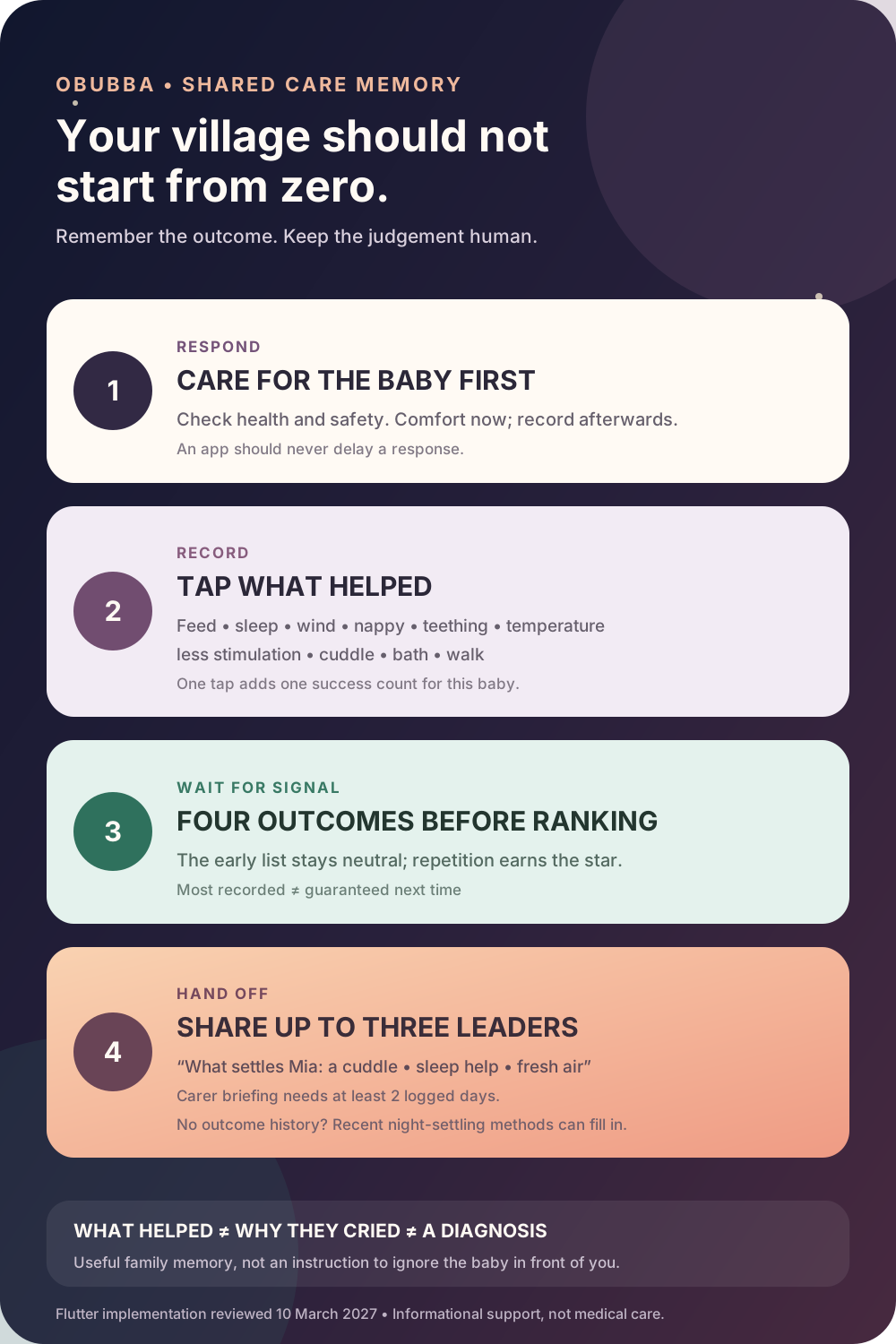
After the moment has passed, tap What helped? inside Care → Crying Helper. OBubba remembers the response for this baby, waits until there is enough history before reordering the choices, then can carry the leading methods into a shareable Carer hand-off.
> The goal is not to label every cry. It is to stop the people who love your baby from starting at zero.
The 30-second answer
The current app connects four steps:
- Respond first. Comfort the baby and check health and safety; do not pause care to complete a form.
- Record the outcome. Tap the option that best describes what helped.
- Let repetition earn weight. The Crying Helper keeps its neutral order for the first few outcomes and only ranks them after four taps in total.
- Pass the useful memory on. The Carer hand-off can include up to three leading soothing responses for a grandparent, partner or babysitter.
This is a memory aid, not a detector of why a baby cried. “A cuddle helped” does not prove the original cause was separation, pain, tiredness or anything else.
Why “what worked last time?” is harder than it sounds
The NHS crying guide lists common needs such as hunger, tiredness, a wet or dirty nappy, wanting a cuddle, wind, temperature, boredom and overstimulation. It also makes an important human point: some methods work better than others, and a warm bath may calm one baby while making another cry more.
The difficult part is not knowing that soothing ideas exist. It is remembering which response has repeatedly helped this baby, in the middle of sleep deprivation and shared care.
A family’s memory is often split across people:
- one parent knows the particular shoulder hold that helps with wind;
- a partner knows that less talking works better than more bouncing;
- a grandparent discovered that a short walk resets a difficult late afternoon; and
- nursery knows the same baby settles differently away from home.
A useful baby app should help preserve that practical knowledge without pretending it has discovered a diagnosis.
Where to record what helped
Open Care → Crying Helper. The screen first offers a breathing pause, an always-visible overwhelmed-parent safety card, any relevant concern from the baby’s current insights, and a calm list of common possibilities.
The list can show live context from today’s records, including:
- how long it has been since the last logged feed;
- time awake since the last logged sleep; and
- how long it has been since the last logged nappy.
Those details reduce mental arithmetic. They do not rule a need in or out. “No feed logged” may mean the baby has not fed, or simply that the feed was not recorded.
At the bottom, What helped? offers ten outcome buttons:
| Button | What it records | |---|---| | Hungry | A feed helped | | Tired/sleep | Help getting to sleep settled the moment | | Wind/gas | Winding or gas relief helped | | Nappy change | A change helped | | Teething | Teething comfort helped | | Temperature | Adjusting or checking temperature helped | | Overstimulated | Less stimulation helped | | Comfort/cuddle | Contact or a cuddle helped | | Bath | A bath helped | | Walk/fresh air | A walk or change of scene helped |
Tap only after you have a reasonable sense that the response helped. You do not need to log an outcome when nothing clearly changed.
Why OBubba waits for four outcomes
One successful walk should not immediately make Walk/fresh air look like the universal answer.
The current UI keeps the original, neutral chip order while fewer than four total outcomes have been recorded. At four or more, it sorts the options by their success counts, moves the most-used response to the front and marks the leader with a star.
That is a modest evidence gate, not statistical proof. Four taps can still reflect one unusual week, and an older baby may prefer something completely different from a newborn.
The ranking should be read as:
> “This has helped most often among the outcomes we recorded.”
It should not be read as:
> “This will work next time,” “this is the cause,” or “try this before checking whether the baby is unwell.”
The count appears beside methods once the ranking is active, so a parent can see whether the apparent leader is based on four outcomes or forty.
What one tap does—and does not save
Each What helped? tap increments a per-baby success counter for that method. It does not create a detailed episode containing duration, symptoms, who was caring, what was tried first or how intense the crying was.
That simplicity is deliberate: the action has to be usable after a draining moment. But it creates an important boundary.
If the family needs a factual record of crying itself, Track → More logs → Crying is separate. That quick logger records a cry at the current time as Mild, Moderate or Intense.
Use the two controls for different questions:
| Question | Use | |---|---| | “How intense was the crying, and when?” | Track → Crying | | “What seemed to help this time?” | Care → Crying Helper → What helped? |
Logging an intense cry does not automatically claim that any method solved it. Tapping Wind/gas does not automatically create a crying event or diagnose trapped wind.
How the memory reaches another caregiver
Open Care → Carer hand-off. Once the baby has at least two days containing logs, OBubba can build a concise briefing rather than a blank template.
The briefing can include:
- the likely next nap and bedtime;
- a plain-language line about last night;
- What settles [baby];
- known conditions and previous allergen reactions;
- medicine names recorded recently;
- current developmental context; and
- one useful non-wellbeing insight.
When What helped? history exists, the hand-off ranks those counts and takes up to the top three responses. The raw internal keys are translated into human wording such as a feed, help getting to sleep, winding, a nappy change, calm / less stimulation, a cuddle or a walk / fresh air.
If no What-helped history exists, the hand-off can fall back to up to two recent night-settling methods already recorded in sleep logs.
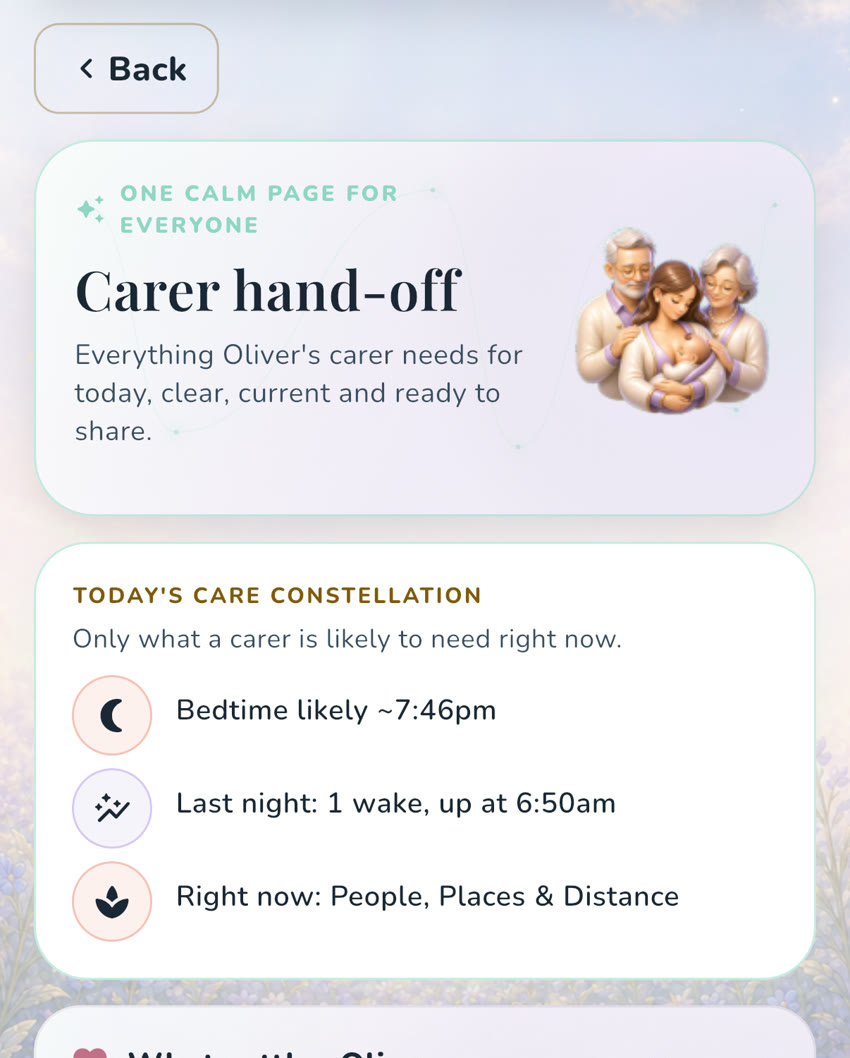
The page can be copied or shared as plain text. That makes it useful for a partner taking the next shift, grandparents covering an afternoon or a babysitter arriving after bedtime has already moved.
It is not medicine authorisation, an allergy action plan or a substitute for the childcare setting’s official records.
What happens when two parents use the app
The soothing counters belong to the baby’s shared record, not to one parent’s private notes. They are designed to persist across sessions and devices.
The merge logic protects the higher known count for each method when family copies reconcile, so an older device copy should not simply replace a stronger history with a smaller number. That is sensible resilience, but these counters are not an audit-grade clinical record. Simultaneous offline taps and later syncing should not be treated as exact research data.
The right promise is practical: the family retains a useful ordering of what has tended to help, even when care is shared.
Five real-life examples
1. Evening crying settles after a feed
Offer the feed responsively. If the baby settles and feeding made the clear difference, tap Hungry afterwards. Do not use the ranking to delay a feed while you try a higher-ranked method first.
2. Baby becomes more upset with every new distraction
You move to a dimmer, quieter room and the baby settles. Tap Overstimulated. The outcome records that reducing input helped; it does not prove a sensory condition or mean every future cry needs darkness.
3. Grandma discovers that a short walk works
Record Walk/fresh air after the settled return. Over time, that response may move up the family’s list and enter the carer hand-off, so useful knowledge does not remain in one person’s memory.
4. A cuddle works after several failed fixes
Tap Comfort/cuddle if contact was what finally helped. “Just needs you” is a valid outcome, not evidence that the earlier attempts were mistakes.
5. Nothing works and the cry sounds different
Do not keep tapping through a checklist. The NHS advises contacting a GP or NHS 111 if a baby cries constantly and cannot be consoled or distracted, the cry is not their normal cry, or they show signs of illness. Use 999 for emergency signs. Trust your instincts.
A better handover sentence
Avoid certainty:
> “Rocking fixes her crying.”
Use the evidence you actually have:
> “A cuddle and less stimulation are what we’ve recorded most often. Try those after checking the basics, but respond to what you see.”
That sentence gives a caregiver a useful starting point without turning an app ranking into an instruction.
Quick answers
Does OBubba listen to the cry and identify its meaning?
No. This feature uses parent-recorded outcomes and today’s logged context. It does not analyse audio or diagnose the reason for crying.
How many outcomes are needed before the buttons reorder?
Four total What-helped taps. Before that, the ten choices remain in their neutral default order.
Can I record more than one thing that helped?
Each tap records one method and the screen moves to a thank-you state. Choose the response that made the clearest difference rather than reconstructing every attempt.
Is “What helped?” the same as logging a cry?
No. Cry intensity is logged separately from Track. What helped is a lightweight success counter inside the Crying Helper.
What appears in the carer briefing?
When outcome history exists, up to three leading responses can appear under What settles [baby]. With no such history, recent sleep-settling methods can provide a fallback.
Does the hand-off appear immediately after one day?
No. The current builder waits for at least two days containing entries before producing the briefing.
Should a caregiver follow the top method every time?
No. Check the baby, the context and any health or safety concern first. The order is remembered experience, not a rule.
Try OBubba free → — remember what helps, keep the knowledge with your baby’s shared record, and give the next caregiver a calmer place to begin.
This article describes the current OBubba implementation reviewed on 10 March 2027. OBubba provides tracking, organisation and informational support, not diagnosis or medical care. If a baby’s cry is unusual, constant or comes with worrying symptoms, seek appropriate professional help; call emergency services when necessary.
Ready to try OBubba?
Use OBubba to track feeds, sleep, naps, nappies, growth, milestones and family handovers in one calm baby tracker app.