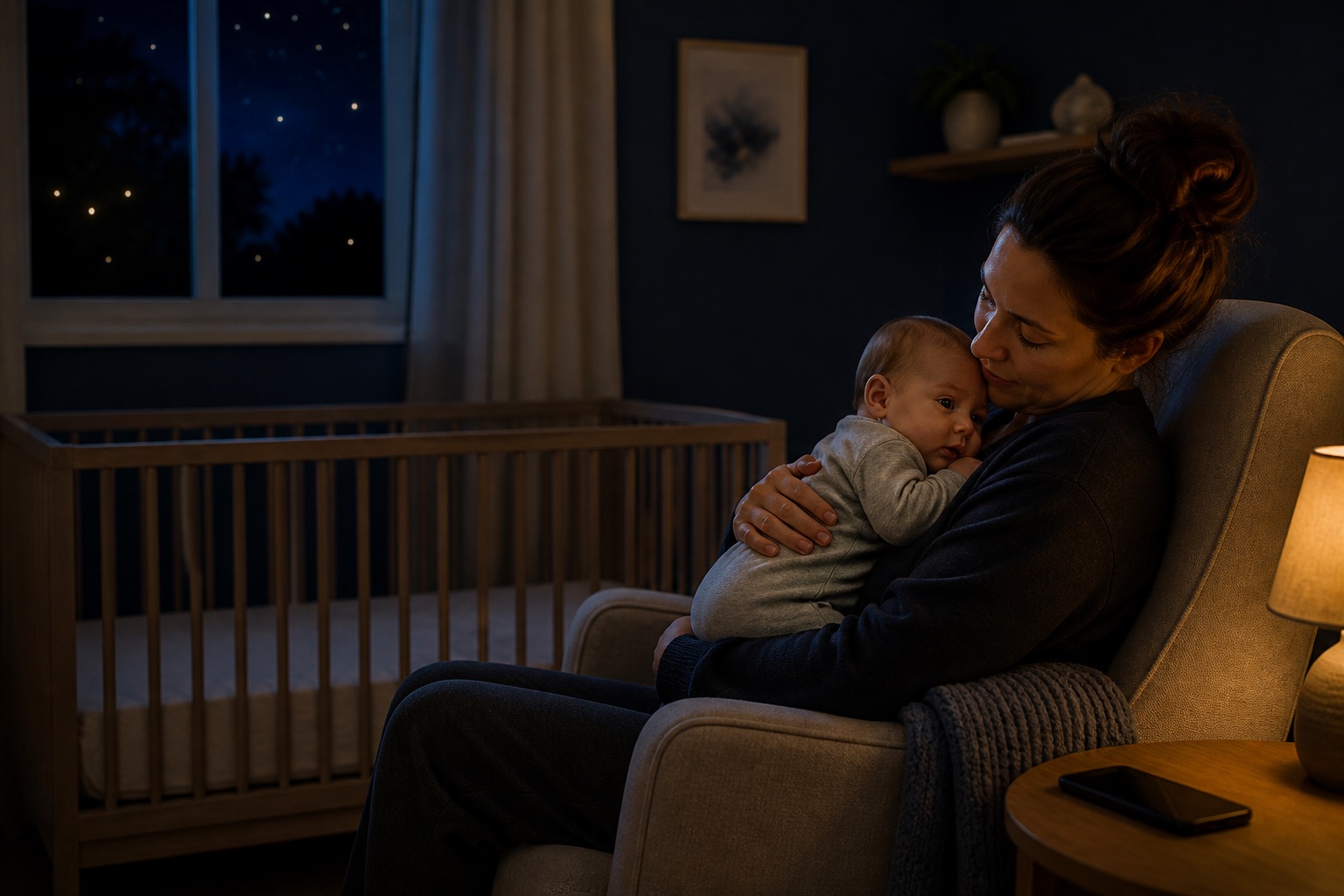
At 3am, the house can feel impossibly small. There is the baby in your arms, the clock doing something unhelpful, and the suspicion that every other family in the world is asleep.
Open OBubba’s Track clock at night and tiny lights drift through the sky. They are fireflies: a symbol of other parents awake, and a reminder that this hour belongs to more than one household.
There is also an important technical truth. In the build reviewed for this article, live anonymous presence is temporarily paused. The lights you see now are a gently changing ambient scene, not a literal headcount of people online. The design meaning remains “you are not the only parent awake”; the current implementation should not be read as “every individual light equals one parent right now.”
That distinction does not make the idea less lovely. It makes the promise clearer.
The short answer
The fireflies do three simple jobs:
- soften the night version of the baby clock;
- represent the many parents doing quiet care at unsociable hours; and
- make opening a tracker feel a little less clinical when you are tired.
They do not show who is awake, where anybody lives, what their baby is doing or whether somebody can see you. They are not a chat, a map, a monitoring service or an emergency signal.
In the current reviewed build, the clock displays between 50 and 72 ambient lights. No live-presence heartbeat is sent and no live-presence list is read. That is why an exact “parents online” interpretation would be misleading today.
Where the fireflies appear
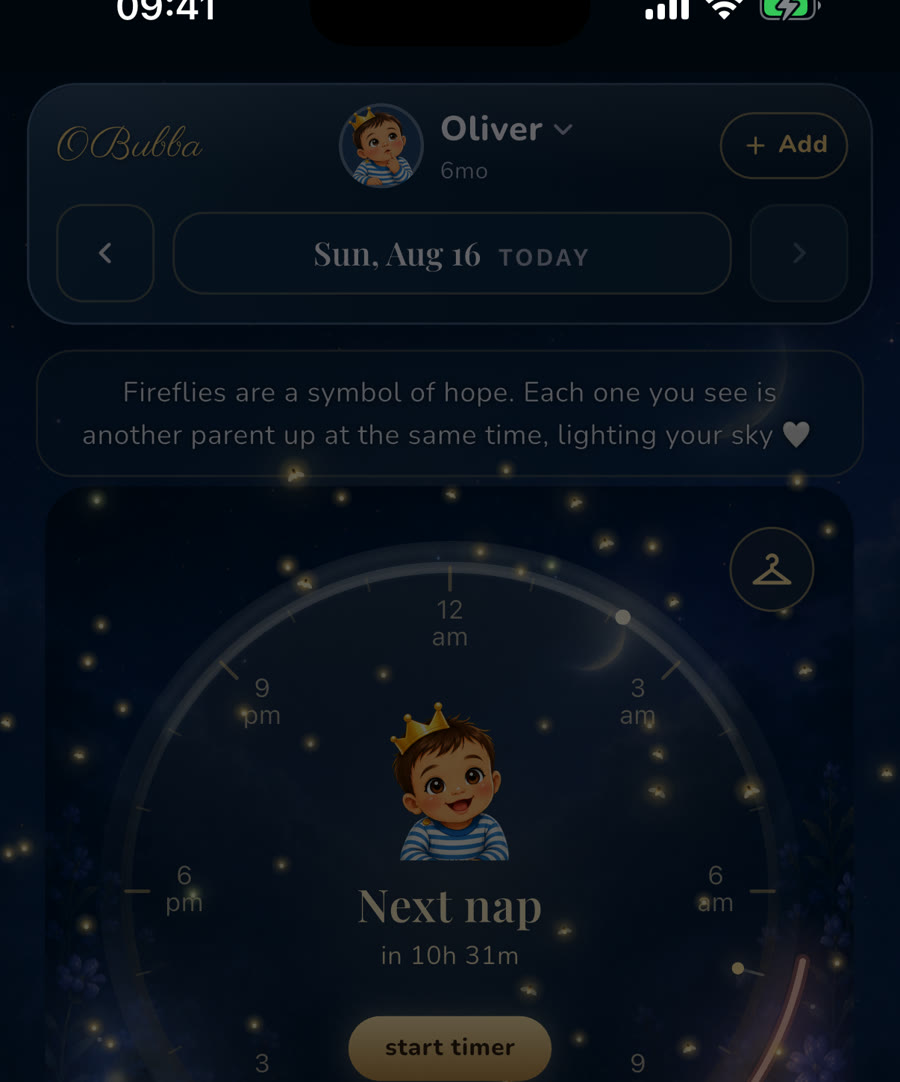
The lights belong to the Track clock, not every screen in the app. The sky changes with the time of day:
- daylight uses the day scene without fireflies;
- civil and astronomical twilight can bring the lights in;
- deep night gives them their strongest visual role; and
- moving to another main tab stops the clock from doing unnecessary presence work.
The app keeps a pool of 72 possible firefly positions. Individual lights fade in and out gradually and drift on a slow cycle, so the sky feels alive rather than flashing from one number to another. Density adjusts with the available space, and the positions stay stable enough that the scene does not jitter every time the interface rebuilds.
Those details are small, but they explain why the effect feels calmer than confetti. The fireflies are part of the clock’s night language: navy sky, low contrast, warm points of gold.
Why OBubba uses a symbol at all
A baby tracker is usually built around facts: 02:14 feed, 03:06 nappy, 41-minute nap. Facts are useful for handovers and patterns, but they are not the whole experience of care.
The emotional fact at 3am is often: I feel like I am the only person here.
OBubba cannot honestly promise to remove loneliness. It can avoid making the moment colder. The fireflies add a tiny piece of social imagination without creating another social network to manage. You do not need a profile picture, a post, a reply or a performance. You can notice the light, log what matters and put the phone down.
One UK App Store reviewer described loving the fireflies because it was comforting to know another mum was awake. That is the human need the feature is trying to meet. The safest wording, while live presence is paused, is simpler: the fireflies are a symbol of parents awake tonight.
What the current build actually does
The presence service has a deliberate master switch. In the version reviewed on 13 May 2027, that switch is off as part of a temporary cost freeze.
With it off:
- the app performs zero presence writes;
- the night clock performs zero presence reads;
- a slowly changing number between 50 and 72 controls the ambient firefly density; and
- the real online-parent count remains zero inside the provider.
This is not the same as secretly collecting presence while hiding the number. The relevant code exits before either side of that live exchange runs.
The static message above the clock currently says that each light is another parent up at the same time. That copy expresses the original design, but it overstates this paused build. Until live mode returns, a more accurate line would be:
> Fireflies are a symbol of hope—and of other parents awake tonight, lighting the dark with you.
That preserves the comfort without asking a decorative sky to act like a live counter.
How anonymous live presence is designed to work
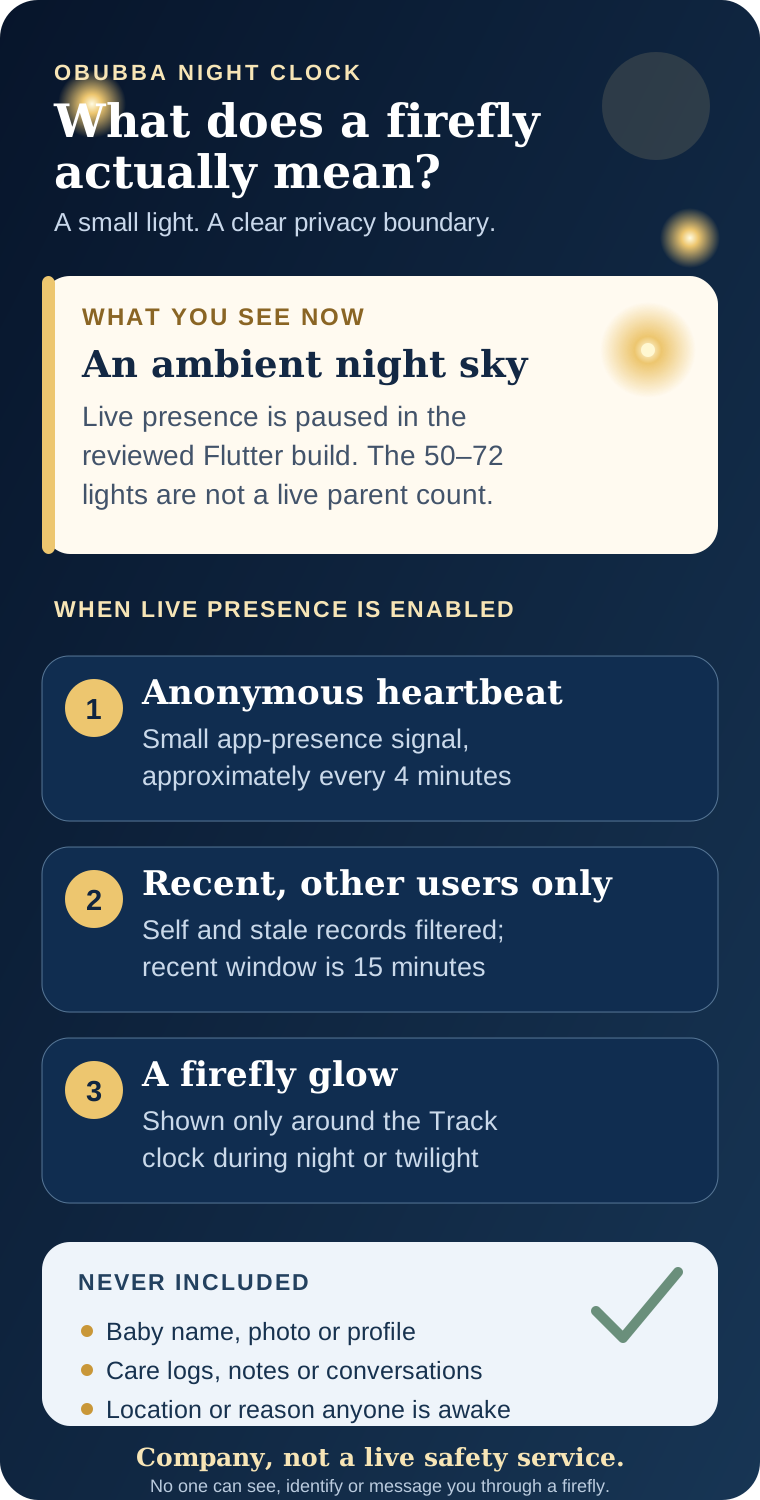
The paused code still shows a careful live design. If the switch is enabled again, the app can send a small anonymous heartbeat approximately every four minutes while OBubba is active.
The night clock then looks for other OBubba app users seen within the last 15 minutes. It polls no more than once every 15 minutes, only when the firefly sky is relevant. The query is capped rather than scanning an unlimited crowd.
The filtering is deliberately conservative. It excludes:
- your own anonymous ID;
- duplicate IDs;
- records from other apps;
- records older than 15 minutes;
- missing or invalid timestamps; and
- timestamps implausibly far in the future because a device clock is wrong.
The heartbeat contains a Firebase anonymous user identifier, the app name, a broad local mode such as night, a minute bucket and timestamps used to decide when the record is stale. It is presence metadata, not a baby-care event.
The phrase “online” also deserves restraint. A 15-minute window does not prove somebody is staring at their phone at this exact second. It means their app was recently present enough to leave a valid heartbeat. They may already have settled their baby, switched screens or put the phone down.
What is never part of a firefly
The presence record does not include:
- the baby’s name, photo, age or profile;
- sleep, feed, pumping, nappy, medicine or solids logs;
- private notes or Luna conversations;
- a home address, GPS location or map position;
- why the parent opened the app; or
- a way for another parent to identify or contact them.
Nobody can tap a light and discover your family. A firefly cannot reveal that you are feeding, resettling, worried, crying or simply checking tomorrow’s plan.
That boundary is essential. The feature should provide the emotional shape of company without making a private caregiving moment observable to strangers.
Why a live design still needs a minimum glow
The live implementation also has a quiet-night safeguard. When at least five other recent users are found, the real count can drive the display. Below five—or if the query fails—the design uses a softly varying floor of 11 to 18 lights and suppresses any factual count label.
Why not show one lonely dot?
Because a tiny sample can do two unhelpful things. Emotionally, it can turn “you are not alone” into “almost nobody is here.” Technically, repeatedly showing very small exact counts can make anonymous activity feel more identifiable than it needs to be.
The floor is therefore a visual treatment, not hidden arithmetic. It should never be presented as “14 parents are online.” The honest rule is:
Real recent presence may shape the sky when there is enough of it; a minimum glow keeps the scene comforting and non-identifying when there is not.
The current frozen mode uses a larger 50–72 range because it is purely ambient and matches the full visual pool. Again, that number is not an audience metric.
What a firefly can—and cannot—do at 3am
It can
- make the tracker’s night state easier on tired eyes;
- remind you that night care is happening in many homes;
- add warmth before you start or stop a timer; and
- give you permission to record one useful fact rather than reconstruct the whole night.
It cannot
- tell whether your baby is safe or well;
- confirm an exact number of parents currently watching the clock;
- summon a moderator, clinician, friend or emergency service;
- let other users see, message or locate you; or
- replace responsive care, safer-sleep guidance or professional support.
This is the most important boundary in the article: company is not supervision. If you are too sleepy to hold the baby safely, put them in a clear, flat sleep space and wake another adult if one is available. If you or the baby may be in immediate danger, use the appropriate urgent or emergency help where you live rather than waiting for an app response.
A low-effort way to use OBubba during a hard wake
You do not need to turn every wake into a research project.
- Care first. Respond to the baby and make the environment safe.
- Log only the decision-changing fact. Start the sleep or feed timer, or add a quick event later if the exact minute does not matter.
- Notice the sky, not the count. Let the fireflies be a cue that night care is shared, not a statistic to audit.
- Leave interpretation until daylight. Reports, Luna and the sleep-planning tools are more useful when you have enough attention to question an answer.
- Reach a real person when you need a real person. Parent Room can point towards support, but a trusted adult or health professional can respond to the situation in front of you.
The goal is not maximum data. It is less remembering while your hands are already full.
The honest bottom line
OBubba’s fireflies are one of the app’s most distinctive ideas because they are not another chart. They acknowledge something baby software often ignores: the person holding the phone may be tired, isolated and doing loving work nobody else can see.
In the current reviewed build, the lights are ambient. Treat them as a symbol of hope and shared night care, not a live parent count. If anonymous live presence is re-enabled, the underlying design limits it to recent app activity, excludes the user themselves and keeps baby records and location completely outside the exchange.
That is the promise worth keeping: a little light, with a firm boundary around your family.
See the OBubba night clock → — free core tracking, a calmer night interface and no need to make a difficult hour look tidy.
Quick answers
Does one OBubba firefly equal one parent online?
Not in the current reviewed build. Live presence is paused and the clock shows 50–72 ambient lights. The one-light-per-parent line in the current interface describes the original live idea too literally for this version.
Is OBubba sharing my baby’s data through the fireflies?
No. The presence design does not include the baby’s name, profile, logs, notes, location or reason the app is open.
Can another parent see me or message me?
No. There is no firefly profile, map, inbox or contact route.
Why do the lights only appear at night?
They belong to the clock’s night and twilight sky phases. The daytime scene does not show them.
What would “online” mean if live presence returns?
It would mean another anonymous OBubba app user had a valid heartbeat within roughly the previous 15 minutes—not proof that they were looking at the screen at that instant.
Why might there be more lights than recent users?
The live design uses a minimum visual glow when the real count is below five or the query fails. This avoids a lonely near-empty sky and avoids presenting tiny exact groups. No factual count should be claimed while that floor is active.
Product verification
- Current surfaces reviewed: the app-wide presence heartbeat, night-clock count provider, Track clock visibility rules, sky phases, firefly animation and Luna’s curated firefly answer.
- 79 focused tests passed on 13 May 2027, covering presence filtering, the 15-minute window, self-exclusion, duplicate handling, quiet-count floors, sky phases, Coach answers and primary UI compilation.
- The app image above is a genuine repository simulator capture using a fictional baby profile and a forced night-clock time. No production family data appears in it.
Feature behaviour and wording can change. This article documents the reviewed build, including its paused live-presence switch. OBubba is a tracking, planning and educational tool; it does not monitor your baby or replace a midwife, health visitor, GP or emergency service.
Ready to try OBubba?
Use OBubba to track feeds, sleep, naps, nappies, growth, milestones and family handovers in one calm baby tracker app.