The first year asks, When did they feed? How long did they sleep? Is this nappy different?
Then the questions change. Why is every boundary enormous? Are they ready for a potty? How do we keep the same words between home and nursery?
Parents should not have to pretend the first chapter never happened in order to get help with the second.
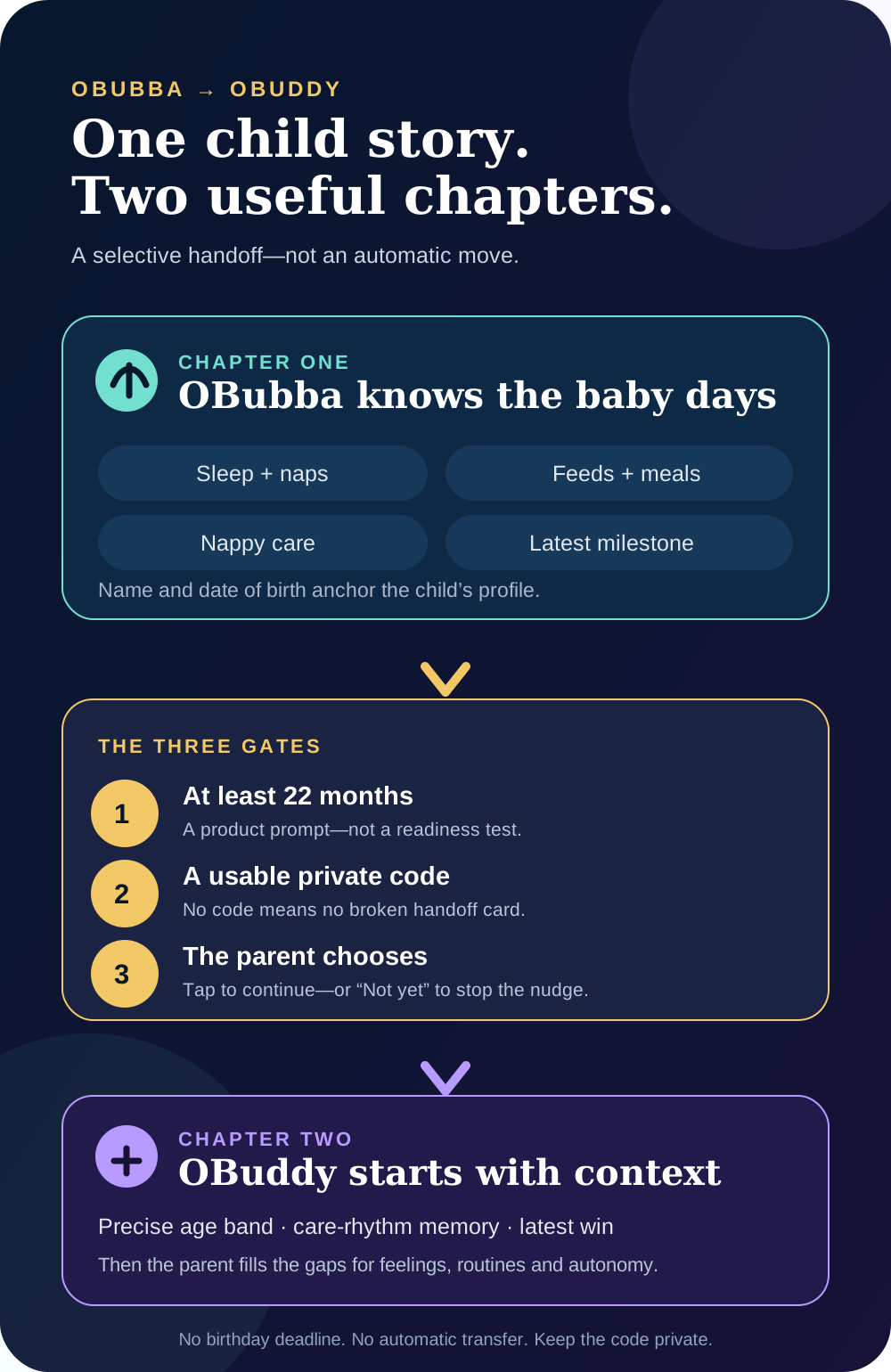
That is the idea behind the current implementation of OBubba’s OBuddy handoff. From around 22 months, an eligible family can see a quiet graduation card in Grow. If the parent chooses to continue, a private OBubba code opens a companion onboarding path that can carry the child’s basics and a compact memory of recent baby-care rhythms into OBuddy.
It is not an automatic migration. It is not a clinical two-year assessment. And 22 months is OBubba’s product threshold, not a claim that every child becomes a toddler on the same Tuesday.
The useful promise is smaller and better:
> When the questions change, the family can change tools without throwing away the context they worked to build.
What the parent actually sees
The handoff starts on OBubba’s Grow tab—the same part of the app that already turns age into activities, milestones, developmental waves and parent-friendly stories.
The live graduation card says the child is growing up, introduces the next chapter and offers two clear choices:
- Bring the child to OBuddy
- Not yet
“Not yet” is real. The current app stores that dismissal locally and does not keep nagging. If the parent does nothing, nothing moves.
The card also stays hidden when the child is under 22 months, while the profile is still expecting, or when OBubba cannot find a backup or child-sync code. That last rule matters: the app does not offer a beautiful button that leads to a broken transfer.
What crosses into OBuddy—and what does not
“Carry the history” could sound as if every bottle amount, wake time and note will be recreated as a toddler diary. The receiving code is more selective than that.
With a readable OBubba family backup or live child record, OBuddy currently maps:
| OBubba context | How OBuddy uses it | |---|---| | Child name | Pre-fills the toddler profile | | Date of birth | Selects a precise month-based age band | | Recent sleep and nap activity | Becomes a short count-based care memory and may shape the first challenge | | Recent feeds or meals | Becomes a short count-based care memory | | Recent nappy or potty care | Becomes a short count-based care memory | | Recent calming signals | Becomes a short count-based care memory | | Latest milestone | Becomes a “last win” in the carried memory | | Recognisable profile cues | May seed a temperament such as sensitive, high energy or careful/shy |
The receiver reads up to the latest 14 logged days when summarising care activity. It does not reproduce those entries as a complete, browsable copy of the OBubba timeline. It converts them into context such as “2 recent sleep/nap logs” or “1 recent feed or meal.”
That distinction is important. OBuddy begins with a clue about the child’s rhythm; it does not claim that a count explains the child.
The parent can review and complete the missing basics during onboarding. OBuddy also adds broad starting goals around a calmer home, responsibility and kindness. Those are product defaults, not conclusions drawn from the child’s baby records.
The exact route through the handoff
In the current sender code, OBubba prefers the family backup code when one exists. Otherwise it falls back to the current six-character child-sync code.
When the parent taps the card:
- OBubba tries to open a private `obuddy://` handoff link.
- If the companion app can handle that link, OBuddy opens its “from OBubba” onboarding route and reads the corresponding cloud record.
- If the link cannot open, OBubba copies the code so the parent can paste it into the companion onboarding later.
- OBuddy validates the code, fetches the child record and shows a clear error if it cannot read it.
- The parent completes onboarding before the imported context becomes an OBuddy profile.
The code should be treated like an access credential. Do not post it in a parenting group, include it in a public screenshot or leave it in a shared note. If a code has been exposed, replace the invite or backup route inside OBubba before trying again.
Companion-app availability and installation can vary by device and release. The fallback is intentionally a copied code—not a false claim that an app-store page is always ready.
Why 22 months appears before the NHS two-year review
OBubba uses 22 months to make the transition discoverable before the second birthday. That gives a family time to decide, dismiss or set up the next chapter without turning the birthday itself into an admin deadline.
It does not replace the health and development review offered at 2 to 2½ years. The NHS says that review covers areas including language and learning, safety, diet and behaviour and gives parents a chance to discuss concerns with the health visiting team. NHS: your baby’s health and development reviews.
Use the two things for different jobs:
- The NHS review is a professional health and development conversation.
- The OBubba–OBuddy handoff is an optional way to avoid retyping useful family context into a parenting tool.
If speech, movement, hearing, vision, feeding, growth or behaviour is worrying you, raise it with the health visitor or GP. An imported age band is not an assessment.
Why toddler support needs different questions
Around this stage, many children are becoming more active and independent while still needing an adult to help them manage intense feelings. The NHS explains that tantrums can become more common from around 18 months as toddlers struggle to express frustration, and recommends helping them regulate, relate and then reason once calm. NHS: help your toddler manage emotions.
That is why a toddler companion should not simply stretch a baby tracker until the labels feel absurd.
The baby record still matters:
- a familiar sleep rhythm may help explain a difficult evening;
- feeding context may matter when a child is hungry and overwhelmed;
- calming notes can remind adults what has helped before; and
- the latest milestone keeps the transition grounded in capability, not only problems.
But the next tool needs to turn that context toward new work: naming feelings, building routines, sharing the same language between caregivers, practising independence and approaching potty learning without turning it into a race.
A five-minute “new chapter” check before you transfer
Whether or not you use OBuddy, this is a useful moment to take stock.
1. Save the baby story you want to keep
Look back through milestones, photos and meaningful notes. Export or record anything you would be upset to lose. A handoff summary is not the same as a personal archive.
2. Check the child’s basics
Make sure the name and date of birth are correct. Age-banded guidance is only as good as the date behind it.
3. Name one current family problem
Choose something observable: “bedtime becomes a battle after nursery,” “we use different words for hitting,” or “potty pressure is making everyone tense.” Avoid importing a vague verdict such as “bad behaviour.”
4. Agree one sentence between caregivers
Try: “I will not let you hit. You are safe. I’m here while the feeling passes.” Consistent words are more useful than five competing techniques.
5. Keep the code private
Copy it directly into the receiving app. Do not use a public message or screenshot as temporary storage.
What happens in common edge cases
My child is 21 months
The card should not appear yet. Nothing is wrong and nothing needs unlocking. The threshold is at least 22 months in the current logic.
My child is old enough, but there is no card
The app may not have a usable family backup or child-sync code. It also hides the handoff for an expecting profile. Check the correct child profile and the Account → Share & Sync route rather than repeatedly refreshing Grow.
I tapped “Not yet”
The card is dismissed on that device and should not keep returning. That is deliberate consent design, not a countdown.
OBuddy is not installed
OBubba copies the handoff code. The parent can use it in the receiving app’s “from OBubba” onboarding when that app is available and installed.
The code opens, but the import fails
Use the exact current code and check the connection. A child-sync code is six characters; an OBubba family backup code is 12 characters and starts with `BK`. If a former sync invite was replaced, copy the new one from Share & Sync.
We have more than one child in the family backup
The current receiving importer selects the first readable child from that backup and records that it came from a multi-child family. For precise control, use the intended child’s live sync code where available and verify the child name before completing onboarding.
Does OBuddy stay live-synced to every future OBubba log?
Do not assume that. The import reads the available record to build an OBuddy profile and memory at handoff time. The product also makes a best-effort sync join for a child-sync route, but the parent-facing value described here is the imported context—not a guarantee that every later OBubba edit will appear in OBuddy.
The real retention feature is a respectful ending
Many apps try to retain families by stretching beyond their competence or making it painful to leave. A better product remembers that the child—not the subscription—is moving forward.
OBubba’s handoff has four unusually good restraints in code:
- no early prompt before the product threshold;
- no prompt without a working data route;
- no automatic move without a parent tap; and
- a persistent “Not yet” that stops the nudge.
That is how an app can stay valuable after its original job changes: by giving the next chapter context, then giving the parent control.
Quick answers
Does OBubba stop working when my child turns two?
The handoff code does not disable OBubba. It offers an optional companion path as toddler questions become more prominent.
Is 22 months the right age to start potty training?
No universal readiness decision is built into the threshold. Twenty-two months only controls when the current OBuddy card may appear. Follow the child’s signs and individual professional advice rather than an app birthday.
Will all my OBubba logs appear in OBuddy?
No. The current receiver carries profile basics and a compact summary of recent care patterns and the latest milestone. Keep OBubba or your own exports for a full baby record.
Can I decline the handoff?
Yes. Tap “Not yet” or ignore the card. No child data is moved merely because the card is visible.
Which code does OBubba use?
It prefers the family backup code and otherwise uses the current child-sync code. Keep either code private.
Does this replace my child’s two-year review?
No. The NHS 2-to-2½-year review is a health and development review. OBuddy is a parenting support tool.
Start the story in OBubba → — track the baby days, understand the patterns and keep a thoughtful route open for the questions that come next.
This article gives general information for UK families and describes the OBubba sender and OBuddy receiver implementations reviewed on 4 March 2027. Product availability and behaviour can change. Neither app diagnoses developmental, behavioural or health conditions or replaces advice from a health visitor, GP or paediatric professional.
Ready to try OBubba?
Use OBubba to track feeds, sleep, naps, nappies, growth, milestones and family handovers in one calm baby tracker app.