At 3:17am, “make a detailed sleep diary” is not helpful advice. You are holding a baby, finding a dummy, deciding whether they need a feed and trying not to wake the whole house. The log has to be easier than the wake itself.
The short answer: record only four things: when the baby properly woke, when they settled again, what helped and whether they fed. Add one short note only when something was genuinely different—fever, teething discomfort, unusual crying, a loud disturbance or a much later nap. The aim is a useful pattern, not a perfect account of every grunt.

Night waking is not automatically a sleep problem
NHS guidance is clear that babies have individual sleep patterns. Newborns wake repeatedly in the first few months, often because they need to feed. Some older babies sleep longer stretches, but not all do, and teething, hunger, illness, growth and development can temporarily change sleep again.
Even a baby who mostly sleeps well may briefly stir between sleep cycles. A fluttering eyelid, small movement or short fussy sound can be light sleep rather than a fully awake baby. If your baby is safe and not distressed, pause long enough to see what state they are in before turning on lights or beginning a full feed. Respond when they need you; logging should never delay care.
A night-wake record is useful when you want to answer a specific question:
- Are wakes becoming longer, or do there simply feel like more of them?
- Is a full feed happening at each wake, or only one?
- Does one settling method work more quickly than another?
- Did the change begin alongside illness, teething, travel or a nap transition?
- Is the baby's night ending early, or is a 4am wake still part of the night?
If you do not have a question and the wakes are manageable, you do not have to keep a sleep diary. One NHS children's-health service notes that sleep diaries can help identify patterns but are not compulsory unless sleep is causing a problem.
The four details worth recording
1. When they properly woke
Use the time you recognised that the baby was awake and needed a response. Do not try to reconstruct whether the first squeak occurred at 3:12 or 3:14. That two-minute precision will not change a useful weekly pattern.
Keep a night wake distinct from woke for the day. A 2am resettle belongs inside the overnight sleep; the morning wake ends it. If the baby is contentedly awake for a long stretch at 4am but later returns to sleep, it is still a night wake rather than the beginning of a new day.
2. When sleep resumed
The interval between waking and settling is often more informative than the count alone. Four brief stirs are a different night from one 75-minute awake stretch, even though both can leave a parent exhausted.
Do not watch the clock while soothing. Mark the start with one tap, respond to the baby, then close it when they are back down. An estimate is better than a fabricated exact time entered the following afternoon.
3. What actually helped
Choose the final combination, not every failed micro-attempt. Useful categories include:
- self-settled
- fed
- rocked
- held
- patted or shushed
- dummy
Real resettling is often a combination: fed, then held; patted, then dummy. A multi-select record is more honest than forcing the night into one label. Avoid judging the method. “Fed” is information, not a bad habit; “self-settled” is not a parenting score.
4. Whether there was a feed
If the wake included a feed, record the normal useful feed detail—breast side and approximate minutes, or bottle amount and milk type—without creating a second imaginary wake. Responsive night feeding is normal, especially in the early months. NHS guidance says babies are likely to need night feeds for at least the first few months, with feeds generally reducing as they grow.
Do not decide that a young baby should stop feeding at night because an app shows a frequent pattern. Night-weaning readiness depends on age, growth, daytime intake, feeding method and clinical context. Ask a health visitor, GP or feeding professional if you are unsure.
The one-note rule
Add a note only when it would help you interpret tomorrow's graph. Good examples are:
- “cough and blocked nose”
- “first nursery day”
- “last nap ended 5:45pm”
- “room unusually warm”
- “dog barked at 2am”
- “new tooth visible”
Skip the essay. “Awake, cried, picked up, put down, cried again” is emotionally real but rarely easier to compare across seven nights. If the cry sounded unusual, the baby seemed unwell or you were worried, stop analysing patterns and assess the baby.
Record room temperature, darkness and noise with the bedtime setup, not repeatedly at every wake, unless something changed. That lets you compare whole nights without turning each resettle into a questionnaire.
What not to track at 3am
You do not need to record:
- every sleepy noise or movement
- the exact second crying began
- every position change
- a guessed cause presented as fact
- your interpretation of the baby's character
- a separate wake and separate night feed for the same event
- data solely because the app offers a field
“Overtired”, “undertired”, “habit”, “regression” and “hunger” are hypotheses. Log what happened first. Interpret only after several comparable nights, alongside age, daytime sleep, feeds and anything unusual.
Read patterns in groups, not one night at a time
Start with three nights if the change was sudden; use seven to fourteen when looking for a routine pattern. Compare like with like. A nursery day, vaccination day, illness night and ordinary home day should not all be treated as identical evidence.
Look at four simple summaries:
- number of true night wakes
- total awake time overnight
- number and size or duration of night feeds
- settling methods used
Then add the daytime context: morning wake, nap count, total nap time, final nap and bedtime. A correlation is not proof of cause. If wakes follow late naps on two nights, that is a clue to observe—not permission to remove needed daytime sleep immediately.
Make one small change at a time and hold it for several suitable nights unless safety, illness or feeding needs require an immediate response. Otherwise, changing bedtime, nap length, feeding and settling together makes it impossible to know what helped.
Keep the night response boring—but responsive
NHS advice suggests keeping lights low, voices quiet and interaction minimal at night. Feed, change and comfort as needed, then return the baby to their safer sleep space. The goal is not to ignore them; it is to avoid accidentally turning 3am into playtime.
For at least the first 6 months, the NHS advises that the safest place for a baby to sleep is in the same room as a parent or carer, in a separate clear cot or Moses basket. Put the baby on their back on a firm, flat mattress and keep pillows, duvets, nests, pods, bumpers, toys and loose bedding out.
If you are so tired that you might fall asleep while feeding or holding the baby, plan for safety before the night begins. Never fall asleep with a baby on a sofa or armchair. Ask a partner or another trusted adult to share the response where possible.
When night waking needs health advice
Contact a health visitor or GP if waking is persistently affecting the baby's feeding, growth, breathing or wellbeing, or if exhaustion is making it hard for you to cope safely. Seek urgent help for breathing difficulty, blue or grey skin, unusual floppiness, a baby who is hard to wake, a non-fading rash or other signs of serious illness.
A sleep log can make a professional conversation clearer, but it cannot diagnose reflux, allergy, sleep apnoea, infection, pain or a feeding problem. Bring a short summary and the original nights rather than an app-generated conclusion.
How OBubba's current night-wake flow works
Start Bedtime on the Track clock when the baby goes down. While the night is running, the centre button reads Pause. Tap it when the baby properly wakes: OBubba creates an open night-wake event and freezes the sleep timer without ending the night.
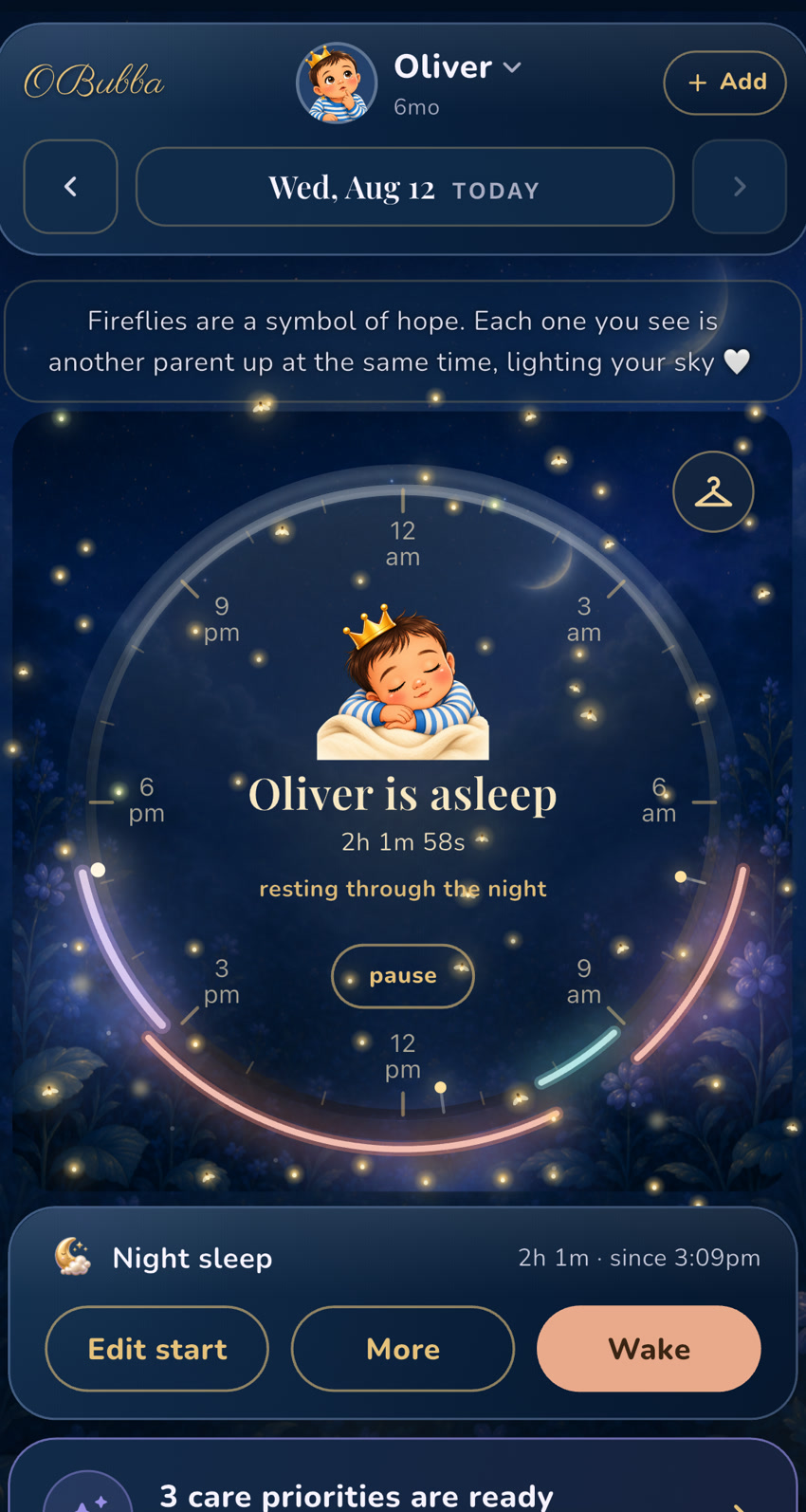
Respond to the baby without filling in a form. When they settle, tap Resume sleep. OBubba asks how they went back to sleep: Self-settled, Fed, Rocked, Held, Patted or Dummy. More than one hands-on method can be selected, while Self-settled remains separate. The pause-to-resume interval becomes the awake duration.
If Fed is selected, OBubba can record bottle, breast or combination details and creates one feed linked to that wake. The linked structure matters: the night-feed analysis sees the intake, while the wake count still sees one event rather than “wake + feed” as two wakings.
The open pause is stored in the child's data, so it can survive leaving the screen and can be visible to a synced partner. If two carers act on the same pause, the implementation includes guards against creating duplicate open wakes or duplicate linked feeds.
If no bedtime timer was running, use Track → Night wake to enter the time and details directly. Manual editing supports the likely reason, awake duration, settling-method sequence and minutes used for each method. At bedtime, the sleep record can optionally capture whether the room was cool/comfortable/warm, dark/dim/light and quiet/white noise/noisy.
OBubba also keeps night wakes with the night they belong to. Families can view days as Wake to wake or Calendar day; changing that preference changes how the timeline is presented, not the underlying log. In the Logs panel, overnight wakes sit above the “woke for the day” divider.
After a wake, OBubba can offer a short reading based only on signals it actually has—such as age, wake time, today's recorded sleep, wake number, parent-selected reason and recent disruption context. It does not know why the baby woke, and the article and app should never present a possibility as a diagnosis.
The useful promise is smaller and stronger: one tap when the wake begins, one tap when sleep resumes, and enough structure to make tomorrow's pattern legible.
Try OBubba free → — live sleep tracking, linked night feeds and calmer overnight records without turning parenting into data entry.
Sources and further reading
- NHS: Helping your baby to sleep
- NHS Best Start in Life: Understanding your baby
- NHS Best Start in Life: Feeding on demand
- Bedfordshire and Luton Children's Health: Creating and maintaining a sleep diary
- NHS Best Start in Life: Safer sleep advice for babies
- NHS: Is your baby or toddler seriously ill?
OBubba supports tracking, pattern review and parent education. It does not identify the cause of a night wake, diagnose illness or a sleep disorder, decide whether a baby still needs night feeds, or replace professional advice.
Ready to try OBubba?
Use OBubba to track feeds, sleep, naps, nappies, growth, milestones and family handovers in one calm baby tracker app.