Your baby sees the dog before you do. Their body becomes still, their eyes widen and one small finger reaches towards the window. Then they look back at you as if to say: Are you seeing this too?
Pointing can look like a tiny hand skill, but it is much more. It lets a baby ask, show, choose and share attention before they have the words.
Many babies begin pointing around their first birthday, but there is a broad normal path into the gesture. Some first reach with a whole hand, hold objects up to show you, follow your point or switch their gaze between you and an object. Pointing may appear gradually rather than on one memorable day.
Do not train the finger or repeatedly test “Where is it?” Give your baby reasons to communicate: notice what they notice, name it, point naturally, pause and respond to any look, sound, reach or gesture.
> The milestone is not just “finger out”. The meaningful part is your baby using a gesture to connect your attention with theirs.
When do babies usually point?
Pointing commonly emerges in the later part of the first year and around 12 months. NHS-linked developmental guidance describes pointing and gesturing among the communication skills families may see by a baby’s first birthday, while emphasising that children develop at different rates.
The NHS 6-to-12-month language guide recommends using gestures, naming and pointing to things you can both see. It explains that babies may copy gestures before they use the matching words.
There is no single correct week. A baby may:
- follow an adult’s point before pointing themselves
- reach with all fingers open
- touch a picture rather than point from a distance
- use an index finger first to poke or explore
- point mainly to request something
- point to show something interesting
- combine a point with a sound, look or word-like attempt
Development is a sequence of overlapping communication experiments, not a switch that flips at midnight on a birthday.
What pointing is trying to say
The same hand movement can carry different messages.
“I want that”
A baby may point towards a snack, cup, toy, pet or person they want. They might look at the object, vocalise and then look towards the adult. This is communication even when no word accompanies it.
“Look at that”
A baby may point towards a plane, bird, light or dog simply to share the discovery. They are not necessarily asking you to bring it closer. They want your attention to meet theirs.
“What is that?”
Repeated pointing can invite a label. When you respond, “That is a bus,” your baby begins linking the shared object, your voice and the word.
“I choose that one”
Given two safe choices, a baby may reach or point to the preferred book, food or toy. Choice does not need a perfect index-finger point to count as communication.
“There it is”
In a familiar book or song, a baby may touch or point to the dog, nose or moon they recognise. That combines attention, memory, understanding and hand control.
Respond to the message before evaluating the shape of the gesture.
The small steps that often come first
Pointing grows out of several earlier skills. You may notice your baby:
- following where you look
- watching when you point to something nearby
- reaching towards wanted objects
- holding or lifting an object for you to see
- giving an object to continue a game
- looking from an object back to your face
- using arms-up, waving or head-shaking gestures
- copying actions such as clapping
- babbling to get your attention
- taking turns in peekaboo or sound games
No baby needs to complete this checklist in order. The wider pattern matters because communication is shared across gaze, facial expression, sound, movement and gesture.
Pointing, reaching and poking are different, but all useful
| What you see | What it may be doing | How to respond | |---|---|---| | open-hand reach towards a cup | requesting or trying to grasp | name the cup and respond to the request | | index finger touches a picture | exploring with one finger or identifying the picture | label what they touched and pause | | point towards an object, then look at you | sharing or requesting with coordinated attention | follow the point and respond warmly | | your baby follows your point | understanding that your gesture directs attention | name the object without turning it into a quiz | | holds a toy up towards you | showing or inviting interaction | notice it: “You found the ball!” | | points with thumb, fist or several fingers | an emerging personal gesture | respond to the meaning; finger shape can refine later |
Do not refuse to respond until the gesture looks textbook-perfect. Communication works because another person notices and answers it.
Five gentle ways to support pointing
1. Point during ordinary life
Point to the cat, bus, banana or running bath while saying the word naturally. Keep your hand within the shared visual space and check whether your baby is interested.
The NHS recommends naming and pointing to things you can both see from six to twelve months. You do not need flashcards; the kitchen window and a walk are full of real reasons to point.
2. Follow your baby’s gaze
If your baby stares at the ceiling fan, look at it too and say, “Fan.” Following their interest shows that communication changes what another person attends to.
3. Pause before supplying the answer
Hold two familiar books where your baby can see them and ask, “Which one?” Wait several seconds. Accept looking, leaning, reaching, sound or pointing as a choice.
The pause should create space, not pressure. If your baby becomes frustrated, help.
4. Share simple picture books
Choose a sturdy book with clear pictures. Point to one picture, name it and wait. If your baby turns the page, mouths the corner or closes the book, follow their lead. Reading with a baby is shared attention, not finishing every page.
5. Pair words with gestures
Wave with “bye”, lift arms with “up”, shake your head gently with “no” and point with “look”. Repetition helps a baby connect actions and meanings.
Use the language or languages that feel natural at home. Multilingual families do not need to choose one language to “make pointing happen”. Rich, responsive interaction in familiar languages supports communication.
What not to do
Avoid turning pointing into a daily exam.
- do not repeatedly ask “Where is the dog?” when your baby wants to move on
- do not take their hand and shape the index finger over and over
- do not withhold a needed drink or comfort until they point
- do not compare a remembered date with another baby’s social-media clip
- do not count random finger extension as proof while ignoring the wider interaction
- do not wait for an app deadline before discussing a concern
You can model the gesture, but your baby should control their own hand. If a professional recommends a specific communication strategy after assessing your child, follow that individual plan.
Does pointing predict talking?
Pointing and gesture are part of early communication and often sit alongside growing understanding, babble and first words. When a baby points and an adult labels the shared object, the moment creates a useful word-learning opportunity.
That does not make pointing a crystal ball. An early pointer is not guaranteed to speak early, and a later pointer is not automatically language-delayed. Speech and language development also involve hearing, understanding, sound production, social interaction, movement and opportunity.
Notice the whole communication picture:
- does your baby respond to voices and sounds?
- do they use facial expressions or sounds to get attention?
- do they look towards familiar people or objects?
- do they enjoy back-and-forth interaction?
- do they use gestures such as reaching, giving, showing or waving?
- are new skills appearing over time?
Bring both strengths and concerns to the 9-to-12-month review.
What if my baby points with their whole hand?
That can be an early version of the same communicative idea. Reaching, an open-hand indication and index-finger pointing may overlap for a while.
Respond as though the communication matters: “You are showing me the light.” Model a relaxed point yourself. There is no need to correct the baby’s fingers.
What matters more is whether the gesture is purposeful and increasingly connected with looking, sounds or shared attention. If you are worried about hand use, vision, movement or communication, ask your health visitor or GP.
What if my baby points but does not look at me?
One instance means very little. A baby may be completely absorbed by the bird, bubble or snack. Across ordinary life, look for a range of connections: following your gaze, responding to a sound, bringing something over, checking your face or enjoying turn-taking.
Shared attention does not require constant eye contact. Do not move your face into your baby’s line of sight or demand “Look at me.” Join their focus and give them time.
If you have concerns about social communication, hearing, vision or development, speak to your health visitor, GP or local speech and language therapy service. You do not need to diagnose the reason before asking.
When should I ask for advice?
The NHS says the 9-to-12-month development review looks at language and learning alongside other areas. It is a natural place to discuss pointing, gestures, response to name, babble, hearing and any other concern, but you can contact the health visiting team sooner.
Ask for advice if:
- your baby loses a gesture, sound or social skill they previously used
- they rarely respond to sound or you are worried about hearing
- they do not seem to notice or follow nearby people and objects
- they are not using gestures such as reaching, showing, giving, waving or pointing around the expected stage
- communication seems to have stopped developing
- they use one hand or side very differently and you are concerned
- your instinct says something is not right
A single missing milestone does not explain the cause. Hearing, vision, movement, communication style and wider development all deserve consideration. Lost skills should be discussed promptly.
For a baby born prematurely, the NHS says developmental age is calculated from the original due date until age two. Use corrected age with your health visitor rather than comparing only with the birth-date birthday.
How the real OBubba app handles pointing
OBubba records Points to things they want within the Language chapter, alongside gestures, babble, response to name and first words. It is not hidden inside fine-motor achievements because the purpose of the point is communication.
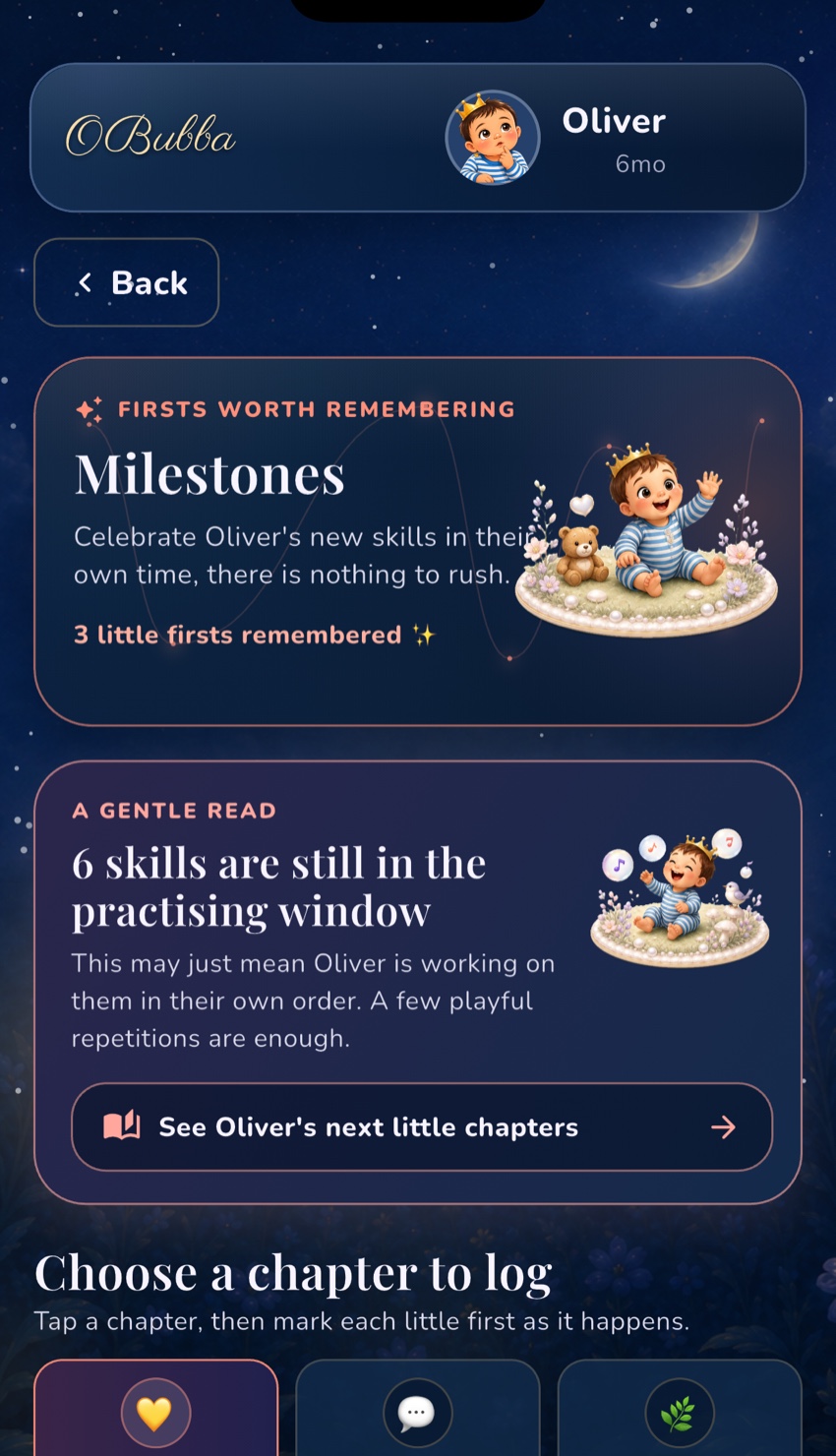
The app’s Skill Forecast is explicitly labelled “A forecast, not a deadline.” With no birthday it does not invent a stage. With age but fewer than two credible dated milestones, it shows age-typical windows. Once at least two credible milestone dates exist, it uses the median of the child’s own earlier-or-later timing to shift upcoming estimates gently.
Several safeguards stop that personalisation becoming false certainty:
- corrected age is used when prematurity context supports it
- implausibly early or far-out catch-up dates do not steer the forecast
- a median reduces the influence of one outlier
- already recorded milestones are removed from “what’s next”
- the interface says “Could be any time now” or “Coming into view” rather than naming a day
- a single late skill does not trigger a “chat with your health visitor” nudge; the surveillance logic requires a credible cluster in the same developmental area and enough real history
Pointing is bridged to two optional activities: Book Pointing and Name & Point. Today’s Play can surface age-matched ideas based on corrected age, recent interests, skills coming into view and newly logged firsts.
Those features can reduce the mental load of deciding what to notice or try. They cannot see whether a gesture is purposeful, assess eye gaze, test hearing, observe hand use or diagnose a communication difference. A parent can also misremember a milestone date. The app’s range never overrules a concern.
Try OBubba free →. Remember firsts, see gentle next chapters and get tiny age-aware play ideas alongside sleep, feeds, weaning and family memories.
A better milestone note
Instead of logging only “pointing: yes”, write what happened:
> 13 December: pointed towards the robin outside, then looked at me and squealed. I said “bird” and they pointed again.
That note preserves the communication, not merely the finger position. Other useful examples are:
- “reached with whole hand towards yoghurt and vocalised”
- “followed my point to the dog across the room”
- “touched the duck picture after I named it”
- “held the ball up for me to see”
If you later ask for advice, these concrete observations are more useful than an uncertain checkbox date.
Frequently asked questions
Is pointing at 9 months early?
Pointing can begin in the later first year, so an emerging gesture at nine months can fall within normal variation. Respond naturally and avoid treating it as a test of advanced development.
Should a 12-month-old point?
Pointing and gesturing are among the communication skills often developing around the first birthday. Look at the wider pattern and discuss concerns at the 9-to-12-month review or sooner with your health visitor.
Does reaching count as pointing?
It is not the same hand shape, but it can carry the same early message: “I want that.” Respond to it as communication while continuing to model natural gestures.
Can I teach my baby to point?
You can support the skill by pointing naturally, naming shared objects, following your baby’s gaze, pausing and reading simple picture books. Avoid repeatedly positioning their hand or withholding what they need.
Is not pointing a sign of autism?
One missing or later milestone cannot diagnose autism. Pointing is one part of social communication. If you are concerned about gestures, gaze, response to name, hearing, play or lost skills, ask your health visitor or GP for a whole-child review.
Can OBubba tell whether my baby’s pointing is typical?
No. OBubba can preserve an observation and place it in age and milestone context. It cannot observe the behaviour or assess development.
Reliable UK sources
- NHS Start for Life: Listening and learning, 6 to 12 months
- NHS: Help your baby learn to talk
- NHS: Your baby’s health and development reviews
- Bedfordshire and Luton Children’s Health: 12-month developmental milestones
- Great Ormond Street Hospital: Speech and language development from birth to 12 months
This article gives general information for UK families. It cannot assess an individual child’s communication, hearing, vision or development and does not replace advice from a health visitor, GP or speech and language professional.
Ready to try OBubba?
Use OBubba to track feeds, sleep, naps, nappies, growth, milestones and family handovers in one calm baby tracker app.