Your baby pushes up, rocks on hands and knees, reaches for a toy and then sits back down. Does that mean crawling is days away, or could this rehearsal continue for another month?
The NHS says babies who crawl will probably begin around 7 to 10 months, but not every baby crawls on hands and knees. Some commando-crawl, roll or bottom-shuffle, and some move on to standing without a recognisable crawling stage. A cluster of new movements can show that strength, balance and coordination are developing; it cannot produce a reliable countdown.
Give your baby safe, supervised floor time and interesting reasons to move. Do not pull their limbs into position, drill the movement or compare the date with another baby. If your baby is not showing any signs of moving by 12 months, the NHS advises asking your health visitor for advice. Ask sooner for lost skills, marked stiffness or floppiness, persistent one-sided movement or anything else that worries you.
Signs crawling may be coming into view
There is no compulsory sequence. Before moving across the floor, a baby may begin to:
- push their chest higher during awake tummy time
- reach with one hand while supporting their weight through the other
- pivot in a circle on their tummy
- tuck one or both knees under their body
- rock forwards and backwards on hands and knees
- move between sitting and the floor with less help
- shuffle backwards before discovering how to move forwards
- pull themselves along on their tummy
- become intensely interested in something just beyond their usual reach
These are ingredients, not promises. A baby may rock on all fours for weeks. Another may appear to skip that rehearsal and suddenly commando-crawl. A bottom-shuffler may keep their hands free and show little interest in crawling at all.
Crawling can look very different
| Movement style | What it can look like | What matters more than the label | |---|---|---| | Hands-and-knees crawl | opposite hand and knee move forwards | both sides take part and the baby explores comfortably | | Commando or belly crawl | tummy stays on the floor while the arms pull forwards | movement becomes purposeful rather than perfectly symmetrical on day one | | Bear crawl | hands and feet support the body with knees lifted | the floor is safe and the baby controls the movement | | Bottom shuffle | baby sits and propels with legs, arms or a bounce | they can change position and use both sides without persistent difficulty | | Rolling or pivoting | baby crosses the floor through repeated rolls or turns | it is an intentional route to explore, not a skill test to correct at home | | No obvious crawl | baby progresses towards pulling up, cruising or walking | the wider movement pattern and professional review matter more than one missing box |
The NHS Baby Moves guide explicitly notes that not all babies crawl and that some shuffle on their bottoms. A different route is not automatically a problem.
What deserves attention is not whether the movement looks Instagram-perfect. Notice whether your baby can vary positions, use both sides, bear weight comfortably and keep gaining skills over time.
Five gentle ways to support movement
1. Make the floor the interesting place
Use a firm, clear area while your baby is awake and directly supervised. A blanket on a stable floor can work; a sofa or adult bed creates a fall risk. Give regular chances to wriggle, roll, pivot and reach without being held in one position.
2. Put one safe object within achievable reach
Place a soft ball, fabric book or favourite age-appropriate toy close enough to invite a small weight shift. “Just beyond reach” should mean an attainable invitation, not repeated frustration. Move it nearer if your baby loses interest or becomes upset.
3. Join them at floor level
Your face can be more motivating than a toy. Lie nearby, copy a sound and pause. Let your baby decide whether the moment becomes movement, conversation or simply eye contact.
4. Allow different positions
Offer awake tummy time, side-lying, reaching from sitting and free movement on the back. The NHS activity guidance says pulling, pushing, grasping and playing with other people all help babies practise different movements.
5. Stop before play becomes physiotherapy-by-internet
Do not pull an arm or leg forwards, hold the baby's hips in an all-fours pose or repeatedly place them where they cannot get themselves. If a particular position or movement worries you, ask a health visitor or children's physiotherapist for advice tailored to your baby.
Rest, feeding, cuddling and watching the dust in a sunbeam are not lost development time. Short, enjoyable opportunities repeated naturally are enough.
What does not teach a baby to crawl faster?
More equipment is not the answer. The NHS advises limiting time in walkers, bouncers and seats. Sit-in baby walkers do not teach independent walking, can encourage tiptoe standing and may delay movement skills when used a lot. They also let a baby reach hazards quickly.
Avoid:
- pulling the baby forwards by their hands
- pushing the soles of their feet to force a movement
- placing them on an adult bed for “softer practice”
- using sleep nests or positioners, or building an unstable or raised crawling course
- turning every play session into a test they must complete
- buying a sit-in walker as a developmental shortcut
No toy can guarantee a milestone. A safe floor, an attentive adult and ordinary interesting objects are a better foundation.
Babyproof before the first crawl, not after it
Early movement can arrive between two cups of tea. Check the room from floor level before you think your baby is mobile.
- fit compliant safety gates at the top and bottom of stairs
- secure accessible windows and keep climbable furniture away from them
- anchor furniture that could tip
- move medicines, cleaning products and hot-drink cables completely out of reach
- remove coins, beads, magnets, pen lids, small toy parts and pet food
- lock away spare and used button batteries; check toy battery compartments are screwed shut
- cover dangerous cords and keep blind cords secured
- keep hot appliances, pans and their cables inaccessible
- remove large toys and bumpers that could become steps inside the cot
The NHS baby and toddler safety guide recommends fitting stair gates and preparing for climbing once crawling begins. If you think a child has swallowed a button battery or magnet, call 999 or go to A&E immediately.
When should I ask about crawling?
Ask your health visitor or GP if your baby is not showing any signs of moving by 12 months. You do not need to wait until that birthday when something else concerns you.
Seek advice earlier if your baby:
- loses a movement skill they previously used; seek advice urgently
- feels unusually stiff or floppy while awake
- consistently uses one side much more than the other
- drags one leg persistently or cannot bear weight comfortably
- cannot sit or change position in a way expected for their stage
- has repetitive, jerky or unusual movements
- seems in pain during ordinary movement
- has feeding, swallowing, vision, hearing or wider developmental concerns
The NHS Baby Moves guide says to speak to a health visitor if your baby is not showing signs of moving by 12 months. Lost skills, marked stiffness or floppiness, persistent asymmetry or anything else that worries you are reasons to ask sooner.
For a baby born prematurely, corrected age may be the fairer developmental frame during the early years. Follow any individual neonatal, paediatric or therapy plan rather than a general internet timetable.
Why nobody can predict the exact crawling date
Crawling depends on several systems coming together: strength, balance, weight shifting, joint stability, motivation, opportunity and the baby's preferred route. A visible rehearsal only tells you what happened today.
An age chart cannot see:
- the quality or symmetry of movement
- whether the baby can get into and out of a position
- how much floor opportunity they have had
- prematurity, illness, muscle tone or joint flexibility
- whether a dated milestone was remembered accurately
- whether the baby will choose bottom shuffling or skip crawling
That is why “your baby will crawl next Tuesday” is false precision. A useful forecast can show what may be coming into view; it must never become permission to delay a concern.
How the real OBubba app keeps Skill Forecast honest
OBubba's current Skill Forecast is intentionally labelled “A forecast, not a deadline.” It looks across the next few social, language, movement and thinking chapters rather than promising the date of one headline skill.
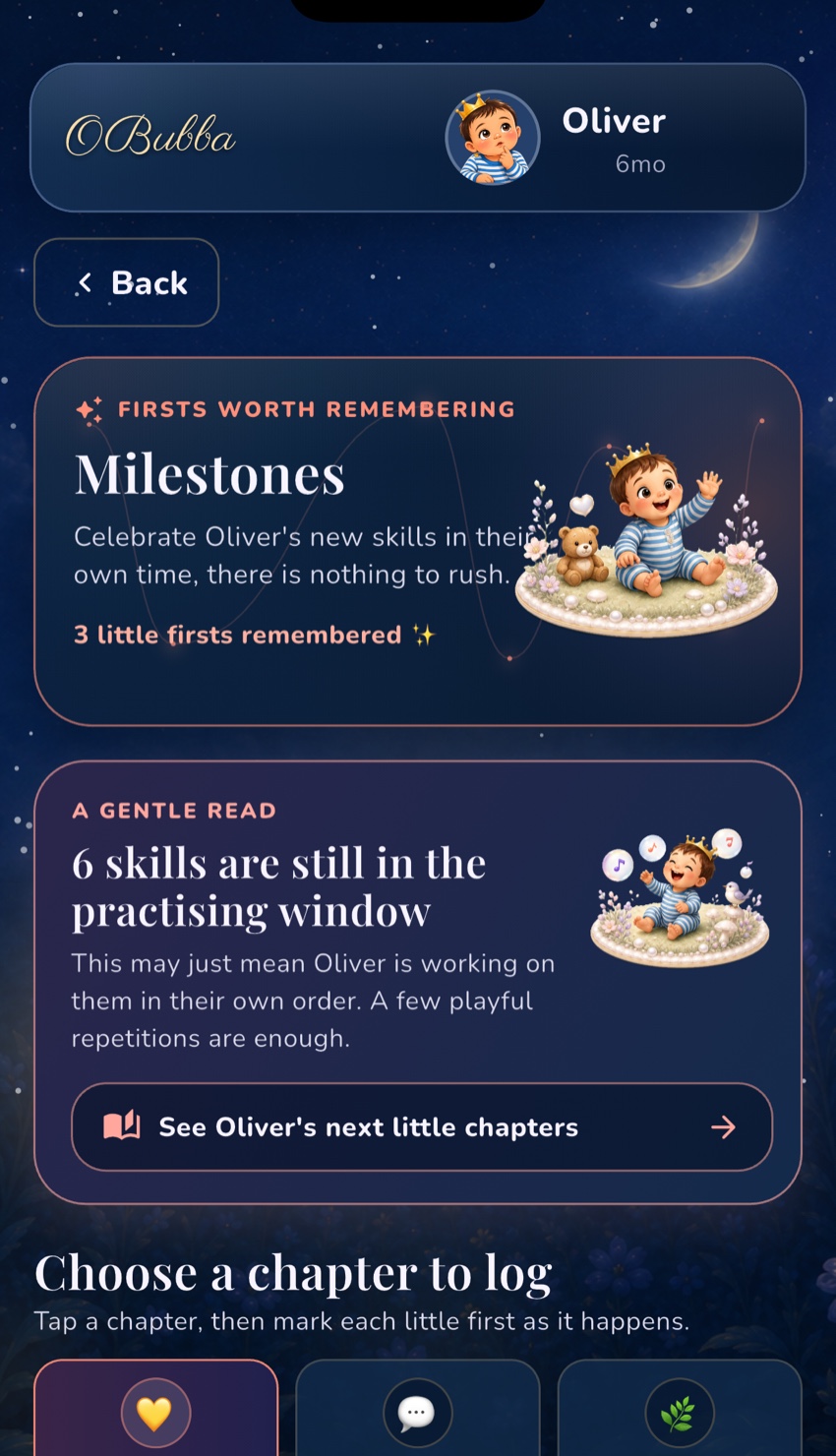
The underlying forecast behaves differently according to the evidence available:
- No known age means no forecast. The screen asks for a birthday instead of inventing a stage.
- With fewer than two credible dated milestones, it uses age-typical timing. The UI says that clearly; it does not call the result personalised.
- With at least two credible dated milestones, it learns the child's median timing offset. If several recorded firsts arrived a little earlier or later than their typical points, that median shifts the upcoming chapters gently.
- Corrected age is used where relevant. When a baby was born at least about three weeks early and a due date is available, developmental ages are anchored to that context.
- Implausible dates do not steer the forecast. A date more than six weeks before a milestone's earliest window, or far outside its own expected span, is discarded as a likely typo or catch-up log.
- The median limits the influence of one outlier once there are several credible dates. With only two dated milestones, both still shape the midpoint, so the forecast remains approximate.
- Already recorded and long-overdue items are not presented as “next.” The engine ranks the nearest plausible unrecorded chapters and uses language such as “Could be any time now”, “Coming into view” or “Around … weeks away”.
The screen displays three main chapters and can reveal one more. It also looks for the first hand-matched, age-appropriate activity connected to those skills. If there is no mapped activity, it leaves the suggestion blank instead of inventing busywork.
One subtle protection matters for crawling anxiety: elsewhere in the milestone engine, a later movement can supersede an earlier unrecorded one. If first steps are recorded, the app does not nag the parent to prove that crawling happened first. Development is not forced back into a sequence the child already moved beyond.
This is personalisation with boundaries. OBubba cannot observe muscle tone, symmetry, hearing, vision or movement quality. It cannot verify a date, diagnose delay or decide whether waiting is safe. A forecast that says “around three weeks” never outranks a parent's concern or a professional assessment.
Try OBubba free → Keep milestones, corrected-age context, short play ideas, sleep, feeds and family memories together, without turning childhood into a race.
A calm two-week observation note
If your baby is well and you simply want a clearer picture, record a few useful observations rather than staging daily crawling tests:
| Notice | Useful wording | |---|---| | Position changes | “Moved from sitting onto both hands without help” | | Weight shifting | “Reached left and right while supporting on the other arm” | | Route across the floor | “Pivoted and moved backwards; no forward movement yet” | | Symmetry | “Used both legs similarly” or the specific difference you noticed | | Tolerance | “Played on tummy happily for four minutes, then rolled away” | | New first | approximate date and what actually happened |
Bring that description to a health visitor if needed. “They are not crawling” is useful; “they sit independently, pivot both ways and pull to stand, but do not crawl” gives a fuller picture.
Frequently asked questions
Is rocking on all fours a sign crawling is close?
It shows that your baby is practising weight bearing and shifting, but it cannot predict the date. Some babies rock briefly; others do it for weeks or choose another way to move.
Is commando crawling normal?
It can be a normal variation. Watch the wider pattern and whether both sides increasingly participate. Ask for advice if your baby persistently drags one side, seems stiff or painful, loses skills or you are concerned.
Is bottom shuffling bad?
Bottom shuffling is a recognised normal variation and some babies move from shuffling towards standing without hands-and-knees crawling. Mention concerns about posture, asymmetry or progress to your health visitor.
Should I move my baby's knees for them?
No. Offer safe opportunities and let your baby organise the movement. If they need hands-on support for a specific difficulty, a children's physiotherapist can show you what is appropriate after assessing them.
Can OBubba tell me when my baby will crawl?
No app can know the exact date. OBubba can show age-contextual upcoming chapters and, after enough credible dated milestones, gently adjust timing from the child's own history. It remains a forecast, not an assessment or deadline.
Reliable UK sources
- NHS Best Start in Life: Baby Moves
- NHS: How to keep your baby or toddler active
- NHS: Baby and toddler safety
- Bedfordshire and Luton Children's Health: Learning to crawl
Ready to try OBubba?
Use OBubba to track feeds, sleep, naps, nappies, growth, milestones and family handovers in one calm baby tracker app.