The nap lasted 34 minutes. Your baby opens their eyes, screws up their face and cries before you have even reached the cot. Yesterday they woke from the same nap smiling. Today, picking them up works instantly, and tomorrow nothing seems to.
Why does a baby wake crying from a nap?
Often, the cry means “I am not comfortably ready for what comes next” rather than one specific sleep problem. Your baby may still be sleepy, startled by the transition, hungry, too warm, uncomfortable or in need of closeness. One crying wake cannot tell you which. The useful clues are the nap length, how they settled, the awake stretch before it, what happens after comfort and whether the same pattern repeats.
> Respond to the baby first. Interpret the nap second.
This guide is for a baby who is breathing normally and otherwise seems well. A cry that is unusual, continuous or impossible to console, especially with poor feeding, fever, vomiting, breathing change, reduced responsiveness or fewer wet nappies, needs health advice rather than a wake-window experiment.
What to do in the first 60 seconds
Before deciding the nap was too short or the schedule was wrong:
- Look before fully waking them. Eyes may flutter and brief fussing can happen during light sleep. The NHS notes that a baby in light sleep may make short fussy or crying sounds and be easy to wake.
- Stay present and respond. If the cry builds, your baby opens their eyes properly or reaches for you, offer your voice, touch or a cuddle. This is not a test of self-settling.
- Check breathing, colour and responsiveness. Anything that looks or sounds wrong takes priority over the nap.
- Check the ordinary needs. Hunger cues, a wet or dirty nappy, temperature, trapped wind, teething discomfort and an awkward position can all matter.
- Notice what resolves it. Do they fall back asleep with a hand on the chest, calm as soon as they are picked up, take a full feed, or remain distressed despite comfort?
Do not leave an escalating cry to run while timing it. A short pause while you are beside the cot and watching a half-asleep stir is different from ignoring a baby who is awake and upset.
A quick read of the crying wake
No row proves a cause. Use it to choose the next observation.
| What you see | What it may mean | What to try next | |---|---|---| | brief cry, eyes closed or fluttering, then quiet | light-sleep sound or an incomplete wake | stay close and give the transition a moment without adding stimulation | | short nap, sleepy face, rooting into you, calms in a dark room | baby may still need sleep | offer a gentle resettle or rescue the nap if that works safely | | short nap, fully alert and cheerful after the first cuddle | enough sleep for that moment or not much sleep pressure | accept the wake; review the preceding awake stretch only if it repeats | | wakes crying after a long nap but calms quickly when held | abrupt transition, hunger, separation or ordinary disorientation | reconnect first, then begin the wake slowly | | cries around the expected feed and takes a purposeful feed | hunger may be part of the wake | feed responsively; compare with naps that land farther from a feed | | arches, gulps, coughs or brings up milk around feeds and lying down | feeding discomfort or reflux may be relevant | seek feeding support if repeated; do not incline the cot or add a wedge | | cries from one nap place but wakes content elsewhere | location, timing or nap position may differ | compare like-for-like naps before blaming the place | | cry is unusual, high-pitched, continuous or cannot be consoled | illness or pain needs considering | check for other symptoms and seek prompt advice |
The most useful distinction is not crying versus not crying. It is whether the baby remains sleepy, becomes comfortably alert, shows a clear need or stays unusually distressed.
Is the baby actually awake yet?
Babies move through different sleep and waking states. The NHS guide to understanding your baby describes light sleep as a state with possible body movements, fluttering eyes and brief fussy or crying sounds. In a drowsy state, a baby may fall asleep again.
That makes the first few seconds ambiguous. Rushing in with bright light, conversation and a nappy change can turn a partial arousal into a full wake. Equally, waiting through an escalating cry because an app says the nap “should” continue is not responsive.
Try a quiet check:
- keep the room as it was
- speak softly or rest a hand gently if baby responds well to touch
- watch whether the body relaxes or becomes more active
- pick up and comfort when the cry builds or baby is clearly awake
You are not teaching a lesson. You are finding out which state your baby is in.
The five most common patterns
1. The nap ended before your baby felt restored
A baby can wake at a light point between sleep cycles and still look tired. Clues include heavy eyelids, yawning, nuzzling into the parent, crying that eases when the room stays dark and falling asleep again with ordinary support.
This is especially common while sleep-cycle linking is still developing. Young babies also have highly variable naps, so one short sleep does not need correcting.
If a resettle works, extend the nap. If it does not, accept the wake and shorten the next awake stretch modestly if your baby continues to look tired. Do not spend an hour repeatedly attempting a nap that has clearly ended.
2. The final awake stretch before the nap was too long
An overtired baby does not always sleep longer. They may take longer to settle, sleep restlessly, wake after one cycle and cry hard because the transition feels difficult.
Possible clues are:
- the wake window ran noticeably longer than on easier days
- settling involved escalating fussing or a sudden “second wind”
- the nap was short and baby woke sleepy or fussy
- several naps became fragmented as the day went on
If the same nap repeats this pattern for three days, try beginning its wind-down 10 to 15 minutes earlier. Change only that lead-in; do not move every nap and bedtime at once.
3. There was not enough sleep pressure yet
Too little awake time can also produce a short nap, but the wake often looks different. Baby may protest going down, take a long time to fall asleep, wake quickly and become bright, social or ready to play after brief reassurance.
If that pattern repeats, try the nap 10 to 15 minutes later. Do not stretch a tired, upset baby merely to hit an age-chart number. The response after waking matters as much as the clock.
4. The nap ended near a physical need
The cry may have little to do with sleep timing.
Check:
- whether a normal feed was due or hunger cues appeared
- whether the nappy needs changing
- whether baby's chest or back of neck feels hot or clammy
- whether teething signs are present
- whether wind, constipation or reflux-like symptoms cluster around feeds
- whether noise, sunlight or a temperature change woke them abruptly
The NHS lists hunger, tiredness, wanting a cuddle, wind, temperature and overstimulation among common reasons babies cry. Treat the observable need rather than forcing the nap to continue.
Do not raise the cot mattress, use sleep positioners or place a baby on their side or front to manage suspected reflux. Keep the sleep space clear, flat and firm and place baby on their back for every nap.
5. Waking is an emotional transition
Some babies dislike the moment of waking even after a reasonable nap. They may cry, reach for the familiar adult and settle almost immediately in arms. Older babies going through separation anxiety may be especially vocal when they wake somewhere different from where they fell asleep.
This does not prove pain or a failed nap. Build a gentle bridge:
- use the same quiet phrase when you enter
- offer a cuddle before switching on bright lights
- open curtains gradually
- give baby a minute of calm contact before expecting play
- keep the first activity low-key
If they become alert and content after reconnecting, the cry may have been the transition itself.
Does the nap length explain the cry?
Not by itself.
| Nap result | Happy on waking | Sleepy on waking | Fussy or crying on waking | |---|---|---|---| | short | may have taken enough sleep or had low sleep pressure | may need a resettle or shorter next window | review overtiredness, hunger, discomfort and how the nap ended | | medium/typical | likely a workable nap for today | allow a slow wake; watch whether tiredness persists | look beyond duration: environment, need, separation or illness context | | long | baby may have needed recovery sleep | could still be catching up or waking slowly | check hunger, temperature, discomfort and whether the cry resolves quickly |
There is no single duration that guarantees a happy wake. A 28-minute nap followed by an engaged baby can be more workable than a 75-minute nap followed by persistent distress.
For this reason, avoid describing every crying wake as “overtired”. That is one possibility, not a diagnosis.
Why does my baby wake crying after exactly 30 to 40 minutes?
That timing often lands around a transition between sleep stages, particularly in younger babies. But the clock cannot tell you whether the preceding awake stretch was too short, too long or perfectly ordinary for a baby who has not yet linked another cycle.
Look at the before-and-after pair:
- long settle + bright wake: consider slightly more awake time
- fraught settle + sleepy, upset wake: consider slightly less awake time
- easy settle + brief cry + resettles: the timing may already be fine
- easy settle + content after comfort: accept that this nap may simply be short
- pain signs or unusual distress: stop adjusting sleep and assess wellbeing
Repeat observations across several comparable days before changing the schedule.
A three-day pattern check
Track one troublesome nap position, such as Nap 1, Nap 2 or the late catnap, for three days. Do not mix the easy first nap with an on-the-go late rescue nap and call them one pattern.
Record:
- when the previous sleep ended
- when the wind-down began and sleep actually started
- roughly how long settling took
- when the nap ended
- wake mood: happy, sleepy or fussy
- nap quality: good, OK or rough
- where it happened
- the nearby feed and useful context such as teething, illness, nursery or travel
Then use one small experiment:
If baby repeatedly wakes sleepy and crying
Move the wind-down 10 to 15 minutes earlier for that nap, or attempt one calm resettle. Hold everything else steady.
If baby takes a long time to settle and wakes alert
Move that nap 10 to 15 minutes later. Stop if baby becomes clearly tired sooner.
If hunger appears every time
Review the feed-and-nap relationship without withholding milk to engineer sleep. Offer feeds responsively and see whether a calm gap before the nap emerges naturally.
If the cry is specific to one location
Compare the same nap position in each place. Nap 1 in the cot versus a late pram top-up is not a fair test.
If nothing is consistent
Do not force a theory. Variable naps are normal, particularly in young babies and during illness, teething, travel or developmental change.
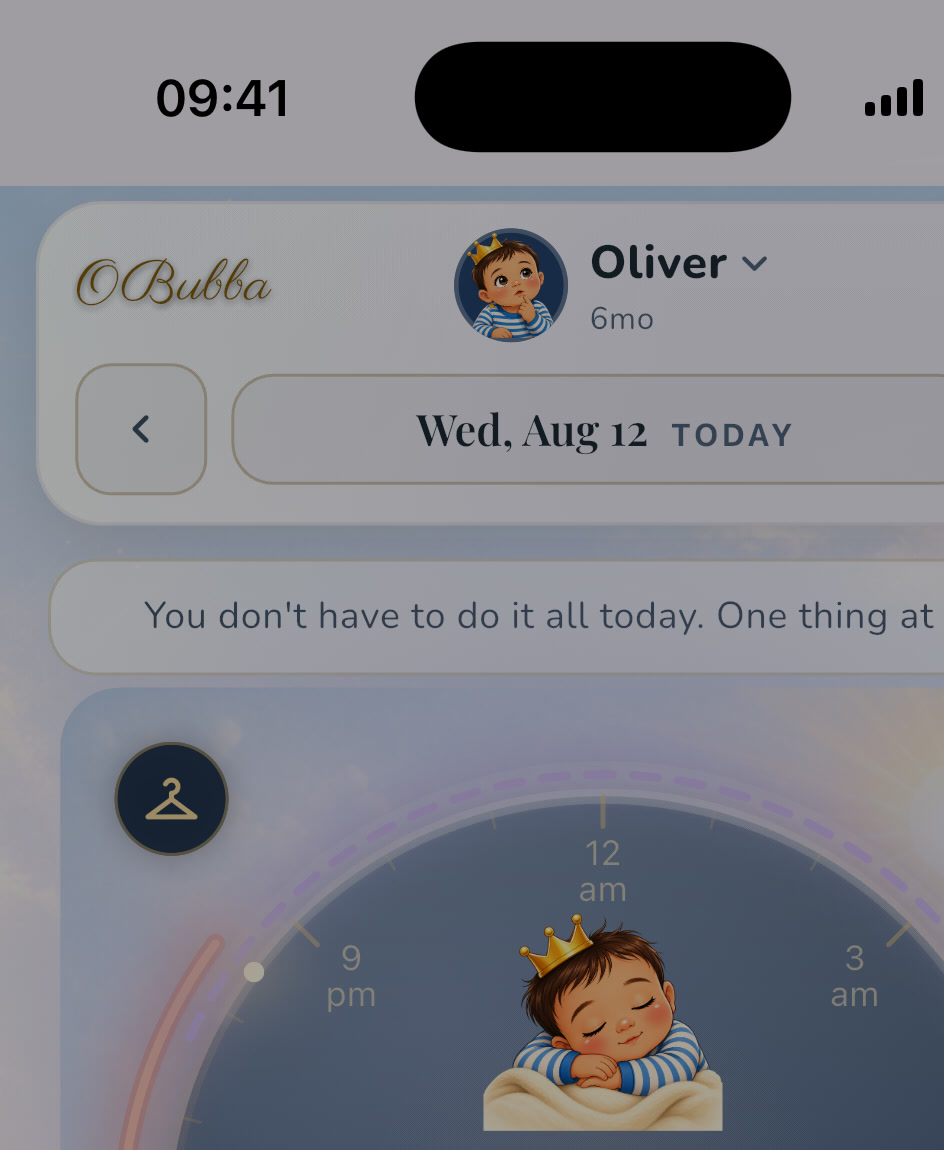
How the real OBubba app reads a crying wake
When a nap ends in the current app, the optional detail sheet asks How did they wake? with Happy, Sleepy or Fussy. It can also record:
- nap quality: Good, OK or Rough
- time to fall asleep: Under 5m, 5 to 15m, 15 to 30m or 30m+
- how baby settled: self-settled, fed, rocked, held, patted or dummy
- where the nap happened: cot, contact, pram, carrier, car or other
Those details are optional. A parent can end the timer and attend to the baby first, then add context later.
Duration does not get the final vote
Inside the app, a completed nap's learning signal combines duration with the baby's age-linked nap range, settling time, wake mood and the parent's quality rating. OBubba does not show parents a punitive nap score; the combined outcome helps its prediction engine learn which preceding awake stretches have produced the most workable naps for this baby.
That means a short nap with an easy settle and happy wake is not treated the same as a short, hard-to-settle nap followed by fussiness.
Personalisation waits for comparable evidence
The personalised wake-window model does not learn from one crying wake. It needs multiple completed naps with useful outcome context and more than one well-sampled 15-minute wake-window band before it can choose a better-performing range.
A separate insight only says a baby's learned wake window differs from the age chart when there are at least eight usable nap samples and the difference is meaningful, about 20 minutes or more. Until enough personal data exists, the app falls back to an age-aware range and the baby's live cues.
It can isolate the nap that changed
If settling is getting harder only for Nap 2, OBubba can keep that separate from Nap 1. Its position-specific trend requires at least five usable examples for that nap, including recent and older samples, and a real increase in settling time. It does not declare the whole schedule broken because one afternoon was difficult.
Location and mood stay separate from duration
OBubba can compare which nap place tends to produce happier wakes. It needs at least three mood-logged naps in each of two locations and a clear contrast before speaking up. The location that produces the longest nap may not be the one that produces the happiest wake.
Illness, fever, nursery, grandparents and travel days are kept out of the ordinary home baseline so an exceptional crying wake does not teach the app a new “normal”. Those days remain in the family history as context.
What OBubba cannot conclude
The app cannot hear the cry, assess pain, see breathing, confirm reflux, measure how restored a baby feels or diagnose why they woke. “Fussy” is a parent's observation, not a medical label. OBubba helps separate repeatable patterns from guesses and gives a health visitor or GP a clearer history when advice is needed.
Try OBubba's personalised nap tracker free →. Use live timing, wake mood, settling and nap place to give adaptive next-nap guidance without judging one difficult wake.
When crying after naps needs medical advice
Contact your GP or NHS 111 if the crying is constant, cannot be consoled or distracted, sounds unlike your baby's normal cry, or comes with signs of illness such as a high temperature or reduced interest in feeding. The NHS crying guidance recommends keeping a record of when crying happens because the timing can help a health professional identify a cause.
Call 999 for an emergency such as:
- difficulty breathing, grunting, very fast breathing or the skin pulling in under the ribs
- blue, grey, very pale or blotchy skin, lips or tongue
- being floppy, unresponsive or unusually difficult to wake
- a fit or seizure
- repeated projectile vomiting
- a rash that does not fade under pressure
For a baby under three months, a temperature of 38°C or above needs urgent medical assessment. Trust your instinct even when a tracker looks ordinary.
Also ask for help if repeated crying leaves you overwhelmed. Put baby safely on their back in a clear cot, step away briefly to calm yourself if needed, ask another adult to take over and never shake a baby.
Frequently asked questions
Does waking crying always mean my baby is overtired?
No. Overtiredness is one possibility, but hunger, discomfort, temperature, a partial arousal, separation or an ordinary waking transition can look similar. Use settling, nap length, wake state and repetition together.
Should I try to resettle after every crying wake?
No. Try when baby still looks sleepy and the attempt remains calm. If they are fully alert, resist resettling or become more distressed, accept that the nap ended and adjust the rest of the day if needed.
Why does my baby cry after a long nap?
A long nap does not prevent hunger, a wet nappy, abrupt waking or a need for closeness. Some babies also need a slow transition into alertness. Check whether they calm quickly with ordinary comfort and whether other symptoms are present.
Why does my baby wake crying only from cot naps?
The cot nap may occur at a different time, last a different length or involve a more abrupt sensory transition than a contact nap. Compare the same nap position across several days. Keep every cot clear, flat and firm; do not add soft items to imitate being held.
Should I feed when my baby wakes crying?
Follow hunger cues and your baby's usual feeding needs. Do not withhold a feed to preserve a schedule, but do not assume every cry is hunger either. Rooting, purposeful sucking and taking a normal feed provide more context.
Can teething cause crying after naps?
Teething can make babies more fretful and disturb sleep, but do not blame every unusual cry or fever on teeth. The NHS describes teething temperature as slightly raised but below 38°C. Check for illness signs and seek advice when concerned.
Is a brief cry with eyes closed normal?
It can happen in light sleep. Stay nearby and watch whether baby settles. Respond when the cry builds, eyes open fully or baby clearly needs you.
The bottom line
A baby who wakes crying has communicated a need, but not necessarily its cause. Comfort them first. Then look at the nap in context: how long it lasted, how settling went, whether baby still looked sleepy, when they last fed, the environment and what made the crying stop.
One wake is a moment. Three comparable wakes can become a useful pattern. An unusual or inconsolable cry with illness signs is neither. It is a reason to seek help.
Sources
- NHS: Understanding your baby's sleep and waking states
- NHS: Soothing a crying baby
- NHS: Helping your baby to sleep
- NHS: Baby teething symptoms
- The Lullaby Trust: Sleeping position
- The Lullaby Trust: Keeping a clear cot
OBubba is a record, pattern and education tool. It cannot assess crying, breathing, pain, illness or sleep quality and does not replace advice from a midwife, health visitor, GP, paediatric team, NHS 111 or emergency services.
Ready to try OBubba?
Use OBubba to track feeds, sleep, naps, nappies, growth, milestones and family handovers in one calm baby tracker app.