When your baby is crying hard, your own brain can start racing: hungry, wind, overtired, teething, reflux — or something wrong? You do not have to identify the cry perfectly. First check whether your baby may be unwell. If there are no warning signs, slow the moment down and try one ordinary need at a time.
The short answer: crying is how babies ask for comfort and care. Sometimes the reason becomes obvious; sometimes several small things overlap; and sometimes a well baby simply needs closeness while the crying passes. A calm checklist helps you respond without pretending every cry has a single diagnosis.
Check for illness before working through the list
Trust your instincts. You know what is normal for your baby. A cry that is constant and cannot be consoled or distracted, or that sounds unlike their normal cry, can be a sign of illness.
Call 999 in the UK if your baby:
- has difficulty breathing, is breathing very fast, grunting or pulling in under the ribs
- has blue, grey, very pale or blotchy skin, lips or tongue
- is unresponsive, floppy or much harder to wake than usual
- has a seizure
- has a rash that does not fade when pressed
- is being violently or repeatedly projectile sick
Contact your GP or call NHS 111 if your baby seems unwell, is not interested in feeding, has noticeably drier nappies, has a high temperature or you are worried. For babies under three months, a temperature of 38°C or higher needs urgent medical advice; for babies aged three to six months, the NHS threshold is 39°C or higher.
This checklist is for an otherwise well baby. Do not keep troubleshooting at home when your instincts say something is wrong.
Before the checklist, take one breath
A baby's cry is designed to get your attention. Feeling tense, upset or unable to think clearly does not mean you are failing — it means your nervous system heard the alarm.
If you can, loosen your shoulders and take one slow breath out before you begin. Then ask one question at a time rather than changing five things at once.
1. Could they be hungry?
Look for the wider feeding picture, not for a special “hunger cry”. Earlier cues can include turning towards touch, rooting, opening the mouth and bringing hands towards the mouth. Crying is often a later cue.
Offer the breast or a bottle according to your baby's usual feeding plan and cues. Evening cluster feeding can be normal, particularly in younger babies. If your baby repeatedly cries during feeds, refuses feeds, coughs or struggles, or feeding is painful for you, ask your health visitor, GP or feeding professional for support.
Our newborn feeding and reflux guide explains what is useful to notice around a feed without diagnosing reflux from crying alone.
2. Do they need a nappy or a temperature check?
Check the simple physical things:
- Is the nappy wet or dirty?
- Are clothes twisted, damp or irritating?
- Does their chest or the back of their neck feel unusually hot or cold?
- Are they sweaty, shivering or not behaving like themselves?
Hands and feet can feel cooler than the body, so they are not the best guide. If your baby seems hot or unwell, use a digital thermometer rather than guessing by touch.
3. Could tiredness or too much stimulation be adding to it?
Tired babies do not always look peacefully sleepy. They may turn away, become jerky, fuss, stare into the distance or escalate into hard crying. Bright lights, several voices, energetic bouncing and repeatedly changing the soothing method can add more input when they need less.
Try a calmer environment:
- dim the lights
- reduce talking and background noise
- hold them securely and move slowly
- repeat one gentle sound or motion
- begin the familiar wind-down you normally use
Wake windows can offer context, but they are not a stopwatch or a diagnosis. Look at your baby's cues and the whole day. Our wake windows without stress guide explains how to use them without turning every difficult moment into a schedule problem.
4. Might they be uncomfortable after a feed?
Some babies need help bringing up wind. Try holding your baby upright against your chest, gently rubbing or patting their back, or moving their legs slowly in a bicycle motion.
Crying around feeds can have several explanations, including positioning, attachment, milk flow or reflux. It is more helpful to note what repeatedly happens before, during and after feeds than to label one unsettled evening. If this is becoming a pattern, a short reflux and colic diary can make a conversation with a health professional clearer.
5. Have you tried less rather than more?
The NHS suggests several gentle options: holding your baby close, swaying, walking, singing, offering the breast if breastfeeding, gentle background sound, stroking their back or trying a warm bath. Different babies prefer different things, and a method that worked yesterday may not work tonight.
Choose one safe, repetitive approach and give it a little time. Rapidly switching between rocking, toys, lights, feeding and bouncing can make it harder to tell what is helping.
Sometimes there is no task to complete. Your baby may simply need contact, your heartbeat and your presence while the crying runs its course.
What if nothing works?
Pause and reassess your baby's health. If the crying is constant, cannot be consoled or distracted, sounds unusual, or comes with poor feeding, fever, breathing changes, a rash, repeated vomiting, fewer wet nappies or reduced responsiveness, seek medical advice.
If your baby seems well but has long crying periods, speak to your health visitor or GP. Crying often increases in the early weeks and may be worse in the afternoon or evening, but you do not have to cope without support.
If you feel overwhelmed, put safety first
Constant crying is exhausting. If you feel anger or panic rising:
- Put your baby safely in their cot.
- Step into another room and give yourself a few minutes to calm down.
- Set a short time limit, such as 10 minutes, then return and check your baby.
- Call someone you trust, your health visitor, GP or NHS 111 if you need help.
Never shake a baby. Even a few seconds can cause serious brain injury. Taking a short, safe break is the responsible choice when you are reaching your limit.
The NHS also lists the free Cry-sis helpline: 0800 448 0737, open from 9am to 10pm, seven days a week, for parents coping with crying or sleepless babies.
What is worth tracking?
You do not need to document every sound. A small amount of context is more useful:
- when the crying started and roughly how long it lasted
- the last feed, nappy and sleep
- what was happening immediately before it began
- any temperature or clear physical symptom
- what you tried and what eventually helped
- whether the same pattern is repeating
A record can help you notice a consistent evening window, crying around every feed or a soothing method that often works. It can also help a health visitor or GP understand the pattern. It cannot tell you with certainty why your baby is crying.
How OBubba turns the checklist into one gentle path
OBubba's Crying Helper starts with a breathing pause and keeps the safety reminder visible. It can place the last logged feed, nappy and time awake beside a one-check-at-a-time list, so tired parents do not have to reconstruct the whole day from memory.
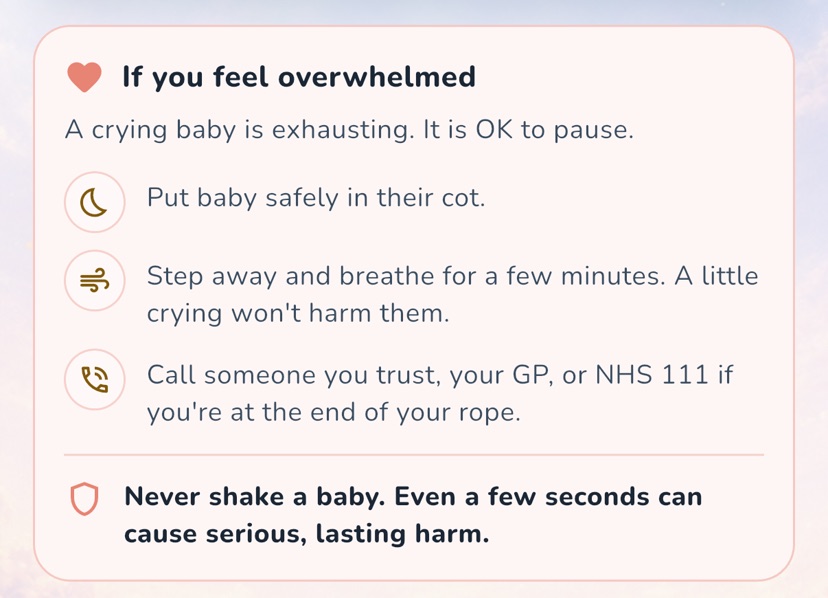
After your baby settles, you can record what helped — such as a feed, sleep, wind, a nappy change, a cuddle, a bath or a walk. Over time, OBubba can move the approaches that have helped your baby before higher in the list. That is personalised memory, not a medical diagnosis.
The important distinction is simple: OBubba can help you remember, organise and notice. It should never delay urgent care when your baby seems unwell.
Try OBubba free → — feeds, sleep, nappies, crying context and gentle guidance in one mum-built app.
Sources and further support
- NHS: Soothing a crying baby
- North Tees and Hartlepool NHS Foundation Trust: How to recognise if your child is seriously ill
- NHS: High temperature in children
- NHS Best Start in Life: Understanding your baby
OBubba is a tracking and education tool, not medical advice. If you are worried about your baby's breathing, colour, responsiveness, feeding, hydration, temperature or behaviour, seek medical help.
Ready to try OBubba?
Use OBubba to track feeds, sleep, naps, nappies, growth, milestones and family handovers in one calm baby tracker app.