When a baby who seemed settled starts waking, feeding or behaving differently, exhausted brains want one clean answer: teething, a regression, a new skill, something they ate—or something we did wrong.
OBubba’s Why right now? screen does not choose a diagnosis from the baby’s age. The current app first asks a more useful question:
> Is this actually a changed pattern for this baby, and what dated clues sit closest to it?
Only then can it rank possible context from sleep, teething, development, illness, feeding and family notes. The result is a hypothesis to inspect, not a verdict to obey.
That boundary matters because the NHS notes that growth spurts, teething and illnesses can all affect sleep—but overlap does not tell a parent which one caused tonight’s wake. Every baby’s sleep pattern also changes as they grow.
Where the feature lives
Open Grow → Development Map → Explore → Why right now? The screen is called Behaviour Explained.
When there is enough context, it opens with “What might be shaping today?” and three clue areas: Sleep, Teething and Development. A developmental signal can appear as “One possible thread”, with expandable reasoning and a plain-language list of the observations behind it.
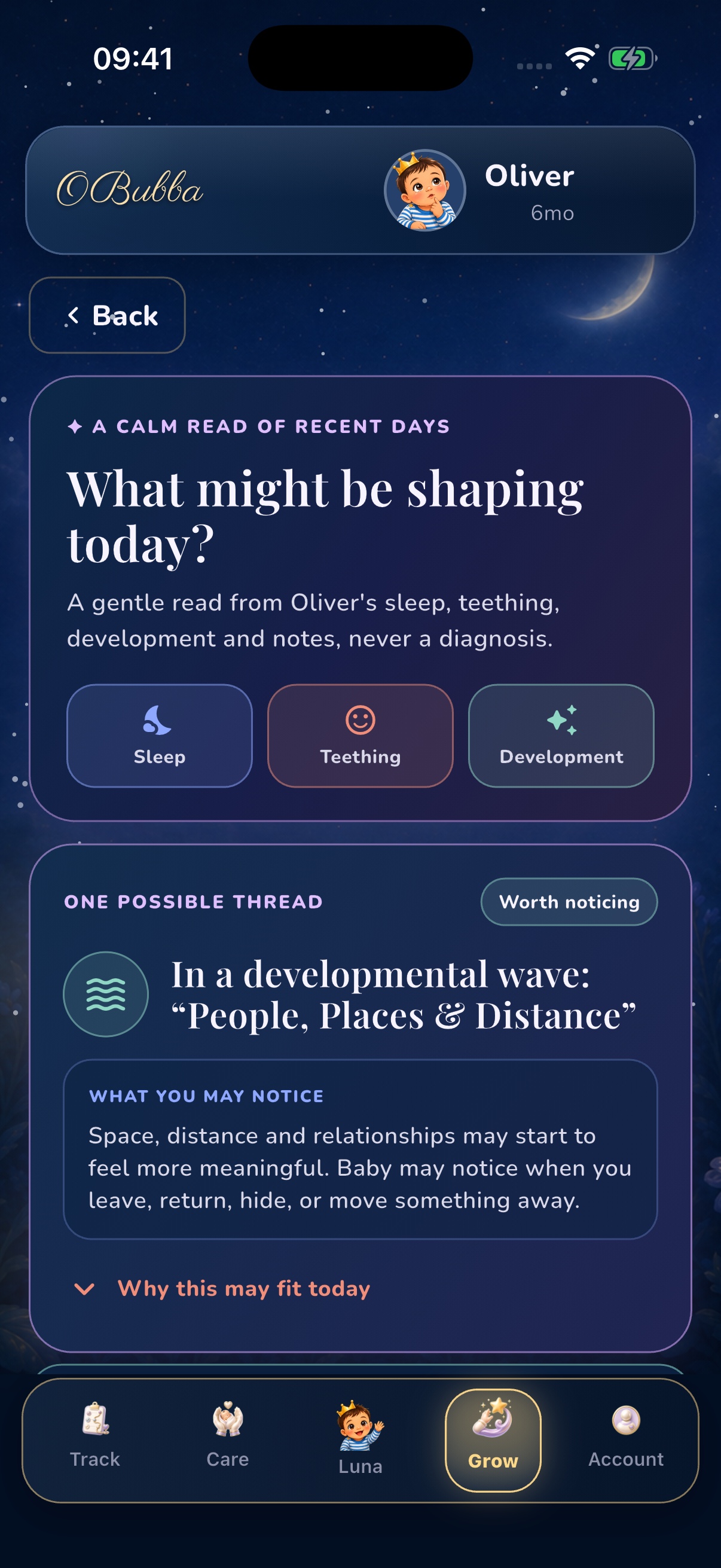
If the record is settled or too thin, the screen can say that nothing needs attention. That quiet state is part of the design. A baby tracker should not invent a story every time it opens.
The evidence ladder behind “Why right now?”
OBubba moves through five layers. Each one limits what the next can honestly claim.
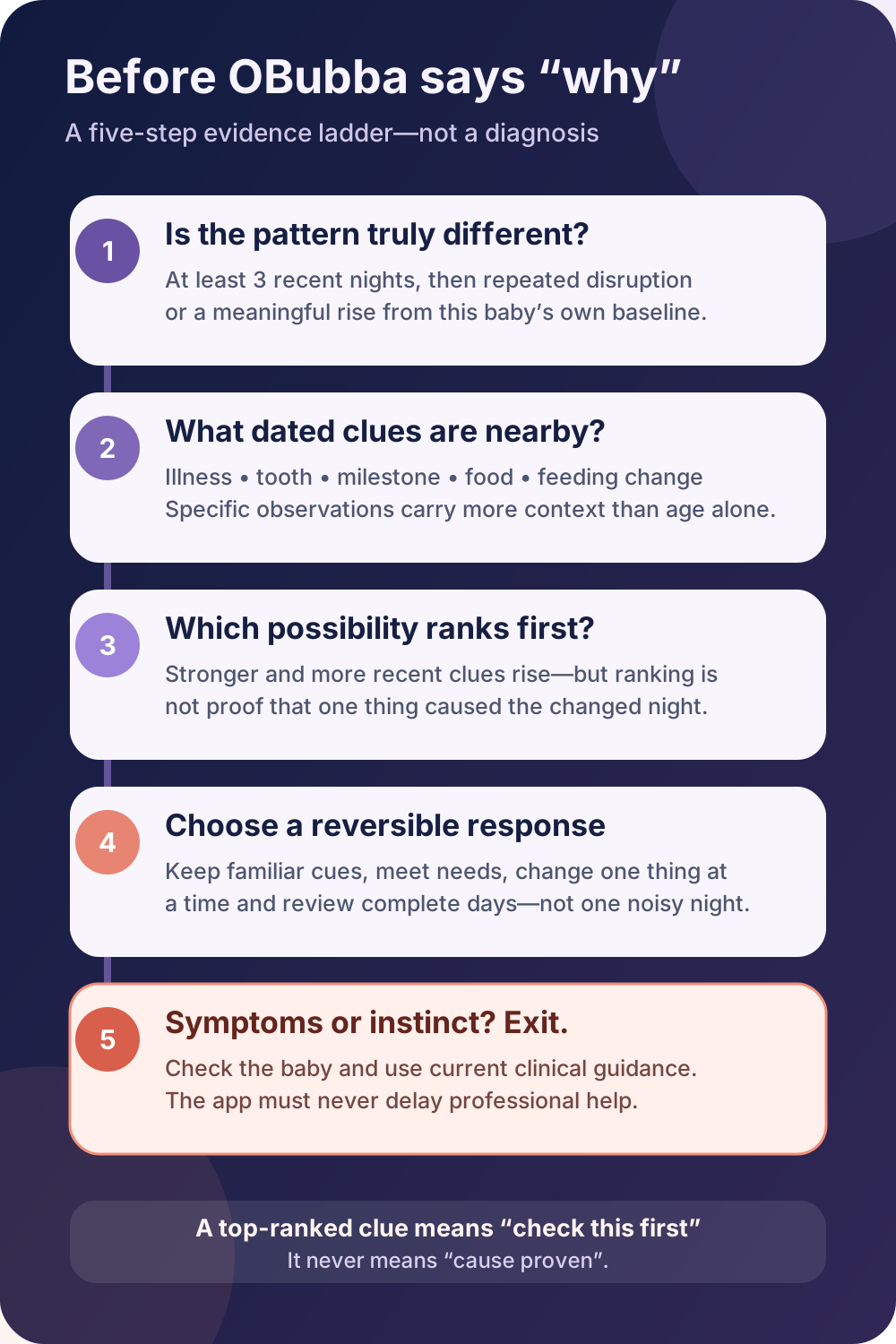
1. It checks for a real sleep change
The disruption detector needs at least three recent nights before it speaks. It then looks for either:
- repeated heavily disrupted nights—at least two of the latest five nights with three or more wakes; or
- a personal spike, where the recent average is meaningfully higher than at least three older nights from the same baby.
This is not a universal sleep target. It is a noise filter. Three wakes may be unusual for one child and ordinary for another; incomplete logging can also make either pattern misleading.
2. It gathers dated clues, not just an age label
Once a disruption is present, the app can consider context the family actually recorded, including:
- a temperature or illness note;
- a recent tooth or suspected teething note;
- a motor or cognitive milestone dated within the previous 14 days;
- a broad current development window;
- a newly introduced food or allergen;
- a genuine recent feeding-volume increase compared with the baby’s own baseline; and
- recovery after a recent illness.
The dates matter. “Pulled to stand four days ago” is more useful context than “is around nine months old.” A feeding surge must also appear in the measurements; the app does not infer it because an age-based growth spurt sounds plausible.
3. It ranks explanations—it does not establish causes
The engine gives stronger, more recent clues greater weight and uses a stable tie-break so equally scored possibilities do not shuffle between visits. A fever or freshly logged milestone can therefore appear above a vague note about chewing.
That ranking means “check this first”, not “we proved this.” Logs can show sequence and overlap. They cannot examine gums, listen to breathing, assess hydration, test an allergy or observe a new skill.
A new food next to a rough night is timing context—not proof of allergy, intolerance or digestive discomfort. NHS guidance recommends introducing foods that can trigger allergy one at a time so reactions are easier to identify, and says reactions can include swelling, wheeze, rash, vomiting or digestive symptoms. Read the NHS food-allergy guidance for babies.
4. It changes how confidently the app suggests action
When a stronger disruption leads the ranking, OBubba can recommend holding a sleep-plan experiment rather than judging a routine during an unusual week. A softer suspicion does not automatically stop every change.
That is a useful decision rule: protect a routine from being rewritten on one noisy night, but do not let a speculative explanation freeze family life indefinitely.
The safest response is usually small and reversible:
- keep the bedtime cues familiar;
- meet hunger, pain, comfort and temperature needs;
- avoid changing several schedule variables at once;
- record one concise observation;
- review the next two or three complete days; and
- ask for health advice when the baby, not the chart, is concerning.
5. Symptoms and instinct leave the ladder
The screen says its suggestions are helpful windows, not certainties, and directs worried parents to a health visitor or GP. That is not boilerplate. It is the most important branch.
For example, teething can involve a sore gum, dribbling, chewing, fretfulness and poorer sleep. The NHS describes only a mild temperature below 38°C as a possible teething symptom and says there is no evidence that teething causes diarrhoea. Check NHS teething symptoms. Do not let an app’s teething clue explain away a fever or an unwell baby.
In the UK, call your GP or NHS 111 now if a baby is under 3 months with a temperature of 38°C or higher, or 3 to 6 months with a temperature of 39°C or higher. NHS fever guidance lists other urgent warning signs too.
Call 999 for signs of a serious allergic reaction, including swelling of the lips, mouth, throat or tongue, difficulty breathing, sudden marked drowsiness or a baby becoming floppy or unresponsive. See the NHS emergency allergy guidance.
A worked example: four rough nights and a new skill
Imagine a baby has four fully logged nights. Three contain more wakes than usual. Four days earlier, the parent dated a new pulling-to-stand milestone. There is no fever or illness record.
OBubba may rank the recent milestone or development context near the top. The useful interpretation is:
> The change is real enough to notice, and skill practice is recent enough to check alongside it.
It is not:
> Pulling to stand caused every wake, so hunger, pain, schedule and sleep environment can be ignored.
The parent might add calm daytime practice getting back down, keep the usual bedtime sequence and watch whether the disruption eases. They should still respond to the baby in front of them.
A worked example: a new food and an unsettled night
Suppose an allergenic food was introduced yesterday and the night was unsettled. OBubba can preserve that timing, which is useful if a symptom appears or a parent later speaks with a clinician.
It cannot label the night an allergic reaction. If there is no symptom, do not diagnose one from sleep alone. If there is swelling, breathing difficulty, a widespread rash, repeated vomiting, marked drowsiness or another worrying change, use medical guidance rather than waiting for more app data.
Starting solids is also not a sleep treatment. The NHS specifically says introducing solid foods does not make a baby more likely to sleep through. Read the NHS first-foods guidance.
Why the quiet screen is valuable
Many parenting products are rewarded for producing an answer. Parents are better served when software can say “there is not enough here.”
OBubba stays quiet when it lacks enough recent nights. It can also show a settled state when the stronger disruption rules are not met. That reduces three common harms:
- turning ordinary variation into a problem;
- blaming development because a baby reached a particular age; and
- encouraging a family to change a working routine on weak evidence.
Silence is not medical reassurance. It only means the app did not find the specific logged pattern its rules require.
Development tracking is not developmental screening
OBubba can help a family remember what they observed and when. It cannot test development or rule out delay. The CDC distinguishes everyday developmental monitoring from formal screening by trained professionals using validated tools. If a child has lost a skill, is not meeting a milestone or a parent is concerned, the advice is to act early and speak with the child’s doctor. CDC: developmental monitoring and screening.
Do not use a “development wave” as reassurance against your own concern.
A two-minute way to use the screen well
- Read the headline as a question. “What might be shaping today?” is the correct level of certainty.
- Open the reasoning. Look for dated observations, not just the baby’s age.
- Check what is missing. Partial nights, unlogged feeds and vague notes weaken the picture.
- Choose one reversible response. Keep the routine, add comfort or pause one experiment.
- Set an exit. Decide when you will review the pattern and what symptom or instinct means contacting a professional sooner.
That turns tracking into a decision aid rather than a story generator.
Quick answers
Does OBubba diagnose a sleep regression?
No. “Regression” is one ranked possibility in a rules-based context engine. The app cannot diagnose the reason for sleep change.
Does a development window automatically trigger an explanation?
No. The stronger disruption view first needs enough night data and a qualifying changed pattern. Other personalised development cards also require specific observations rather than age alone.
Will one bad night trigger it?
No. The main disruption detector requires at least three recent nights. One bad night can still matter to a parent, but the app does not turn it into a ranked pattern.
Is the top-ranked clue definitely the cause?
No. It is the highest-ranked recorded context under the app’s current rules. Correlation, incomplete logs and unobserved factors remain.
Should I keep logging if my baby seems ill?
Only if it does not delay care. Check the baby, follow current health guidance and contact a clinician when worried. The timeline can help you remember dates and symptoms later; it is not the first responder.
Try OBubba free → — see sleep, feeds, weaning, teething and milestones together, with the reasoning visible and the right to say “not enough evidence.”
This article gives general information for UK families and describes the current OBubba app reviewed on 2 March 2027. OBubba does not diagnose illness, allergy, developmental delay or the cause of sleep disruption. Seek medical advice whenever you are worried about your baby.
Ready to try OBubba?
Use OBubba to track feeds, sleep, naps, nappies, growth, milestones and family handovers in one calm baby tracker app.