OBubba says waving is “around 3 weeks away.” Then you log another little first and the estimate moves.
Did the app change its mind? Does three weeks mean your baby should be waving by then? And how can software possibly know what a baby will learn next?
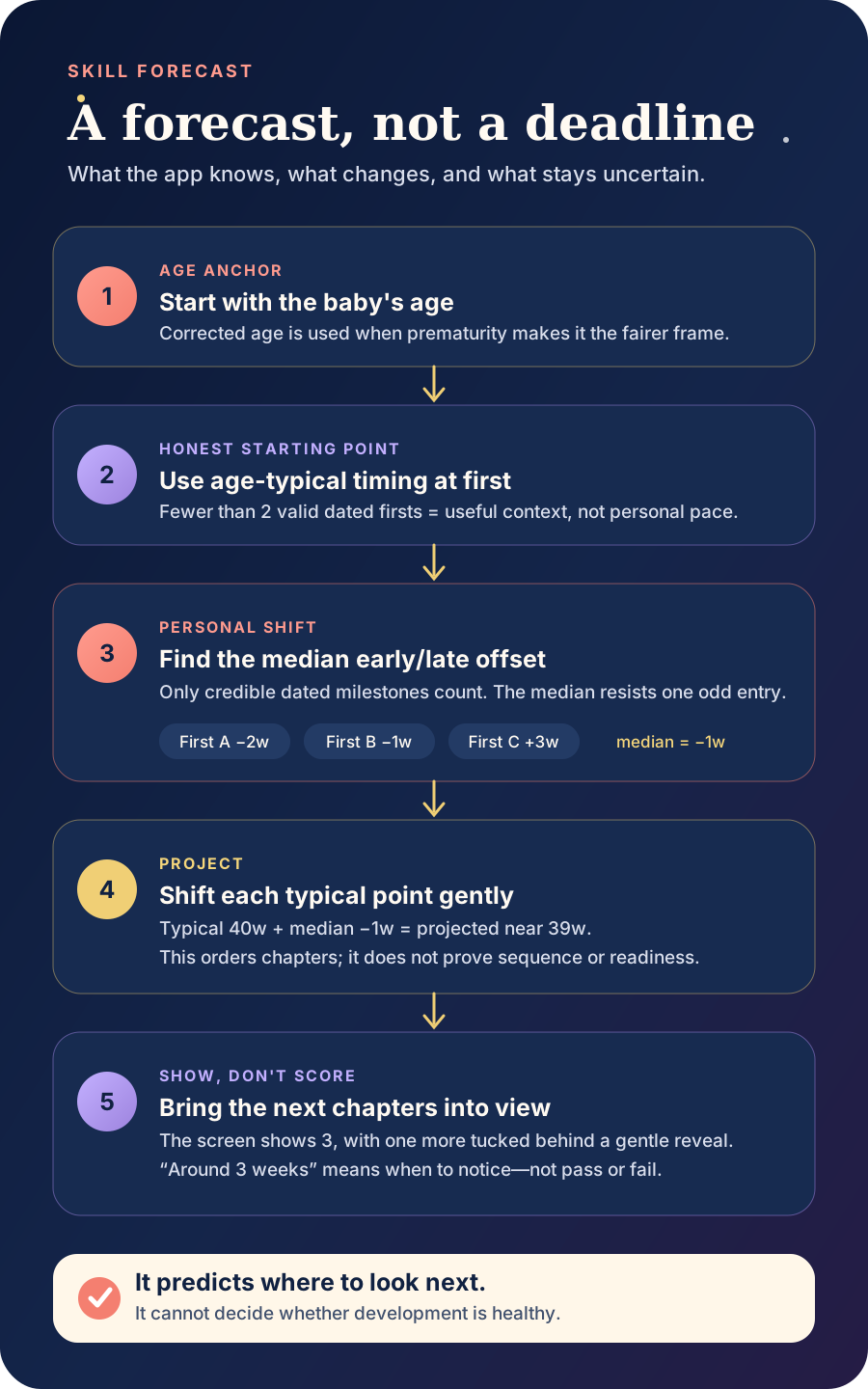
We inspected the current Skill Forecast for this guide. Its answer is gentler than a countdown: OBubba starts with age-typical milestone timing, uses corrected age when applicable and—only after at least two credible dated firsts—shifts the next few chapters by the median pace in the child’s own record.
It is a deterministic estimate from the information you logged. It is not an AI diagnosis, a developmental score or a promise that one skill will arrive before another.
The short answer
“Around 3 weeks away” means:
> Based on the age information and milestone dates currently saved, this skill has one of the nearest projected typical points.
It does not mean:
- the skill is due in exactly 21 days
- this is the skill your baby must learn next
- the app has observed the quality of your baby’s movement, hearing or communication
- a later date means delay
- an earlier date means advanced development
The number is a way to focus curiosity. It should help a parent notice an emerging chapter, not watch the calendar.
What the real screen shows
The current screen is deliberately titled “What’s blooming next” and describes the results as the child’s “next little chapters.” Under the heading it says: “A forecast, not a deadline, [name] leads the way.”
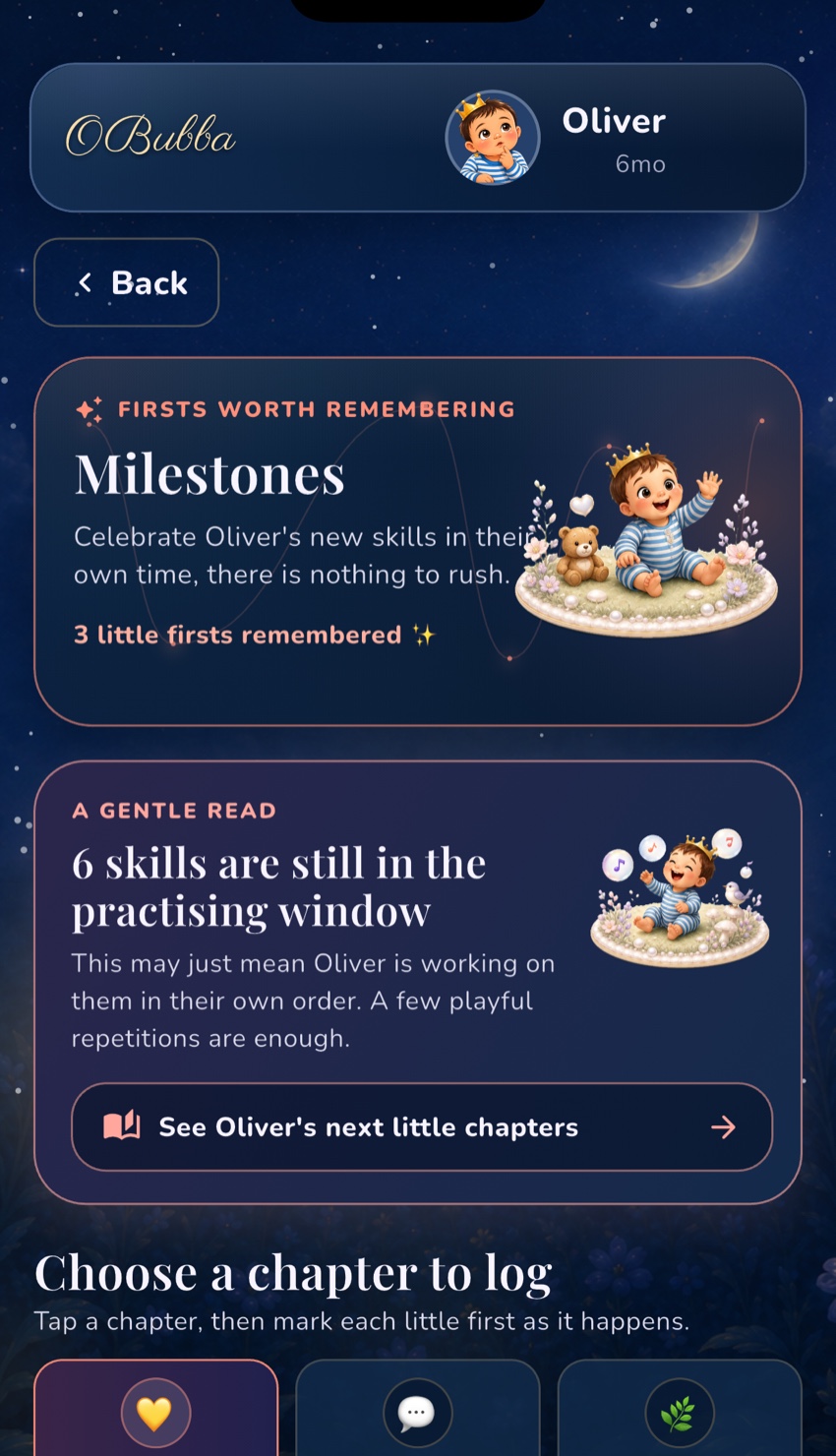
The forecast brings three chapters into the main journey. A fourth sits behind “One more chapter is coming into view.” Each chapter belongs to social and emotional development, language, movement or thinking. Timing reads as:
- Could be any time now when the projected point is now or has just passed
- Coming into view when it is about one week away
- Around N weeks away when it is further ahead
Those phrases are interface language, not probability bands. The engine does not claim a 70% or 90% chance, and the word around matters.
Step 1: the forecast needs a fair age anchor
If no birthday is saved, OBubba does not invent a stage. The screen asks the parent to add one.
For a term baby, milestone dates are read against age from the birth date. When a due date is available and the baby was born at least three weeks early, the current app can use corrected age while that correction remains relevant.
The age engine keeps the full correction through the earlier period, then tapers it gradually over the final six months before about 24 months. That avoids a premature baby’s developmental context jumping forwards overnight on one calendar boundary.
UK neonatal guidance commonly describes corrected age as the age a premature baby would be from their due date, and NHS services often use it when discussing development into the second year. A baby’s own neonatal or paediatric plan should always take priority over a general app rule.
Step 2: at first, the forecast is age-typical—not personal
OBubba can still show useful chapters when there are fewer than two credible dated milestones. In that state, it uses its age-typical reference points without a personal shift.
The screen says so plainly:
“Age-typical windows for now; each logged milestone makes this more personal.”
That is an important trust boundary. Selecting three completed skills without dates does not teach the forecast whether they arrived earlier or later. One dated first is still too fragile to define a child’s pace. Personalisation switches on only after at least two usable dated milestones.
Step 3: credible dates become early-or-late offsets
For every usable completed milestone, the engine compares:
age when logged as achieved − that milestone’s typical reference age
Imagine three dated firsts:
| Dated first | Relative to its typical point | |---|---:| | First A | 2 weeks earlier | | First B | 1 week earlier | | First C | 3 weeks later |
Ordered as −2, −1 and +3 weeks, the middle value is −1 week. That becomes the shared timing shift. A future milestone with a typical point at 40 weeks would therefore be projected near 39 weeks.
The app uses the median, not the average. In this example the average is zero, because the +3-week entry cancels the two earlier ones. The median better describes the middle of the small history and is harder for one unusual or misremembered date to pull around.
Why some milestone dates do not count
Parents often join an app months into the story and reconstruct firsts from memory. OBubba protects that catch-up logging from creating a misleading pace.
The current engine ignores a date when it is:
- more than six weeks before the earliest point in that milestone’s internal window, suggesting a typo, or
- so far from the typical point that it sits beyond the width of that milestone’s own window, suggesting an unreliable retrospective date
That does not delete the milestone or tell a parent the memory is wrong. It simply stops a doubtful date steering every future estimate.
This is also why the number of milestones named on the forecast can be smaller than the number marked complete. The screen’s “shaped by N milestones” count refers to usable dated samples, not every tick in the record.
Step 4: the same pace shift is applied to upcoming chapters
The forecast excludes skills already marked complete, adds the learned median shift to each remaining milestone’s typical reference point and orders the nearest projected results.
If a projected point is more than four weeks in the past, the engine does not present it as “next.” An old unlogged skill may simply have been missed during catch-up logging; putting it at the top of the future journey would be confusing.
This ordering has two important limits:
- It is not a prerequisite graph. Being listed first does not mean one skill must happen before the next.
- It uses one shared pace shift across categories. It does not yet model a child who is early in movement and later in language as two separate trajectories.
That second limit is easy for a personalised app to overstate. OBubba knows the middle timing pattern across credible dated firsts. It does not know the full shape of the child’s development.
Why the forecast can move after one new log
A changing estimate is usually the expected result of changing evidence.
The newly achieved skill leaves the future list
Once you mark waving complete, the forecast looks for the next nearest uncompleted chapters. A different skill naturally moves into view.
The second credible date turns personalisation on
With one usable date, the screen remains age-typical. Add a second and the engine can calculate a median shift. Several upcoming estimates may move together.
A later date changes the median
As more credible dated firsts arrive, the middle of the history can move earlier or later. The forecast is recalculated from the record rather than frozen to its first guess.
Age keeps moving even when the projected age does not
The engine first estimates a corrected age at achievement, then subtracts the child’s current corrected age. A chapter projected near 39 weeks can change from “around 3 weeks away” to “coming into view” as time passes.
Corrected-age context can taper
For eligible premature babies, the age correction gradually reduces near the end of the app’s correction window. That can alter weeks-away wording without anything suddenly changing about the child.
What a forecast can help a parent do
The useful question is not, “How do I make this happen by the date?” It is, “What ordinary opportunities might be enjoyable if this interest is emerging?”
The screen looks for one genuine activity connected to the upcoming milestones. Its bridge is conservative: it deduplicates repeated activities and leaves a milestone without a suggestion when there is no honest match.
For an emerging reaching or object-exploration chapter, a useful invitation might be a few safe objects on the floor while an adult joins at the baby’s level. For an emerging communication chapter, it might be copying a sound and pausing. The baby can engage, change the game or stop.
No activity is homework. Rest, feeds, cuddles, repetition and unstructured play are part of development too.
Try OBubba free → — remember little firsts, see when the app has enough evidence to personalise the path and keep development beside sleep, feeds, growth and family context.
Skill Forecast and developmental surveillance are different systems
The forecast answers: what might be useful to notice next?
The milestone surveillance path answers a different question: is there a sufficiently supported pattern worth mentioning to a health visitor?
The current surveillance engine does not raise that suggestion for one missing skill. It looks for at least two genuinely past-window skills in the same category—and splits fine and gross movement into separate streams so one of each does not create a false cluster. It also requires enough completed and dated history, ignores old unlogged infant skills from a late-starting parent and suppresses an earlier skill when a later same-domain achievement already shows the child has moved beyond it.
For example, a child with first steps recorded should not be nagged to prove that crawling happened first.
These product safeguards reduce false alarms. They do not assess the child. Do not wait for an app flag if you are concerned.
When to speak to a health visitor or GP
The NHS offers regular health and development reviews, including a review around 9 to 12 months that looks at language and learning, diet, behaviour and safety. Parents can also contact a health visitor, GP or baby clinic between routine reviews.
Ask for advice whenever development worries you, rather than waiting for a forecast date or notification. Seek prompt professional advice for loss of a skill, unusual stiffness or floppiness, persistent one-sided movement or concerns about hearing, vision, feeding, interaction or movement.
The app’s silence is not reassurance, and a forecast moving later is not a diagnosis.
How to log milestones without turning the day into a test
Useful records are small and descriptive:
- mark the first you genuinely observed, not the day you think it “should” have happened
- use the approximate date if that is all you know; do not manufacture precision
- add a plain note such as “waved after Dad waved first” or “stood for two seconds holding the sofa”
- let connected caregivers record the same family story rather than coaching the baby for proof
- bring concrete observations to a review if something worries you
“Not walking yet” is useful. “Pulls to stand, cruises both ways and lowers to the floor, but has not taken an independent step” gives a health professional more context.
Frequently asked questions
Is OBubba using AI to predict my baby’s development?
The current Skill Forecast is a deterministic calculation over the saved age and credible dated milestones. It does not ask a language model to invent the next skill.
Why does the app say age-typical when I have logged milestones?
Personal timing requires at least two usable achievement dates. Completed skills without dates, or dates rejected by the credibility guards, do not define pace.
Does “around 3 weeks away” mean the milestone is due then?
No. It is the distance to a shifted typical reference point, rounded to whole weeks. Milestones emerge across broad windows and in different orders.
Why did my estimate move after I corrected a date?
That date may now enter or leave the usable sample, or change the sample’s median. Recalculation is preferable to preserving an estimate built from information you corrected.
Why are three skills shown instead of one exact prediction?
Several social, language, movement and thinking changes can be emerging together. Showing a small group is more honest than pretending development follows one single-file queue.
Can one late milestone make every forecast later?
It is less likely because the engine uses a median and screens extreme dates. With only two usable dates, however, both values influence the midpoint. The result remains a forecast, not an assessment.
Does an earlier forecast mean my baby is advanced?
No. It only means the middle of the credible dated history sits earlier than the app’s reference points. Development is uneven and cannot be reduced to one pace label.
Should I practise the forecast skill every day?
Offer ordinary, enjoyable opportunities if the baby is interested. Do not drill, position or pressure a baby to meet an app estimate.
The best forecast protects the child from the forecast
A milestone feature becomes harmful when it turns attention into surveillance and variation into failure.
OBubba’s current design makes a narrower promise: use a fair age anchor, say when the result is only age-typical, learn gently from credible dates, resist an outlier and show a few nearby chapters. Then keep reminding the parent that the baby leads.
The date can move. The order can surprise you. The forecast can be wrong.
The little first is still worth remembering.
Sources and further reading
- NHS: Your baby’s health and development reviews
- Bedfordshire Hospitals NHS Foundation Trust: Neurodevelopment and corrected age
- Healthier Together: When should I worry about my baby’s movements?
OBubba is a tracking, planning and education tool, not a medical device or developmental assessment. Skill Forecast estimates are based on saved age information and milestone dates. They do not diagnose delay, verify a skill or replace a health visitor, GP, neonatal team or other qualified professional.
Ready to try OBubba?
Use OBubba to track feeds, sleep, naps, nappies, growth, milestones and family handovers in one calm baby tracker app.