Your baby woke four times. Yesterday’s nap ended late. A tooth may be moving. Bedtime has drifted. There is already a sleep plan in progress—and the app has three other observations waiting.
Should you shorten the nap, move bedtime, reduce a feed, practise a new settling method or simply offer more comfort?
OBubba’s current app is designed not to hand a tired parent five simultaneous jobs. Inside Coach → Sleep Consultant, its pinned “Tonight, in one glance” card gives one system precedence, shows one action and keeps lower-priority observations on a quiet radar.
The short version is:
> Stabilise a disrupted week first. Otherwise protect an active plan. If there is no plan, use the strongest longer pattern. If there is no longer pattern, make one small response to last night. If nothing deserves action, change nothing.
That is product prioritisation, not medical certainty. The app can decide which of its own suggestions should speak first. It cannot decide why a baby is unwell, whether they are hungry or what a family must do.
Where the card lives
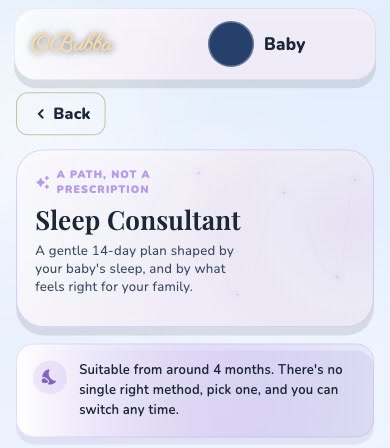
Open Coach → Sleep Consultant. The page introduces a gentle 14-day plan shaped by the child’s sleep and the family’s chosen approach. The one-thing card is pinned directly beneath that introduction whenever a child profile is available.
The card can look different depending on what wins. It might say:
- Tonight: ride it out, gently
- Night 4 · Earlier bedtime test
- Tonight, just one thing
- A touch overtired
- Nothing to change tonight
Those are not five cards shown together. They are five possible outcomes from one priority order.
Four systems enter; one answer leaves
OBubba has several deterministic sleep engines. The orchestrator does not average their advice. It checks them in a strict sequence and stops at the first action strong enough to lead.
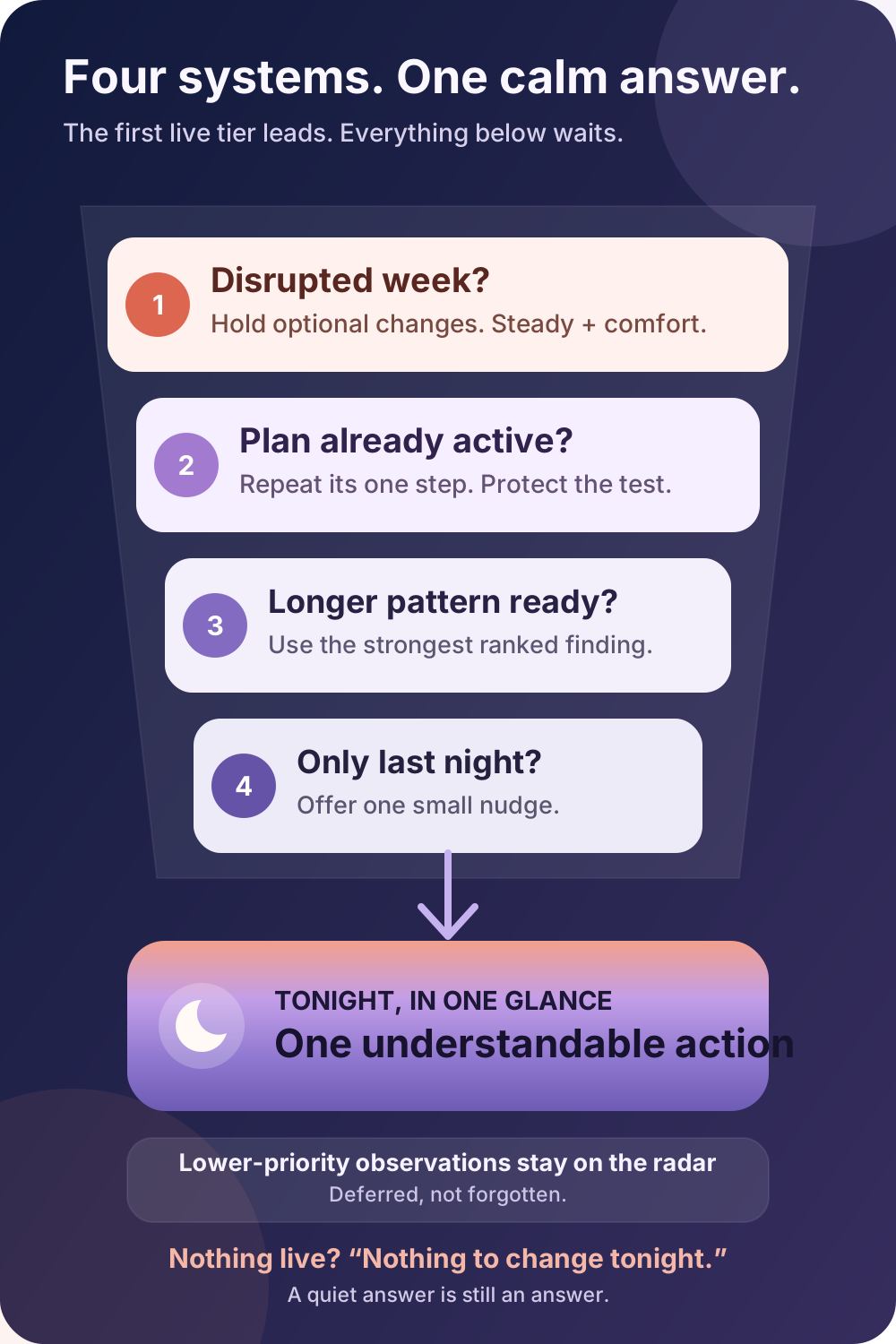
Priority 1: is this a disrupted week?
A stronger disruption outranks every optional sleep change. In the current app, that means the top disruption clue has crossed the same internal threshold that can hold a sleep plan. Examples include a sufficiently supported illness, developmental, teething or recently logged food context.
The lead becomes: keep bedtime familiar, offer extra comfort and do not start a new experiment tonight. Existing plan steps and other sleep findings move onto the radar.
Important: the score behind this decision is an OBubba product threshold, not a medical severity score. “Ride it out” means pause optional sleep work. It never means wait out concerning symptoms or avoid health advice.
The NHS notes that teething, illnesses and growth spurts can affect baby sleep, and that sleep patterns change as babies grow. Its guidance also recommends speaking to a health visitor when sleep problems or routines need more support.
Priority 2: is a plan already active?
If no stronger disruption is leading, OBubba protects the current sleep-plan or experiment step.
Suppose the family is on Night 4 · Earlier bedtime test and the action is to begin bedtime 20 minutes earlier. The app will not also promote a nap cap and a different settling response merely because those observations exist. It repeats the active step and can show how that experiment is progressing.
This preserves interpretability: if three variables change together, a parent cannot tell which one helped, which one made no difference or which one was simply followed inconsistently.
Consistency does not mean rigidity. The NHS says every child is different and parents should use what feels suitable for their child; it also describes a calm, predictable bedtime routine as a useful starting point. NHS: sleep and young children.
Priority 3: what is the strongest longer pattern?
With no disruption and no active plan, the app can use the highest-ranked unresolved finding from its Sleep Consultation.
That consultation is not created from one morning. The implementation:
- looks back across up to 14 complete past days;
- skips today in the live view because a partial day can distort naps and feeds;
- includes a day only when it contains at least two entries;
- requires at least five usable day profiles before producing a consultation; and
- ranks findings such as day sleep, bedtime variation, wake-time variation, nap consistency, nap recovery, night feeds and the final wake window.
The top finding supplies the one action. Lower-ranked findings are not erased; they are deferred until the first lever has had a fair chance.
Five usable profiles are a minimum for the app’s rule—not proof that the conclusion is correct. A family logging only naps, forgetting difficult nights or changing childcare arrangements may still create an incomplete picture.
Priority 4: did last night show one actionable pattern?
If there is no stronger week-level finding, OBubba can use the previous night’s reconstructed bedtime and sleep record.
Only selected actionable reads enter this final tier, such as a possible timing mismatch, false start, split night, hunger pattern, early waking or fragmented night. The wording is intentionally smaller: one small adjustment, nothing drastic.
A single night cannot prove a schedule problem. This tier is best treated as a low-cost suggestion to observe, not a reason to rebuild the day.
For very young babies, feeding and development come first. The NHS explains that newborns wake repeatedly and need to feed little and often; their sleep will not resemble an older baby’s schedule. NHS guidance on newborn and baby sleep should take precedence over an optimisation mindset.
Priority 5: nothing deserves a change
When none of the four systems has a suitable lead, the card says:
> Nothing to change tonight
That is a real answer. It prevents the app from manufacturing work to prove its value.
The all-clear is only about the patterns OBubba can read. It does not confirm that the baby is healthy, safe or comfortable. A parent’s direct observation still outranks an empty software finding.
What “Also on OBubba’s radar” means
Deferred items appear as small labels beneath the lead card. They answer a useful question: did the app forget the other problem?
No. The radar means the observation remains visible to the system but is not tonight’s job.
For example:
| Lead tonight | What may stay on the radar | |---|---| | Disrupted week | current plan, longer consultation finding, last-night note | | Active plan step | consultation finding, last-night note | | Strongest consultation finding | last-night note | | Last-night nudge | nothing lower remains |
The radar is not a queue that must eventually become four interventions. A lower-priority finding may disappear when the lead issue settles. That is one reason to reassess rather than automatically working down a checklist.
A worked example: teething context during an earlier-bedtime test
Imagine an active test asks the family to move bedtime 20 minutes earlier. Two nights later, a recent tooth record and a qualifying run of disrupted sleep become the strongest context.
The disruption tier moves above the plan. OBubba’s lead changes to a steady bedtime and extra comfort; the earlier-bedtime experiment becomes a deferred label.
This does not prove teething caused the wakes. The useful decision is simply that an optional experiment is harder to judge during an unsettled period.
If the baby has a fever or seems unwell, check the baby rather than the app theory. NHS guidance describes only a mild temperature below 38°C as a possible teething symptom. A temperature of 38°C or higher is a fever and needs its own assessment.
A worked example: no plan, but bedtime varies widely
Suppose the consultation has at least five usable complete days and bedtime varies enough to become the strongest ranked finding. There is no active disruption and no plan already running.
The one-thing card can lead with the consultation’s bedtime action. The app may still have a note about last night being slightly overtired, but that stays on the radar because the longer pattern ranks above one night.
The family can then keep other inputs reasonably steady and see whether the change fits real life. If childcare, work or feeding makes the suggested timing unrealistic, the parent can decline it. A mathematically tidy bedtime is not automatically the right family bedtime.
How OBubba knows when to move on
When a plan is active, the app reruns the consultation against fresh data. It can celebrate that the original top category has dropped out and move the focus to the next issue—or say everything it had flagged is settled.
The current guardrails require:
- at least three whole days since the plan started;
- at least five usable current profiles; and
- the exact category that led when the plan began to be absent from the new findings.
Stopping logging does not count as improvement. The category shown at activation is stored so editing an old log cannot silently rewrite what the app originally asked the family to work on.
That is a stronger feedback loop than counting calendar nights alone, but it still measures the app’s finding—not a clinical outcome or a guarantee of better family wellbeing.
A better one-change experiment
You can use the same principle without obeying every suggestion:
- Name the problem in observable terms. “Three wakes before midnight” is clearer than “terrible sleep.”
- Choose one reversible change. Move bedtime modestly, protect one nap or repeat one settling response.
- Keep safety and feeding responsive. Never withhold a needed feed, comfort or medical care to protect an experiment.
- Hold the other variables loosely steady. Perfect laboratory conditions are impossible; aim for recognisable, not rigid.
- Review complete days, not the 3am feeling. Look for direction across several comparable nights.
- Stop when the cost is wrong. If the baby or parent is becoming more distressed, the experiment is not owed more time.
The value of one thing is not that one lever always solves sleep. It is that the family can understand what they actually tried.
When the app should not lead
Skip sleep optimisation and respond to the baby in front of you when:
- the baby seems unwell, unusually difficult to wake or is breathing differently;
- feeding has fallen, wet nappies have reduced or there are strong hunger cues;
- pain, vomiting, diarrhoea, rash or fever is present;
- the baby is in the early newborn period and needs frequent responsive care;
- the suggested action conflicts with advice from the baby’s clinician; or
- a parent’s instinct says something is wrong.
The NHS emphasises that parents know their baby best and should trust their instincts when appearance or behaviour is worrying. NHS tips for new parents.
Safer-sleep practice also stays unchanged regardless of the lead card: place baby on their back in a clear, separate, firm and flat sleep space, and keep them in the same room as a parent for at least the first six months.
Quick answers
Does OBubba use AI to choose the one thing?
The priority described here is deterministic logic. It checks fixed tiers in a fixed order. The card can be traced back to the disruption, active-plan, consultation or last-night engine that supplied it.
Why is my sleep-plan step not leading tonight?
A stronger supported disruption may have temporarily outranked it. The plan should remain on the radar rather than being silently discarded.
Why is last night’s advice being ignored?
It may be deferred behind an active plan or a stronger multi-day consultation finding. Last night is the lowest action tier because one night is noisy.
How much logging unlocks the longer consultation?
At least five usable day profiles. The app looks across up to 14 complete past days and skips thin days with fewer than two entries.
Does “nothing to change” mean my baby is fine?
No. It means none of the app’s current sleep systems produced a suitable action. It is not a health assessment.
Do I have to follow the one thing?
No. The card is a decision aid. Family values, feeding needs, clinician advice and the actual baby always come first.
Try OBubba free → — turn sleep logs into one understandable focus, keep the other observations visible, and let “nothing to change” be a valid answer.
This article gives general information for UK families and describes the current OBubba implementation reviewed on 3 March 2027. OBubba does not diagnose illness or the cause of sleep disruption, assess a baby in person or replace individual advice from a health visitor, GP or paediatric professional.
Ready to try OBubba?
Use OBubba to track feeds, sleep, naps, nappies, growth, milestones and family handovers in one calm baby tracker app.