Open OBubba’s Care tab and you may notice two story-shaped things.
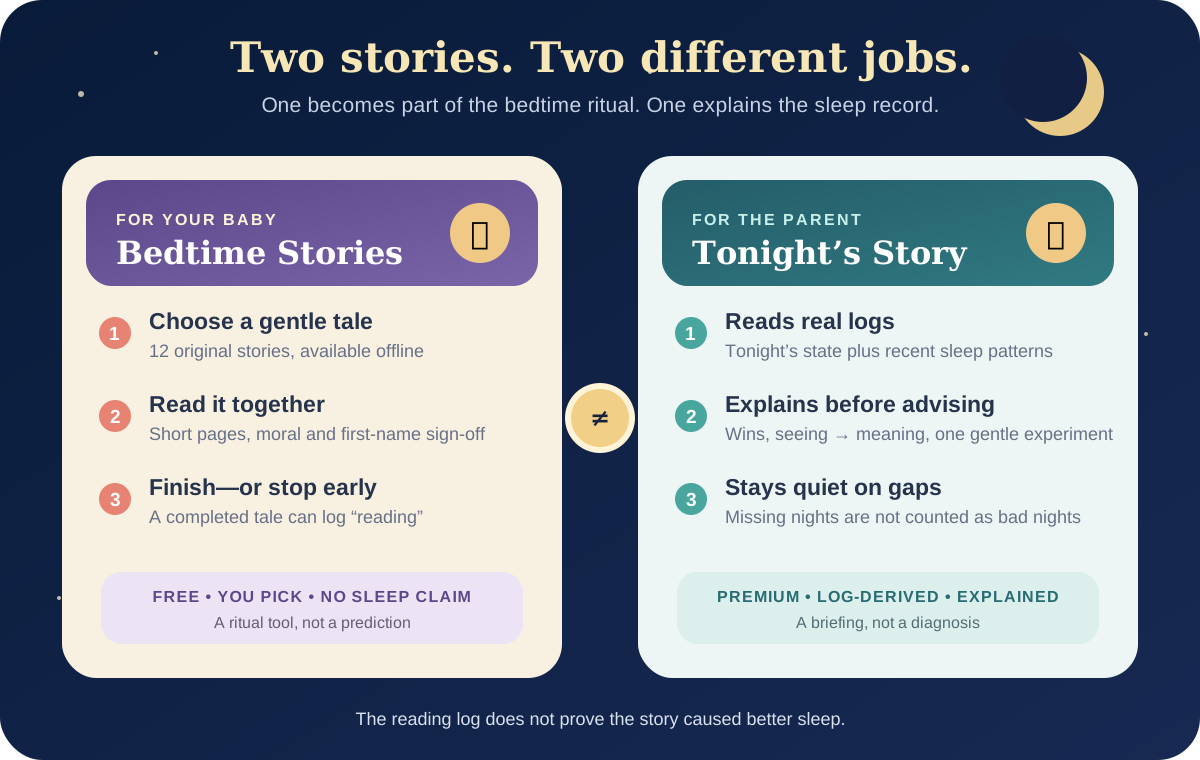
One is Bedtime Stories: a shelf of gentle animal tales to read aloud to your baby. The other is Tonight’s Story: an evening read for the grown-up, built from the sleep and nap record already in the app.
They sound similar. They do completely different jobs.
Bedtime Stories helps you create a calm, repeatable moment before sleep. Tonight’s Story helps you understand what the recorded week may mean for tonight. One is content you choose. The other is an explained summary that must earn its confidence from real logs.
Neither promises that a story will make a baby sleep through. That boundary is exactly what makes the pair useful. The useful bedtime technology is the part that gets out of the way: one calm read for the baby, one clear explanation for the parent, then the phone can rest.
The difference at a glance
| | Bedtime Stories | Tonight’s Story | |---|---|---| | Who it is for | Baby and caregiver together | The parent making sense of sleep | | What it contains | 12 original, short animal tales | Tonight’s guidance, weekly wins, observations and gentle experiments | | Where it comes from | A fixed offline library inside the app | A deterministic read of the baby’s actual logs and active plan | | Personalisation | Baby’s first name in the dedication and sign-off | Baby’s name, current bedtime state and recorded patterns | | Data needed | None | At least 2 days of logs; stronger night language needs enough recorded nights | | Access in the reviewed build | Free | Premium; its Care-page preview remains visible | | What it cannot prove | That reading caused better sleep | Why a baby woke or that a suggestion will work |
Story one: the little offline library
Open Care → Bedtime Stories and the current app shows a physical-looking bookshelf rather than an endless feed. There are 12 original tales, each organised around a value such as kindness, sharing, honesty, patience, courage, gratitude or empathy.
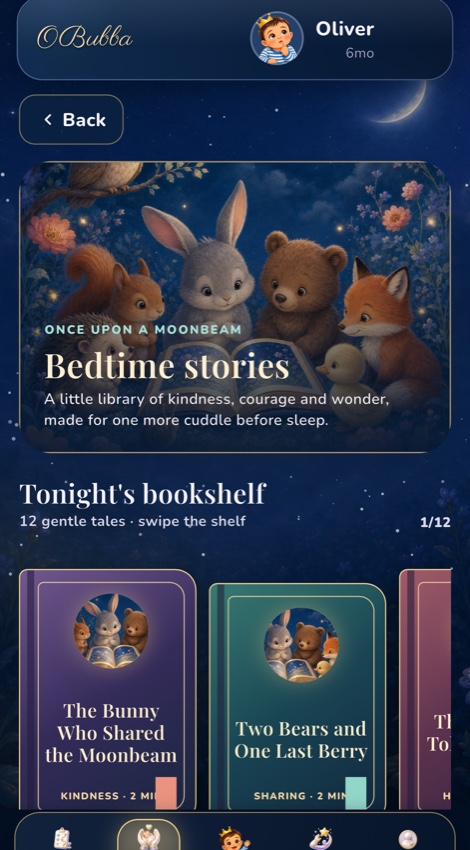
The stories live in the app. They do not require a network request to generate a new plot, and they do not inspect feeding, sleep or mood data before deciding what your baby should hear. You choose the story yourself.
Each book shows its theme and an estimated reading time. The estimate uses a deliberately unhurried read-aloud pace, so the current tales land at roughly two minutes. Inside the reader, one paragraph appears per page, followed by the moral and a first-name goodnight line.
That light personalisation is intentionally small. OBubba inserts the baby’s first name into the dedication and closing; it does not rewrite the whole tale around private family data. If the profile name is blank, the wording falls back gracefully instead of leaving an empty sentence or code token on screen.
What happens when you finish one
On the final page, Finish story adds a `reading` entry with the time and story title to the baby timeline. It only happens when you tap the button. Opening a book, swiping through a few pages or stopping because your baby has had enough does not silently mark it complete.
If a tale finishes after midnight or in the early hours, OBubba assigns it to the previous bedtime day rather than making a 12:10am story look like a morning activity. That follows the app’s broader 11am night boundary.
The log is a memory of the ritual—not evidence of an effect. In the reviewed engine, the reading event does not make Tonight’s Story declare that books improved sleep. It does not award a better sleep score or manufacture a correlation from one good night.
That restraint matters. Parents deserve to remember “we read the bunny story” without being told that the bunny fixed a developmental night wake.
Story two: the evening sleep briefing
Tonight’s Story is not a children’s story and does not generate fiction. It is the premium evening report reached from the featured banner in Care.
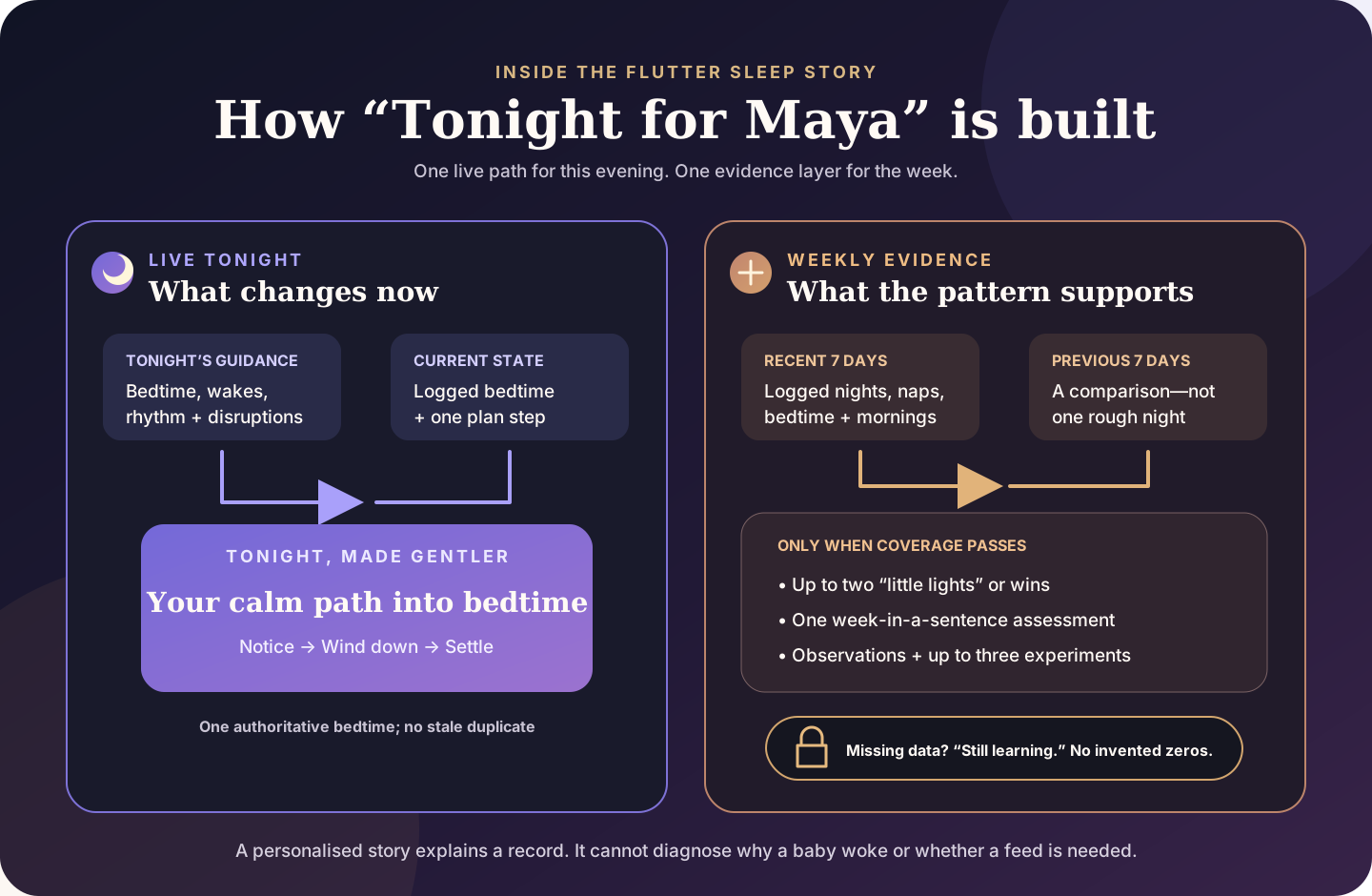
The current engine builds it deterministically from two layers:
- What is true tonight: live guidance such as the resolved bedtime, first-wake context or a relevant teething, allergen, milestone or recovery note, plus the active sleep-plan step when one exists.
- What the recent record supports: the current 7 days, with the previous 7 available for careful comparisons such as a genuine reduction in night wakes.
The screen turns that into a calm path: Notice → Wind down → Settle. Below it are up to two little wins, a one-sentence assessment, “seeing → meaning” cards and up to three gentle experiments.
It has to know when it does not know
With fewer than two logged days, the story does not fill the space with generic confidence. It says it is still learning and asks for bedtime and morning-wake anchors.
Two days are enough to open a basic story, but not enough to speak confidently about nights. The overnight assessment waits for at least two nights containing a bedtime or night entry. An empty night is not counted as zero wakes.
The same principle protects the more complex parts:
- a day with no nap entries is not treated as zero day sleep;
- a bedtime without a measurable morning end is not turned into a short night;
- a current, partially logged day is excluded from the completed-day sleep-debt series;
- moment-style bedtime logs are not mistaken for zero overnight sleep;
- babies under 16 weeks do not receive the older-baby “running sleep deficit” framing; and
- if tonight’s bedtime has already been logged, the card leads with the real “Down at…” moment instead of repeating a stale target time.
The app can still be wrong because a log can be incomplete or inaccurate. The difference is that its rules are designed not to convert obvious absence into a dramatic conclusion.
Which one should you open first?
If bedtime is approaching and you use Premium, read Tonight’s Story before the wind-down begins. Take one useful thought—perhaps protect the last wake window or keep the first wake low-key—then leave the analysis there.
During the routine, open Bedtime Stories only if a story helps your family settle into the sequence. Choose one tale, read slowly and stop when your baby loses interest. A wriggly six-month-old who chews the corner of a board book is not failing story time.
The NHS includes reading among the activities that can form a simple, soothing baby bedtime routine, alongside dimmed lights, a cuddle and a lullaby. It also emphasises that babies’ sleep patterns vary. A routine is a familiar pathway towards sleep, not a contract for a wake-free night. NHS: helping your baby to sleep
The NHS also says that babies can enjoy hearing a caregiver read before they can speak, and that sharing books supports bonding, emotional wellbeing and early language experience. Ten minutes is useful; two calm minutes still count. NHS: baby and toddler play ideas
But isn’t an app story still screen time?
Yes. It is still on a phone.
OBubba’s story reader uses page-by-page text rather than animation, video, sound effects or tap-to-win rewards, but that does not turn the screen into paper. If the light distracts your baby, lower the brightness, use the app’s night presentation, angle the screen towards the adult and make your voice and face the interesting part.
For older children, NHS guidance advises avoiding phones and tablets in the 30 to 60 minutes before bed because screen light can interfere with sleep. A paper book is the simplest answer when it works for your family. NHS: sleep and young children
The built-in library is useful when the usual book is downstairs, you are travelling, another caregiver needs a familiar tale or your hands are already full. It is not a claim that a phone is better than a book.
A four-minute way to use both without extending bedtime
Try this sequence:
- Parent reads first. Before bringing the baby into the final wind-down, scan Tonight’s Story and choose no more than one action.
- Analysis ends. Put the sleep chart away. Do not keep checking predictions through bath, feed and cuddle.
- Baby gets the simple story. Pick a familiar two-minute tale. Repeating one is allowed; novelty is not required for a sleep cue.
- Finish or stop. Tap Finish story if you reach the end. If the baby turns away, close it without turning completion into a task.
- Phone rests. Continue with your normal cuddle, song and safe sleep setup.
On a hard night, skip both. Feed, comfort and settle the baby you have in front of you. The app is there to reduce decisions, not demand a perfect sequence.
Why the separation makes OBubba more trustworthy
Many products blur content, tracking and advice until every tap appears to “teach the algorithm.” OBubba’s two story systems are cleaner than that.
The child’s story is selected by the parent and works without baby data. The parent’s story is selected by evidence and becomes less specific when baby data is missing. A reading completion can sit in the family timeline without being promoted to a causal sleep insight.
That makes the experience feel less magical in the marketing sense—and more useful at 7pm:
- the baby gets a warm voice and a familiar ending;
- the parent gets a short explanation rather than another dashboard;
- the app does not confuse a lovely ritual with a treatment; and
- nobody has to generate, optimise or score the cuddle.
Try OBubba free → — the 12-story offline library and core tracking are available without Premium; Tonight’s Story is part of the deeper personalised sleep experience.
Quick answers
Are OBubba’s Bedtime Stories free?
Yes in the reviewed build. Care opens Bedtime Stories directly. Tonight’s Story uses the Premium gate.
Are the stories generated by AI from my baby’s data?
No. The 12 children’s tales are fixed, original content stored in the app. The baby’s first name can appear in the dedication and sign-off, but sleep logs do not rewrite the plot.
Does reading a story improve OBubba’s sleep prediction?
Not directly. Finishing can add a reading event to the timeline, but the reviewed Tonight’s Story engine does not treat it as proof that reading improved sleep.
How much logging does Tonight’s Story need?
It needs at least two logged days to move beyond the “still learning” state. Its overnight assessment needs at least two recorded nights, and individual insights apply additional completeness checks.
Will it show two different bedtimes?
The current engine explicitly removes the bedtime line from the observation cards after using it in the headline. If bedtime is already logged, the real down time leads instead of a stale target.
Is Tonight’s Story medical sleep advice?
No. It is an explained consumer-app summary of recorded patterns. It cannot diagnose a sleep disorder, assess illness or replace advice from a health visitor, GP or paediatric clinician.
Product verification
- Current surfaces reviewed: the offline story content model, bookshelf, page reader, completion log, Care routing and Premium gate, Tonight’s Story screen, sleep-story engine and live evening-guidance handoff.
- 47 focused tests passed on 15 May 2027, covering story integrity and personalisation, after-midnight filing, sparse-data handling, missing-night guards, newborn sleep-debt suppression, one-bedtime consistency, live guidance and compact Care rendering.
- The app image above is a genuine repository capture using a fictional baby profile. No production family data appears in it.
This article describes the reviewed build. OBubba supports routines, tracking and parent education; it does not guarantee sleep, diagnose sleep or feeding problems, or replace personalised clinical advice.
Ready to try OBubba?
Use OBubba to track feeds, sleep, naps, nappies, growth, milestones and family handovers in one calm baby tracker app.