Three wakes can sound like a bad night.
But imagine the first lasted five minutes, the second six and the third four. There was no feed, and each ended almost as soon as it began. That is a very different night from one 75-minute wake, even though a simple counter makes the first night look “worse”.
When those brief wakes are logged precisely, OBubba may say:
> Brief cycle-linked stirs
This is one of the rare sleep insights whose recommendation is nothing to change. The current app is not rewarding a perfect sleeper. It is recognising a specific shape in the parent’s records: several short interruptions, all timed, all 10 minutes or less and none paired with a night feed.
The distinction matters because tired parents do not need every wake converted into a new technique. Sometimes the most useful intelligence is permission not to fix what may be ordinary between-cycle stirring.
The exact rule
OBubba uses this label only when every gate below passes:
| Gate | Current requirement | |---|---| | Age | Baby is at least 16 weeks | | Number of wakes | 2 or more night wakes | | Duration completeness | Every wake has an explicitly logged duration | | Duration range | Every duration is 1–10 minutes, inclusive | | Night feeds | 0 night feeds | | Active disruption | If illness, teething or a developmental leap is supplied to the classifier, that context takes priority | | Result | Brief cycle-linked stirs and “nothing to change” |
There is no seven-night trend requirement. This is a reading of one reconstructed night, not a claim that a long-term pattern has formed.
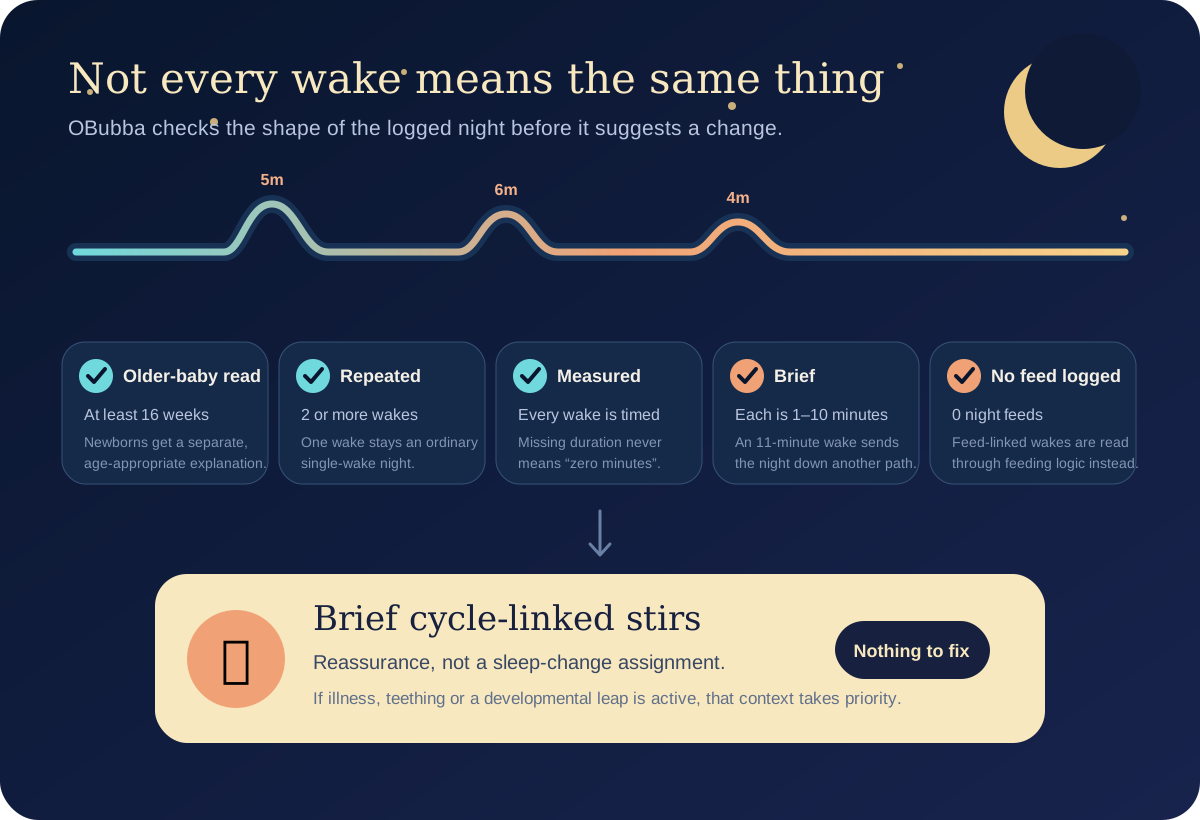
Wake count tells you how often; duration tells you what kind of night it was
A basic tracker can report “three wakes”. OBubba keeps the awake interval attached to each wake, because the intervals change the interpretation.
Consider three nights:
| Logged night | Wake count | Time awake | What the shape suggests to OBubba | |---|---:|---:|---| | 11:30pm for 5m, 1:30am for 6m, 3:30am for 4m | 3 | 15m total | All short and self-contained: cycle-linked reassurance can qualify | | 11:30pm for 5m, 1:30am for 11m, 3:30am for 4m | 3 | 20m total | One wake exceeds the brief-wake boundary: no cycle-linked label | | 1:30am for 75m | 1 | 75m total | A sustained middle-of-night interval: assessed through split-night logic |
The difference between the first two examples is one minute. That does not mean a 10-minute wake is biologically safe and an 11-minute wake is a problem. It means the app needs a deterministic boundary before it can attach a confident reassuring label.
The boundary is a product rule, not a medical threshold.
“Cycle-linked” is a pattern name, not something the phone observed
The app does not listen to the baby, analyse movement or know which sleep stage occurred. It cannot confirm that a particular wake happened at the exact boundary between two sleep cycles.
It knows only what the family logged:
- when the wake began;
- when the baby resettled, or the exact minutes entered;
- whether a feed was part of that wake;
- any reason or settling details recorded elsewhere; and
- the surrounding bedtime and morning records used to reconstruct the night.
“Cycle-linked” is therefore OBubba’s plain-language interpretation of a brief, repeated, non-feed wake shape. It is not a physiological measurement or a diagnosis.
The underlying reassurance is consistent with NHS information: Newcastle Hospitals notes that babies wake at the end of sleep cycles and that brief waking during the night is normal for infants and children (Newcastle Hospitals: Sleep, infants 0–12 months). The NHS also emphasises that babies have individual waking and sleeping patterns and that those patterns change as they grow (NHS: Helping your baby to sleep).
That supports the general reframe. It does not prove the cause of any one logged wake.
Missing duration does not mean zero minutes
This is one of the best conservative choices in the implementation.
Inside the night summary, an untimed wake carries a zero as an internal sentinel. The classifier explicitly refuses to interpret that zero as a zero-minute wake. For the reassuring branch to fire:
- the number of recorded durations must equal the number of wakes; and
- every duration must be greater than zero and no more than 10.
So this night cannot earn the label:
> 11:30pm wake — 5 minutes > 1:30am wake — duration missing > 3:30am wake — 4 minutes
The app does not fill in the missing middle with an assumption. With three wakes and no more than one feed, that example can fall through to the more cautious Frequent comfort wakes read instead.
That fallback may feel less flattering, but it is epistemically cleaner: OBubba cannot call every wake brief when one was never timed.
How the parent records the evidence
The night-wake sheet offers two ways to capture duration:
- enter Woke at and Resettled at, allowing the app to calculate the interval; or
- type the exact minutes awake directly.
Quick-fill buttons include 10, 20, 30, 45, 60 and 90 minutes, but the field accepts an exact value. A six-minute resettle can remain six minutes rather than being forced into a bucket.
If the baby is still awake, the wake can remain open while settling continues. OBubba does not treat that open state as a completed 12-hour wake, and it does not let it qualify as a short stir. Once sleep resumes, the final interval can be stored.
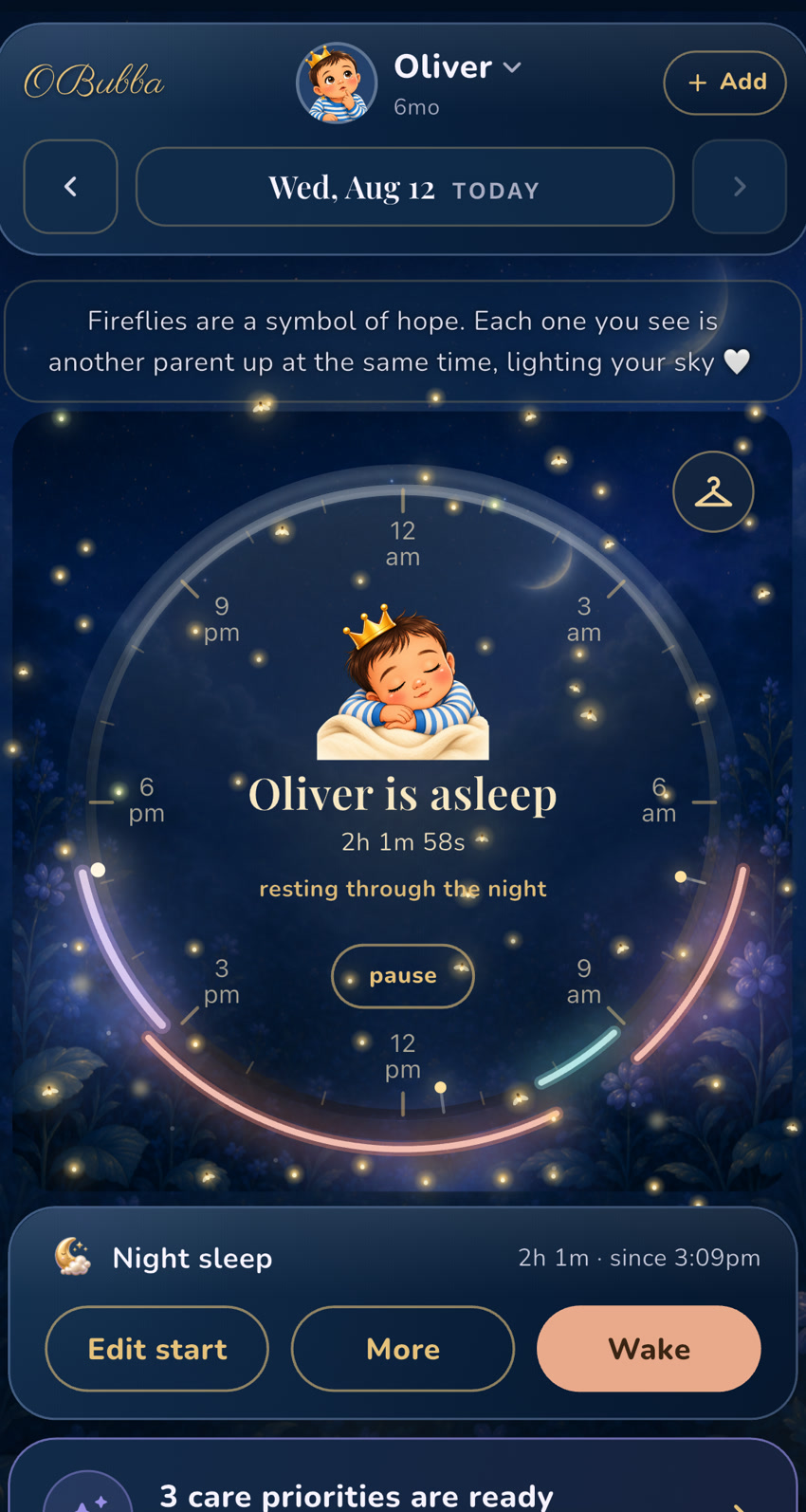
You do not need to time every murmur. Log the events that genuinely interrupted the night or that you want help understanding. Precision is useful when you want OBubba to distinguish several quick resettles from a sustained waking.
Why a feed changes the route
The cycle-linked branch requires no night feeds.
This is not a judgment that feeding is bad or that a fed wake cannot be brief. It prevents the app from ignoring a stronger logged signal. When feeds dominate the wakes, assesses feed-driven waking, tagged hunger and—where bottle volumes are available—the difference between substantial and consistently small feeds.
A standalone night feed can also count as a waking, because the baby had to wake to feed. Dream feeds, pumps, solids and companion feed records already attached to the same wake are handled separately so they do not inflate the count.
Most importantly, parents should not withhold a feed just to preserve this label. NHS responsive-feeding guidance says to follow a baby’s hunger cues, and notes that babies are likely to need night feeds for at least the first few months (NHS: Feeding on demand). If a baby seems hungry, feed responsively or follow the feeding plan given by the baby’s clinician.
Why newborns do not get this interpretation
The entire older-baby night classifier is held behind a 16-week age gate.
For a baby younger than that, repeated waking is read as Normal newborn sleep rather than a habit, a split night or cycle-linking progress. The copy says newborns wake often for feeds and comfort and should be fed on cue; it does not prescribe sleep training.
This gate stops a neat-looking duration pattern from overpowering developmental context. The NHS says newborns wake repeatedly during the first months, often for feeding, and that babies vary greatly in how long they sleep (NHS: Helping your baby to sleep).
The app’s 16-week boundary remains an implementation decision, not a birthday on which sleep biology suddenly changes.
Illness, teething and a developmental leap can take priority
When those disruption flags are actually supplied to `diagnoseNight`, does not return the bare “nothing to change” message. It uses a caveat such as A rough night, likely illness, not a habit, encourages extra comfort and says to keep the routine steady.
That ordering protects against an overly mechanical conclusion. Three five-minute wakes during an illness may still be brief, but the family’s active context matters more than celebrating cycle linking.
There is an implementation nuance: not every screen currently passes every disruption flag into the classifier. The central function supports illness, teething and developmental-leap context, but callers that provide only age, day sleep and wake-window data will not activate that override. Parents should use what they know about their baby rather than treating one card as the whole clinical picture.
If a baby seems unwell, is difficult to wake, has breathing difficulty, is feeding much less than usual or the parent is worried, seek appropriate medical advice. A sleep-pattern label cannot assess illness.
What OBubba does after the label
The diagnosis is used in more than one place.
In the Care sleep review, it contributes to:
- What happened — bedtime, morning, wake count, feeds and longest stretch;
- Why it may be happening — the diagnosis title and explanation; and
- What helps next — for this cause, “nothing to change”.
In the Track guidance panel, the same night analysis appears in the debrief and influences Today’s focus. For cycle-linked stirs, the focus is to keep the routine steady rather than move bedtime, cut naps or start an experiment.
That restraint is the product value. The same engine can suggest a 15-minute timing adjustment for a specific overtired or undertired pattern, but it does not manufacture a lever here merely because the parent opened the app.
What would prevent the label
Several stronger or incompatible reads are checked before cycle-linked reassurance:
- a morning before 6:00am can be read as an early finish;
- a wake within about 45 minutes of bedtime can be a false start;
- two hard wakes of at least 15 minutes between 3:00am and 5:00am can trigger an overtired early-hours read;
- a middle-of-night wake lasting at least 60 minutes can be a split night;
- repeated hunger tags can take precedence; and
- an illness, teething or leap flag can replace the label with a disruption caveat.
The branch ordering is why a mixed night is not reduced to “most of the wakes were short”. One long or specifically explained wake can change the useful story.
A note on the wording: 10 minutes counts
The current detail says each wake was “under 10 minutes”, while the executable test is `duration <= 10`.
That means a wake logged as exactly 10 minutes does qualify. The most accurate translation is “10 minutes or less”, which is why this article uses that wording.
This tiny mismatch is a good example of why feature explanations should be based on the running logic as well as the visible sentence. Parents deserve the real boundary, not an approximation copied from a card.
What “nothing to change” does—and does not—mean
It means the logged shape does not, by itself, justify a schedule adjustment.
It does not mean:
- the parent was not disturbed;
- every sound should be ignored;
- the baby never needed reassurance;
- a feed should be delayed;
- the sleep space is automatically safe; or
- future longer wakes should be treated the same way.
Respond to the baby in the way that fits their age, cues, health and the family’s approach. Keep night interactions calm and low-light when practical. If the baby is only stirring in light sleep, the NHS notes they may make brief fussy sounds and may fall back asleep, so it can help to pause long enough to see their state before fully waking them—while still responding when they need you (NHS: Understanding your baby).
Safer sleep rules do not change because a wake is short. The Lullaby Trust advises placing a baby on their back in their own clear, flat, firm sleep space and sharing the room for at least the first six months (The Lullaby Trust: Safer sleep for babies).
The honest translation
The most precise version of the card is:
> For a baby at least 16 weeks old, this reconstructed night contains two or more wakes. Every wake has an explicitly recorded duration from one to 10 minutes, none includes a night feed, and no supplied disruption context has taken priority. That looks more like several quick resettles than one sustained sleep problem, so OBubba is not suggesting a change from this night alone.
That is more useful than celebrating a low number and kinder than pathologising a high one.
OBubba connects exact night-wake intervals with bedtime, morning, feeds, naps, age and family context so three tiny ripples do not look like three identical problems. Explore OBubba when you want a baby tracker that knows when to guide—and when to let a reassuring night simply be reassuring.
Ready to try OBubba?
Use OBubba to track feeds, sleep, naps, nappies, growth, milestones and family handovers in one calm baby tracker app.