You log milk feeds and completed naps for a few weeks. Then OBubba says:
“The feed-to-nap gap that helps Leo nap longest.”
The card may compare naps averaging 1 hour 10 minutes when a feed was logged 30–60 minutes beforehand with 32-minute naps when the feed sat within 15 minutes of sleep.
Has the app proved that feeding close to sleep caused the short naps? Is 45 minutes now the “right” gap for every nap? Should a hungry baby wait so the chart stays tidy?
No.
We traced the current detector, its 21-day caller, feed and nap data model, baseline-day filter and automated tests. It is a useful personalised comparison with sensible silence thresholds—but the card currently sounds more certain than the calculation allows.
The honest translation is:
> “Across the eligible logs available on this device, naps paired with one broad feed-timing band have run longer on average than naps in another band. If it fits your baby’s cues, you could test that spacing on one nap without withholding a feed.”
The short answer
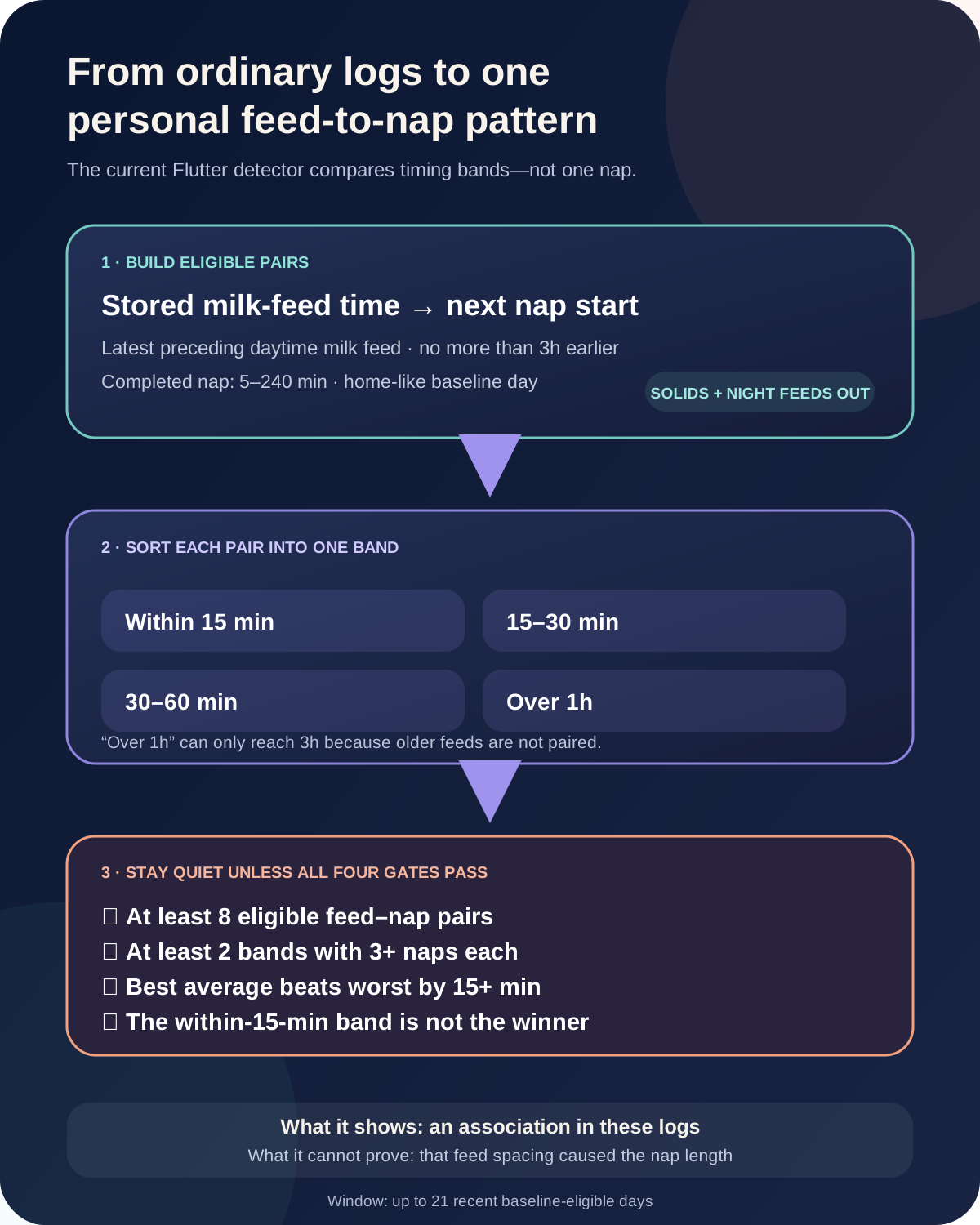
| Question | Current behaviour | |---|---| | What does it pair? | Each completed daytime nap with the latest preceding daytime milk feed, provided it was within three hours | | What counts as milk? | Feed entries other than solids; breast, bottle and combination feeds can qualify | | Do solid meals count? | No | | Do night feeds count? | No | | How many pairs are required? | At least eight | | How are gaps compared? | Within 15 minutes, 15–30 minutes, 30–60 minutes and over one hour | | How well sampled must the comparison be? | At least two bands must contain three or more naps each | | How large must the difference be? | The best band’s average nap must beat the worst by at least 15 minutes | | Can it recommend feeding immediately before sleep? | No; the detector suppresses itself when “within 15 min” is the winning band | | Does it prove causation? | No; it is an association in the available logs |
What the detector actually reads
The OBubba brain gathers up to 21 recent days for this comparison. It first removes days marked Sick, Travel, Daycare, Grand, Grandparents or Nursery, plus days containing a plausible logged fever.
That means the model is deliberately learning from home-like baseline days. A disrupted illness day should not teach the app that a normal pre-nap feed gap produces a 14-minute nap. The trade-off is that a baby who takes most naps at nursery may build this insight more slowly—or not at all.
For every remaining day, the detector finds:
- completed entries of type nap;
- a start and end time;
- a duration from 5 to 240 minutes;
- the most recent earlier daytime milk feed;
- a gap of no more than 180 minutes from that feed time to the nap start.
Open naps are ignored. A four-minute accidental timer is ignored. A five-hour corrupt nap is ignored. A feed after the nap begins cannot be paired. If the last qualifying milk feed was more than three hours earlier, that nap contributes nothing.
Each nap can produce at most one pair: its most recent qualifying feed and its own duration.
The four timing bands
OBubba does not learn an exact number such as “42 minutes”. It sorts every eligible pair into one of four broad bands:
| Stored feed time before nap start | Label shown by the detector | |---|---| | 0–14 minutes | Within 15 min | | 15–29 minutes | 15–30 min | | 30–59 minutes | 30–60 min | | 60–180 minutes | Over an hour |
The last label sounds open-ended, but the earlier pairing rule caps it at three hours. A feed four hours before a nap is not in “over an hour”; it is outside the comparison.
The detector calculates the arithmetic mean nap duration inside each sufficiently sampled band. It then orders the bands from longest average nap to shortest.
This is why the card can say:
> “Leo’s naps average 1h 10m when the last feed ends 30–60 min before the nap, versus 32m when it’s within 15 min.”
The automated test behind that example supplies four 70-minute naps in the 30–60-minute band and four 32-minute naps in the within-15-minute band.
Why the app usually says nothing
One lovely nap is not a pattern. Neither is one difficult nap.
The function returns no card unless all of these are true:
- At least eight eligible feed–nap pairs exist.
- At least two timing bands contain three or more naps each.
- The longest band average beats the shortest by at least 15 minutes.
- The winning band is not within 15 minutes.
The tests confirm each silence rule. Seven pairs are insufficient. Ten pairs all sitting in one band are insufficient. A 60-minute versus 68-minute comparison is insufficient. And if naps closest to a feed happen to run longest, the detector deliberately refuses to recommend that pattern.
That last rule is a product policy, not a neutral statistical result. OBubba is willing to suggest a longer gap but will not suggest feeding immediately before a nap—even when the available logs favour it.
“Feed time” is not always “feed end”
The current card says the last feed ends a certain time before the nap. The underlying comparison does not have a universal feed-end timestamp.
In the shared `BabyEntry` model, a feed is a moment event stored under `timeMin`. A bottle or manually entered breastfeed uses the selected feed time. A live breastfeeding timer saves the time the timer started, while left- and right-side minutes are stored separately.
So a 25-minute breastfeed beginning at 9:00 followed by a 9:45 nap is placed in the 30–60 minute band because the stored start-to-nap gap is 45 minutes. The actual end-to-nap gap was closer to 20 minutes.
For a quick bottle entry, the selected time may be whichever reference point the parent naturally chose. The app does not ask “start or finish?” on every feed.
That does not make the comparison useless, but it changes what can honestly be claimed. The current metric is:
stored feed time → nap start
It is not reliably:
feed finished → baby went to sleep
Until the data model carries an explicit finish time—or derives one consistently for timed feeds—the card should say “feed was logged” rather than “feed ends”.
An association is not a diagnosis
Even perfectly timed logs would not establish why one band has longer naps.
The 30–60-minute feeds might happen mostly before the first nap, when sleep pressure is different. The within-15-minute feeds might cluster on overtired afternoons when a parent uses feeding to rescue an already difficult nap. Location, settling method, age, hunger, noise, light, teething and ordinary development can all travel with the gap.
The current detector does not adjust for:
- nap position, such as Nap 1 versus a late catnap;
- wake-window length;
- nap location;
- how the baby settled;
- breast versus bottle;
- feed amount or breastfeed duration;
- day-to-day age and developmental change;
- a few unusually long or short naps pulling the average.
Its body reports a correlation. The explanation becomes causal when the within-15-minute band is worst: it says feeding right up to sleep makes the feed the fall-asleep cue and that the baby looks for it again at the first roughly 40-minute cycle boundary.
Those things may fit some families, but this particular calculation cannot prove them. A more accurate explanation would say the pattern can be consistent with a feed-to-sleep association and invite a low-pressure test.
Feeding to sleep is not automatically a bad habit
Young babies often doze during feeds. The NHS says that in the early weeks a breastfed baby may fall asleep for short periods during a feed and parents can continue until the baby has finished or is fully asleep.
UNICEF UK’s Baby Friendly Initiative describes responsive feeding as responding to a baby’s needs, with feeding providing nutrition, comfort, love and reassurance—not obeying a rigid clock.
The current detector has no explicit minimum-age gate. If enough eligible pairs exist and its thresholds pass, it can produce the card for a very young baby. That is another reason to treat the result as optional pattern information, not an instruction to separate every feed from sleep.
Do not delay a feed for a hungry baby to preserve a nap experiment. The NHS recommends responsive or on-demand feeding: follow hunger and fullness cues rather than forcing a strict schedule.
Why solids are excluded
A solid meal is stored as a feed-type entry, but this detector deliberately removes it before pairing.
That is the right boundary. A spoonful of yoghurt 25 minutes before a nap should not replace the milk feed the detector is trying to study. Early solids are not equivalent to a full milk feed, and beginning solids is not a sleep treatment.
For a baby who is weaning, the same day can contain:
- a breast or bottle feed;
- a small solid-food meal;
- a nap;
- a reaction or texture note.
OBubba keeps that context together while asking a narrow question here: how does the timing of logged daytime milk feeds sit alongside nap duration?
It does not ask whether lunch made the baby sleepy or whether a larger portion would lengthen the nap.
How to use the insight without chasing the clock
Treat the winning band as a hypothesis for one repeatable nap, not a prescription for the whole day.
- Check the raw times. Were feeds logged at the start, finish or an approximate moment? Correct obvious mistakes first.
- Choose one nap. The first nap or another relatively stable nap is easier to compare than changing every transition.
- Follow hunger cues. Feed when your baby needs milk. If the proposed gap clashes with hunger, the experiment loses.
- Add a tiny bridge. If appropriate for your baby, use a cuddle, nappy change, short story or song between feed and nap rather than stretching them awake.
- Keep the sleep space safe. Put your baby down in their usual clear, flat sleep space according to safer-sleep guidance.
- Watch several like-for-like attempts. Compare the same nap position across ordinary days, not one cot nap with one pram catnap during travel.
- Stop if it adds stress. A longer feed-to-nap gap is not a success when it creates hunger, distress or a missed nap.
What to log—and what not to manufacture
The detector only needs two ordinary things recorded consistently:
- the milk feed time;
- the nap’s start and end.
You do not need to write “fed before nap” in a note. You do not need to wake a sleeping baby to create an end time. You do not need to move a feed into a prettier band.
For timed breastfeeding, let the timer keep the real start and duration. For manual feeds, use one consistent convention when possible. For naps, stop the timer when the nap truly ends, not at the first brief stir if the baby resettles.
Label unusual days. The current brain removes nursery, grandparents, travel, sick and plausible-fever days from this baseline comparison. That protects the home pattern, but it also means critical nursery information should still be kept for handover and other day-type analysis.
When to ignore the card
Do not run a spacing experiment when:
- a newborn or young baby needs frequent responsive feeds;
- your baby is showing clear hunger cues;
- weight gain, milk transfer, supply or hydration is being monitored;
- a clinician or feeding specialist has given an individual plan;
- illness, fever, vomiting, diarrhoea or an allergic reaction is present;
- reflux or discomfort makes a different position or timing important;
- the comparison came from approximate or inconsistent feed times;
- the “winning” band belongs mainly to one nap position or location.
If feeding or growth concerns exist, the useful question is not “How can I protect the nap average?” It is “What does this baby need now?” Speak to your midwife, health visitor, infant-feeding team, GP or other appropriate professional.
What this feature should improve next
The detector’s restraint is a strong foundation. Five changes would make the conclusion match the evidence:
- Use an honest time label. Say “logged 30–60 minutes before” unless a reliable feed-end time exists.
- Remove causal certainty. Replace “feeding right up to sleep makes…” with “this pattern can fit a feed-to-sleep association”.
- Add an age and care-plan boundary. Very young babies and babies following feeding plans should receive responsive-feeding context before any spacing experiment.
- Compare like with like. Stratify by nap position or control for wake window, location and settling method before naming a best gap.
- Show the evidence. Let parents open the eight or more paired naps, see counts per band and exclude an obviously unusual day.
That would turn a clever detector into a transparent decision aid: not “OBubba knows the perfect gap”, but “here is a repeatable difference in your own record, here is exactly how it was calculated, and here is a gentle way to find out whether it matters.”
Try OBubba’s personalised feed and nap tracking → — keep milk, solids, naps, night sleep and real-life day context together, then let the app wait for a pattern instead of giving every family the same schedule.
Frequently asked questions
How many feeds and naps does OBubba need for this insight?
At least eight eligible feed–nap pairs. At least two timing bands must contain three or more naps each.
Does a solid meal count as the feed before a nap?
No. The detector excludes solids and uses daytime milk-feed entries.
Does the app use the beginning or end of a feed?
It uses the feed’s stored moment time. A timed breastfeed stores its start time plus separate duration fields, so the comparison is not consistently based on feed end despite the current card wording.
What if feeding within 15 minutes produces the longest naps?
The detector stays silent. It is designed not to recommend feeding immediately before sleep.
Does the insight mean feeding to sleep caused short naps?
No. It reports an association between broad timing bands and average nap duration. Other differences may explain the result.
Should I delay a feed to reach the suggested gap?
No. Feed responsively and follow your baby’s hunger cues and any individual feeding plan.
Why did the card disappear after an illness or nursery week?
Those day types are excluded from this baseline detector. The app may no longer have enough eligible pairs or the difference may have fallen below 15 minutes.
Is “over an hour” unlimited?
No. A preceding feed must be within three hours, so this band covers approximately 60–180 minutes.
Ready to try OBubba?
Use OBubba to track feeds, sleep, naps, nappies, growth, milestones and family handovers in one calm baby tracker app.