Yesterday your baby logged six milk feeds. Today the count reaches nine and OBubba says:
> Feeding is up, likely a growth spurt
Does the app know your baby is growing? Does nine feeds mean low supply? Should a bottle be made bigger so everyone gets more sleep?
No. The current feature has noticed that today contains substantially more milk-feed events than your baby’s own recently logged days. “Likely a growth spurt” is a gentle possible explanation, not a measurement of growth and not a diagnosis.
The helpful response is to follow feeding cues, protect the caregiver’s food and water, and watch the whole baby. Do not stretch a hungry baby to restore a tidy average, and do not pressure a bottle-fed baby to finish more milk because the app expects a busy day.
The short answer
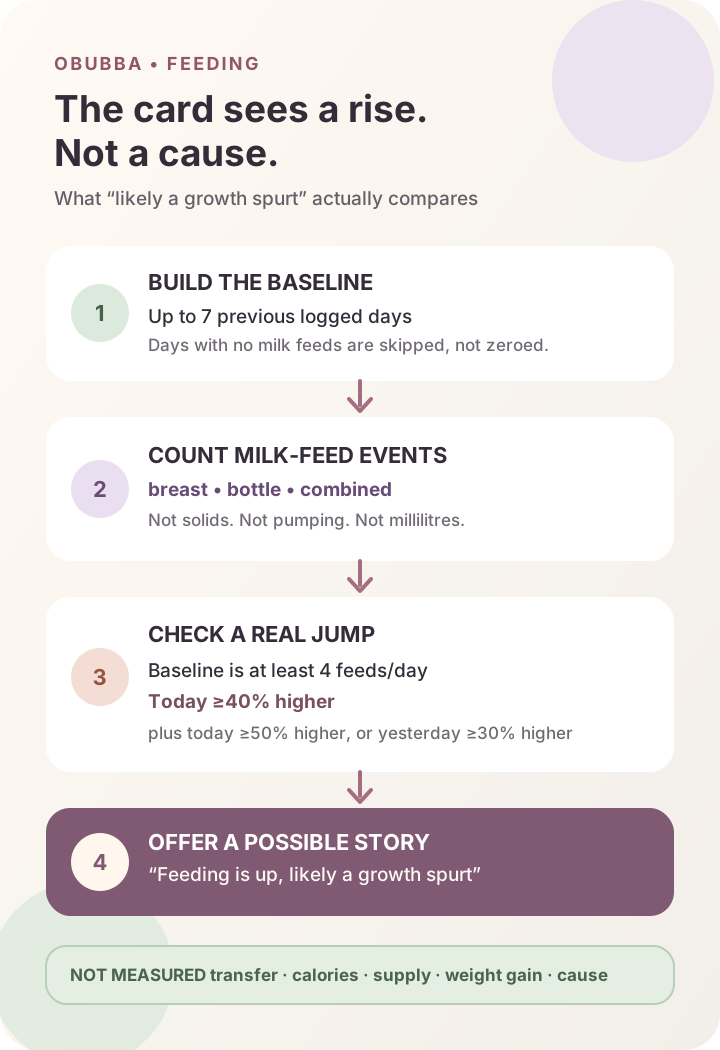
OBubba’s current detector builds a personal feed-count baseline from up to seven previous calendar days. It then asks whether today is unusually busy.
The growth-spurt card needs:
- an average of at least four logged milk feeds on the recent days that contain feeds;
- today’s count to be at least 40% above that average; and
- either today to be at least 50% above baseline or yesterday to have been at least 30% above baseline too.
The comparison includes breast, bottle and combined milk feeds. It excludes solids meals and pumping sessions because solids are not milk feeds and expressed milk is milk moved out, not milk the baby has drunk.
This is a count pattern. It does not use a scale, measure milk transfer, total calories or bottle completion, or inspect a baby for a developmental growth spurt.
A worked example
Imagine the previous logged milk-feed counts were:
> 6 · 5 · 6 · 6 · 5 · 6 · 5
The baseline is about 5.6 feeds per logged day.
| Today’s record | What the current detector sees | |---|---| | 6 feeds | close to baseline; no growth-spurt card | | 7 feeds | busier, but not 40% higher; no card | | 8 feeds and yesterday was ordinary | more than 40% higher, but not quite the strong single-day 50% gate; no card | | 8 feeds and yesterday was also clearly elevated | two-day rise clears the persistence route; card can appear | | 9 feeds | at least 50% above baseline; the single strong day can qualify |
Because feed counts are whole numbers, the exact jump needed changes with the baseline. The point is not a magic total such as “nine feeds means a spurt”. It is more feeds than this baby’s own recent record.
If a day has no milk feeds logged, OBubba does not treat it as a genuine zero when building this baseline. It is skipped. That protects the average from an obviously incomplete day, but it also means the pattern is only as representative as the days a family logged.
What counts as one feed?
The detector counts feed entries, not the nutritional size of each entry.
- A breastfeed is one feed event whether it was logged as brief or long.
- A bottle is one event whether the baby drank a little, drank most of it or paused halfway.
- A combined breast-and-bottle entry is one milk-feed event.
- A solids breakfast is not counted.
- A pumping entry is not counted as something the baby consumed.
- A dream feed remains a milk feed for this particular daily count.
That distinction matters. Nine small top-ups and nine full feeds look identical to a count-only detector. A breastfeed’s duration cannot tell the app how much milk transferred. Bottle millilitres are measurable, but the card does not total them.
The cleanest log is one real feeding occasion per entry. If one bottle is accidentally split into three entries, the day can look busier than it was. If several feeds are never logged, a genuine increase may be missed. OBubba turns the record back into a useful question; it cannot make incomplete data clinically complete.
Why solids do not count—even after weaning starts
Suppose an eight-month-old usually has six milk feeds. Today they have the same six milk feeds plus breakfast, lunch and tea. Counting every `feed` event would make the total nine and could falsely label an ordinary weaning day a growth spurt.
The implementation explicitly removes solids from both today’s total and the recent milk baseline. That is why adding meals does not manufacture a “feeding is up” card.
It also reflects the wider feeding picture. The NHS says breast milk or first infant formula remains a baby’s main drink throughout the first year while complementary food expands gradually. A solids log can be useful for texture, allergens, response and variety, but it is not interchangeable with the milk-feed rhythm.
Why pumping does not count
A pumping session describes milk expressed by a parent. It does not prove that the baby drank that milk that day—or at all.
Counting a 150ml pump as a baby feed would cause two problems:
- it could create a false rise in the number of feeds;
- it could make measured intake look higher than it was.
OBubba therefore keeps pumping separate from baby milk feeds in this pattern. If expressed milk is later offered by bottle, the bottle feed is the consumption event.
Cluster feeding gets first refusal
“More feeds today” and “cluster feeding” are related patterns, but they are not the same calculation.
The current feed detector checks for a cluster before it checks for the broader daily rise. Between roughly 8 and 40 weeks, three daytime milk feeds whose first-to-third span is no more than 90 minutes can form a cluster spell. Four overlapping feeds inside one continuous spell count as one cluster, not two.
If that more specific pattern qualifies, OBubba returns Looks like cluster feeding first rather than stacking a second growth-spurt explanation on top.
The NHS describes cluster feeding as a period when a baby wants to feed much more frequently, sometimes almost constantly. It is particularly common in the first three to four months and may happen for a few days around growth. It can occur with breast or formula feeding.
The distinction in the app is practical:
- cluster feeding: feeds are bunched tightly in time;
- feeding is up: the whole day’s count is high against the baby’s baseline, with either a very strong rise today or support from yesterday.
Neither pattern proves the cause. A baby may feed more for hunger, comfort, heat, recovery, a change in routine, a supply-building phase or ordinary variation.
Why “likely” matters
A real growth spurt is biological growth. To demonstrate growth, someone would need appropriate measurements over time and clinical context. A feed tracker has neither from count data alone.
OBubba’s phrase is best read as:
> “Today’s feeding frequency looks like the kind of temporary rise families often call a growth-spurt day.”
It does not mean:
- the app has measured weight or length gain;
- the baby is definitely in a named week-by-week leap;
- breast milk supply is low;
- the current formula volume is inadequate;
- more feeds will automatically improve sleep; or
- every extra cry means hunger.
Babies do not follow a universal calendar of exact growth-spurt ages. The log-based comparison is personal, but the explanation remains a hypothesis.
What to do when the card appears
If breastfeeding
Offer the breast responsively. UNICEF UK’s Baby Friendly guidance describes responsive breastfeeding as meeting hunger, comfort and reassurance needs rather than following a rigid interval. More frequent effective milk removal can support milk production.
Useful practical support is gloriously untechnical:
- bring water and a hand-held snack within reach;
- accept help with food, washing-up or an older child;
- change position if feeding is becoming uncomfortable;
- listen and look for effective swallowing;
- ask a midwife, health visitor or breastfeeding specialist to watch a feed if attachment, pain or intake worries you.
Frequent feeding alone does not prove low supply. The NHS advises judging intake from the wider picture: swallowing, a relaxed feed, baby coming off independently, alertness, wet nappies and growth.
If bottle feeding
Offer feeds when hunger cues appear and pace the bottle. The NHS recommends holding baby close and semi-upright, keeping the bottle nearly horizontal, allowing pauses and stopping when baby shows they have had enough.
Do not make every bottle larger simply because today’s count rose. A large feed does not guarantee a longer interval or better night, and forcing the last milk can be distressing. Prepare formula exactly as directed—never add extra powder or dilute it—and discard leftovers according to current safety guidance.
If combination feeding
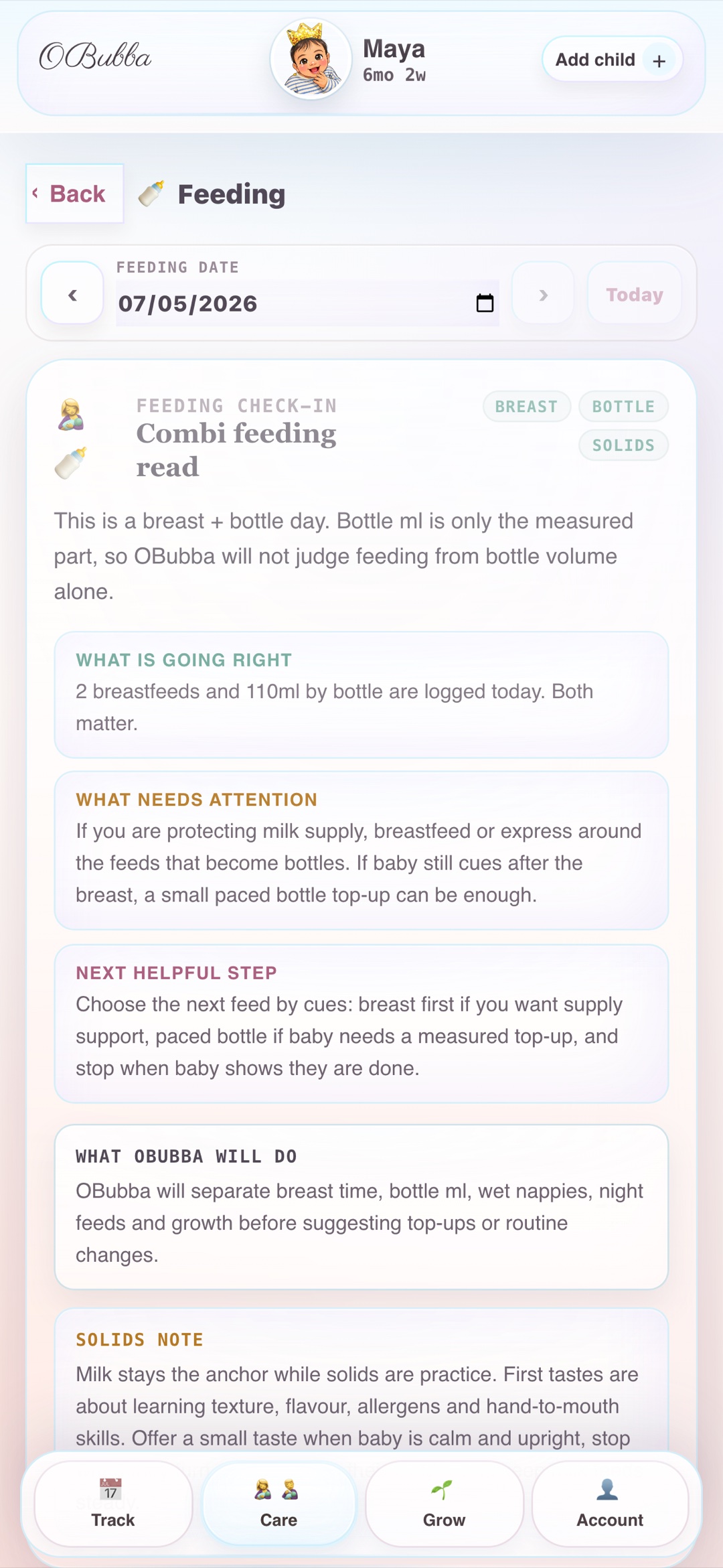
The count can recognise both kinds of feed, but it cannot combine breast milk transfer with bottle millilitres into a trustworthy total. Keep following cues. If the family is protecting breast milk supply, individual advice from a feeding professional is more useful than trying to reverse-engineer a target from the card.
What about sleep tonight?
The growth-spurt card says to expect that sleep may be disrupted for a night or two. That is preparation, not a forecast.
A baby who takes more feeds may wake to feed more. Another may take extra daytime milk and sleep exactly as usual. A third may be unsettled because of illness or development rather than growth. One busy feeding day cannot tell the difference.
Do not delay a needed feed to protect a wake window, and do not overfeed in the hope of buying a longer stretch. Keep the sleep environment safe, respond to hunger and review the pattern when everyone is awake. OBubba’s sleep tools can record what happened, but the feeding card does not promise a particular night.
When the card may be wrong
The pattern can be mathematically correct and the label still not describe real life.
Logging was different today
Perhaps nursery logged every bottle, a partner began using the app, or yesterday’s feeds were backfilled more completely. The detector sees a rise in records, not a change in logging habits.
Feeds were split into several entries
A paused bottle resumed ten minutes later might be one feeding occasion but two logs. Edit the history if the separation was accidental; do not try to feed to match the inflated count.
The recent baseline is thin
The detector requires the baseline average to be at least four, but missing days are skipped. Two meticulously logged days can therefore influence the average more than five blank ones. More consistent logging makes the comparison more representative.
Something else changed
Hot weather, vaccination, travel, distraction, teething discomfort, illness, a change in caregiver or a new bottle flow can alter the pattern. “Likely growth spurt” must never be used to explain away a baby who seems unwell.
When to look beyond the pattern
More frequent feeding can be completely ordinary. Seek feeding or medical advice when the wider picture worries you, including:
- feeds are painful, ineffective or baby repeatedly struggles to latch or suck;
- baby is feeding very differently and you are worried;
- nappies are drier than usual;
- baby is unusually sleepy, floppy or difficult to wake;
- there is breathing difficulty, a concerning colour change or persistent vomiting;
- weight gain or milk transfer is uncertain; or
- the parent is exhausted, in pain or cannot sustain the pattern safely.
The NHS advises trusting your instincts when a baby seems seriously ill. A baby who is not feeding normally, has drier nappies, is hard to wake or has breathing or colour changes needs prompt assessment. Use NHS 111, urgent care or 999 according to the severity.
What makes this feature useful
The value is not the phrase “growth spurt”. Parents already hear that phrase everywhere.
The value is that OBubba:
- compares the baby with their own recent rhythm rather than a generic schedule;
- separates milk feeds from weaning meals;
- keeps pumping output out of baby intake;
- uses a strong single-day rise or a repeated two-day rise rather than reacting to one extra feed;
- gives a cluster pattern priority when the timing supports it; and
- suppresses a contradictory comfort-feeding suggestion when the safer message is to keep responding to cues.
That is what a thoughtful baby tracker should do: notice a meaningful change, show its limits and make the next step calmer.
Try OBubba’s responsive feed tracker free → — keep breast, bottle, pumping, solids, nappies, growth and sleep in one record without pretending they are all the same measurement.
Frequently asked questions
Does the card mean my baby is definitely having a growth spurt?
No. It means the logged milk-feed count is substantially above the recent baseline. Growth is one plausible explanation; only appropriate measurements and clinical context can assess actual growth.
Does frequent breastfeeding mean my supply is low?
Not by itself. Frequent feeding can be normal and can support supply. Look at attachment, swallowing, comfort, wet nappies, alertness and growth. Ask a midwife, health visitor or breastfeeding specialist for an observed feed when concerned.
Should I offer a bigger bottle?
Follow hunger and fullness cues rather than the card. Offer milk responsively, pace the bottle and never force a finish. Do not alter the formula-to-water ratio.
Why did OBubba show cluster feeding instead?
The current detector gives the tighter time pattern priority: at the relevant age, three daytime milk feeds within roughly 90 minutes can produce a cluster-feeding card before the daily-count check runs.
Why did solids not increase the count?
Because the feature measures the milk-feed rhythm. Counting breakfast, lunch and tea as milk feeds would falsely label ordinary weaning progress as a growth spurt.
Why did pumping not increase the count?
Pumping is milk expressed, not milk known to have been consumed. A later bottle made from that milk counts when the baby drinks it.
Could the card appear at the wrong time of day?
It can appear whenever today’s recorded count clears the comparison. It does not wait for bedtime. Treat it as a live observation of the record, not a final verdict on the day.
Will extra feeds make my baby sleep longer?
Not predictably. A bigger bottle does not guarantee a longer gap, and frequent feeding may coincide with more wakes. Feed responsively and use the sleep log to observe the night rather than trying to purchase sleep with milk.
Sources and further reading
- NHS: Feeding on demand
- NHS: Cluster feeding
- NHS: Is my breastfed baby getting enough milk?
- UNICEF UK Baby Friendly Initiative: Responsive feeding
- NHS: Is your baby or toddler seriously ill?
OBubba is a tracking, pattern and education tool, not a medical device. Its growth-spurt card is a deterministic comparison of parent-entered feed events. It cannot measure milk transfer, calories, hydration, supply, weight gain, illness or the cause of frequent feeding. Follow feeding cues and seek professional advice when feeding, nappies, growth or wellbeing concerns you.
Ready to try OBubba?
Use OBubba to track feeds, sleep, naps, nappies, growth, milestones and family handovers in one calm baby tracker app.